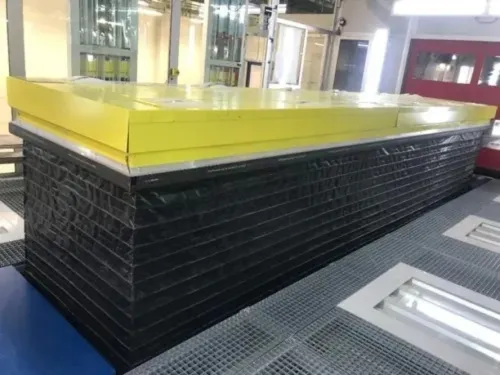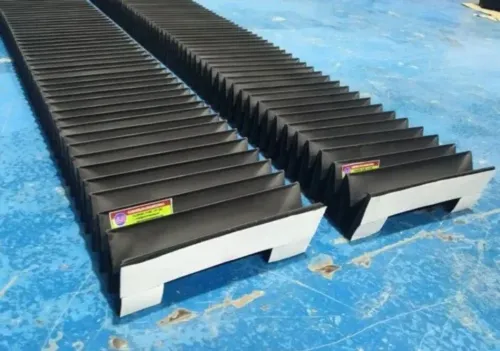
A damaged or collapsing cover does not always mean you need a new one, but inspecting it while the lift is energized can create a serious pinch and crush hazard. You will be able to isolate the machine, assess the cover’s condition, identify the failure cause, and collect the measurements needed for a reliable replacement quotation.
Key takeaways
- Lock out the lift and install mechanical supports before inspection.
- Clean each fold before judging cracks, tears, heat damage, or loose attachments.
- Watch the full lift cycle to identify rubbing, stretching, or misalignment.
- Record compressed length, extended length, width, height, and clearance before ordering.
Make the lift safe before inspecting the cover
Before examining scissor lift bellow covers for maintenance, make the lift incapable of moving and remove every energy hazard. Do not begin beneath a raised platform supported only by hydraulic pressure.
1. Apply the site’s lockout/tagout procedure. Isolate electrical supply, hydraulic energy, pneumatic energy, and stored mechanical energy; disconnect power to automatic controls; then release hydraulic or pneumatic pressure.
2. Lower the platform onto a stable surface. If it must remain raised, install rated mechanical supports and secure the scissor arms against unexpected movement. Keep every person outside the platform’s travel path and all scissor-arm, hinge, and pinch zones.
3. Set inspection intervals using operating hours, lift cycles, contamination, and exposure. Inspect after heavy chip or abrasive-dust events, nearby welding or cutting, and fluid spills, then record inspections at defined hour or cycle intervals in the maintenance log.
4. Establish a post-installation baseline before normal service. Photograph the cover with folds closed and extended, record platform travel and clearances, and note the cover’s material, coating, seams, reinforcement, lamellae, and mounting construction.
Compare later findings with this baseline rather than judging wear from appearance alone. A shortened fold, changed clearance, or altered tracking can reveal interference before the cover tears. Reapply the exclusion zone and confirm isolation whenever the inspection requires reaching near moving components.
Clean every fold and inspect the materials and attachments
Clean every fold before examining the cover: remove chips and abrasive dust with a soft nylon brush or low-pressure air directed away from seals and sensors. Then wash with clean water and a mild, material-approved detergent using a soft cloth or sponge.
Good scissor lift bellow covers care prevents grit from being worked into the folds.
1. Do not use sharp tools, abrasive pads, uncontrolled pressure-washing, acetone, ketones, paint thinner, or unapproved degreasers. Use a solvent only when the cover manufacturer confirms compatibility with the fabric, coating, seams, wiper strips, and adhesives.
2. Inspect the inner radii, fold valleys, flexible sections, stitched or welded seams, lamellae, end plates, mounting flanges, fasteners, clamps, rails, and guide-adjacent areas. Look underneath and inside the folds, not only at the exposed upper surface.
3. Record every cut, pinhole, delamination, frayed stitch, exposed reinforcement, hardened fabric, heat or welding-spatter mark, chemical swelling, crushed fold, separated fastener, loose clamp, and distorted rail. A small superficial hole is not equivalent to an intact cover when reinforcement is exposed or a fold no longer opens correctly.
4. Do not apply oil or grease to the cover. Lubricate only specified machine joints or guides unless the cover manufacturer documents a compatible cover product and application procedure; oil can soften coatings, retain abrasive dust, attack adhesives, and contaminate sensors.
After cleaning, leave the cover dry and record photographs of defects before deciding whether repair or replacement is justified.
Watch the complete lift cycle to separate wear from a correctable cause
A complete lift cycle separates normal wear from a correctable cause or a replacement condition. For scissor lift bellow covers care, clean the folds, restore the exclusion zone, and run the lift slowly from closed to open and back under controlled conditions.
Watch folded height, extended length, lateral tracking, fold compression, rubbing points, pinch zones, end stops, cylinders, link arms, cables, hoses, and nearby guides. Check for debris trapped inside the folds, and test both travel directions with foreseeable offset loading.
| Condition | What it indicates | Action |
|---|---|---|
| Normal wear | Even surface wear with intact folds, seams, and reinforcement | Monitor and record |
| Repair opportunity | Small superficial hole in non-load-bearing fabric, damaged seam, loose fastener, or one-sided rubbing | Patch, resew, replace hardware, or correct alignment only if reinforcement remains intact and the cover stays outside the motion path |
| Replacement condition | Flattened folds, separating seams or reinforcement, weakened material, harmful holes, repeated collapse, or abnormal resistance | Specify scissor lift bellow covers replacement |
One-sided abrasion points to misalignment, unequal loading, insufficient clearance, a damaged guide, loose attachment, or incorrect mounting—not ordinary wear. Replacing the cover without correcting that cause invites repeat failure.
Choose replacement when chemical or heat damage has weakened the material, or stiffness creates abnormal drive load. If the cover is a machine guard, review the decision against the machine’s guarding risk assessment.
Record the dimensions and clearances that determine a correct replacement
Record the machine height and every dimension that controls movement before requesting scissor lift bellow covers replacement. Length and width alone cannot show whether the cover will buckle, rub, or become trapped.
1. Measure the protected cylinder or area diameter, cover width and height, closed length, fully extended length, working stroke, fold pitch, compressed width, extended width, end-frame dimensions, mounting-hole pattern, attachment orientation, and travel direction. Record the platform height when closed and fully extended.
2. Map the clearance envelope through the complete scissor motion. At both ends of travel, measure gaps to cylinders, link arms, guides, cables, hoses, end stops, and adjacent structures. Check intermediate positions too; nominal stroke does not prevent rubbing or buckling.
3. Photograph both sides of the installed cover when closed, halfway, and fully extended. Photograph every mounting point, fastener, retainer, frame, rail, and damaged area with a ruler or other scale visible.
4. Add the lift’s cycle rate and travel speed, expected debris, actual cutting fluids and cleaners, nearby heat or welding, ultraviolet exposure, ozone, and chemical contact. These exposures determine whether the material or coating will survive.
5. Ask the supplier to confirm dimensional tolerances, fold geometry, attachment details, material and coating, seam construction, and the approved drawing before manufacture. Include the mounting photographs and measurements; do not submit only length and width.
Use the quotation process to verify fit before installation
Evaluate a scissor lift bellow covers supplier in Ahmedabad by demanding written dimensional confirmation, not a nominal-size match. Send the dimension sheet, marked photographs, machine or cover drawing, exposure conditions, cycle rate, travel speed, and mounting details before requesting a quotation.
Ask the supplier to document:
- Proposed fold pitch, closed and extended dimensions, end-frame dimensions, hole pattern, fabric or coating, seam method, temperature and chemical compatibility, and inspection records.
- The drawing approval stage, the specified stroke test, and tolerances for length, width, mounting holes, and surrounding clearances.
| Quotation evidence | Accept | Reject |
|---|---|---|
| Fit information | Approved drawing and measured dimensions | Length and width only |
| Construction | Material, coating, seams, and compatibility stated | “Standard fabric” with no specification |
| Verification | Full-stroke motion check and tolerances recorded | No test method or inspection record |
GURUKRUPA BELLOWS PVT LTD belongs in the comparison when it can document these fit and construction details; Ahmedabad location may improve communication or lead time, but it does not replace a motion test.
Before installation, inspect reused rails, clamps, retainers, screws, and rivets. Replace distorted or missing hardware, then run the lift slowly from fully closed to fully extended and back, checking both directions, offset loading, end stops, cables, hoses, and debris-filled folds.
Record new baseline photographs and measured clearances. Compare them with later inspections; recurring clearance loss indicates misalignment, not another scissor lift bellow covers replacement.
Related products
 | Bellow Cover ₹5000 Product Details: Brand GURUKRUPA Color Black-Blue Size Customised With the support of our excellent team workers, we have been delivering the best... View product → |
 | Product Details: Brand GURUKRUPA Color Black-Blue Size Customised With support of our excellent team workers, we have been delivering the best... View product → |
Frequently asked questions
How do you make a scissor lift safe before inspecting its bellows?
Isolate electrical, hydraulic, pneumatic, and stored mechanical energy; lower the platform where possible and install rated mechanical supports before entering the hazard zone.
What should you inspect after cleaning scissor lift bellows?
Check every fold for cracks, punctures, thinning, heat damage, chemical attack, separated seams, loose fasteners, damaged frames, and failed attachments.
How can a lift cycle reveal the cause of bellows damage?
Observe the cover through its complete movement and look for rubbing, pinching, twisting, overextension, uneven folding, and contact with cables or structural members.
Which measurements verify a replacement scissor lift bellow cover?
Record compressed and extended lengths, cover width and height, mounting dimensions, attachment type, stroke, direction of movement, and all surrounding clearances.