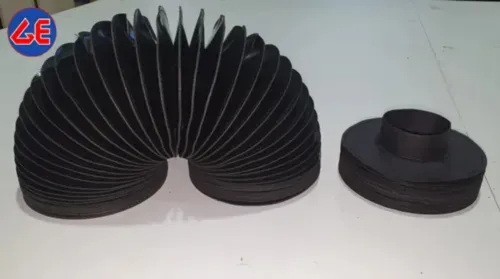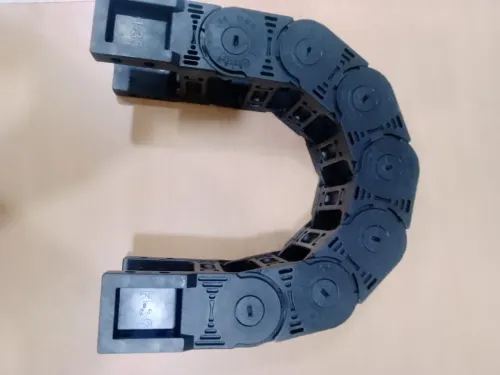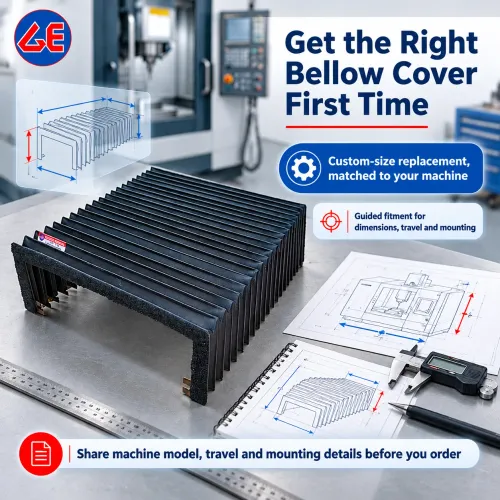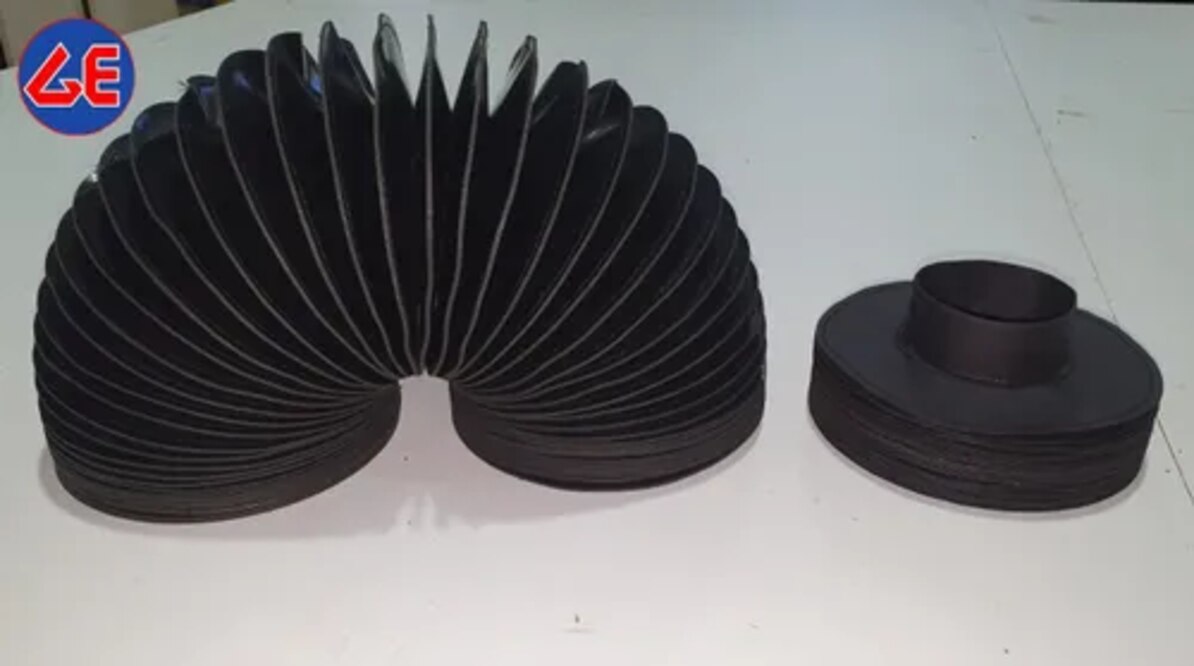
Chips, abrasive dust and coolant can reach the ball screw nut, damage raceways and disturb the lubrication film that keeps CNC motion smooth. By the end, you will know how a bellow cover protects the screw assembly, calculate its real travel requirement, check clearances, and specify materials and attachments without sacrificing axis speed or service access.
Key takeaways
- Keep chips, abrasive dust and coolant away from the screw, nut and recirculating balls.
- Allow full axis travel without stretching, folding, rubbing or blocking the bellow cover.
- Check compressed length, extended length, mounting space, fasteners and moving clearances before approval.
- Match fabric, coating, seals and attachments to coolant, heat, chips and cleaning methods.
How contamination disrupts ball-screw precision
A ball-screw bellow cover supports precision CNC movement by keeping chips, abrasive dust and coolant away from the screw, nut, recirculating balls, seals and lubrication film. It protects the assembly indirectly; it does not improve lead accuracy, preload, backlash or thermal compensation, which depend on the screw, bearings, mounting and CNC control.
| Contaminant | Damage path | Result |
|---|---|---|
| Abrasive grit | Enters raceways or the ball-nut interface | Marks raceways, raises drive torque, accelerates wear, creates backlash and shortens nut life |
| Flood coolant | Dilutes, displaces or carries away lubricant | Increases friction, corrosion risk and lubrication failure |
| Chips and dust | Reach seals and recirculating-ball returns | Damage wipers and carry debris through the nut |
The external cover works with ball-nut wipers, not instead of them. Wipers remove contamination at the nut interface; the cover reduces what reaches that interface. Either layer alone leaves an entry route.
An accordion cover is not automatically coolant-tight. End frames, seams, mounting flanges, damaged folds and transitions around the ball nut can leak, so inspect those points and provide a cleaning or drainage path. That is why ball screw bellow covers for CNC machines must be treated as contamination-control components.
Bellow covers for precision CNC movement are not automatically machine guards under ISO 12100. They may not withstand impact or prevent access to hazardous motion, so safeguarding and risk reduction require a separate assessment.
Design details that keep the cover moving with the axis
Cover geometry, not fabric alone, determines whether a cover follows a precision CNC axis. Specify folded height, compressed height and extended length, then confirm the required travel direction. Unsupported folds can sag, flutter or rub during rapid traverse.
A fixed mounting plate belongs on the stationary structure; a moving mounting plate follows the saddle or ball nut. Internal guides, guide strips or anti-sag supports control long spans, while sound fold stitching or bonding prevents the bellows from opening at the creases.
Wipers protect the transition around the ball nut, but they do not replace clearance.
| Feature | Failure risk | Design check |
|---|---|---|
| Fold geometry | Sag, rubbing or lost stroke | Compare folded height and compressed length with the saddle, bearing housing and end cover |
| Guidance and attachments | Flutter or sideways loading | Confirm fixed and moving plates, travel direction, guide strips and anti-sag support |
| Dynamic clearance | Contact during motion | Sweep the rotating screw envelope, nut body, coupling and bearing supports |
Check clearance while the axis runs, not only at rest. Shaft runout, mounting misalignment and fold sag can close a static gap around the screw or nut.
Protection also adds drag, friction, moving mass and fold stiffness. Include them when checking acceleration, servo following error and settling time. A cover that is too heavy or stiff can reduce the response advantage of a fast ball-screw axis.
That is why ball screw bellow covers for precision CNC movement need dynamic fit data, not just nominal screw diameter.
How to calculate travel and complete a full fit check
Specify the cover from attachment-point geometry, not ball-screw length. For ball screw protection covers in Bangalore, record the fixed-end and moving-end points at both axis limits, then capture:
- Screw diameter, ball-nut length and width, and maximum axis stroke
- Required minimum and maximum cover lengths, folded height and extended length
- Mounting-hole pattern and the complete installation envelope
- Maximum axis speed and acceleration
Let Dmin and Dmax be the distances between those attachment points at the two travel endpoints. Required cover travel is Dmax minus Dmin. Set the cover’s minimum and maximum lengths from Dmin and Dmax, then add the supplier’s specified compression and extension allowances. Exposed screw length is not cover travel.
Check each position before approving the drawing:
| Position | Measure | Reject if |
|---|---|---|
| Minimum travel | Compressed cover length and folded height | It contacts the saddle, bearing housing, motor, coupling, support bearings or end cover |
| Maximum travel | Extended length and fold condition | Folds are taut or the cover pulls sideways |
| Intermediate travel | Clearance through the full stroke | It approaches cables, hoses, lubrication lines or guards |
For ball screw bellow covers for CNC machines, review the supplier drawing with speed and acceleration included. Sweep the axis while running and confirm that shaft runout, nut movement, misalignment or fold sag cannot make the cover rub the rotating screw or ball nut.
Match materials, sealing and attachments to the workshop
A cover choice starts with the fluid and cleaning process, not the fabric label. Record whether the machine uses water-miscible semi-synthetic coolant, straight cutting oil, or synthetic fluid, plus biocides, extreme-pressure additives, abrasive chips, cast-iron dust, wash-down pressure, operating temperature, sparks and cleaning chemicals.
Ask the supplier for written evidence covering:
- Coolant and additive compatibility, temperature limits and fire performance.
- Seam stitching or bonding, fold reinforcement, end-frame sealing and drainage or cleaning access.
- Clearance from the rotating screw, ball nut, coupling and bearing supports during movement.
| Construction | Best fit | Evidence to verify |
|---|---|---|
| Coated fabric | General coolant, chips and moderate abrasion | No swelling, cracking or delamination in the named fluid |
| Elastomeric fabric | Flexible folds and frequent movement | Flexibility and chemical resistance at operating temperature |
| Heat-resistant laminate | Sparks, hot chips or elevated temperature | Tested heat and flame performance for the actual exposure |
The material alone is not a coolant seal. Seal the fixed and moving end frames, then provide a drain or cleaning path for trapped fluid and chips.
Use a fixed-end frame and moving-end frame on rigid machine structures, never on the rotating screw, ball nut or bearing blocks. Allow for mounting error, frame misalignment and sag so folds do not pull sideways; retain access to lubrication points, nut wipers, support bearings and end seals.
For ball screw protection covers in bangalore, specify workshop conditions rather than city location. GURUKRUPA BELLOWS PVT LTD can be evaluated against that written specification, not a “corrosion-resistant” label.
Choose accessible frames and a replaceable bellows when downtime matters. A permanently bonded installation can cost less initially but require major machine disassembly when the cover wears.
Related product
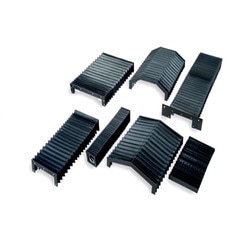 | CNC Bellow Cover Product Details: Brand GURUKRUPA Color BLACK Size ANY We are considered a well-known name in the business that manufactures and supplies CNC Bellow... View product → |
Verify service life before approving the cover
Approve service life only after the installed cover survives a production-speed trial, not a stationary fit check. Request a dimensioned drawing before installation showing:
1. Minimum and maximum lengths, folded height, mounting-hole locations, screw and ball-nut clearances, material construction, seam method, guide strips, end frames, and attachment details.
2. Run the axis through its full stroke at production speed and acceleration. Watch both travel endpoints and listen for fold contact, then inspect fold creases, stitched or bonded seams, end frames, mounting plates, guide strips and rubbing marks.
Look for retained coolant, trapped chips and sideways pulling; a cover can fail progressively without a visible tear.
3. Confirm that lubrication points remain accessible. Check that the cover has not hidden leakage or contaminated grease around the nut, seals or support bearings.
Set replacement criteria before operation begins. Replace the cover for severe abrasion, lost flexibility, delamination, cracked coating, damaged folds or repeated interference, even when it still extends.
For ball screw bellow covers for precision CNC movement in Bangalore, specify the workshop rather than the postcode: coolant type, airborne dust, chip shape, wash-down practice, ambient temperature, axis speed, acceleration and service access. Treat the cover as a contamination-control component.
It does not prove improved lead accuracy, preload, backlash or thermal compensation in the ball screw.
Frequently asked questions
How do contaminants affect ball-screw precision?
Chips, abrasive dust and coolant can contaminate the screw, nut, recirculating balls, seals and lubrication film, increasing wear and disrupting smooth movement.
What design details help a bellow cover follow CNC axis movement?
The cover needs the correct extended and compressed lengths, guided folds, mounting points and clearances so it moves without stretching, rubbing or obstructing the axis.
What measurements are needed to fit a ball-screw bellow cover?
Record the axis travel, screw and nut envelope, available mounting space, compressed length, extended length, attachment locations and nearby moving-part clearances.
How should you select materials and attachments for a workshop?
Match the cover fabric, coating, sealing approach and attachments to coolant type, chip shape, heat, cleaning chemicals and the machine's mounting arrangement.
How can you verify service life before approving a cover?
Review the expected cycle count, stroke frequency, fold motion, exposure conditions, attachment strength and inspection plan against the machine's duty.