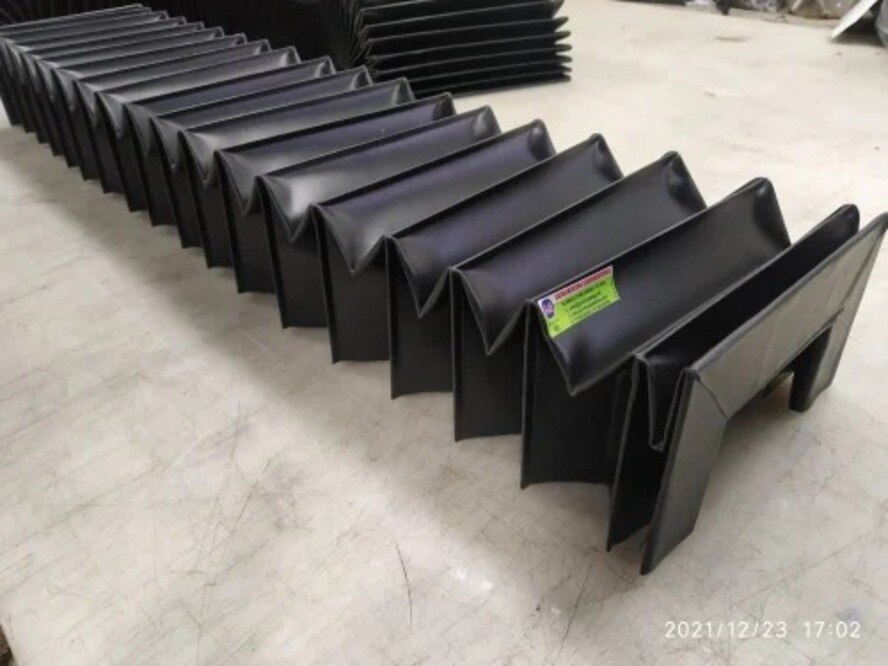
A bellow cover can keep abrasive dust, smoke residue, coolant and hot particles away from a moving axis, but it is not automatically suitable for every laser machine. By the end, you will be able to match the protection type to your laser source and layout, specify the cover without missing dimensions, and test whether its cost is justified by machine uptime.
Key takeaways
- Protect guideways, rails, ballscrews, cables and hoses—not the laser beam.
- Match cover materials and clearances to heat, debris, motion and laser layout.
- Specify travel, folded height, mounting points, speed and contamination before ordering.
- Validate full stroke, bend radius, acceleration and cycle life before production approval.
What exactly does a laser machine bellow cover protect?
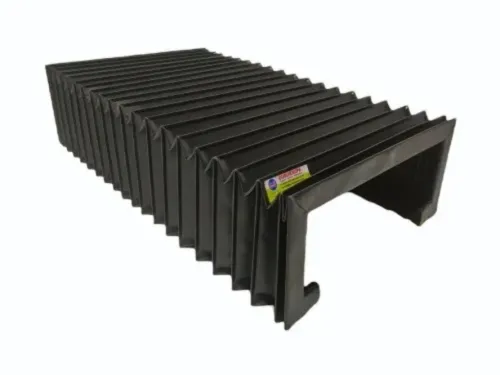
A laser machine bellow cover protects moving machine parts from contamination and mechanical damage, not the laser beam itself. It shields guideways, linear rails, racks, cables, hoses, ballscrews and other exposed axes when metallic dust, slag, smoke residue, coolant mist, cutting oil, assist-gas residue, abrasive particles or hot fragments can reach them.
Choose laser machine bellows for manufacturers when an uncovered axis would suffer from:
- Fine particles entering bearings or screw drives
- Slag and hot fragments striking rails or cable runs
- Smoke and oil residue accumulating in fold valleys
- Repeated abrasion during rapid axis travel
Bellows are not hermetic seals. Coordinate the folds with wipers, positive extraction, drainage and chip-management features, or smoke and debris can pass through end connections and collect behind the cover.
| Protection option | Main role | Limitation |
|---|---|---|
| Bellows | Covers moving axes, cables and hoses | Folds need wipers, extraction and drainage |
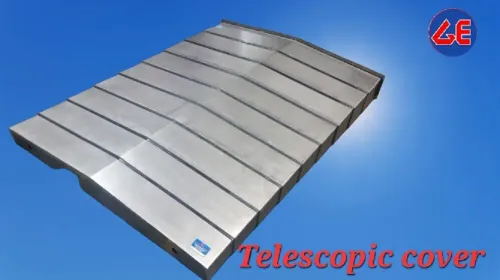
| Telescopic steel cover | Resists severe chips and impact | Adds mass and needs retracted space |
| Brush seal | Blocks coarse debris at an opening | Does not stop fine dust or smoke |
A bellow is not the primary laser enclosure. Beam containment, access control, interlocks, viewing windows and hazard classification must follow IEC 60825-1 for the laser wavelength and power. A direct strike can melt, char, delaminate or ignite the cover, so shield it from the beam path, piercing plume and predictable reflections.
Choose bellows for contamination and moving-part protection—not instead of laser safety engineering.
Which protection works with your laser source and machine layout?
CO₂ sources commonly operate near 10.6 µm; many fibre and disk sources operate near 1.03–1.08 µm. Neither wavelength makes a fabric or polymer safe under direct or reflected exposure, so specify laser machine bellow covers by source, beam geometry and machine layout.
| Option | Strength | Limitation |
|---|---|---|
| Telescopic steel cover | Handles severe chips and impact | Adds mass and needs retraction space |
| Brush seal | Blocks coarse debris at an opening | Does not stop fine dust or smoke |
| Roller shutter | Suits certain long-axis arrangements | Needs suitable routing and winding space |
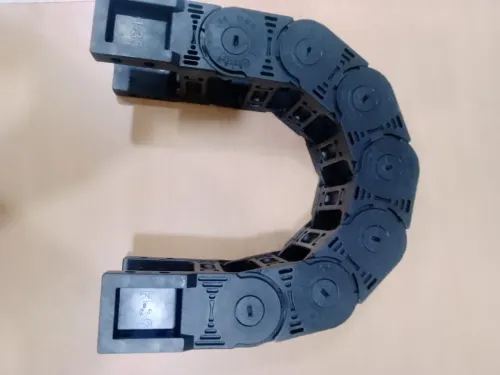
| Flexible cable carrier | Guides cables and hoses | Does not protect rails or guideways |
| Exposed guideway | Offers access with low complexity | Leaves precision surfaces exposed to contamination |
| Bellow cover | Protects moving parts across a changing gap | Folds can trap dust and must stay outside radiation |
For sheet cutting, tube cutting and other layouts, trace the carriage path, underside exposure, workpiece proximity, extraction flow and available retracted envelope. A steel cover suits impact-heavy zones; a bellow suits a protected moving gap where low mass matters.
A roller shutter fits some long axes, while a cable carrier handles services rather than rail protection.
Reject a bellow if it obstructs the optical path, restricts travel, traps abrasive dust, contacts a hot workpiece or sits where direct radiation is possible. Place it behind shielding and coordinate it with wipers, extraction and drainage; folds are not a hermetic barrier.
What must you specify before ordering a custom cover?
Do not approve custom laser machine bellow covers from extended length alone. An incorrect retracted envelope or fold height can cause bottoming out, buckling, rubbing, fold inversion, or obstruction of the working envelope.
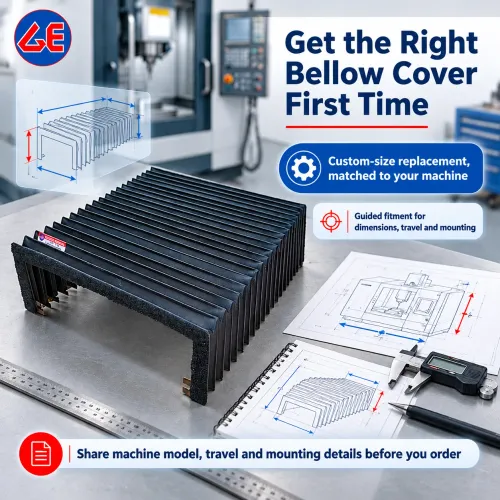
1. Send the supplier the axis and motion direction, total stroke, fully extended and retracted lengths, folded height, internal width and height, end-frame dimensions, mounting-face geometry and hole pattern, bend radius, guide arrangement, speed, acceleration, adjacent interference zones, clearance around the laser head and carriage, and available installation and replacement access.
2. Specify the construction stack-up: sewn fabric, heat-sealed or welded polymer, stainless-steel protective slats, or a defined combination. Request named material grades, maximum continuous and peak temperatures, spark and molten-metal limits, flame-test method, chemical compatibility, and any direct laser-radiation limitation. “Laser” is not a material qualification.
3. Identify the actual coolant, oil, cleaning agent, concentration, temperature, and wash-down method. State Bangkok’s humidity, condensation risk around chilled equipment, airborne dust, drainage arrangement, and required operating and storage temperature and humidity limits.
4. Mark the laser path, piercing plume, hot-workpiece envelope, cable carriers, sensors, and every nearby obstruction on the drawing. A cover that fits at full extension can still rub, trap contamination, block extraction, or enter the optical path when retracted.
5. Request a dynamic fit check through the complete stroke at operating speed and acceleration, including retracted height, fold collapse, mounting loads, leakage at end frames, and replacement access. A static extension check will not expose dynamic buckling.
How do you prove the cover will survive precision-axis motion?
A static extension check cannot prove that a cover will survive precision-axis motion. For laser machine bellow covers in Bangkok, acceptance must test the assembled unit through the complete stroke at the real or worst-case speed and acceleration.
| Test | Procedure | Failure revealed |
|---|---|---|
| Static extension | Extend and retract the cover without motion loading | Misses buckling, fold inversion and rubbing |
| Dynamic acceptance | Run the assembled cover through full travel at maximum specified speed and acceleration | Exposes collapse, mounting loads, leakage and interference |
During the dynamic run, measure retracted height and inspect fold collapse, inversion, rubbing, end-frame leakage, sensor clearance and interference with cable carriers. Record actuator load as well.
Thicker multilayer covers and metal lamellae improve abrasion and spark resistance, but their added mass increases inertia and actuator load. Compare cover mass and fold-pack height with the axis acceleration profile instead of choosing maximum thickness automatically.
Treat cable management separately. A drag chain, fibre-optic lead or assist-gas hose inside the cover can violate minimum bend radius, accumulate heat, rub the bellows or create an unintended load path. Verify the carrier’s bend radius and the cover’s free-motion envelope independently.
Reject a cycle-life claim unless it states:
- Test stroke, speed and acceleration
- Contamination, temperature and cleaning conditions
Set inspection intervals for torn folds, loose stitching or welds, coating damage, hardened elastomers, blocked drainage and failed wipers. Confirm replacement access; a cover requiring major axis disassembly is the wrong choice despite passing the motion test.
When is the investment justified for a Bangkok precision manufacturer?
Say yes only when contamination reaches a precision axis, the machine provides sufficient retracted space, and the cover stays outside the beam and hot-workpiece envelope. The supplier must document construction, fit, operating limits, humidity, condensation, dust, wash-down and drainage requirements for Bangkok conditions.
| Option | Proceed when | Reject or redesign when |
|---|---|---|
| Bellow cover | Guideways, rails, racks, cables or hoses face dust, slag, smoke residue, coolant mist or hot fragments; full motion remains clear | It adds unacceptable inertia, traps abrasive dust, blocks extraction, restricts travel or faces direct radiation |
| Telescopic steel cover | Severe chips, impact and abrasion justify added mass and installation space | Mass, retracted depth or access exceeds the axis design |
| Brush seal or roller shutter | Coarse debris or a particular long-axis geometry suits it | Fine smoke, dust or complex underside exposure needs stronger protection |
Compare delivered cost, not unit price: include mounting frames, wipers, wear-strip replacement, installation access, import or lead-time exposure, planned downtime and the cost of a failed cover.
GURUKRUPA BELLOWS PVT LTD is a supplier a buyer may contact for a drawing-based discussion; send the complete fit, motion, contamination, temperature, chemistry and laser-exposure specification, then request written limits.
- Approved drawing and construction stack-up
- Named materials and operating limits
- Test method and acceptance-test criteria
- Maintenance access and replacement lead time
A generic cover is not a precision-engineering decision.
Related products
 | Laser Machine Bellows We are committed to manufacture, export, and supply a qualitative range of Laser Machine Bellows for our esteemed clients. View product → |
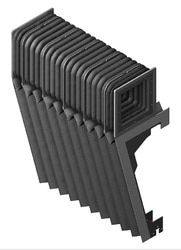 | Laser Cutting Machine Bellows We offer Laser Cutting Machine Bellows made specifically for your laser machine. View product → |
Frequently asked questions
What does a laser machine bellow cover protect?
It shields guideways, linear rails, racks, cables, hoses, ballscrews and other exposed machine axes from dust, slag, smoke residue, coolant mist, cutting oil, abrasive particles and hot fragments.
Which protection works with a laser source and machine layout?
Choose the cover form, material and mounting arrangement according to the laser source, heat exposure, debris type, axis travel, available clearance and cable or hose routing.
What information is needed for a custom laser machine bellow cover?
Provide the protected component, axis travel, retracted and extended dimensions, mounting points, folded height, motion speed, acceleration, bend direction, temperature exposure and contamination hazards.
How can you prove a cover will survive precision-axis motion?
Check the cover through its complete stroke, including folded height, bend radius, mounting alignment, acceleration, cycle count, interference points and access for inspection or replacement.
When is the investment justified for a Bangkok precision manufacturer?
It is justified when contamination or heat creates unplanned cleaning, guideway wear, alignment errors, downtime or replacement costs that exceed the cover's purchase and maintenance effort.
Related product
 | Trumpf Laser Bellows Product Details: Minimum Order Quantity 1 Number Brand GE Color Black Size any We offer bellows made specifically for your Trumpf® laser machine. View product → |