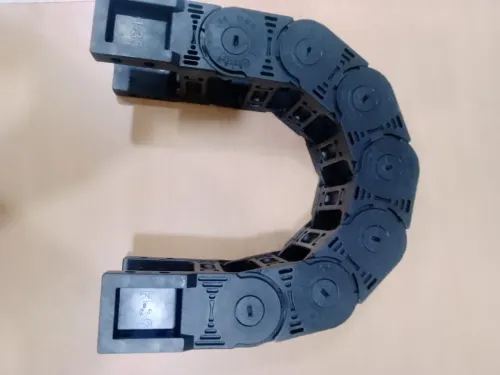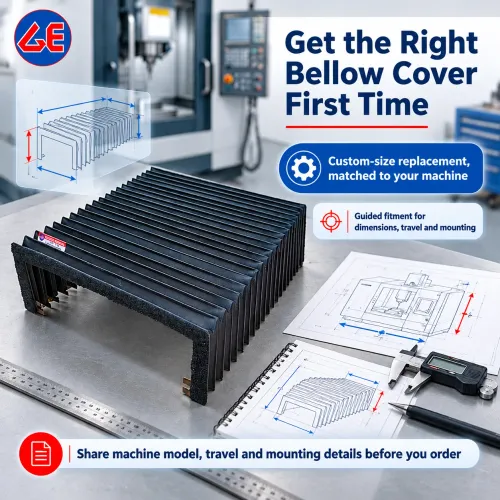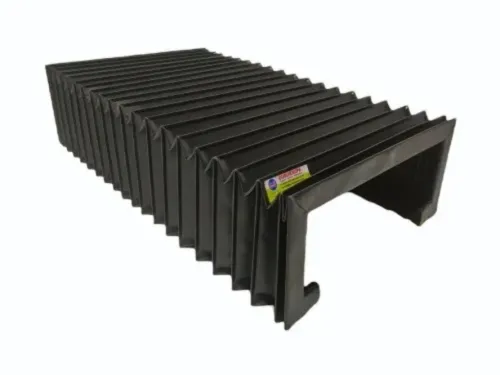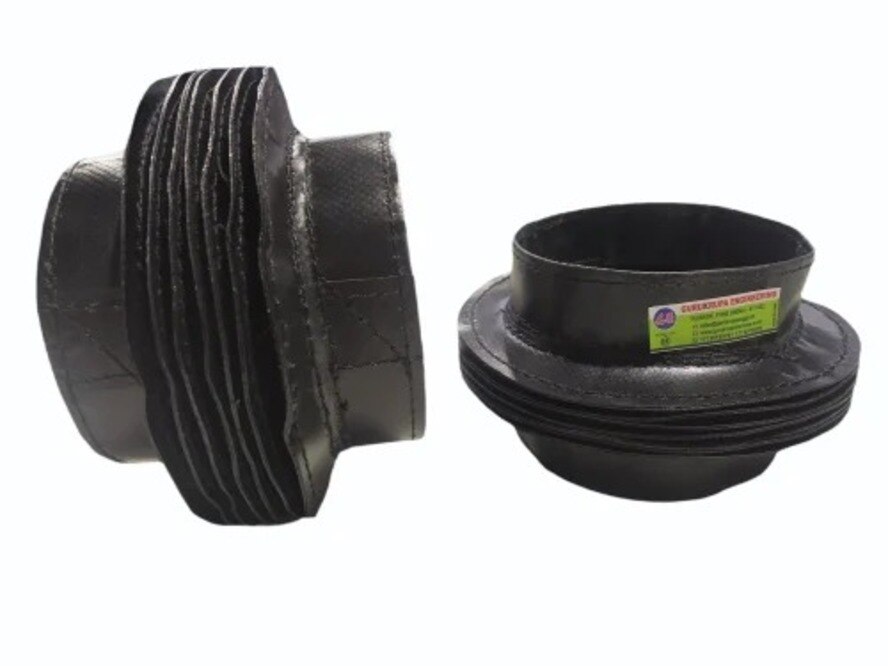
A round rubber bellow cover can protect a moving shaft, guideway, lead screw, piston rod, or actuator from chips, dust, coolant, water, and other contamination, but the wrong geometry can rub, buckle, trap fluid, or restrict travel. By the end, you will know which dimensions, motion data, materials, attachment details, and confirmation documents to request before choosing a standard or custom design.
Key takeaways
- Measure compressed, extended, and lateral motion before ordering.
- Match rubber compound and construction to heat, coolant, chips, and chemicals.
- Use bellows for contamination control, not load-bearing or automatic wiper-seal duties.
- Request attachment details, dimensions, materials, and a verifiable design drawing.
What Does a Round Rubber Bellow Cover Actually Protect?
Round bellow covers for equipment protect moving components such as shafts, spindles, lead screws, ball screws, piston rods, guideways, hydraulic cylinders, and actuators. Rubber bellow covers for machinery keep chips, dust, coolant, water, and other contamination away from sliding or rotating surfaces. They do not carry mechanical loads or automatically replace a wiper seal.
A cover is suitable only when its movement and exposure match the machine:
- Motion: The bellows must extend and compress without buckling, overstretching, twisting, or rubbing surrounding parts.
- Clearance: The folded cover must fit within the available space at every point in the stroke.
- Contact: Sharp swarf, concentrated chips, welding spatter, and abrasive dust can cut or wear rubber even when the compound resists coolant.
- Sealing duty: Do not treat a conventional bellows as a pressure vessel, vacuum seal, or fine-particle barrier without a manufacturer’s rating.
| Condition | Suitable when | Verify before ordering |
|---|---|---|
| Oil or coolant | The rubber compound matches the actual fluid | Name the local oil or coolant, including additives |
| Heat, humidity, and storage | The cover’s temperature and storage limits fit the site | Confirm the full temperature range and Bangkok storage conditions |
| Pressure or vacuum | A documented rating covers the application | Check the mounting arrangement as well as the rating |
| Leakage or fine dust | A bellows works with a wiper, labyrinth, dynamic seal, or purge system | Add dedicated sealing where exclusion is critical |
| Replacement planning | The supplier identifies the cover and provides a dimensional drawing | Confirm lead time and replacement identification |
Measure the Full Motion Envelope Before You Order
Measure the machine at both travel endpoints, not just the shaft diameter. A cover that fits the shaft can still buckle, rub, or bottom out when the moving assembly reaches either limit.
1. Record the retracted length between the fixed and moving mounting faces. Record the extended length at full travel, then calculate usable stroke as extended length minus retracted length.
2. Measure the largest outside diameter available around the cover and the smallest inside diameter needed to clear the shaft, rod, screw, nut, coupling, fittings, and eccentric sweep.
3. Measure both mounting diameters at the fixed and moving ends. Note whether each interface is a plain cylindrical seat, flange, collar, clamp location, or drilled pattern; these details change the effective length.
4. Trace the complete shaft envelope through its motion. Include rotating couplings, lubrication points, keyways, connectors, and any part that swings or moves off-centre.
5. Check available clearance at full extension, full retraction, and every intermediate position. Leave room for folds to open without touching guideways, guards, chips, or coolant lines.
Send a dimensioned sketch for round bellow covers for equipment showing both end interfaces, retracted and extended lengths, maximum outside diameter, bore clearance, stroke, and mounting details. Ask the supplier to confirm minimum fold radius and compressed height; an apparently correct length can still cause folds to rub or collapse.
Never treat the cover as a pressure vessel or vacuum seal without a stated rating.
Match the Cover to Motion, Material Exposure, and Heat
Oil, coolant, heat, and motion decide whether rubber bellow covers for machinery will survive—not the round shape alone. Choose the compound for the exact fluid, concentration, temperature, and exposure time, then check whether the cover can handle bending, twisting, eccentric movement, and repeated contact.
| Compound or design | Suitable exposure | Limits to verify |
|---|---|---|
| NBR | Mineral oil, grease, and many hydraulic fluids | Confirm the exact coolant, temperature, and ozone exposure |
| EPDM | Hot water, steam, and many polar chemicals | Do not use it with petroleum oil unless the compound supplier approves it |
| Silicone | Wide temperature range and flexible movement | Check abrasion, tear strength, oil compatibility, and welding-spatter resistance |
| FKM | Higher temperatures and hydrocarbon exposure | Confirm low-temperature flexibility, chemical concentration, and cycle life |
| Reinforced or shielded bellows | Abrasive dust, chips, sparks, and rubbing | Add a chip shield or spark barrier when sharp swarf or welding spatter strikes the folds |
High speed, acceleration, and frequent cycling can cause fold flutter, heat buildup, fatigue, and cracking. Specify actual travel speed, acceleration, cycle frequency, duty cycle, stroke, and clearance; do not provide maximum stroke alone.
A conventional bellows protects against contamination but is not a pressure vessel or vacuum seal unless its rating and mounting arrangement are documented. UV, ozone, humidity, and storage conditions also matter. For custom round bellow covers, request the compound designation, temperature range, fluid-compatibility statement, and replacement identification.
Compare Bellows with Other Protection Methods
A round rubber bellow cover is preferable when a shaft, spindle, piston rod, ball screw, or actuator needs flexible protection through axial, angled, or eccentric movement in a compact space. Round bellow covers for equipment block coolant, dust, and chips without the bulky housing of a telescopic cover.
Rubber bellow covers for machinery are not load-bearing parts, pressure vessels, or universal seals.
| Option | Best use | Choose a round rubber bellow when |
|---|---|---|
| Accordion fabric bellow | Large guideways and long strokes | You need a compact cover, flexible movement, and better resistance to coolant or moisture. |
| Telescopic cover | Heavy chips, impact, and rigid sliding protection | You have space for metal boxes and concentrated swarf would cut flexible material. |
| Spiral cover | Light protection on rotating or translating shafts | You need simple low-contact coverage and the motion does not demand full enclosure. |
| Scraper | Removing chips or coolant from a sliding surface | You need active surface cleaning; add a bellow behind it for enclosed protection. |
| Rigid guard | Preventing impact or operator access | The hazard requires structural strength rather than movement-following coverage. |
| Dynamic seal | Controlling leakage across a moving shaft | Pressure retention or fluid exclusion is the primary requirement. |
| Wiper | Sweeping fine contamination from a rod | Fine particle exclusion matters more than enclosing the full stroke. |
| Labyrinth | Non-contact exclusion around rotating parts | You need low-friction dust control and can tolerate a defined leakage path. |
| Purge system | Positive protection in severe contamination | Clean, dry air or inert gas is available and particle exclusion is critical. |
Check the pressure and vacuum rating before specifying a bellows. Heavy chips, welding spatter, abrasive dust, or rubbing can require a shield, wiper, or combined system.
Specify the Attachment and Request a Verifiable Design
A flange, collar, clamp, stitched ring, or mounting-hole pattern is part of the motion design, not just installation hardware. It adds length, limits fold movement, or forces a smaller mounting diameter, reducing usable stroke and causing folds to rub, buckle, or bottom out.
Check compressed and extended lengths, minimum fold radius, mounting diameters, and clearance together.
For a supplier RFQ, send the motion data and request:
- A dimensioned drawing showing both end interfaces, retracted and extended lengths, stroke, maximum outside diameter, shaft or bore clearance, and every hole, flange, collar, or clamp.
- A sample fit or first article for checking attachment, fold clearance, and interference throughout the complete travel.
- Written confirmation of the rubber compound’s resistance to your specific coolant, oil, chemicals, UV, ozone, and temperature range.
- Service-life guidance based on travel speed, acceleration, cycle frequency, and duty cycle rather than stroke alone.
- A replacement part number, identification method, replacement lead time, and storage limits for heat and humidity.
Round rubber bellow covers for industrial equipment in Bangkok still require this verification; Bangkok’s climate does not determine compatibility. Confirm operating temperature, humidity, storage conditions, and the actual local coolant or oil type.
Treat pressure separately. A conventional molded or fabric-reinforced cover protects against contamination, but it is not a pressure vessel or vacuum seal without a stated rating and suitable attachments.
Custom round bellow covers make sense when standard dimensions miss the clearance, compressed length, mounting geometry, or media resistance. When comparing round rubber bellow covers in Bangkok, GURUKRUPA BELLOWS PVT LTD can be asked for the drawing and replacement identification before approval.
Related product
 | Round Bellow Covers To match with our reputation in the market, we are here to present an unparalleled assortment of Round Bellow Covers. View product → |
Frequently asked questions
What does a round rubber bellow cover protect?
It shields shafts, spindles, lead screws, ball screws, piston rods, guideways, hydraulic cylinders, and actuators from chips, dust, coolant, water, and other contamination.
What should you measure before ordering a round bellow cover?
Measure the protected component diameter, mounting diameters, compressed and extended lengths, stroke, lateral movement, bend requirements, and available clearance.
How do you match a bellow cover to equipment conditions?
Specify the motion type, cycle rate, temperature range, coolant or chemical exposure, chip load, abrasion risk, and required rubber or fabric construction.
Are bellows better than telescopic covers, wiper seals, or spiral guards?
Bellows suit flexible contamination protection around moving parts, while telescopic covers handle rigid guideway protection, wipers seal contact points, and spiral guards protect rotating shafts.
What attachment information should you request?
Request mounting-ring dimensions, flange or clamp details, fastening locations, material specification, compressed and extended dimensions, motion limits, and a drawing that can be checked against the machine.