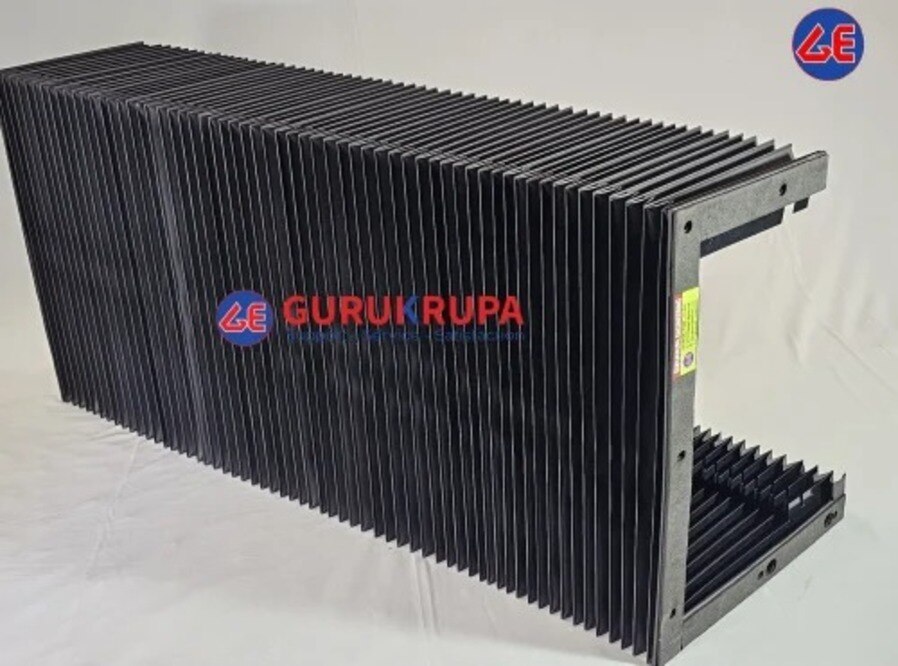
A correct travel length is not enough to order a fabric bellow cover: compressed height, fold geometry, mounting space, material exposure, and machine motion all affect whether it survives. By the end, you will have a supplier-ready checklist for measurements, construction, materials, protection level, and quotation review.
Key takeaways
- Record travel, compressed length, extended length, and clearances.
- Specify fold count, motion speed, orientation, and every mounting point.
- Match coated fabric and seams to heat, oil, chips, coolant, or fire exposure.
- Require materials, tolerances, testing, and acceptance criteria on the quotation.
What machine and dimensional details must you provide?
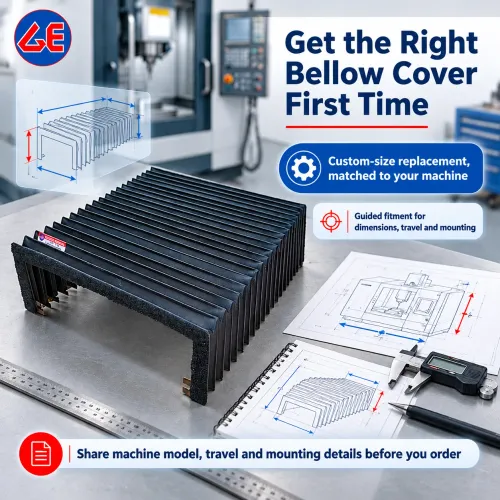
Give the supplier the machine identity and a complete dimensional record, not only the required travel. Identify the protected component, machine make and model, axis location, mounting orientation, and every fixed or moving attachment point.
- Cover length, travel length, fully compressed length, and fully extended length
- Internal width and depth, external width and depth, closed height, and extended height
- Number of folds, fold pitch or fold depth, and required clearance for fold movement
- Guideway clearance, parked height, maximum compressed height, and opening required at full extension
- Mounting-hole pattern, flange shape, end-frame position, and distance between fixed and moving attachment points
Measure travel between the machine’s actual parked and working positions. Do not measure only the exposed guideway: folds need room to move without rubbing, pinching, or trapping chips. A cover with the correct stroke can still bottom out when its compressed stack is taller than the available space.
Separate internal working dimensions from external envelope dimensions. The internal opening must clear rails, tooling, chips, coolant lines, and moving cables throughout the stroke. The outside dimension must fit adjacent guards, housings, and machine panels.
Record these fabric bellow cover specifications on a dimensioned drawing, including the axis direction and attachment locations. For fabric bellow covers in Bangkok, verify the installed space at both parked and fully extended positions; a nominal catalogue size will not reveal an interference problem.
How should motion, folds, and mounting be specified?
A motion specification must show that the cover can follow the axis without rubbing, sagging, or packing unevenly. Record maximum travel speed, acceleration, cycle frequency, axis orientation, and whether travel is horizontal, vertical, inclined, or multi-axis. Add minimum bend radius, allowable compression ratio, permitted sag, and allowable lateral movement.
For a vertical or offset installation, ask whether internal support rings, slats, guides, or a guided construction are necessary. Unsupported folds can collapse, drag against the guideway, and trap chips even when the travel length is correct.
Include these fabric bellow cover specifications in the order:
- Fold count, fold pitch or depth, minimum fold radius, compressed stack height, and clearance between adjacent folds
- Required protection: liquid-tight, dust-tight, or chip deflection only
- End construction: aluminum or steel frames, bolt-on flanges, clamping strips, sewn hems, hook-and-loop attachment, access panels, or removable sections
- Sealing method at fabric seams, flanges, end frames, and moving interfaces
More folds do not automatically provide more travel. They can increase friction, packing height, and chip trapping, while insufficient clearance lets adjacent folds pinch or wear.
State the attachment geometry and moving-interface design on the drawing, not in a later installation note. A sewn hem may need a coated overlap, sealant, or welded seam for coolant exclusion; an unsealed interface defeats a liquid-tight claim. Specify the required mounting-hole pattern and whether the cover needs a guided track or restraint.
Which fabric expansion bellows materials match the exposure?
Choose fabric expansion bellows materials by construction, not labels such as “heavy-duty fabric” or “high temperature.” Identify the base cloth, coating or laminate, thread, reinforcement, and seam construction before comparing quotations.
| Material | Construction | Best fit |
|---|---|---|
| PVC- or polyurethane-coated polyester | Flexible polyester base with polymer coating | General machine-tool service with coolant, dust, and moderate chip exposure |
| Silicone-coated glass fabric | Glass-fibre cloth with silicone coating | Higher-temperature service, including radiant heat where the coating and seam ratings permit |
| PTFE-coated glass fabric | Glass-fibre cloth with PTFE coating | Chemical exposure and higher-temperature service where resistance to the actual fluid is confirmed |
Check the actual coolant, concentration, operating temperature, biocide, alkaline cleaner, chlorine cleaner, oil, solvent, abrasive chip, welding spark, UV exposure, and corrosive chemical. “Oil resistant” does not prove resistance to water-miscible coolant; swelling, delamination, embrittlement, or seam failure can follow.
Request these ratings separately:
- Continuous temperature, short-duration peak temperature, coating limit, thread limit, adhesive limit, and flexing-seam temperature.
- Suitability for direct flame, radiant heat, or only warm dust and coolant spray.
- Fabric weight, thickness, corner and seam reinforcement, flange reinforcement, high-wear sacrificial layers, thread type, and sewn, welded, bonded, or clamped seams.
For fabric bellow covers in Bangkok, record humidity, condensation, mold resistance, UV exposure, and mounting-hardware corrosion. Confirm welding-spark protection rather than assuming a heat-rated cloth will resist hot, sharp chips.
Which protective cover type fits the machine application?
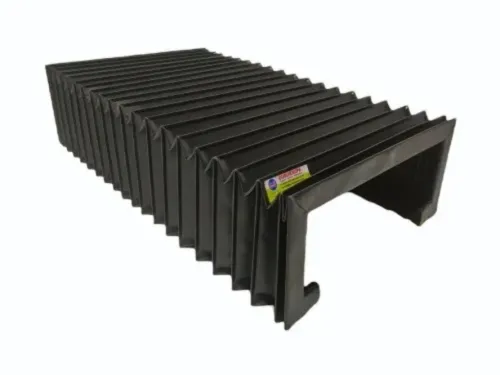
Choose the cover by movement and hazard, not by price or catalogue name. A fabric bellow cover follows a reciprocating or guided axis, folding repeatedly around guideways, cables, hoses, or machine components. Compare the alternatives against the actual application:
| Option | What it protects | When it applies |
|---|---|---|
| Fabric bellow cover | Moving guideways, cables, hoses, or components | Reciprocating or guided axes with repeated folding |
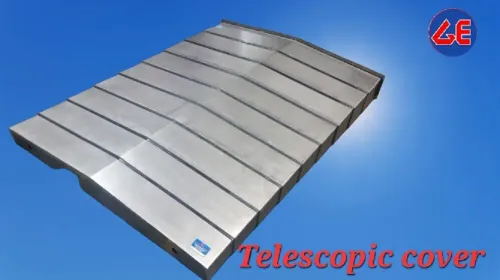
| Guideway cover | Exposed ways and rails | Heavy chips or impact require telescoping steel boxes, sliding plates, or rigid sections |
| Fabric expansion joint | Fixed ducts, pipes, housings, or equipment | Thermal or mechanical movement occurs between fixed connections |
| Apron cover | Long exposed ways | Overlapping or rolling strips fit where a bellows stack cannot |
| Scissor-lift cylinder cover | Extending cylinder, rod, or lifting mechanism | Telescoping geometry controls the cover design |
Record the chip type, chip temperature, coolant direction, cleaning method, and particle-control target. Hot, sharp chips can puncture ordinary coated cloth even when enclosure temperature remains acceptable.
Ask a fabric bellow cover supplier to state whether the design includes:
- Chip deflectors, wire reinforcement, or a sacrificial outer layer
- Welded seams, coated overlaps, or mechanical clamps
- Liquid-tight or dust-tight sealing at seams, end frames, flanges, and moving interfaces
- Compatibility with the cleaning method and coolant
A supplier such as GURUKRUPA BELLOWS PVT LTD should be evaluated against this application checklist, not a generic product label.
Related product
 | Bellow Cover We are considered a well-known name in the business that manufactures and supplies Bellow Cover. View product → |
What must appear on the quotation and acceptance checklist?
The quotation proves fit and performance only when it includes a dimensioned drawing and measurable acceptance criteria. Require these drawing details:
- Internal and external dimensions
- Fully compressed and extended lengths
- Fold count, fold pitch, and bend radius
- Mounting-hole pattern and attachment orientation
- Flange details and estimated mass
The material schedule must name the base cloth, coating, thread, reinforcement, seam method, coating thickness where relevant, temperature ratings, and chemical-compatibility limits. State whether seams are sewn, heat-welded, mechanically clamped, sealed with an overlap, or bonded. Thermoplastic-coated fabrics may be heat-welded; silicone- and PTFE-based fabrics often require sewing or clamping.
Add inspection criteria for travel, stack height, sag, lateral movement, sealing, and attachment alignment. Request a first-article sample or sectional mock-up for a short compressed space, offset guideway, or unusual flange.
Compare fabric bellow covers for specifications before ordering in Bangkok on construction and test evidence, not dimensions alone.
| Evidence | What to verify | Why it matters |
|---|---|---|
| Drawing | Dimensions, holes, flanges, orientation | Prevents bottoming-out or misalignment |
| Material schedule | Cloth, coating, thread, reinforcement, limits | Exposes incompatible construction |
| Inspection record | Travel, stack, sag, sealing, alignment | Defines acceptance rather than opinion |
A fabric bellow cover supplier must also state lead time, installation requirements, maintenance access, replacement parts, and the exact acceptance documents supplied.
Frequently asked questions
What machine and dimensional details must you provide for a fabric bellow cover?
Provide the machine make and model, protected component, axis location, mounting orientation, travel, compressed and extended lengths, cross-section dimensions, clearances, and every fixed or moving attachment point. Include drawings or photographs that show nearby guards, tooling, cables, and hoses.
How should motion, folds, and mounting be specified?
State the direction and speed of travel, cycle frequency, acceleration, operating temperature, minimum bend or fold radius, required fold height, and the number of folds. Describe whether the cover mounts with frames, flanges, plates, snaps, or another arrangement, and identify which end moves.
Which fabric expansion bellows materials match common machine exposures?
Match the coated fabric, thread, seams, and reinforcement to the exposure. Request oil-resistant material for cutting oils, coolant-resistant material for water-based fluids, heat-rated material near hot surfaces, abrasion-resistant construction for chips, and flame-resistant material where ignition risk exists. Ask the supplier for a temperature range and chemical-compatibility statement.
Which protective cover type fits the machine application?
Use a sewn fabric bellow for flexible enclosure around guideways, slides, and irregular paths. Compare it with telescopic steel covers for rigid, high-chip environments; roll-up covers where space is limited; and apron covers for broad flat travel. Choose based on travel geometry, available clearance, chip load, heat, speed, and cleaning access.
What must appear on the quotation and acceptance checklist?
Require the drawing revision, material and coating, dimensions, tolerances, travel, compressed and extended lengths, fold count, mounting details, seam construction, temperature range, chemical limits, delivery scope, inspection method, and warranty terms. Confirm that the quotation identifies exclusions and defines acceptance checks for fit, motion, clearance, and mounting-hole alignment.