A telescopic cover succeeds only when its stages, wipers, seals, drainage and mounting geometry match the machine axis. By the end, you will be able to decide between steel, fabric or combined protection, prepare a quotation-ready specification, and test whether the cover will survive your chips, coolant and duty cycle.
Key takeaways
- Define stroke, closed length, height, width and mounting space before requesting quotes.
- Choose steel for chips and impact; use fabric where flexibility and low mass matter.
- Specify seals, wipers, temperature limits and contamination type from the real duty.
- Test full stroke, stage overlap, clearance, sealing and mounting before production release.
How telescopic bellows protect a moving machine axis
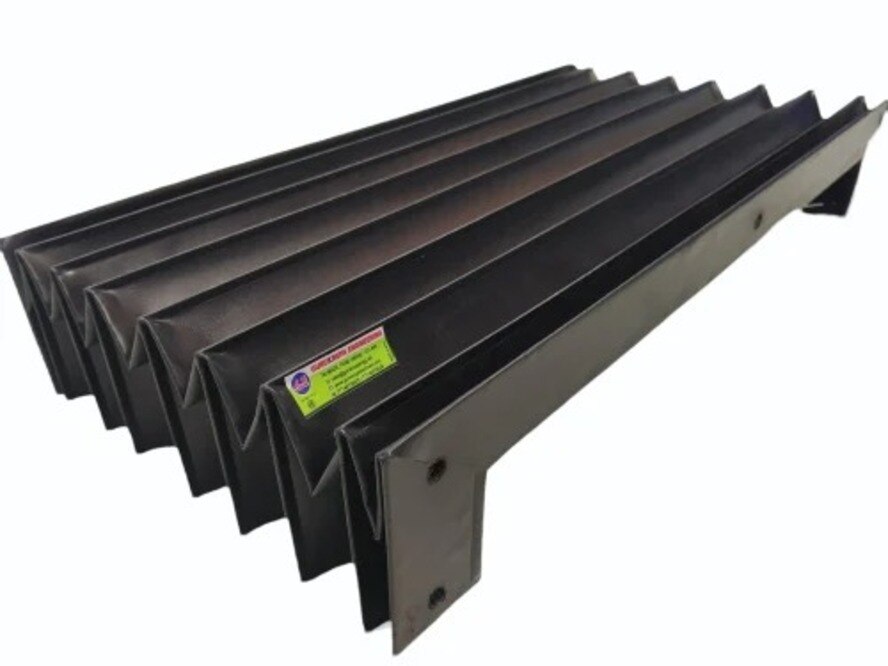
As the machine axis extends, nested steel stages slide out while retaining an overlap between adjoining sections. The cover’s fixed end attaches to the machine frame, and its moving end follows the carriage, keeping the guideway enclosed throughout the stroke. During retraction, the stages slide back into a compact stack.
Wiping edges remove chips from each sliding interface, while guides and rollers keep the sections aligned instead of letting them scrape or bind.
The cover’s protection depends on more than the visible steel panels. Check these leakage routes:
- Gaps at the fixed and moving end interfaces
- Openings around mounting attachments
- Drain paths that return coolant without directing it onto the guideway
A telescopic cover is not automatically coolant-tight. Overlap geometry, wiper material, drainage and orientation determine whether fluid and chips stay out; the adjacent machine enclosure must complete the barrier.
Cover mass and wiper friction become part of the moving axis load. Check the cover’s weight, drag force and acceleration demand against the axis drive before approving the design, or dynamic performance can fall even though contamination control improves.
Treat the cover as way protection, not operator guarding: hazardous access still requires a separate risk assessment, guard and safety-distance design.
Choose steel, fabric or a combination by axis and contamination
Choose steel for an axis exposed to hot, sharp or heavy chips; choose fabric or elastomeric bellows for lighter contamination, low moving mass and tight folded space. Make the decision per axis, not per machine.
For buyers comparing telescopic bellow covers in noida, the operating envelope and contamination path matter more than catalogue availability.
| Option | What it means | When it applies |
|---|---|---|
| Steel telescopic cover | Nested metal stages with scrapers, wipers and seals | Turning, milling or grinding axes facing hot chips, abrasive swarf, heavy coolant flow or impact |
| Fabric or elastomeric bellows | Flexible coated fabric or moulded elastomer that folds into a compact package | Axes exposed to dust, fine particles, splash and light chips, especially where low mass, high speed or limited retraction space matters |
| Combination on one machine | Steel protection on one axis and flexible bellows on another | Machines with a chip-producing cutting axis plus a lighter-duty cross-axis, cable route or auxiliary slide |
Check mass and wiper drag against ballscrew, linear-motor or servo capacity. An oversized steel cover protects the guideway but increases acceleration demand and can reduce positioning performance.
Use both types when contamination differs by axis. A steel cover on the horizontal cutting axis and a fabric bellows on a vertical cable or auxiliary axis is sensible; fitting steel everywhere wastes space and moving capacity.
Fit the cover to the actual axis envelope, and verify that stage clearances, drains and maintenance access remain usable through the full stroke.
Specify the axis envelope before requesting a quotation
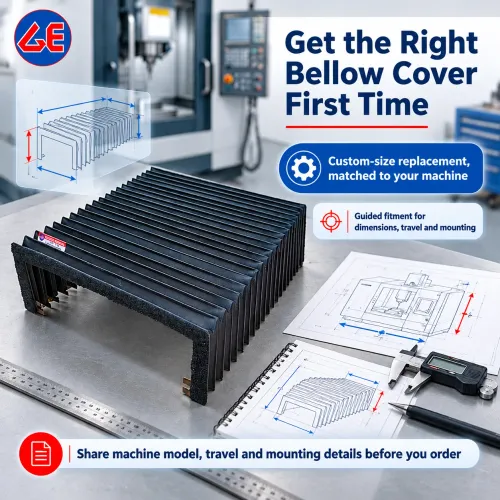
Give the supplier the complete axis envelope, not a catalogue size. For telescopic bellow covers for machine tool builders in noida, the RFQ must show the axis travel, closed and extended lengths, retraction direction, maximum width and height, mounting position, guideway geometry, and every restricted clearance.
- Mark the fixed and moving attachment points, mounting-face dimensions, hole pattern, and permitted position error between the machine structure and guideway.
- State axis speed, acceleration, cycle frequency, and whether the cover’s mass and wiper drag must be included in ballscrew, linear-motor, or servo sizing.
- Show stage clearances, minimum transition or bend geometry, drain locations, chip-flow direction, and access needed to install, inspect, and replace parts.
- Draw the full stroke around the tool changer, pallet, coolant lines, adjacent guards, and any service doors. Include the permitted interference zones.
| Input | Supply | Why it matters |
|---|---|---|
| Closed and extended length | Both end positions and usable travel | Sets stage count and prevents over-compression |
| Width and height | Maximum envelope at every stroke position | Stops collisions with guards, tooling, and machine castings |
| Mounting interface | Faces, holes, brackets, guide rails, and alignment tolerance | Controls squareness; the cover must not correct casting or guideway errors |
| Operating duty | Speed, acceleration, cycles, coolant, chips, and temperature | Determines wiper design, moving load, drainage, and service life |
A hand-movement check before commissioning should reveal binding, asymmetric gaps, or uneven wiper marks. These indicate misalignment, not a cover that needs “running in.”
Match materials, seals and cover types to the real duty
A painted steel cover suits ordinary metal chips and soluble-oil coolant when its stages drain freely and the paint system matches the cleaning chemicals. It is a poor choice for persistent moisture, abrasive grinding dust or damaged paint, where corrosion begins under chips and increases wiper drag.
| Option | Coolant, chips and corrosion | Speed, space and maintenance |
|---|---|---|
| Painted steel | General machining; protect cut edges and joints from corrosion | Robust, but heavier; replace scrapers and repair chipped paint |
| Stainless steel | Frequent wash-down, monsoon moisture, neat oil or corrosive cleaners | Higher cost; confirm grade, weld finish and compatible wipers |
| Coated steel | Adds chemical or abrasion resistance to a steel structure | Specify coating thickness and repair method; damage exposes the substrate |
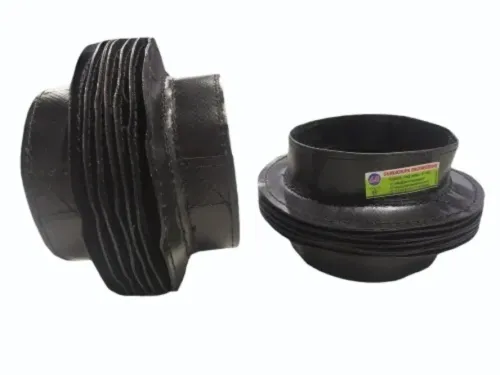
| Fabric or elastomeric bellows | Tight spaces, light chips, heat or irregular paths; select material for the coolant | Low mass and friction; vulnerable to sharp swarf and puncture |
| Steel plus fabric | Steel handles hot chips while fabric seals a secondary gap or attachment | Useful on mixed duties; inspect two protection systems and their interfaces |
For telescopic bellows for machine tools, compare the supplier’s stated coolant, chip and temperature limits rather than treating an IP rating as proof of way-cover sealing. Check end interfaces, drains, overlap seals, wipers and moving attachments; contamination can enter through any of them. Request prices and lead times for scrapers, springs, rollers and stage seals.
Check cover mass and drag against servo acceleration. Keep machine guarding and safety distances separate: a cover protects ways and screws, not operators.
Validate the cover before releasing the machine for production
Release the machine only after the supplier’s drawing matches the complete axis envelope, not merely the catalogue size. The drawing must show closed and open lengths, travel, width, height, fixed and moving attachment points, hole pattern, stage clearances, transition geometry, drain locations, and permitted alignment error relative to the guideway.
1. Ask for the cover mass, calculated drag force, maximum speed, acceleration limit, wiper material, seal arrangement, and expected service life. Confirm that the ballscrew, linear motor or servo can move the added load without higher following error.
2. State the actual duty: soluble-oil or neat-oil coolant, grinding swarf, abrasive dust, wash-down pressure, monsoon moisture, ambient temperature and cleaning chemicals. Ask where coolant and chips exit, and how the end interfaces and moving attachments are sealed.
3. Run the cover through its full stroke on the machine, including the fastest repeated cycle. Check for rubbing against the tool changer, pallet, guards, coolant lines and guideway; measure motor load or drag force rather than judging motion by hand.
4. Flood-test the enclosure with the intended coolant or wash-down method, then inspect the guideway, drains, stage joints and end seals for ingress. Repeat after chip accumulation.
5. Record noise, vibration, snagging, collapsed-stage alignment and installation access. Obtain prices and lead times for scrapers, wipers, springs, rollers, seals and mounting hardware before release.
Whether you buy telescopic bellow covers in Noida from GURUKRUPA BELLOWS PVT LTD or another supplier, keep the approved drawing, test record and replacement-part list with the machine file. That evidence prevents a low purchase price from becoming unplanned downtime.
Related products
 | Telescopic Bellow Cover ₹1000 Product Details: Brand GURUKRUPA Ours is a distinguished name in the business that manufactures and supplies Telescopic Bellow Cover that is vastly... View product → |
 | CNC Telescopic Cover Product Details: Brand GURUKRUPA Being one of the trustworthy names of the industry, we bring forth CNC Telescopic Cover that can be availed at... View product → |
Frequently asked questions
How do telescopic bellows protect a moving machine axis?
A fixed end attaches to the machine frame while the moving end follows the carriage. Nested stages retain overlap during extension and retract into a compact stack, enclosing the guideway against chips, dust and coolant.
Should you choose steel, fabric or combination telescopic bellows?
Choose steel for sharp chips, impact and heavy contamination. Choose fabric for flexible protection, lower mass or irregular movement. Use a combination when the axis needs steel shielding in one zone and flexible coverage in another.
What axis information is needed for a telescopic bellow quotation?
Provide stroke, closed and extended lengths, cover height and width, mounting method, available clearance, carriage speed and acceleration, plus the contaminant, coolant, temperature and chip load.
How do you validate a telescopic bellow before production?
Run the cover through the complete axis stroke and inspect stage overlap, retraction, clearance, mounting rigidity, seal contact and interference. Check protection against the actual chips, coolant, heat and movement before releasing the machine.
Related products
 | Telescopic Cover Product Details: Brand GURUKRUPA Being one of the trustworthy names of the industry, we bring forth CNC Telescopic Cover that can be availed at... View product → |
 | Industrial Telescopic Covers Our company is known as one of the eminent names of the industry to manufacture and supply Industrial Telescopic Covers. View product → |
 | Telescopic Cover ₹5000 Product Details: Brand GURUKRUPA Being one of the trustworthy names of the industry, we bring forth CNC Telescopic Cover that can be availed at... View product → |