A fabric cover that suits dry dust can fail when exposed to sharp chips, hot swarf, coolant jets, or repeated high-speed motion. By mapping the machine’s hazard envelope, measuring both travel limits, and checking the complete material construction, you can specify a cover that protects the guideway without folding, rubbing, leaking, or obstructing the machine.
Key takeaways
- Specify chips, fluids, heat, speed, acceleration, and washdown before selecting fabric.
- Match the fabric system to chemical exposure, temperature, abrasion, and welding spatter.
- Measure the machine fully retracted and extended, including folds, clearance, and mounting points.
- Approve only after testing motion, drainage, seams, access, and maintenance intervals.
Start with the hazard envelope, not the fabric grade
Specify the hazard envelope before choosing fabric machine protection covers. Record chip size and temperature, abrasive-dust load, cutting-oil or coolant type and concentration, hydraulic oil, alkaline wash, solvents, welding-spatter exposure, washdown pressure, ambient and peak temperature, axis speed, acceleration, cycle frequency, and expected service hours.
- Reject a fabric bellows design without added shielding for high-volume sharp chips, direct heavy impact, severe welding spatter, high-pressure coolant jets, unsupported long spans, or temperatures beyond the complete fabric system’s rating.
- Treat corrosion resistance as only one property: it does not prove compatibility with every chemical. Check the coating, thread, adhesive, closure, and reinforcement against each fluid and cleaner.
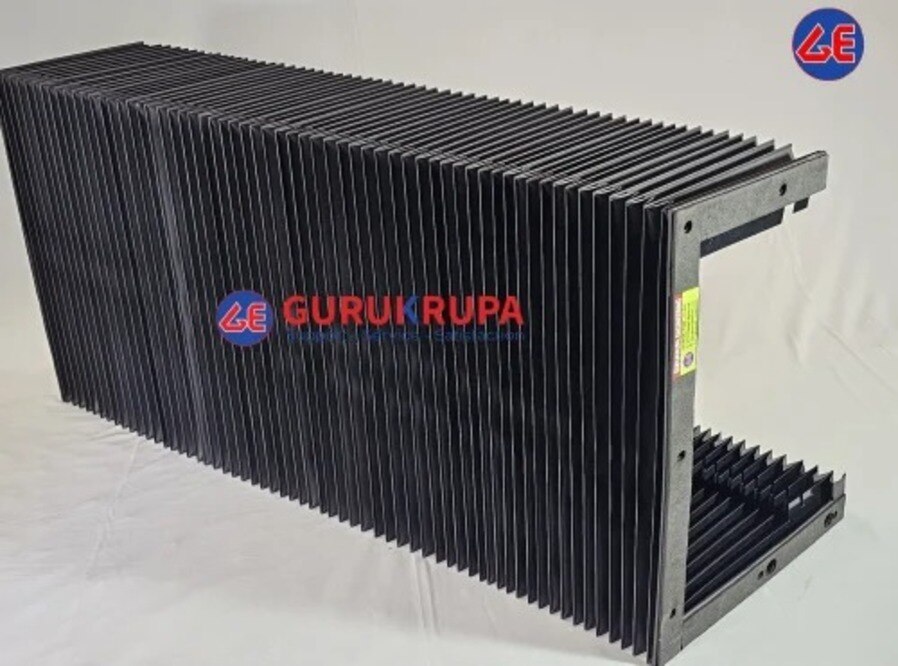
A machine-guideway bellows protects the moving area; it does not route cables or absorb structural loads.
| Option | Primary job | Decision point |
|---|---|---|
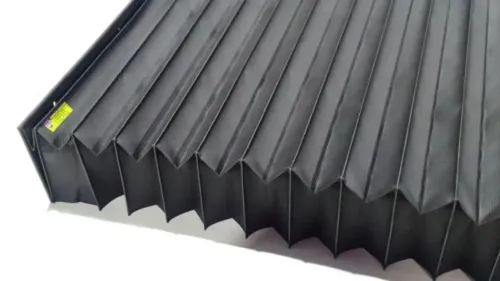
| Machine-guideway bellows | Encloses a moving guideway | Use for dust, chips, and fluid exclusion within its rating |
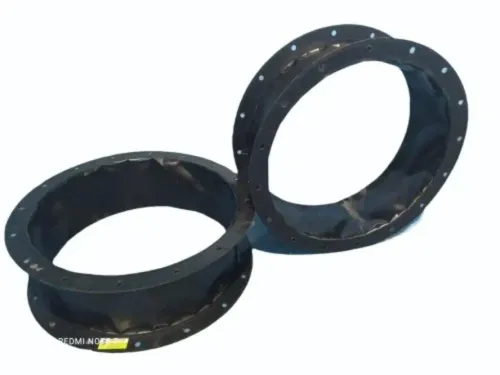
| Fabric expansion joint | Accommodates pipe or duct movement | Do not substitute for guideway protection |
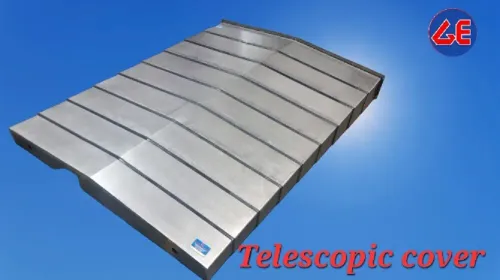
| Telescopic steel cover | Resists heavy chips and impact | Prefer for severe cutting and direct loading |
| Apron cover | Shields broad beds and long travels | Use where overlapping slats suit the motion |
| Cable carrier | Controls cable bend radius, separation, tensile load, and dynamic life | Required for guided cables and hoses |
An industrial fabric bellows is the wrong choice when chips strike at high volume, spatter burns the textile, coolant arrives as a high-pressure jet, or folds cannot remain supported. Pair it with shields, wipers, or a separate chip-management system when exposure exceeds the bellows envelope.
Match fabric, coating, reinforcement, and temperature to the exposure
Oil, coolant, chips, heat, and flexing demand different constructions. Coated polyester is the balanced starting point for general industrial fabric bellows, but custom fabric bellow covers need a material choice tied to the actual exposure.
| Option | Strengths | Trade-off or use |
|---|---|---|
| Coated polyester | Balanced flexibility, cost, oil and coolant resistance | General-purpose duty; not high-temperature or severe-spatter service |
| PVC-coated fabric | Economical liquid and particulate barrier | Less flexible and less heat-resistant; useful for basic coolant and dust protection |
| Polyurethane-coated fabric | High flexibility and abrasion resistance | Costs more than PVC; verify chemical compatibility |
| Silicone-coated fabric | Higher-temperature capability and flexibility | Higher cost; abrasion resistance depends on the construction |
| Neoprene-coated fabric | Oil, weather and moderate-heat resistance | Confirm compatibility with the specific oil, solvent or cleaner |
| Leather | Strong abrasion and selected heat resistance | Heavy, less flexible, and unsuitable for many coolants or continuous wet service |
| Textile composite | Layers, films, scrims or high-temperature fibres solve demanding duty | More complex, costly and harder to repair |
Specify the actual operating range and peak-temperature limit for the complete assembly: base cloth, coating, thread, adhesive, hook-and-loop closure, elastic, reinforcement and mounting hardware. The fabric’s rating alone is not enough.
Add fold reinforcement, lamellae, guide frames, anti-sag devices or wipers when speed, acceleration, span or chip loading causes flutter, buckling or fold contact. Sewn seams suit flexible, repairable or complex shapes; welded or heat-sealed seams improve liquid and particle resistance only when the coating supports welding and the seam remains flexible.
Measure the machine at both travel limits before drawing the cover
1. Measure the machine fully retracted and fully extended; nominal stroke alone misses crushed folds and exposed guideways. Record closed length, extended length, usable stroke, any overtravel, fold height or pitch, inside and outside dimensions, guideway width, lateral offset, angular misalignment, and clearance to the slide, tooling, and surrounding structure.
2. Calculate the required expansion ratio as extended length divided by closed length. Do not approve the design from that ratio alone: confirm the number of convolutions, fold pitch, minimum bend radius, reinforcement, allowable compression, and actual compressed length.
Check that folds do not bottom against one another, rub the guideway or slide, twist under offset, or obstruct motion at either travel limit.
3. Measure both fixed and moving interfaces, including mounting surfaces, hole spacing and diameter, mounting-hole pattern, flange orientation, fastener-head clearance, and the required sealing or access gap. Inspect every interface for burrs, sharp edges, weld spatter, exposed fastener heads, and inadequate edge radii; these defects can cut fabric machine protection covers during cycling.
4. Put all measurements and tolerances on the production drawing, including travel, clearances, allowable compression, fold geometry, and complete interface geometry. A photograph and one overall dimension cannot support custom fabrication of custom fabric bellow covers. Before release, verify free movement through full travel and overtravel without snagging, fold contact, guideway exposure, or mounting interference.
Validate motion, drainage, seams, and maintenance before approval
1. Require the supplier’s allowable speed and acceleration for the complete assembly, not just the textile’s static dimensions. At high acceleration, specify internal stiffeners, lamellae, guide frames, or anti-sag devices when unsupported folds could flutter, buckle, touch the slide, or create inertial drag.
2. Design drainage for coolant-heavy tools instead of accepting a waterproof claim. Orient seams to shed liquid, eliminate horizontal pockets, and seal corners; low seams and unsealed corners retain coolant and chips, adding weight, sag, chemical exposure, and cleaning time.
Specify the cleaning chemicals, concentration, temperature, pressure, and cleaning method for the finished fabric machine protection covers.
3. Put the acceptance conditions in the drawing for the industrial fabric bellows: full stroke, operating speed, operating acceleration, both travel limits, and any machine overtravel. Inspect for snagging, abnormal noise, leakage, fold-to-fold rubbing, obstruction, and unintended tensile or torsional loads at the mounts.
4. Record and correct chip accumulation, sharp machine edges, excessive compression, unsupported spans, incompatible cleaners, undersized end frames, and poor installation access before approval. Static extension cannot reveal dynamic failures.
5. Add wipers or brushes when fine chips or coolant can pass beneath the moving edge; add shields for sharp, hot, or high-velocity debris. Use a separate chip-management system when chip volume overwhelms the cover, such as heavy cutting, high-pressure coolant, or debris collecting between convolutions.
Reject the design until the full-stroke trial passes without contact or load transfer.
Turn the specification into a local supplier and installation decision
1. Send a production drawing, not a photograph and one overall dimension. Include travel, closed and extended lengths, inside and outside dimensions, guideway width, mounting-hole pattern, flange orientation, fold pitch, minimum clearances, material layers, reinforcement, seam type, temperature, chemicals, cleaning method, wipers or brushes, dimensional tolerances, and allowable compression. Mark every fixed and moving interface.
2. Require the fabric bellow covers supplier in Noida to provide material datasheets, coating and seam details, chemical and temperature limitations, rated speed and acceleration for the complete assembly, installation instructions, replacement-part identification, lead time, transport protection, and a documented inspection or test procedure.
Ask how the supplier will verify full-stroke operation at speed and acceleration, including overtravel, without rubbing, snagging, leakage, abnormal noise, or mounting-load transfer.
3. For fabric bellow covers for selection in Noida, request a site measurement before approval. A local installer can verify access, deburr interfaces, check fastener clearance, confirm mounting orientation, and approve the drawing before production. Ask who supports installation, full-stroke commissioning, replacement folds or frames, and service after delivery.
A Noida manufacturer and supplier such as GURUKRUPA BELLOWS PVT LTD earns consideration when it converts those measured conditions into an approved drawing and documented installation plan. That is the practical basis for ordering custom fabric bellow covers, rather than selecting a material name from a quotation.
Related products
 | Bellow Cover We are considered a well-known name in the business that manufactures and supplies Bellow Cover. View product → |
 | Soft Material Bellow Product Details: Brand GURUKRUPA Specifications:- Function of accordion machine shield: water-proof,oil-proof, anti-corrosion, fire-proof... View product → |
Frequently asked questions
What hazards must you define before selecting fabric bellow covers?
Record chip size and temperature, abrasive dust, coolant and oil chemistry, alkaline wash, solvents, welding spatter, washdown pressure, temperature, axis speed, acceleration, cycle frequency, and service hours.
How do you match fabric bellow covers to industrial exposure?
Select the fabric, coating, reinforcement, seam construction, and temperature range against the actual exposure. Check resistance to coolant, hydraulic oil, alkaline cleaners, solvents, abrasion, heat, and welding spatter.
What measurements are needed for custom fabric bellow covers?
Measure the protected length at both travel limits, then record folded height, extended height, width, mounting points, guideway clearance, bend radius, nearby obstructions, and access requirements.
What should you validate before approving industrial fabric bellows?
Run the cover through full travel and check compression, extension, rubbing, snagging, drainage, seam integrity, mounting security, cleaning access, inspection points, and replacement time.
Related products
 | Extruded Aluminum Apron Covers Extruded Aluminum Apron Covers Product Details: Brand GURUKRUPA Color Silver Condition New Size Customised We are offering a wide range of Extruded Aluminum Apron Covers. View product → |
 | Bellow Cover ₹1000 We are offering an excellent quality of Protective Bellows for all type Guideways. This design covers three sides of the rail. View product → |