A round rubber bellow covers a moving shaft, rod, cylinder, screw, or exposed joint while the machine part travels, bends, or reciprocates. By the end, you will know which contaminants and movements these covers handle, when another protection method is better, and which dimensions and operating limits to specify before ordering.
Key takeaways
- Protect shafts, guide rods, screws, actuators, and cylinder rods from contamination.
- Use convoluted bellows to expand and compress around reciprocating movement.
- Compare rubber, fabric, steel, and simple covers against heat, debris, and travel.
- Provide compressed, extended, inside, outside, and mounting dimensions before ordering.
Which machine parts do round rubber bellows protect?
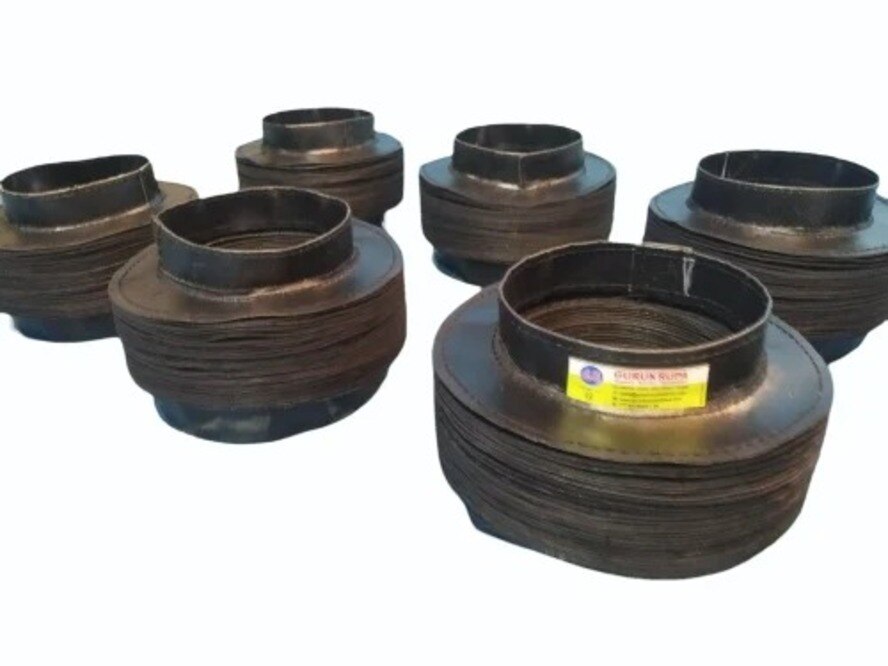
A round rubber bellow surrounds moving cylindrical parts and shields their working surfaces from contamination. It protects shafts, guide rods, ball screws, linear actuators, hydraulic and pneumatic cylinder rods, spindles, exposed joints, and other translating machine components.
Its round cross-section fits closely around a rod or shaft without flat folds that can catch on nearby hardware. On CNC turning, milling, drilling, grinding, and conventional machine tools, it helps keep metal chips, coolant, grinding dust, and abrasive particles away from the moving surface and its seals.
| Part | Typical equipment | Protection provided |
|---|---|---|
| Shafts and spindles | CNC lathes, drills, grinders | Limits chips, dust, and coolant entry |
| Guide rods and ball screws | Milling machines and linear-positioning systems | Shields precision motion surfaces |
| Cylinder rods and actuators | Presses, lifting equipment, and automation slides | Reduces contamination at rod seals |
| Exposed joints | Handling equipment and translating mechanisms | Covers moving gaps during travel |
Automation slides, lifting equipment, and linear-positioning systems use the same principle: protect the motion element while other guards handle the wider enclosure. A search for round rubber bellow covers for uses in Surat should therefore match the cover to the machine’s movement and contaminants.
This cover provides environmental protection, not pressure containment. It does not replace a hydraulic seal, pneumatic seal, machine way cover, wiper, or chip-management system. Use those systems alongside the bellow where the machine requires broader protection.
How does a round bellow accommodate movement?
The convolutions shorten during compression and expand during extension, allowing a rod or actuator to travel without opening the protective barrier.
During bending, the folds deform unevenly; during repeated reciprocating motion, they cycle between their compressed and extended positions while limiting the path for chips, dust, coolant, oil mist, moisture, textile lint, and general shop contamination.
Nominal diameter alone does not establish stroke. Confirm these movement specifications:
- Number and pitch of folds
- Fold height and wall thickness
- Minimum compressed length and maximum extended length
- Required stroke, speed, and acceleration
- Allowable lateral offset and minimum bend radius
Over-compression or over-extension can create permanent set, cracking, fold inversion, and early failure. The cover must reach its required length without forcing adjacent folds together or stretching the rubber beyond its design range.
Torsion creates a separate risk. If connected parts rotate relative to each other, specify a rotary-rated design, add anti-rotation hardware, or use a separate guide; do not twist a standard axial bellow.
Rapid piston movement pumps air into or out of the cover, causing ballooning, collapse, or fold inversion. Controlled venting or breather holes can relieve pressure, but position them so they do not become a direct contamination path.
These checks matter in round bellow cover applications in Surat because machining coolant, textile lint, and outdoor dust impose different movement and sealing demands.
Where are round rubber bellows used in Surat machinery?
CNC and conventional machines in Surat use round bellows to shield moving parts from the contamination each process creates. The phrase round bellow cover applications in Surat describes equipment and hazards, not a city-specific specification.
- CNC turning and milling: protect a ball screw from metal chips and machining coolant.
- Conventional lathes, drills, and fabrication equipment: cover exposed shafts, guide rods, and reciprocating members.
- Hydraulic and pneumatic cylinders: cover a cylinder rod on a press or lifting unit.
- Automation slides: shield linear guides and actuators from dust.
- Welding machinery: protect moving joints and torch-slide actuators from spatter, while checking heat limits.
- Textile machinery: isolate machine rods and shafts from lint.
- Packaging lines: protect actuators from wash-down moisture and product debris.
- Material-handling equipment: cover moving joints exposed to warehouse dust or outdoor dust.
Match the cover to the contaminant. Mineral oil and coolant require chemical compatibility; diamond-processing or grinding dust demands abrasion resistance. Welding spatter and hot chips can destroy ordinary rubber, while outdoor equipment faces ozone, sunlight, and moisture.
A rubber bellow is the wrong sole barrier for red-hot particles, severe grinding swarf, or direct flame. Use heat-resistant or coated fabric, a metallic telescopic cover, a wiper, or a sacrificial shield when the hazard reaches the bellow directly.
How should you choose rubber, fabric, steel, or a simpler cover?
Choose round rubber for cylindrical shafts and rods that need repeated axial movement, bending, and a compact contamination barrier. For round rubber machine bellows in Surat, select by motion and hazard, not by location or the word “rubber.”
| Option | Best fit | Main limitation |
|---|---|---|
| Round rubber bellows | Shafts and rods with repeated axial travel and bending | Poor choice for red-hot or sharp debris |
| Fabric or coated fabric bellows | Higher heat, sparks, welding spatter, or unusual geometries | Needs careful sealing and abrasion review |
| Telescopic steel cover | Sharp, hot, heavy chips and rigid machine-tool protection | Does not suit freely bending shafts |
| Flat bellows | Broad guideways and flat machine surfaces | Not suited to cylindrical rods |
| Wiper | A rod where a sealing lip can scrape away contamination | Covers only the wiping interface |
| Boot | Short travel around a joint | Limited stroke and folding space |
| Simple flexible sleeve | Modest movement, abrasion, and end-retention demands | Fails when motion or retention is severe |
Specify nitrile for mineral oils and lubricants; EPDM for water, steam, ozone, and weather when petroleum oil is absent. Silicone handles broad temperature service where abrasion is limited. Polyurethane offers stronger abrasion resistance after chemical checking, while neoprene balances weathering and oil resistance.
Require a material designation, not “rubber” alone. Approve the design against:
- Temperature range, oil, coolant, and solvent compatibility
- Flame exposure, ozone, abrasion, and fire risk
- Pressure or vacuum effects, including collapse or ballooning during rapid motion
What measurements and documents should you provide before ordering?
Measure the moving assembly, not just the cover’s nominal diameter. Record:
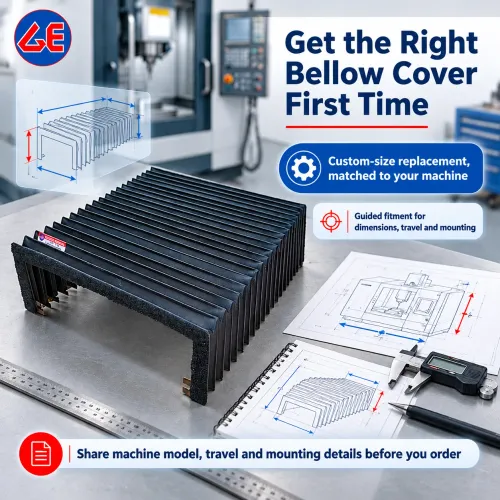
- Protected-part outside diameter, rod or shaft diameter, required mounting diameter, minimum compressed length, maximum extended length, and total stroke.
- Available clearance, fold height, allowable bend radius, lateral offset, both end-flange dimensions, collar or clamp locations, mounting method, nearby fasteners, and venting space.
- Operating speed, acceleration, temperature, pressure or vacuum exposure, rotation, chemical names, coolant type, oil type, dust, chips, sparks, and wash-down conditions.
| Supplier document or sample | What it lets you verify |
|---|---|
| Dimensional drawing | Clearances, flange fit, fold count, stroke, and attachment geometry |
| Material designation and limits | Temperature, oil, coolant, solvent, ozone, and chemical compatibility |
| Compression, bend, and mounting data | Whether movement causes cracking, fold inversion, or clamp failure |
| Inspection method and fit sample | Whether the supplied cover matches the drawing and operates correctly |
Buyers searching for round rubber machine bellows in Surat or round rubber bellow covers in Surat can compare manufacturers such as GURUKRUPA BELLOWS PVT LTD on technical fit, not colour or an “any size” claim. A sample also exposes interference before production installation.
Before approval, confirm:
- Free movement through the full stroke.
- Folds do not invert.
- Clamps do not cut the collar.
- End attachments have no contamination gaps.
Related product
 | Round Bellow Covers ₹1000 To match with our reputation in the market, we are here to present an unparalleled assortment of Round Bellow Covers. View product → |
Frequently asked questions
Which machine parts do round rubber bellows protect?
They protect shafts, guide rods, ball screws, linear actuators, hydraulic and pneumatic cylinder rods, spindles, and exposed joints from dust, chips, moisture, and abrasion.
How does a round bellow accommodate movement?
Its folded or convoluted wall expands and compresses as the protected part moves, while end collars or flanges keep the cover attached.
Where are round rubber bellows used in Surat machinery?
They are used on machine tools, CNC equipment, hydraulic and pneumatic systems, automation equipment, textile machinery, and other industrial machines operating in Surat workshops.
How do you choose rubber, fabric, steel, or a simpler cover?
Choose based on temperature, chemicals, chips, fire exposure, travel speed, bend radius, and required flexibility; use rubber for sealing, fabric for lighter flexible protection, steel for severe chip loads, and simple covers for low-risk environments.
What measurements and documents should you provide before ordering?
Provide the protected part diameter, required inside diameter, compressed and extended lengths, stroke, mounting dimensions, end style, temperature, speed, and a drawing or photos showing clearance and attachment points.