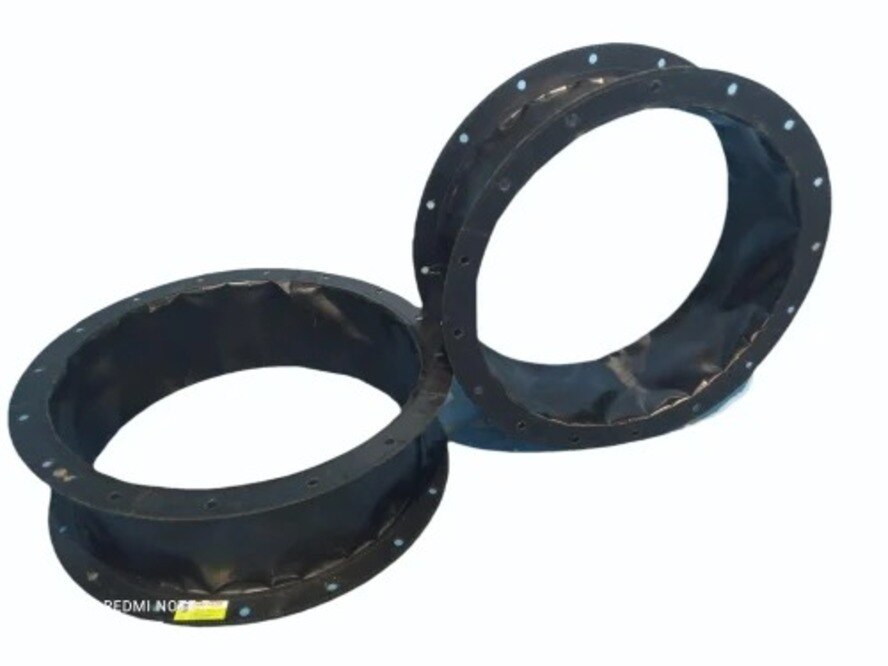
Choosing a bellow cover by material name alone can leave you with the wrong travel range, pressure capability, seam construction, or resistance to chips and chemicals. You will be able to match the cover type to the movement, exposure, installation space, and specifications of your machine or ducting system.
Key takeaways
- Use fabric covers for flexible movement and low structural weight.
- Choose metal or telescopic covers for severe chips and rigid protection.
- Specify travel, movement, temperature, chemicals, pressure, and mounting dimensions.
- Check the supplier drawing for clearances, seams, materials, and test conditions.
How a Fabric Expansion Bellow Cover Moves and What It Protects
Pleats absorb axial compression and extension by folding and opening, while flexible fabric accommodates lateral offset and angular movement. That lets fabric bellow covers shield a moving guideway, cable, hose, or duct connection from chips, dust, coolant, and selected hot particles without adding a heavy telescopic structure.
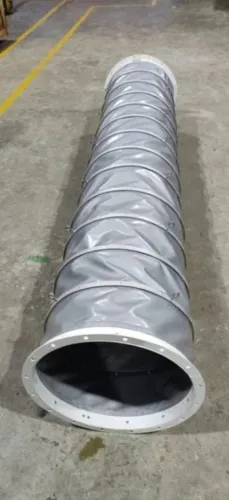
Do not confuse two applications. A fabric expansion joint in air or gas ducting manages thermal or mechanical displacement in a flow path; a machine-tool fabric bellow cover follows a moving axis and protects the enclosed mechanism.
Fabric expansion bellows suit inclined axes, non-planar travel, irregular openings, and three-dimensional geometry because transitions can flex around changing shapes.
The name does not make a cover gas-tight, liquid-pressure-rated, fire-rated, or explosion-proof. Specify those properties through the fabric, seams, mounts, barriers, and tests; otherwise leakage, pressure failure, or ignition protection remains unproven.
Design travel from pleat height, folded package, fold-to-fold rubbing, sag, inversion, snagging, and support-frame behaviour. These factors change real movement, especially at speed or on an inclined axis. Set the usable travel-to-compressed-length ratio for the application; never assume a catalogue number applies to your geometry.
Fabric, Rubber, Metal, Accordion, and Telescopic Covers Compared
Choose fabric expansion bellow covers for comparison when movement is multi-axis, inclined, non-planar, or arranged around an irregular opening. Their low moving mass and compact folded package suit restricted installation space, but controlled support is essential: unsupported fabric bellows can sag, buckle, rub, or become trapped.
| Option | Strength | Main limitation |
|---|---|---|
| Fabric bellow covers | Multi-axis conformity, low mass, compact installation | Less rigidity and concentrated chip-impact resistance than steel; needs support |
| Rubber bellows or expansion joints | Elastic movement and sealing | Check compound compatibility, compression set, ozone, oil, solvents, temperature, and pressure |
| Metallic expansion joints | Higher structural and thermal capability | More mass, fatigue concerns, and tighter installation constraints |
| Accordion bellows | Describes a folded protective geometry | Does not identify material, pressure rating, or movement capacity |
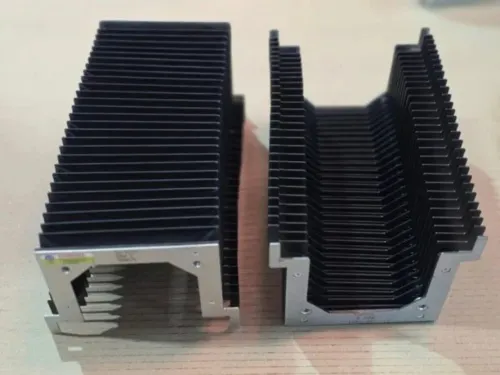
| Telescopic steel covers | Resists heavy chips and impact; holds structural shape | Sliding boxes, guide rails, wipers, and larger space add complexity |
| Roll-up covers | Efficient for mainly one-dimensional travel | Drum, spring, slat, or strip mechanisms add alignment and fatigue constraints |
Sewn and laminated fabric covers require a seam review. Stitching perforates the barrier, while welded or bonded seams avoid needle holes; neither removes fatigue risk at corners, fold roots, mounting flanges, or repeatedly rubbing folds.
Roll-up designs can package tightly on a straight axis, but fabric bellow covers conform better to three-dimensional travel and irregular openings. Select fabric only after confirming support, chip loading, and the full movement envelope; steel is the safer choice for concentrated impact or load-bearing protection.
Choose the Construction for Heat, Chips, Chemicals, Pressure, and Weather
Choose the construction by movement speed and acceleration, then by the contaminant that actually reaches the folds. Fine abrasive swarf, long stringy chips, hot intermittent chips, grinding dust, coolant splash, tramp oil, welding sparks, outdoor weather, alkaline washdown, solvents, and process chemicals create different failure modes.
The coating or laminate usually controls resistance to oil, coolant, heat, sparks, flame, abrasion, and ultraviolet exposure; polyester, aramid, glass-fibre, or other reinforcement supplies much of the tear and tensile strength. Fabric expansion bellows suit low mass, multi-axis movement, and irregular openings, while rubber suits elastic sealing and metal suits load-bearing or concentrated impact.
Hot sharp swarf, severe washdown, or structural loading can justify a sacrificial layer, telescopic steel cover, or another geometry.
| Option | Prefer it for | Main warning |
|---|---|---|
| Fabric | Dust, coolant, weather, multi-axis travel | Unsupported folds can distort under pressure or suction |
| Rubber | Sealing and elastic movement | Check compound, oil, solvent, ozone, temperature, and pressure compatibility |
| Metal | Impact, heavy chips, structural loads | Adds mass and needs space, guides, and fatigue control |
Put these expansion bellow cover specifications in the purchase document:
- Fabric type, coating, laminate, ply count, seam construction, continuous temperature, short-duration peak temperature, radiant-heat exposure, contact-chip limit, pressure rating, vacuum rating, and chemical compatibility.
- State whether the cover sees positive pressure, suction, or atmospheric protection; add reinforcement rings, sliders, runners, or shaped frames when folds could sag, invert, or snag.
- Record outdoor UV and weather exposure, and define repair limits: a patch can restore splash protection without restoring tear strength or flex life.
Build a Complete Expansion Bellow Cover Specification
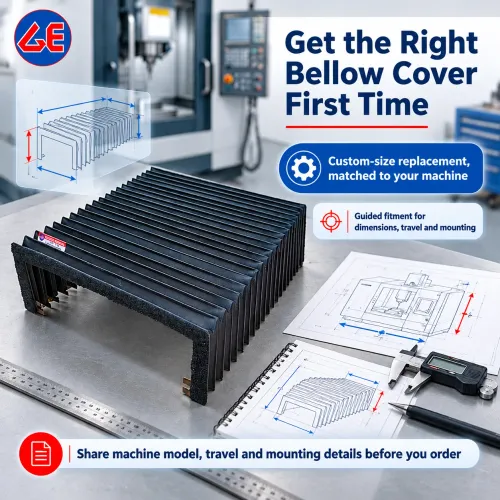
Overall width and travel do not define adequate expansion bellow cover specifications. Record the geometry, motion, mounting, and surrounding hazards before fabrication; nominal travel alone can still produce buckling, rubbing, or trapped hardware.
- Measure installed length, fully compressed length, fully extended length, maximum extension, axial movement, lateral offset, angular movement, folded or pleat height, internal and external dimensions, orientation, motion speed, acceleration, minimum bend radius, available clearance, and the full travel envelope.
- For an existing machine, measure both end positions while running the axis through its complete stroke. Mark pinch points against rails, cables, hoses, clamps, tools, and guards; photograph mounting faces; check the compressed package at one end and extended folds at the other. Record service access, cleaning access, and chip or liquid drainage direction.
| Specification item | Record |
|---|---|
| Mounting | Frame details, mounting-surface material, flange or frame thickness, bolt pattern, hole diameter, fastener access, and whether attachment is inside, outside, or over the opening |
| Clearances | Space for folds, fasteners, sliders, runners, reinforcement rings, and end transitions |
| Motion | Speed, acceleration, stroke profile, orientation, and movement in each axis |
| Envelope | Internal and external dimensions at both end positions, including adjacent moving hardware |
| Protection | Chip, coolant, dust, heat, and washdown exposure; identify surfaces requiring drainage |
| Access | Removal path for inspection, cleaning, lubrication, and machine servicing |
| Geometry | Minimum bend radius, pleat height, support points, and any non-rectangular transition |
| Validation | Confirm no fold inversion, snagging, rubbing, or interference throughout the complete travel envelope |
How to Evaluate a Supplier Drawing and Select the Final Cover
Choose the final cover from the supplier drawing, not from a catalogue photograph. Ask the drawing to show compressed and extended profiles, pleat geometry, support method, seam locations, corner transitions, mounting flange, bolt pattern, attachment orientation, and minimum clearances. Include the complete travel envelope so folds, fasteners, cables, and rails do not collide.
- Require expansion bellow cover specifications for the complete construction: continuous temperature, short-duration peak temperature, flexing-at-temperature limit, pressure or vacuum limit, chemical compatibility, abrasion test method, flame or spark requirement, and any tested leak or movement condition. A coating resin’s headline temperature is not the cover’s operating rating.
- Confirm whether the textile is sewn, welded, bonded, laminated, or combined. Ask how the supplier inspects stitch lines, flange edges, fold roots, corner transitions, and repaired areas.
- Obtain approved repair criteria and replacement triggers. A patch can restore splash protection without restoring original tear strength or flex life.
Use this comparison when reviewing submissions:
| Evidence | Acceptable submission | Procurement concern |
|---|---|---|
| Drawing | Profiles, clearances, flange and bolt pattern shown | Shape label or “universal” sizing only |
| Construction data | Complete limits and test conditions stated | Coating temperature alone |
| Quality control | Inspection and repair procedure identified | No criteria for seams or fold roots |
For a UAE installation with guideway, cable, hose, or irregular geometry, GURUKRUPA BELLOWS PVT LTD can be considered when its drawing and stated limits match the machine. Compare fabric expansion bellow covers for comparison by evidence, not colour or appearance.
Related products
 | Bellow Cover We are considered a well-known name in the business that manufactures and supplies Bellow Cover. View product → |
 | Fabric Expantion Bellow Make in Heavy duty Fabric’s View product → |
Frequently asked questions
How does a fabric expansion bellow cover move?
Its pleats fold and open for axial compression and extension, while the fabric accommodates lateral offset and angular movement.
How do fabric, rubber, metal, accordion, and telescopic covers differ?
Fabric and rubber suit flexible movement; metal and telescopic designs provide greater rigidity and chip resistance; accordion covers describe a pleated form that can use different materials.
Which cover construction suits heat, chips, chemicals, pressure, and weather?
Select the material and reinforcement against the actual hazard: fabric for flexible lightweight protection, metal for severe chips, and purpose-selected coatings or layers for heat, chemicals, pressure, and outdoor exposure.
What belongs in an expansion bellow cover specification?
Document travel, compressed and extended lengths, lateral and angular movement, opening dimensions, mounting method, operating temperature, chemicals, chips, pressure, weather exposure, and material construction.
How do you evaluate a supplier drawing before selecting a cover?
Check every stated dimension, movement clearance, seam and reinforcement detail, mounting interface, material layer, operating limit, and test condition against the machine installation.