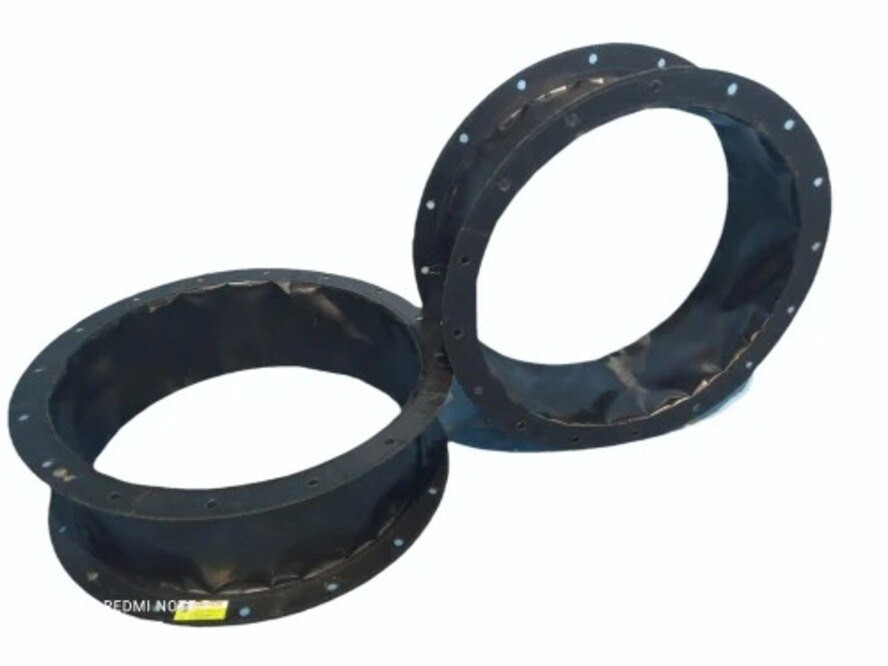
A bellow cover must protect the expansion joint without becoming a restraint, heat trap, pressure seal, or source of rubbing. By the end, you will be able to define the joint’s movement, measure the installed geometry, select a documented fabric system for Abu Dhabi exposure, and compare supplier drawings before approving fabrication.
Key takeaways
- Separate gas-tight membrane duties from the outer protective cover.
- Put movement limits, dimensions, attachment points and clearances on the drawing.
- Match fabric and coating to heat, dust, UV, moisture and chemical exposure.
- Require a signed drawing, material data and inspection plan before approval.
What must the bellow cover do at the expansion joint?
First decide whether the bellow cover is a separate external protection layer, a movement-accommodating component, or part of the joint’s gas-tight construction. A fabric expansion joint normally separates these duties into an inner gas- or dust-tight membrane, insulation where required, and an outer protective layer.
Do not treat the outer cover as the primary pressure seal unless the supplier designs and documents it for that function. State these operating conditions separately:
- Internal pressure and pressure pulses
- Fan or duct loads
- Process media and temperature
- Leak consequences
- Startup, shutdown, thermal-transient, and fault conditions
Map the joint’s axial compression, axial extension, lateral offset, angular rotation, vibration frequency, and any torsional movement. Pipe guides and accurate alignment must prevent twisting; a fabric joint is not a correction for poorly arranged pipework. Torsion can tear seams, distort folds, and shorten service life.
Use EJMA guidance for movement terminology, not as a complete design standard for a non-metallic fabric assembly. Request separate qualification for the membrane, insulation, seams, restraints, and outer cover, including the complete movement envelope and temperature exposure. These checks form the starting point for selecting bellow covers for fabric expansion joint in abu dhabi.
A cover suited to low-pressure hot air can fail quickly on steam, process gas, or pressure surges.
Which measurements belong on the supplier’s drawing?
Measure the installed joint, not the nominal pipe or duct size. A nominal 500 mm flange can conceal misalignment, uneven gaps, or a face-to-face dimension that leaves no room for the cover to fold.
Record these dimensions and conditions:
- Free length, minimum compressed length, maximum extended length, outside diameter, inside diameter, flange width and thickness, actual face-to-face dimension, bolt-circle diameter, hole count, hole diameter, and bolt accessibility.
- Maximum movement envelope in axial, lateral, angular, and vertical directions, plus minimum clearance at full compression and full extension.
- Nearby guide surfaces, supports, clamps, cable trays, inspection openings, drainage points, and any obstruction within the folded height.
- Required slack or pre-tension, pleat depth, sliding attachment or fixed flange, and the minimum bend or fold radius. A tight radius can crack seams; excessive folded height can jam the joint.
- For custom bellow covers for machinery, travel speed, cycle count, movement frequency, chip direction, hot-swarf path, coolant splash, cutting-oil contact, and welding-spatter exposure.
| Attachment choice | Drawing requirement | Failure if missed |
|---|---|---|
| Sliding attachment | Show travel direction and slot length | Cover pulls against the joint |
| Fixed flange | Show bolt access and gasket face | Installation becomes impossible |
| Slack or pre-tension | State the installed condition | Pleats collapse or overstretch |
Ask for a dimensioned supplier drawing showing maximum extension, minimum compression, attachment points, seam locations, and access panels before fabrication. Photograph the joint and measure at several clock positions; one diameter reading will not reveal misalignment.
How should fabric and coating be matched to Abu Dhabi exposure?
Separate the joint-media temperature from the external temperature that the protective cover must withstand. Specify continuous and peak temperature, peak exposure duration, temperature gradient across the cover, pressure and pulses, movement frequency, solar UV, ambient heat, humidity or condensation, airborne sand, salt air, oil mist and cleaning chemicals.
Outdoor service alone is not a specification for flexible bellow covers in Abu Dhabi.
Compare the complete construction, not the polymer name.
| Option | Construction to verify | Suitable use or caution |
|---|---|---|
| Silicone-coated fibreglass | Fibreglass base cloth, silicone coating, heat-resistant thread, sealed seams, reinforcement, finished edges and attachment hardware | Flexible weather-exposed protection; confirm heat and abrasion limits |
| PTFE-coated fabric | Woven glass or compatible base cloth, PTFE coating, thread, low-friction seam, reinforcement, edge finish and hardware | Chemical exposure and low-friction interfaces; verify flex-cycle performance |
| Neoprene-coated fabric | Base cloth, neoprene coating, thread, stitched or sealed seam, reinforcement, edge treatment and fasteners | Use only after confirming actual oils, fuels, ozone and temperature cycle |
| Reinforced elastomer | Elastomer compound, fabric reinforcement, moulded or bonded seam, edge profile and hardware | Confirm chemical swelling, ozone, pressure and repeated thermal movement |
| Multi-layer assembly | Inner barrier, insulation, outer cloth, coatings, thread, seams, reinforcement, edge finish and attachments | Select when media heat and external weather require separate duties |
Do not accept one temperature number. Request continuous and peak limits for the complete assembly, including coating and seams, with test method and permitted exposure time. Obtain chemical-resistance data or a test report for flue gas, hydrocarbons, acids, alkalis, steam, abrasive dust and cleaning chemicals at stated concentration and duration.
Record cleaning method, reject mismatched materials, and request ISO 4892-3 UV data related to actual Abu Dhabi service.
How do you prevent movement restriction and premature failure?
Misalignment, over-compression, poor support, and pipe weight turn a sound cover into a seam or flange failure. Treat the attachment, folds, and restraints as movement components, not decoration.
- Check pleat geometry, reinforcement placement, stitch construction, seam sealing, edge finishing, drainage, venting, and the retention system against the full movement envelope. Leave clearance for compression, extension, lateral offset, and rotation so folds do not collapse, rub, trap heat, tear seams, or displace the cover.
- Define flange alignment tolerances, support and guide requirements, permitted installation position, installation pre-tension or slack, temporary shipping-restraint removal, fastener torque, and the gasket or clamp arrangement.
- Keep an external protective cover out of the hot-gas path. Add insulation or a heat shield when radiant exposure exceeds the complete assembly’s limit.
- Inspect for fraying, pinholes, delamination, cracks, coating breakdown, oil swelling, sand accumulation, seam failure, corrosion beneath hardware, and distorted folds. Increase inspection after dusty periods, chemical cleaning, unusual thermal events, or frequent movement cycles.
- Set inspection intervals from heat, UV, sand, cleaning, cycle count, and failure consequence. Record every finding and replace the cover before movement exposes the joint.
- For flexible bellow covers in Abu Dhabi, reject a textile cover where severe hot chips, rigid impact, high pressure, or personnel guarding is involved. Use an aluminium apron, telescopic steel cover, or tested elastomeric bellows instead.
Specify custom bellow covers for machinery by hazard and duty cycle, not geometry alone. A machine cover is not a safety guard unless designed, tested, and integrated for that function.
What should you require before approving a custom cover?
Require a complete submittal before approving bellow covers for fabric expansion joint in Abu Dhabi. Your request for quotation must include measured geometry, a movement table, pressure, media, temperature cases, exposure duration, cleaning chemicals, UV and salt-air conditions, cycle count, installation position, access requirements, and replacement constraints.
Ask each supplier for:
- A dimensional drawing showing the movement envelope, clearances, seams, attachment points, and access panels; material and coating data; temperature and pressure limits; and a media-compatibility statement.
- Seam and attachment details, an inspection-and-test plan, batch traceability, a material certificate, service-life assumptions, and fire-test or flame-spread data where specified.
Compare the offers on the work required to make the design reliable, not on “waterproof,” “corrosion-resistant,” or nominal diameter alone.
| Supplier factor | What to compare |
|---|---|
| Design | Review effort, prototype iterations, movement verification |
| Execution | Lead time, installation labour, shutdown duration |
| Support | Local stock, emergency response, spare-cover storage |
| Lifecycle | Documented replacement procedure and service-life evidence |
Before commissioning, check the supplied cover against the approved drawing and material certificate. Record alignment, clearance, fastener condition, restraint removal, and movement-test results. GURUKRUPA BELLOWS PVT LTD belongs in the comparison when its team can review installed dimensions and provide evidence for custom bellow covers for machinery.
Keep the approved drawing, conformity statement, inspection records, cleaning instructions, and replacement trigger in the asset file.
Related products
 | Fabric Expantion Bellow Make in Heavy duty Fabric’s View product → |
 | Bellow Cover We are considered a well-known name in the business that manufactures and supplies Bellow Cover. View product → |
Frequently asked questions
What must a bellow cover do at a fabric expansion joint?
Define whether it protects the joint externally, accommodates movement, or forms part of the gas-tight construction. Keep the inner membrane, insulation and outer cover duties distinct unless the design specifically combines them.
Which measurements belong on the supplier’s drawing?
Show the joint’s installed length and width, movement directions and limits, cover depth, attachment points, bolt patterns, clearances, folded dimensions and any hot-surface or obstruction locations.
How should fabric and coating be matched to Abu Dhabi exposure?
Specify materials against the actual temperature, dust, UV, moisture, chemicals and fire exposure. Ask for the fabric grade, coating type, temperature limits and resistance data rather than accepting a generic fabric description.
How do you prevent movement restriction and premature failure?
Give the supplier the full movement envelope, allow clearance at the maximum travel position, avoid tight stitching or clamping, and check that folds do not rub, snag or contact hot surfaces.
What should you require before approving a custom cover?
Require a dimensioned approval drawing, material and coating data, temperature and movement limits, attachment details, inspection requirements and confirmation that the cover does not carry unintended gas-tight duties.
Related product
 | Bellow Cover The range of CNC Bellow Cover is manufactured on our premises, under the guidance of our expert professionals. View product → |