Canvas is suitable for many moving machine components, but the word alone says too little about temperature, chemicals, chip load, construction, or service life. By matching the cover to the machine’s movement, environment, dimensions, and guarding needs, you can decide whether a canvas design is appropriate or whether another protection system is safer.
Key takeaways
- Check full travel, folding rate, rubbing points, and minimum bend radius.
- Match fabric, coating, seams, and temperature rating to the machine environment.
- Choose steel, telescopic, or laminated bellows for hot swarf or impact hazards.
- Give suppliers compressed length, extended length, opening size, and mounting details.
When does a canvas bellow cover suit the machine’s movement?
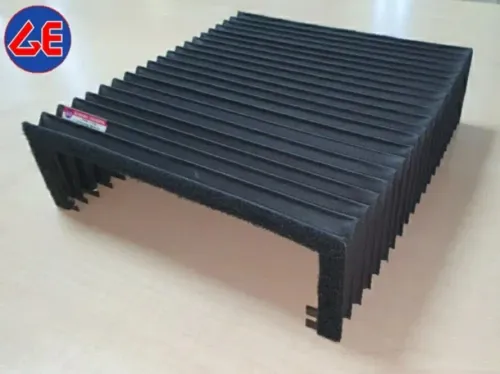
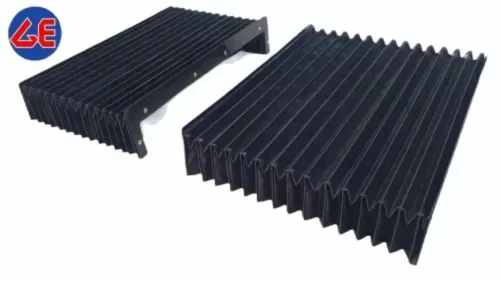
A canvas bellow cover suits a machine when it can follow the component’s full movement path without twisting, rubbing, buckling, or exceeding its travel rate. Canvas machine bellows fit repeatedly moving linear guideways, ball screws, spindles, shafts, and similar parts where dust, swarf, and splash protection matters more than rigid impact resistance.
Check these dimensions together, not stroke length alone:
| Feature | Compatible condition | Failure risk |
|---|---|---|
| Travel speed | The cover’s rated speed matches the machine’s cycle | Heat, vibration, or seam failure |
| Stroke length | Required travel fits between closed and extended lengths | Restricted travel or frame overload |
| Fold pitch and folded height | Folds compress without exceeding the specified height | Self-rubbing, sagging, or buckling |
| Bend radius | The cover and any enclosed cable respect the specified radius | Creased fabric or broken conductors |
| Lateral clearance | Clearance remains available across the entire stroke | Fixed-edge rubbing and misalignment |
| Mounting space | Flanges, fasteners, and attachment frames fit squarely | Detached mounts or uneven loading |
Run the cover square to the guideway and inspect its complete path at both ends, during acceleration, and at maximum extension. Insufficient compression is as damaging as insufficient extension. These checks define practical canvas bellow cover applications.
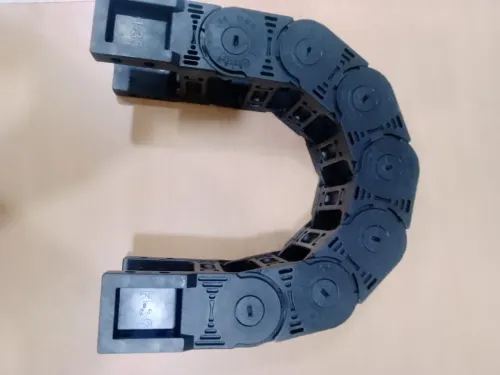
A bellows cover can shield a cable bundle, but it does not replace an energy chain. The chain controls bend radius, repeated routing, and tensile loads; select it against the cable manufacturer’s minimum radius and cycle-life data.
Which canvas construction and operating conditions determine suitability?
Suitability depends on the named construction, not the word “canvas.” For canvas equipment protection covers, identify the base fabric, coating or laminate, thickness, thread, seam construction, corner reinforcement, flame resistance, abrasion resistance, oil resistance, and whether the cover is breathable or sealed.
Ask the supplier to document:
- Continuous and peak temperature limits separately
- Resistance to hot chips, welding spatter, radiant heat, steam, coolant, and outdoor sunlight
- Thread and seam sealing under the stated exposure
- Abrasion performance and reinforcement at corners, folds, and mounting edges
A brief peak-temperature exposure does not prove suitability for continuous heat. Canvas bellow cover applications involving welding spatter, glowing chips, sparks, or radiant heat need a documented exposure limit; standard coated textile bellows can fail by scorching, melting, delamination, or embrittlement.
| Exposure | What can go wrong | Evidence to request |
|---|---|---|
| Dry dust or ordinary splash | Surface contamination and dampness | Coating and sealing specification |
| Abrasive metal chips | Cutting, puncture, and fold wear | Abrasion and tear data |
| Water-miscible coolant | Coating attack or seepage through seams | Test data at actual concentration and temperature |
| Neat cutting oil or hydraulic oil | Swelling, softening, or loss of adhesion | Fluid-specific compatibility data |
| Solvents or cleaning chemicals | Rapid coating and thread damage | Named-chemical resistance data |
| Salt spray | Corrosion at fittings and fabric degradation | Salt-spray or outdoor-exposure evidence |
| Sparks or molten particles | Burn-through and ignition | Spark-exposure and flame-resistance limits |
Require testing with the actual coolant or oil, at its operating concentration and temperature. “Oil resistant” is not proof against every formulation.
When should you choose another protection system instead of canvas?
Choose another system when the hazard exceeds what a flexible textile can absorb. Flexibility, low mass, and frequent reciprocation favour canvas machine bellows and canvas equipment protection covers; sharp swarf, heat, impact, jets, or airtight containment do not.
| Option | Strength | Choose it when |
|---|---|---|
| Coated textile bellows | Flexible, light, economical | The duty is dust, ordinary splash, and repeated movement |
| Polyurethane-coated fabric | Better abrasion and oil resistance | Coolant and rubbing exceed ordinary textile limits |
| Rubber | Elastic, sealed, chemically resistant | Stretch, splash sealing, or vibration matters |
| Leather | Tough against rubbing and moderate heat | Abrasion is intermittent and flexibility remains important |
| Silicone- or PTFE-coated glass fabric | Heat and flame resistance | Hot chips, welding spatter, radiant heat, or grinding sparks occur |
| Steel telescopic covers | Rigid, impact-resistant | Sharp or glowing swarf and continuous abrasive impact are present |
| Roller blinds | Compact, guided shielding | Space is limited and movement is mostly linear |
| Fully sealed way covers | Enclosed contamination control | An airtight or high-pressure coolant barrier is required |
Direct flame, high-temperature cutting, and high-pressure coolant jets favour a reinforced heat shield, metallic protection, or a purpose-built sealed cover. Confirm continuous and peak limits with the supplier; “canvas” alone proves nothing.
A contamination barrier is not automatically a machine guard. Your risk assessment must determine whether access prevention meets ISO 14120.
On horizontal guideways, add drainage, suitable fold orientation, wipers, chip deflectors, or an auxiliary shield. Folds can collect coolant and chips, then carry them to the guideway.
How do you measure and engineer custom canvas bellow covers?
A supplier needs a complete measurement schedule and movement drawing before quoting custom canvas bellow covers. Stroke alone is insufficient: compressed length, extended length, fold pitch, number of folds, and available clearance must work together.
1. Record the protected component’s width and height, required travel, closed length, extended length, opening dimensions, mounting-flange dimensions, attachment points, guide clearance, allowable compression, access requirements, and guideway orientation.
2. Specify the fold direction, number of folds, and fold pitch. Incorrect pitch can cause sagging, fold-to-fold rubbing, buckling, excessive compression, restricted travel, or excessive load on the mounting frame.
3. Draw the full movement path, including the fixed and moving edges, mounting faces, nearby tooling, hoses, cable routes, and the maximum envelope at both ends of travel. Mark bend radius and every obstruction.
4. Send the drawing for approval before manufacture. Require checks for square running, lateral clearance throughout the stroke, twisting, drainage, and contact with any fixed edge.
The drawing must show how the cover behaves, not merely where it fits at rest. A horizontal guideway can collect chips or coolant in the folds, so include drainage, fold orientation, wipers, chip deflectors, or an auxiliary shield where pooling is possible.
Ask for compressed-length and travel data in the quotation. A cover that reaches the required stroke but is forced below its designed compression will buckle or rub, then transfer damaging loads into seams and mounting frames.
What should you ask a Bangalore supplier before placing an order?
A low quote or local manufacture does not prove suitability. Compare canvas bellow covers for industrial equipment in bangalore by requiring evidence tied to your machine, fluid and duty cycle.
Ask each supplier to include:
- An approved dimensional drawing showing closed and extended lengths, travel, fold pitch, clearances and mounting points.
- The named base fabric, coating or laminate, thickness, thread, seam construction and reinforcement locations.
- Separate continuous and peak temperature limits, plus abrasion, spark and flame-exposure limits.
- Chemical-compatibility evidence for your actual coolant or oil, including concentration and operating temperature.
- Inspection criteria, installation details, and a stated repair or replacement provision.
| Quotation item | Weak comparison | Evidence to require |
|---|---|---|
| Material | “Canvas” | Base fabric, coating, thickness and sealed or breathable construction |
| Movement | Stroke alone | Compressed length, travel, fold behaviour and clearance |
| Environment | “Oil resistant” | Data for the named coolant, oil, temperature and concentration |
| Service | Lowest price | Inspection method and repair or replacement terms |
For custom canvas bellow covers, ask GURUKRUPA BELLOWS PVT LTD to review the machine drawing, match the duty to the material construction and document every operating limit instead of quoting from “canvas” alone.
Select canvas when movement, environment, dimensions and the guarding role are documented. Reject it when any critical limit remains unknown.
Related product
 | Bellow Cover We are considered a well-known name in the business that manufactures and supplies Bellow Cover. View product → |
Frequently asked questions
When do canvas bellow covers suit industrial equipment?
Canvas bellow covers suit repeatedly moving linear guideways, ball screws, spindles, and shafts when the cover can follow the complete travel without twisting, rubbing, buckling, or exceeding its folding rate. They work well against dust, swarf, coolant splash, and general industrial debris.
Which conditions determine whether canvas machine bellows are suitable?
Specify the fabric, coating, seam construction, temperature range, chemical exposure, travel speed, cycle frequency, and minimum folded radius. Match these details to the machine’s heat, coolant, oil, abrasive swarf, and movement conditions before ordering.
When should you choose another protection system instead of canvas?
Choose telescopic steel covers when sharp or heavy hot chips could puncture fabric. Consider laminated, rubberised, or specialised high-temperature bellows when the machine faces severe heat, aggressive chemicals, fire risk, or impact that the selected canvas construction cannot withstand.
What measurements are needed for custom canvas bellow covers?
Provide the protected component’s length, width, height, travel, compressed length, extended length, mounting dimensions, clearance, and end-frame details. Also state speed, acceleration, cycle frequency, folded-pack space, and the smallest bend radius available.
What should you ask a Bangalore supplier before ordering canvas bellow covers?
Ask which fabric and coating match your temperature, coolant, oil, and swarf conditions; request a drawing showing open and closed lengths; confirm mounting hardware, inspection access, trial-fit procedure, lead time, and replacement or repair options.