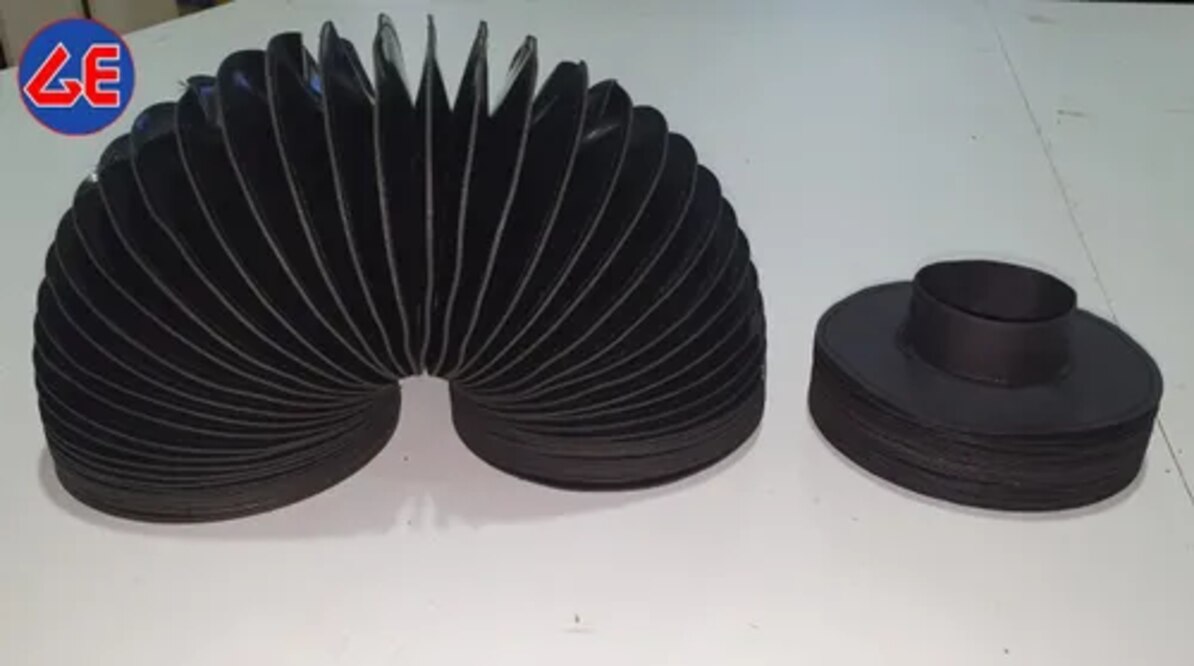
A ball screw cover must keep chips, grinding dust and coolant away from the screw, nut, return tubes, seals and lubrication film without restricting axis travel. By the end, you will know how to match the cover construction to Chandigarh’s climate and workshop exposure, calculate the required dimensions, check installation clearances and compare supplier quotations.
Key takeaways
- Specify travel, compressed length, expanded length and mounting dimensions.
- Choose heat- and coolant-resistant fabric for the actual machining environment.
- Add chip deflectors when sharp swarf can strike the folded bellows.
- Test full axis travel before releasing the machine for production.
What Chandigarh workshop conditions demand from a ball screw cover
A cover for ball screw bellow covers for machine conditions in Chandigarh must handle more than travel and screw diameter. Design for:
- Hot summer heat and winter temperature swings that stress fabric, adhesive and mounting hardware.
- Monsoon humidity and coolant that promote corrosion and soften contamination deposits.
- Wind-borne dust, grinding residue and metal chips that abrade folds and enter the nut.
- Coolant trapped in folds, which carries fine grit onto moving surfaces.
The protected zone includes the screw raceway, ball nut, return tubes, nut seals and the lubrication film. Ball screw bellow cover protection is a contamination barrier, not a pressure-tight seal.
Keep the screw’s wipers functional, apply the correct lubricant, and use suitable end sealing; coolant or abrasive dust can still pass through a mounting gap or an exposed return side.
Do not select a cover from nominal screw diameter alone. A cover can fit the screw yet foul the nut, lack compression space, or admit moisture through an unsuitable end frame. Check the nut envelope, mounting faces, collapsed length, extended length and nearby moving parts.
On a horizontal axis, the upper surface needs chip shedding and drainage. Folds that form pockets collect swarf and liquid, then crush that debris into the fabric during repeated motion.
Rising noise, drive torque, motor load or nut temperature indicates an alignment, lubrication or wiper fault—not a reason to hide the problem with a thicker cover.
How to choose the bellows construction for chips, coolant and motion
Specify the actual attack before choosing construction: water-miscible coolant, neat oil, alkaline cleaner, tramp oil and biocide package can affect fabric, coating, seam and adhesive differently. Request immersion or cyclic-exposure data; “oil resistant” alone is not a coolant specification.
| Construction | Seam and repair | Thickness, temperature and chip behaviour |
|---|---|---|
| Sewn | Strong, field-repairable; needle holes need sealing | Flexible, but exposed thread can catch sharp chips |
| Heat-welded | Continuous seam with no thread; difficult to repair | Thin, clean folds; verify weld temperature limit |
| Bonded | Smooth seam; adhesive failure requires replacement | Flexible; chemistry and heat can attack the bond |
| Moulded elastomer | Seamless and consistent; limited repair | Thick, durable folds; confirm chemical and temperature limits |
| Lamella-reinforced | Metal-supported folds; replacement is specialised | Best impact defence, but heavier and less flexible |
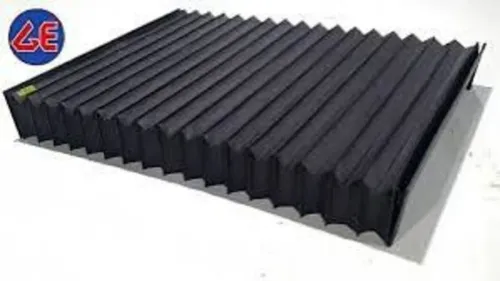
For ball screw bellows for machinery, put fabric type, coating, thickness, abrasion result, fold pitch, pleat count, folded height, extended length and working temperature limits on the drawing.
Ordinary PVC-coated fabric is a poor choice where hot, sharp chips land repeatedly; compare higher-temperature fabric, aramid or glass-fibre reinforcement, chip deflectors, metallic lamellae or a telescopic steel cover.
Choose a horizontal cover that sheds chips and drains coolant. A vertical axis needs fold tracking, support and a drain path to prevent sag, rubbing and liquid accumulation. High-speed or multi-axis motion favours low-mass folds and verified acceleration; short-stroke axes need a small folded height, while long-stroke axes require controlled compression and guidance.
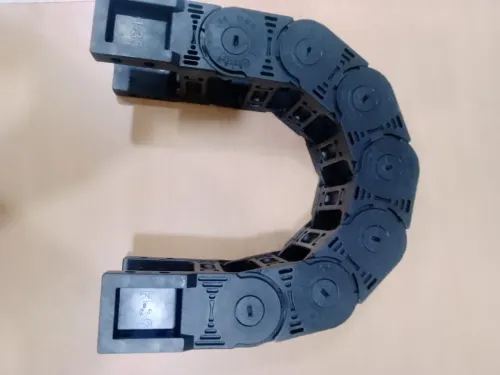
Check cable separation so carrier movement does not load the bellows.
How to measure a ball screw cover before requesting a quote
Measure from the machine, not a catalogue: ordering by screw diameter alone can leave the ball nut rubbing the folds or provide too little collapse space for reliable ball screw bellow cover protection.
1. Record the screw outside diameter, ball-nut length and width, return-tube position, axis orientation and usable axis stroke.
2. Measure the required extended length and available collapsed length between the fixed bed and moving nut attachment points. Usable cover stroke is approximately extended length minus collapsed length and mounting allowances.
3. Measure each mounting face, end-frame geometry, mounting-plate thickness and hole pattern. Mark whether the cover attaches to the fixed bed, moving nut, or a separate support frame.
4. Check the maximum permitted outside dimensions and adjacent-axis clearances. Include guide rails, couplings, limit switches, sensors, lubrication ports and access space for removing the nut.
5. Measure the space at maximum extension and maximum collapse. The bellows must clear the rotating screw, nut body, guideway, table and saddle throughout the complete stroke.
6. Photograph the assembly with a scale visible, and mark obstructions, drainage paths and cable-carrier movement. Move the axis slowly through its full travel before requesting the quote.
Give the supplier every measurement and request the fold pitch, extended length and minimum folded length on a dimensioned drawing. Require confirmation that the fold’s working compression limit is not exceeded; a nominal “full stroke” does not prove adequate compression space.
How to integrate, test and maintain the cover on each axis
A sewn or reinforced bellows suits ball screw bellows for machinery when chips are moderate and the folds have room to move. Compare alternatives before installation:
| Option | Best fit | Avoid when |
|---|---|---|
| Sewn or reinforced bellows | Flexible motion and custom geometry | Sharp chips, heavy coolant, high-impact cutting |
| Machined telescopic steel cover | Sharp chips and high-impact cutting | Restricted clearance or complex short strokes |
| Spiral cover | Narrow radial space and rotating screw protection | Heavy coolant or vertical sag |
| Brush wiper | Light dust at an accessible opening | Sharp chips or coolant containment |
| Open screw guard | Low-contamination environments | Grinding dust, chips or coolant |
| Simple way cover | Protecting broad guideway surfaces | Direct ball-screw, nut or return-tube protection |
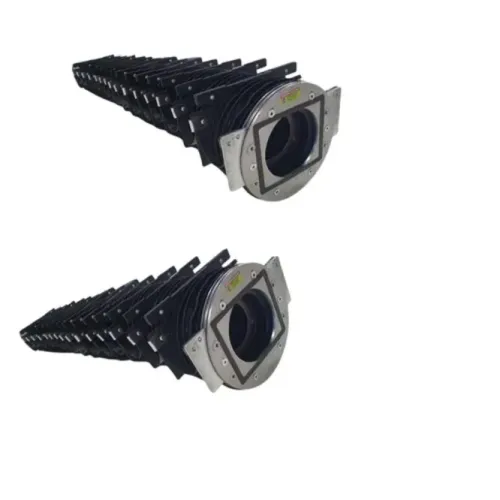
For a fixed-bed arrangement, attach one end to the bed and the other to the moving nut or saddle through rigid mounting plates. A moving-nut arrangement needs a guided frame that keeps folds aligned; add drainage slots or channels at low points. Support long vertical covers against sag, buckling and trapped coolant.
Separate the cable carrier: its bend radius and chain pull must not load unsupported folds.
Test each axis slowly through full travel, checking maximum extension and collapse, then repeat at rapid traverse and rated acceleration. Inspect rubbing, flutter, fold tracking, compression, drainage and contact marks. Confirm rated speed, acceleration and cycle frequency.
- Clear swarf from folds; inspect seams, adhesive and mounting plates.
- Confirm screw wipers, end seals and lubrication.
- Investigate abnormal torque, noise, motor load or nut temperature before replacing the cover; check alignment and guideways first.
What to demand from a ball screw cover supplier in Chandigarh
Demand documented geometry, performance and service data—not “custom size”—from every ball screw cover supplier in Chandigarh. A dimensioned drawing must show folded and extended lengths, fold pitch, mounting-hole pattern, end-frame geometry, clearances at full collapse and extension, and access for replacing the cover.
Attach this information to your enquiry:
- Axis orientation, usable stroke and collapsed-space limit
- Maximum rapid-traverse speed, acceleration and cycle frequency
- Screw, nut and return-tube dimensions
- Coolant name or safety-data-sheet details, plus chip type
- Photographs showing mounting faces, nearby guides, sensors and access constraints
Require the quotation to state material, coating, thickness, temperature limits, coolant and chip compatibility, abrasion or seam test method, rated speed, acceleration, expected cycle life, inspection method, and availability of replacement folds or spare parts. Ask how the supplier verifies clearance and fold compression at maximum travel.
Compare suppliers on evidence, not colour, nominal diameter or lowest initial price.
| Supplier | Compare | Reject if missing |
|---|---|---|
| GURUKRUPA BELLOWS PVT LTD | Drawing, construction, test data and replacement support | “Custom size” is the only specification |
| Local alternative | Same documented dimensions and ratings | Only screw diameter, colour or price is provided |
Use the same drawing and machine data for every quotation; that makes fit, construction and serviceability comparable.
Related products
 | Bellow Cover The range of CNC Bellow Cover is manufactured on our premises, under the guidance of our expert professionals. View product → |
 | CNC Bellow Cover Product Details: Brand GURUKRUPA Color BLACK Size ANY We are considered a well-known name in the business that manufactures and supplies CNC Bellow... View product → |
Frequently asked questions
What must a ball screw cover withstand in Chandigarh workshops?
Assess metal chips, coolant exposure, dust, humidity, heat, corrosion risk and the axis travel rate before selecting materials and construction.
How do you choose construction for chips, coolant and motion?
Match the bellows fabric, coating, fold geometry, reinforcement and mounting method to chip sharpness, fluid type, temperature and movement frequency.
What measurements are needed for a ball screw bellow cover quote?
Provide screw diameter, axis travel, open and closed lengths, available width and height, mounting-hole pattern, clearance and the required end fittings.
How should you test and maintain a ball screw cover?
Move the axis through its complete stroke, check for rubbing and compression, inspect folds and fasteners, and remove accumulated chips and dried coolant.
What should you ask a ball screw cover supplier in Chandigarh?
Request a dimensioned drawing, material and temperature limits, cleaning guidance, expected service conditions, inspection points and confirmation of the proposed fit.