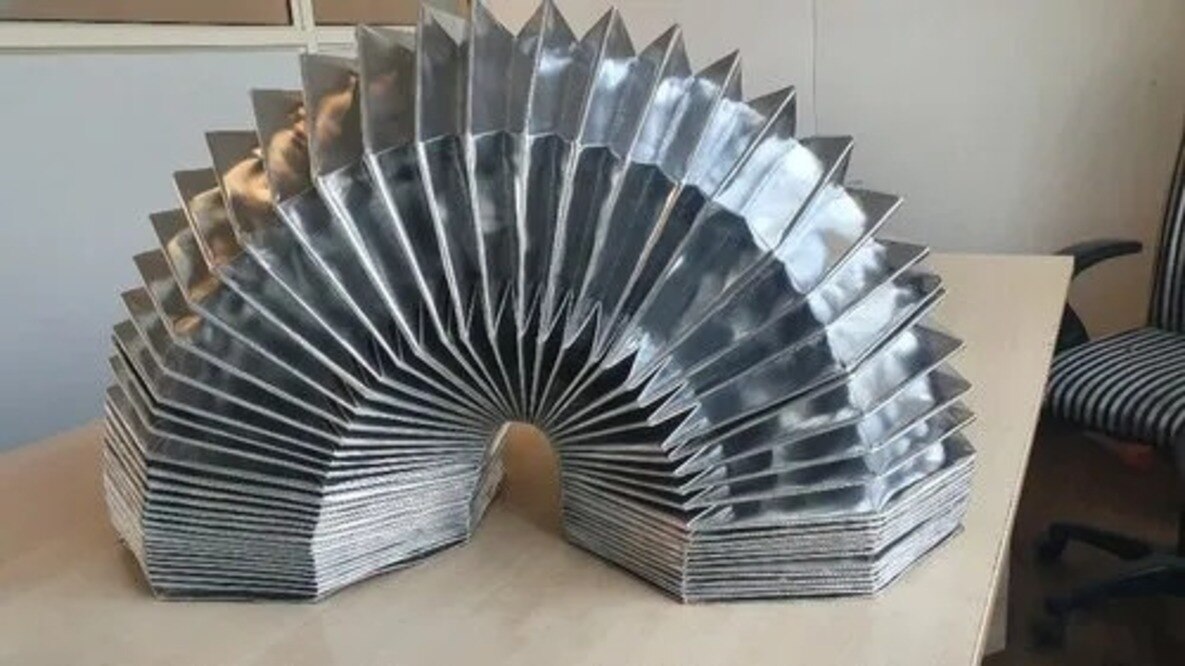
“Fireproof” does not tell you whether a bellow will survive welding sparks, hot chips, radiant heat, open flame, coolant or continuous machine temperature. By the end, you will be able to define the hazard, compare fabric constructions, specify the motion envelope and assess test evidence before requesting a quotation in Chandigarh.
Key takeaways
- Define sparks, flame, radiant heat, or sustained temperature before choosing fabric.
- Match the coating and reinforcement to chemicals, abrasion, and hot-chip exposure.
- Measure the machine’s complete movement envelope, including folds and clearance.
- Request test reports, construction details, and an on-machine trial before approval.
Define the fire and heat hazard before comparing fabrics
A “fireproof” label is not a usable specification for heat resistant fabric bellow covers. Define whether the hazard is welding sparks, hot chips, direct flame, radiant heat, or sustained temperature before comparing materials.
| Claim | What it means | Hazard it addresses |
|---|---|---|
| Flame-retardant | Slows ignition or flame spread under a defined test | Brief sparks, small hot chips |
| Self-extinguishing | Stops burning after the ignition source is removed | An isolated spark or flame contact |
| Fire-resistant | Resists ignition, flame spread, or heat for a stated exposure | Direct flame or welding spatter |
| Heat-resistant | Retains specified properties within a temperature range | Radiant heat or continuous hot surroundings |
Request all of the following in writing:
- Separate continuous-service and short-duration peak-temperature limits.
- Exposure duration, sample construction, and whether each figure describes the fabric, substrate, radiant heat, or test temperature.
- Limits after flexing and exposure to coolant, oil, or cleaning chemicals.
- The temperature ratings of coating, thread, adhesive, backing film, fasteners, grommets, and seam edges; these can fail before the reinforcement fabric.
- For any “1000 C” claim, the test method, duration, laboratory, sample construction, and report on the finished bellow—not loose fabric.
ISO 15025, NFPA 701, ISO 6942, and ISO 9151 provide useful flame or heat test references. They do not automatically approve a machine bellow for operating temperature, hot chips, or cycle life.
Match the fabric construction to sparks, chemicals and abrasion
PTFE-coated glass fibre is the stronger starting point for low flammability, solvent exposure and chemical contamination. Silicone-coated glass fibre is preferable when repeated folding, abrasion and intermittent heat matter more. Neither choice works alone: the coating, backing, thread, adhesive, seam and fasteners form the actual cover.
| Option | Flexibility and heat | Abrasion, shedding and joining | Oil and coolant behaviour |
|---|---|---|---|
| Coated nylon | Very flexible; limited for sustained heat | Good folding, low shedding, easy sewing; coating can burn or melt | Check cutting oil, coolant and solvent compatibility |
| Polyurethane-coated fabric | Flexible; moderate heat capability | Good abrasion and seamability; coating damage exposes the fabric | Often suitable for oils and coolants, but verify the exact formulation |
| Silicone-coated glass fibre | Flexible; handles intermittent heat well | Strong abrasion performance; low shedding; seams require suitable thread and edge treatment | Good resistance, subject to coolant and cleaning-chemical testing |
| PTFE-coated glass fibre | Less supple; strong chemical and low-flammability performance | Good thermal stability; pinholes and seam damage need control | Strong oil, coolant and solvent resistance; confirm flex-life |
| Fiberglass | Stiff; good heat capability | Abrasive fibres can shed; sewing is difficult without a coating | Check fibre wetting, oil retention and coolant attack |
| Silica | Higher thermal capability than ordinary glass fibre; less flexible | Brittle under folding; fibre shedding and seam construction are concerns | Verify contamination and chemical resistance |
| Aramid | Flexible and tough; heat capability depends on finish | Good abrasion and folding; fibre edges need containment | Oil and coolant performance depends on coating |
| Ceramic fibre | Very high heat capability; poor flexibility | Brittle, sheds readily and is difficult to seam | Treat chemical and coolant resistance as unproven until tested |
Use this hazard matrix before specifying fabric bellow covers for machinery:
- Hot chips, welding spatter and radiant heat: compare silicone-coated glass fibre with PTFE-coated glass fibre, then test the finished stack-up.
- Cutting oil, coolant and solvent: prioritise the coating’s compatibility, not the fibre’s name.
- Abrasive dust and repeated folding: favour a flexible, abrasion-resistant coating and demand pinhole, adhesion and seam-strength evidence.
Ask for cleaning-chemical compatibility, coating adhesion, pinhole resistance and finished-bellow seam strength. A fibre rating alone does not prove service life.
Size the bellow from the machine’s full movement envelope
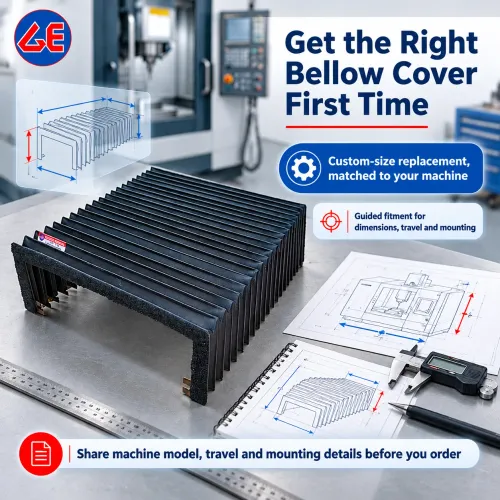
A quotation based only on axis stroke will miss the space and forces that make a bellow fail. Measure the machine’s full movement envelope, including motion that is not parallel to the protected axis.
- Record the compressed length, extended length, stroke, folded height, fold pitch, internal dimensions and external dimensions.
- Record travel speed, acceleration, lateral offset, torsion, minimum bend radius and the mounting orientation.
- Supply mounting-flange or mounting-frame dimensions, hole positions, fixing access and any allowable interference limits.
- Mark clearances at maximum compression and extension around guideways, tools, fixtures, way wipers, chip conveyors and hot surfaces.
- Ask the supplier to confirm the fold geometry against the complete travel cycle, not against stroke length alone.
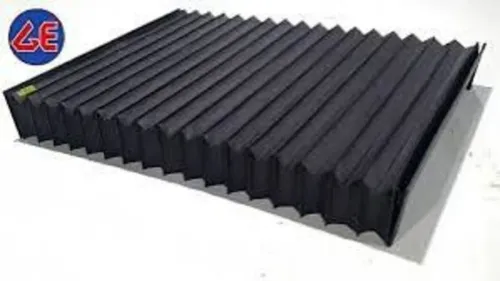
Accordion folds absorb movement along the axis, but they do not automatically tolerate twisting or side movement. Shallow folds can bottom out, crease sharply or rub together during compression; deep folds increase drag, collect chips and coolant, and can make motion unstable.
Check the cover at both travel limits with the machine powered down, then run it slowly through the complete cycle. Watch for fold collapse, rubbing, trapped debris, coolant ingress, changed mounting loads and contact with adjacent components. Repeat at operating speed and acceleration before approving the final dimensions.
Choose the construction for the machine and Chandigarh shop conditions
A CNC way cover must survive chips, coolant and rapid cycling; a foundry cover needs severe heat and contamination. Select the complete construction—fabric, coating, thread, seams, backing and fasteners—not the fibre name alone.
| Application | Main exposure | Construction priority |
|---|---|---|
| CNC machining | Hot chips, coolant, cutting oil, rapid cycling | Flexible, abrasion-resistant coating; sealed seams and verified coolant compatibility |
| Laser equipment | Sparks, radiant heat, occasional hot particles | Low-flammability outer layer with documented radiant-heat performance |
| Welding area | Sparks, spatter and radiant heat | Spark-resistant face, heat-tolerant seams and replaceable sacrificial shields |
| Grinding machine | Abrasive dust, hot particles and repeated folding | Abrasion-resistant, low-shedding fabric with protected fold edges |
| Press | Crushing, abrasion and high stroke speed | Reinforced folds, controlled compression and secure mounting |
| Foundry equipment | Severe heat, scale, dust and contamination | High-temperature assembly with contamination-resistant outer surface |
| Oil-and-gas machinery | Oil, vapour, ignition hazards and outdoor exposure | Oil-compatible, flame-tested construction with corrosion-resistant hardware |
Record the actual site conditions for Chandigarh, Mohali or Panchkula:
- Indoor or outdoor installation, seasonal temperature range, humidity and monsoon water exposure
- Dust type, coolant type and concentration, cutting oil, and cleaning chemicals
- Maximum speed, acceleration, stroke frequency and nearby heat sources
A flexible way cover protects moving machine components; it is not automatically a personnel safety guard. ISO 14120 addresses guards intended primarily to protect people from mechanical hazards, so do not claim compliance unless the risk assessment and protective function support it.
Treat “fireproof fabric bellow covers for industrial machines in Chandigarh” as a search phrase, not proof of suitability.
Audit the supplier’s evidence and prove the cover on the machine
Approve a fireproof fabric bellow cover supplier in Chandigarh only after matching its evidence to your machine, not its listing language. A flame certificate for loose fabric cannot prove that the sewn, coated, fastened bellow will survive folding, coolant or chips.
1. Request a dimensioned drawing showing compressed and extended length, fold pitch, mounting points, clearances and minimum bend radius. Obtain the material stack-up, fabric weight, coating type, seam and thread details, continuous and peak temperature limits, and chemical-compatibility statement for your coolant, oil, solvent and cleaning chemicals.
2. Demand an applicable flame or heat-test report identifying the laboratory, test method, sample construction, exposure temperature and test duration. The report must cover the finished bellow, not loose fabric alone.
Reject a report that says only “fireproof” or quotes 1,000°C without stating whether the figure describes continuous service, a brief peak, radiant heat, substrate temperature or test exposure.
3. Confirm cycle-life evidence at the specified stroke, speed and bend radius. Ask about replacement-part availability and installation instructions, including mounting orientation, preload and inspection points. Use this same evidence packet to assess GURUKRUPA BELLOWS PVT LTD or any competing local manufacturer.
Before acceptance, run the installed cover through full travel at operating speed. At maximum compression and extension, check fold collapse, rubbing, trapped chips, coolant ingress, mounting-load changes, seam damage and interference with guideways, fixtures and wipers. Record photographs and repeat the test after cleaning.
Related products
 | Soft Material Bellow Product Details: Brand GURUKRUPA Specifications:- Function of accordion machine shield: water-proof,oil-proof, anti-corrosion, fire-proof... View product → |
 | Industrial Telescopic Covers Our company is known as one of the eminent names of the industry to manufacture and supply Industrial Telescopic Covers. View product → |
Frequently asked questions
How do you define the fire and heat hazard for a fabric bellow cover?
Identify whether the cover faces welding sparks, hot chips, direct flame, radiant heat, or sustained temperature, then compare fabric performance against that exposure.
Which fabric construction suits sparks, chemicals, and abrasion?
Compare the base fabric, coating, thread, seams, reinforcement, and closure design against the specific sparks, chemicals, and mechanical wear present around the machine.
How should you size a fabric bellow cover?
Measure the guideway’s full travel envelope, folded and extended lengths, cross-section, mounting points, bend radius, and surrounding clearances.
What supplier evidence should you request for fireproof fabric bellow covers?
Request the fabric specification, coating details, test reports, temperature limits, seam construction, drawings, and evidence from a machine trial.