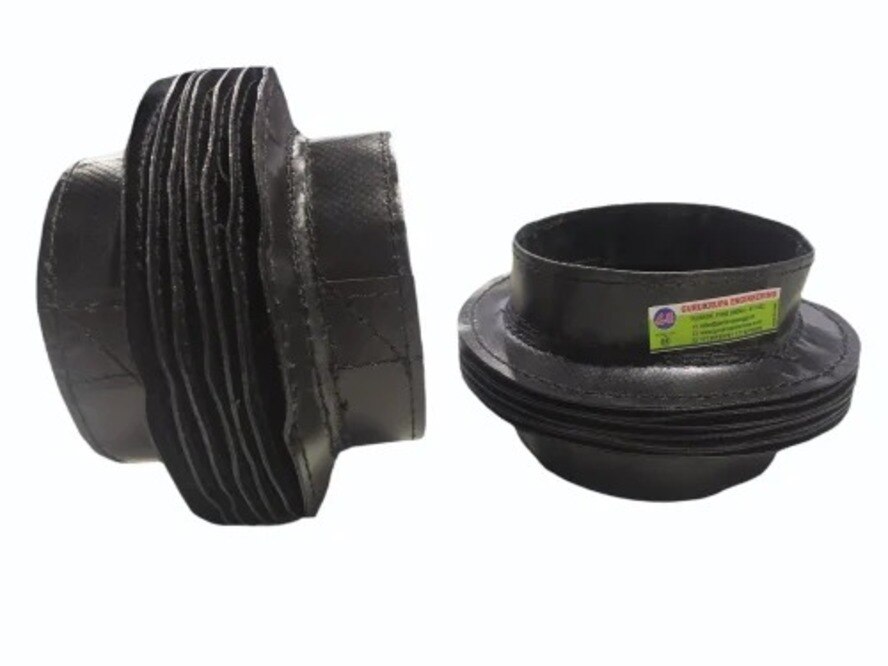
A round bellows cover must match the machine’s travel, clearances, contamination and mounting arrangement—not just the shaft diameter. By the end, you will have a measurement procedure, material-selection checklist, supplier brief and inspection plan for choosing a cover that moves without rubbing or failing prematurely.
Key takeaways
- Identify the moving component before choosing a cover.
- Measure compressed length, extended length, diameter and mounting space.
- Match elastomer and fold geometry to heat, oil, abrasion and movement.
- Compare suppliers using drawings, material details, lead times and replacement costs.
Match the Cover to the Protected Component and Application
Identify the protected part first: shaft, guide rod, hydraulic cylinder, slide, spindle or another moving machine-tool component. Confirm that it is guided independently; the cover must not carry side loads, guide the member, support weight, or absorb torsion.
A bellows cover blocks chips, dust, coolant, oil mist, moisture and mechanical wear. It is not a pressure vessel, vacuum-rated seal, or personnel guard. A separate guard and interlock assessment is necessary wherever people can reach moving parts.
| Option | Contamination and speed | Stiffness, folded size and space |
|---|---|---|
| Molded rubber bellow cover | Flexible splash, dust and oil-mist protection; confirm high-speed cycle evidence | Low stiffness and compact flexibility; suits round, clear spaces |
| Fabric-reinforced bellows | Abrasive chips, tearing and heavier contamination | Greater stiffness and folded size; useful for demanding travel |
| Thermoplastic bellows | Confirm chemical, temperature and cycle compatibility | Flexible construction with application-specific fatigue limits |
| Telescopic steel cover | Severe abrasion and hot chips | Stiff, bulky and space-demanding; suits rigid guided slides |
| Rollway cover | Hot chips and long unsupported spans | Compact in travel direction but needs suitable mounting space |
Use rectangular or telescopic protection when the protected area is not round. Require documented fire performance for welding spatter or fire exposure. Do not approve rubber bellow covers for machines on high-speed CNC axes, hydraulic cylinders, scissor lifts or oil-and-gas equipment without application-specific cycle and environment evidence.
Measure the Machine Before Specifying the Round Bellow Cover Size
Measure the fixed and moving positions at both ends of the machine, then give the supplier every dimension with the direction of travel. Record these machine measurements:
- Collapsed length, extended length, required stroke and available installation length.
- Largest moving-part outside diameter, surrounding obstruction diameter and clearance available around the cover.
- Mounting diameter or flange at each end, bolt-circle diameter, hole spacing, collar width and sealing face.
- Fixed-versus-moving attachment, including whether each end is open, closed, flanged, clamped, bolted or fitted with a custom ring.
Check the internal diameter against clamps, connectors, lubrication fittings and the likely thickness of accumulated chips. Clearing only the bare rod or spindle is not enough; a protruding fitting can tear a cover during travel.
| Dimension to confirm | Why it matters |
|---|---|
| Free length and compressed length | Establishes the installed package and compression allowance |
| Extended length and usable stroke | Shows travel capacity; calculate extended length minus collapsed length |
| Inside and outside diameter | Prevents rubbing and confirms surrounding clearance |
| Convolution height, pitch and number of folds | Determines fold geometry, package length and travel |
| Minimum bend or deflection limit | Prevents buckling, twisting and fold inversion |
| Mass, allowable speed and acceleration | Confirms suitability for the moving axis |
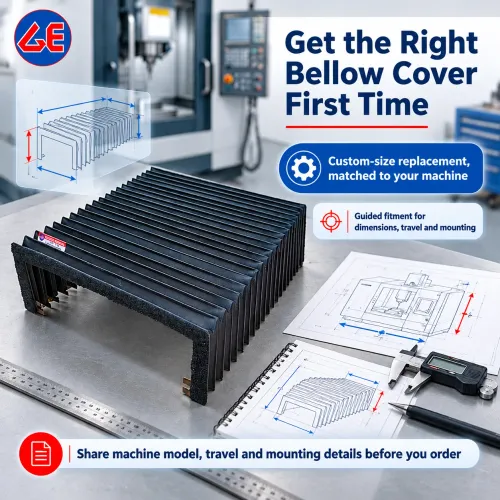
Ask for a dimensional drawing stating all those values. Confirm that the specified stroke leaves compression allowance at one end and prevents overextension at the other. Do not choose a round bellow cover size from diameter alone: equal diameters can hide different fold geometry and travel.
Choose Elastomer, Fold Geometry and Mounting for the Actual Environment
Specify the elastomer from the actual environment, not from the word “rubber.” Tell the supplier the continuous ambient temperature and peak temperature from hot chips or nearby machining, plus exposure to cutting fluid, hydraulic oil, lubricating oil, coolant, abrasive dust, welding sparks, UV, ozone, humidity and corrosive chemicals.
| Material | Suitable exposure | Important limitation |
|---|---|---|
| NBR | Mineral oil, hydraulic oil and many metalworking fluids | Confirm compatibility with the exact fluid and compound |
| EPDM | Water, steam, UV and weathering | Unsuitable for many petroleum oils |
| Silicone | Broad temperature capability | Not automatically suitable for abrasive chip service |
Request the exact compound, chemical-compatibility data, continuous and peak temperature limits, UV and ozone resistance, fungus resistance, and a documented fire-resistance rating where required. For round rubber bellow covers for machinery in Chandigarh, temperature ratings must identify the compound and service duration.
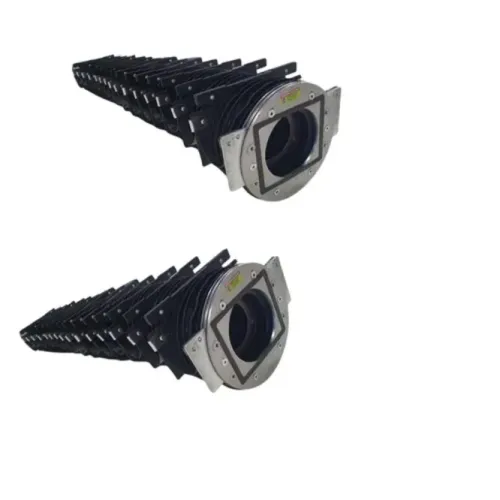
Select convolution height, pitch and fold count from stroke, compressed package length, minimum radius, speed and acceleration; appearance cannot prove usable travel or buckle resistance. Define each end as open-ended, closed-ended, flanged, clamped, bolted or fitted with a customised mounting ring.
Specify the bolt pattern, bolt-circle dimensions, sealing lip, collar and support for any thin edge. A clamp on unsupported material can tear the cover during cycling.
Install it on the moving axis, with bend radius, compression allowance and clearance from clamps and fittings. Prevent twisting, sagging, fold inversion, trapped chips and lateral rubbing. Suction or pressure differentials require separate design validation.
Send a Complete RFQ and Compare Chandigarh Suppliers on Evidence
Send the same RFQ to every round bellow cover supplier in Chandigarh. Include:
- Machine type, protected component, photographs, marked-up dimensions, collapsed and extended lengths, stroke, direction of movement, speed, acceleration and cycle frequency
- Mounting drawings, quantity and whether this is a replacement
- Operating temperature, peak chip temperature, chemicals, coolant type, oil type, UV exposure and a description of contamination
Request a GA drawing showing compressed and extended lengths, internal and external diameters, fold count and geometry, material and reinforcement, mass, mounting details, minimum bend or deflection limits, allowable speed and acceleration, inspection criteria and replacement-part identification. Do not approve a nominal size from diameter alone.
Compare offers against evidence, not catalogue language:
| Evidence | Why it matters |
|---|---|
| Sample approval and prototype fitting | Exposes interference before production |
| Dimensional inspection and test records | Confirms the drawing and repeatability |
| Chemical and temperature data | Tests compound suitability |
| Representative cycle-life evidence | Relates service life to stroke, speed, acceleration, temperature, contamination and mounting |
| Custom tooling, packaging, lead time and replacement support | Reveals total procurement risk |
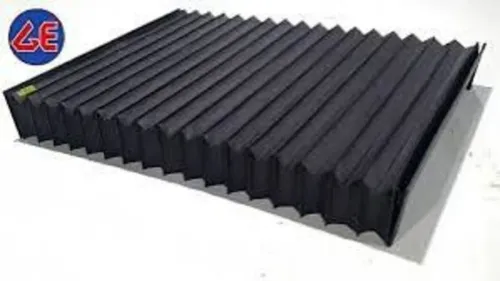
A static sample or unloaded flex test does not prove service life on a rapidly cycling axis. Clarify a listing that names GE as the brand: it still does not identify rubber grade, construction, dimensions, mounting design or test standard.
Include GURUKRUPA BELLOWS PVT LTD in the same evidence-based comparison, rather than selecting it on claims about fine raw material or unspecified compliance testing.
Related product
 | Round Bellow Covers ₹1000 To match with our reputation in the market, we are here to present an unparalleled assortment of Round Bellow Covers. View product → |
Plan Installation Checks, Service Life and Replacement Costs
1. Before commissioning, cycle the machine slowly through its full stroke. Confirm that the cover does not rub, twist, buckle, sag or overextend, trap chips, or interfere with fittings and guards.
2. Set the inspection interval from stroke cycles and contamination. Shorten it for abrasive chips, hot particles, oil, coolant, outdoor UV, high-speed acceleration, seasonal humidity, monsoon water or exposed service in Chandigarh. Require cycle-life evidence tested at representative stroke, speed, acceleration, temperature, contamination and mounting conditions; a static sample proves little.
3. Inspect every fold and mounting point for cracks, pinholes, delamination, loose clamps or bolts, fold damage, seam separation, hardening, swelling, lost flexibility and changed compressed length. Record the cycle count and compare the measured compressed length with the approved drawing.
4. Replace the cover when damage exposes the protected component, folds no longer recover, or mounting damage cannot be corrected without distortion. Keep the approved GA drawing, material and reinforcement record, bend or deflection limits, allowable speed and acceleration, compressed and extended lengths, mass, mounting details, inspection criteria and replacement-part identification with the machine.
5. Budget site measurement, drawing approval, prototype fitting, custom tooling, installation labour, downtime and periodic replacement alongside the purchase price. A supplier quote does not capture these costs, and a visually similar replacement can have inadequate stroke, clearance or chemical resistance.
Frequently asked questions
Which machine parts can round rubber bellow covers protect?
They can protect shafts, guide rods, hydraulic cylinders, slides, spindles and other moving machine-tool components. The component must be guided independently because the cover must not carry side loads, support weight or absorb torsion.
What measurements determine the round bellow cover size?
Measure the protected member’s diameter, the available mounting diameter, the cover’s compressed length and the required extended length. Also record stroke, clearance and the space available at both ends.
How do you choose rubber, fold geometry and mounting?
Specify the elastomer against the actual heat, oil, coolant, dust, chemicals and abrasion exposure. Select fold geometry for the required stroke and compressed height, then confirm that the mounting method fits the machine end points.
What should you include in an RFQ for a Chandigarh supplier?
Include a dimensioned sketch, component and stroke measurements, operating temperature, fluids, contaminants, movement speed, mounting details, quantity, delivery requirement and requested material information.