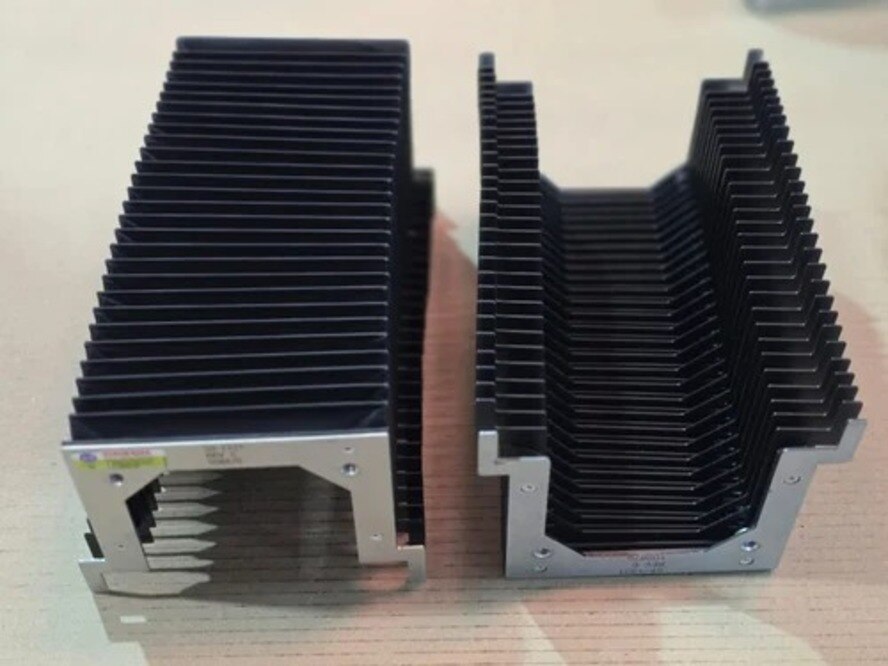
Chips, grinding dust, coolant, sparks and repeated machine movement can damage guideways, screws, cylinders, cables and exposed mechanisms long before a failure becomes visible. You will be able to match each machine part with the right cover type, check the operating limits, and prepare the dimensions and conditions a supplier needs for a workable design.
Key takeaways
- Protect guideways, linear rails, screws, rods, shafts, cables, hoses, and exposed mechanisms.
- Match the cover to travel direction, compressed length, heat, chips, coolant, and required flexibility.
- Use bellows for contamination barriers, cable carriers for routing, and guards for impact protection.
- Give suppliers travel, extended and compressed lengths, opening dimensions, mounting details, and operating conditions.
Which machine parts need protection, and what causes the damage?
A bellow cover purpose is to block contamination from guideways, linear rails, ball screws, lead screws, hydraulic and pneumatic rods, shafts, cables, hoses, and exposed mechanisms. It is a contamination barrier, not a cosmetic enclosure: without it, moving interfaces ingest debris and wear faster.
Different contaminants damage different parts:
| Protected part | Main threat | Result |
|---|---|---|
| Guideways, linear rails, ball screws and lead screws | Abrasive grit and fine grinding dust | Scoring, rough movement and shortened bearing or guide life |
| Hydraulic and pneumatic rods | Chips, grit, coolant and oil | Cut or worn seals, corrosion, swelling and degraded rod-cover material |
| Shafts and exposed mechanisms | Chips, grit, coolant and oil | Surface wear, seized movement, corrosion and contaminated lubrication |
| Cables and hoses | Chips, coolant, oil and rubbing debris | Cut insulation, softened jackets, swelling, cracking and leaks |
| Bellows folds and seams | Chips and welding sparks | Cut or folded material, pinholes and burn-through |
Machine component protection covers need closer specification for grinding. Fine dust can pass ordinary protection through seams or moving gaps, so request tighter construction, overlapping folds, wipers or scrapers.
Inspect for torn folds, pinholes, delamination, exposed reinforcement, hardened or swollen material, loose mounts, rubbing and trapped coolant or chips. Replace a damaged cover before contamination reaches the guide, screw, rod or cable.
How does a bellows cover move with the machine?
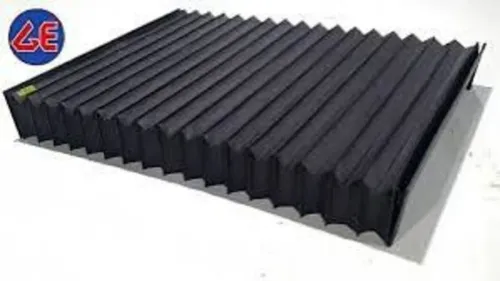
Industrial bellow covers explained in practical terms move by folding and unfolding along the machine axis. One end frame or mounting plate attaches to the fixed machine structure; the other attaches to the moving member.
As the axis travels, the folds compress toward the fixed end and extend over the protected guideway, screw, rod or mechanism.
Calculate these dimensions together, not separately:
- Travel direction and full stroke
- Fold pitch and number of folds
- Minimum compressed length
- Maximum extended length
- Required clearance from the machine
- Mounting-face dimensions
- Complete installation envelope
Over-compression crushes the folds, while a pitch that is too tight accelerates crease fatigue. Side loading and torsion twist the fabric instead of letting it fold cleanly. A sharp machine edge can cut the material, and rubbing can create pinholes even when the coating suits the coolant.
Horizontal or long-span covers also carry their own unsupported weight. Sag can cause rubbing; buckling can obstruct travel or trap chips. Use guide strips, intermediate frames or a guided mounting arrangement when the span cannot support itself. Add drainage where coolant or washdown can collect in the folds.
Verify the design under acceleration, not only at slow manual movement, because shifting weight can pull mounts sideways and distort the cover.
Which cover construction fits the heat, chips and movement?
Fabric bellows fit coolant, dust and moderate-temperature chips; steel or slat protection fits hot, sharp or heavy swarf. This is the practical core of industrial bellow covers explained: lightweight folds follow guided travel, while rigid barriers absorb impact.
| Option | Construction | Best fit | Main limitation |
|---|---|---|---|
| Sewn fabric bellows | Joined fabric panels and stitched seams | Coolant, dust and moderate chips on complex travel paths | Seams can wear or leak under abrasion |
| Heat-sealed fabric bellows | Welded, sealed fabric joints | Cleaner contamination barrier where compatible materials are available | Heat, chemicals and sparks can exceed the joint rating |
| Telescopic steel cover | Sliding rigid steel boxes | Hot, sharp or heavy swarf on straight-axis travel | Adds weight and needs precise alignment |
| Sacrificial slat system | Replaceable overlapping slats | Severe chips, sparks and impact | Costs space and cannot follow every path |
| Flexible boot | One-piece elastomer sleeve | Short, simple shaft or rod movement | Poor choice for long, repeated guided travel |
Choose a bellows for repeated compression and extension along a defined axis. Choose a flexible boot for a short stroke with uncomplicated motion; forcing a boot through long travel causes stretching, tearing or binding.
A bellows is a contamination barrier, not a chip remover, lubrication system or hydraulic seal. It does not guarantee protection from pressure jets, hot chips, flames or chemicals.
Compare these limits before specifying machine component protection covers:
- Operating temperature and chip temperature
- Coolant and oil compatibility
- Spark, abrasion and tear resistance
- Travel speed, cycle frequency and permissible bending radius
How do bellows differ from cable carriers and machine guards?
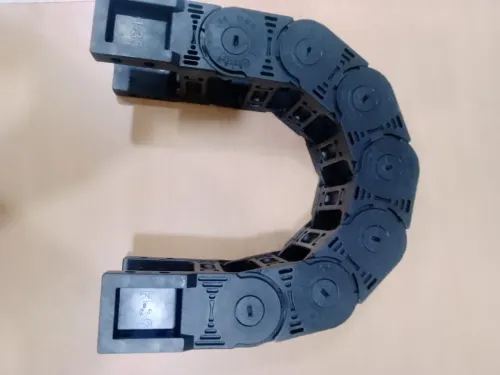
Bellows shield a moving machine component or travel envelope; a cable carrier controls the bend radius and routing of cables and hoses. They solve different protection problems, so one does not replace the other.
| System | Travel or movement | Main protection function | Attachment points |
|---|---|---|---|
| Moving guideway | Linear travel along rails or slides | Bellows block chips, grit and coolant | Fixed machine frame and moving slide |
| Cylinder rod | Axial extension and retraction | A bellows protects the exposed rod from contamination | Cylinder body and rod-end mount |
| Cable carrier | Repeated guided chain bend | Carrier controls cable and hose routing and bend radius | Machine frame and moving carriage |
| Hose bundle | Flexing along a defined loop | Carrier prevents kinking, crushing and cable-to-cable motion | Fixed and moving hose supports |
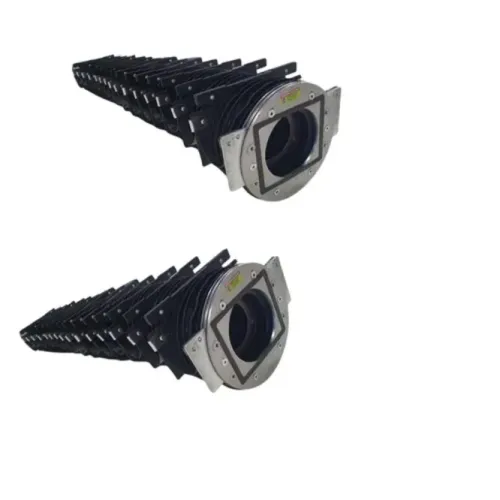
| Scissor-lift mechanism | Vertical movement with changing angles | Bellows cover the mechanism’s travel envelope | Lift frame and moving platform |
| Machine guard | Access around a hazard | Guard prevents contact, rather than merely blocking contamination | Rigid frame, door or enclosure |
A bellows alone cannot control cable bend radius, separate hoses, or stop cable-to-cable rubbing. A machine may therefore use both a bellows for machine component protection covers and a carrier for the services inside or beside it.
Inspect the cover for pinholes, torn folds, delamination, exposed reinforcement, hardened or swollen material, loose mounts, abnormal rubbing, and trapped coolant or chips. Replace damage before debris reaches the guide or screw.
A bellows is not automatically a compliant safety guard. Assess construction, openings, attachment and risk under ISO 14120 and ISO 13857 before relying on it to prevent access.
What measurements and questions should you give a supplier?
Give the supplier a measured installation envelope and operating record, not just the guideway’s nominal width. Use this checklist:
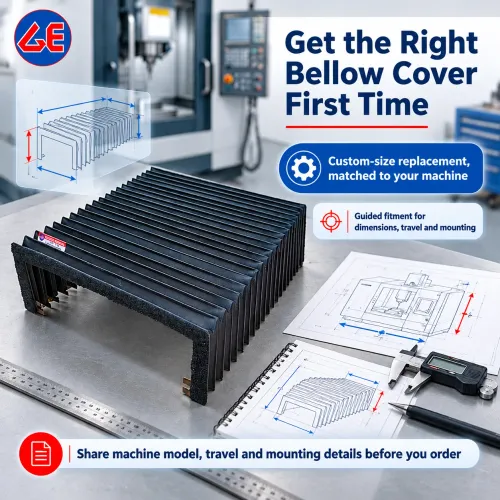
- Measure guideway width and height, full travel, folded length, extended length, mounting-face dimensions, bolt pattern and corner radii. Record nearby obstructions, required clearances and service-access points.
- State travel orientation—horizontal, vertical or inverted—plus speed, acceleration and cycle frequency. Include whether the cover will sag, rub or need intermediate support.
- Record operating conditions: ambient and chip temperature, coolant or chemical exposure, oil, cleaning fluids, UV exposure and the chip type. Identify hot swarf, abrasive dust and welding sparks.
- Specify required features, including wipers or scrapers, guides, drainage, support strips, spark resistance and flame resistance. Note whether the cover protects a guideway, screw, rod, shaft, hose bundle or another moving part.
Ask for a dimensioned drawing showing fold pitch, mounting details and the installation envelope. Request stated limits for minimum compression, maximum extension, speed, acceleration and temperature, along with the material, coating, mounting method and repair or replacement provisions.
A bellow cover supplier in Chandigarh should support those limits with application details rather than quote on width alone. For bellow covers in Chandigarh, evaluate GURUKRUPA BELLOWS PVT LTD against the documented fit and service requirements, not nominal price alone.
Related products
 | Bellow Cover ₹1000 We are offering an excellent quality of Protective Bellows for all type Guideways. This design covers three sides of the rail. View product → |
 | Round Bellow Covers ₹1000 To match with our reputation in the market, we are here to present an unparalleled assortment of Round Bellow Covers. View product → |
Frequently asked questions
Which machine parts need protection from contamination?
Guideways, linear rails, ball screws, lead screws, hydraulic and pneumatic rods, shafts, cables, hoses, and exposed mechanisms need protection when debris can reach moving interfaces.
How does a bellows cover move with an industrial machine?
Folded sections expand and compress as the protected component travels, maintaining a covered barrier while accommodating the machine’s movement.
How do you choose bellows construction for heat, chips, and movement?
Specify the operating temperature, chip size, coolant or oil exposure, travel, speed, orientation, and required flexibility before selecting fabric, coating, reinforcement, and fold construction.
What is the difference between a bellows cover, cable carrier, and machine guard?
A bellows blocks contamination, a cable carrier guides and separates moving cables and hoses, and a machine guard prevents contact with hazardous moving parts.
What information should you give a bellows cover supplier?
Provide travel length, extended and compressed lengths, opening dimensions, mounting method, movement direction, speed, temperature, contaminants, and photographs or drawings of the installation.
Related products
 | Bellow Cover ₹5000 Product Details: Brand GURUKRUPA Color Black-Blue Size Customised With the support of our excellent team workers, we have been delivering the best... View product → |
 | Bellow Cover We are considered a well-known name in the business that manufactures and supplies Bellow Cover. View product → |
 | Product Details: Brand GURUKRUPA Color Black-Blue Size Customised With support of our excellent team workers, we have been delivering the best... View product → |