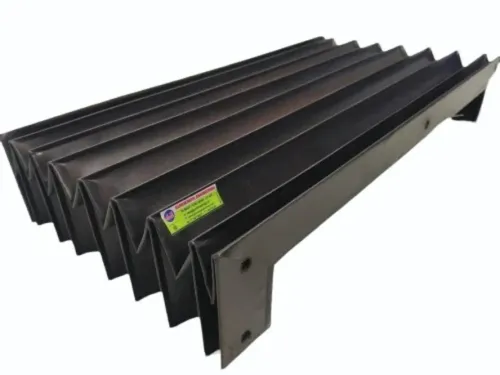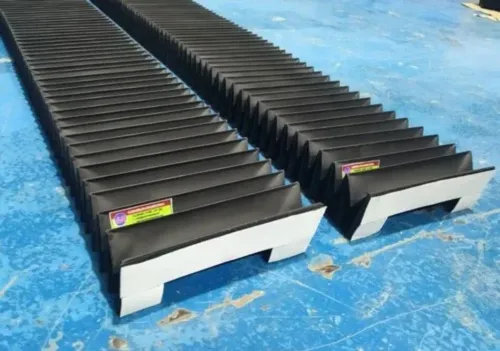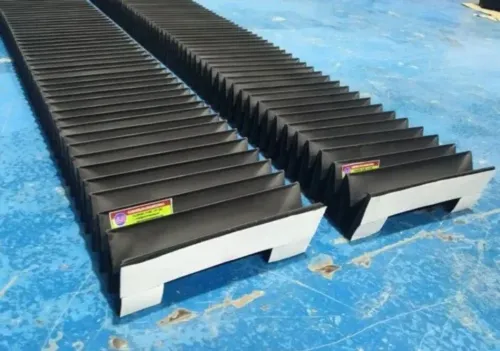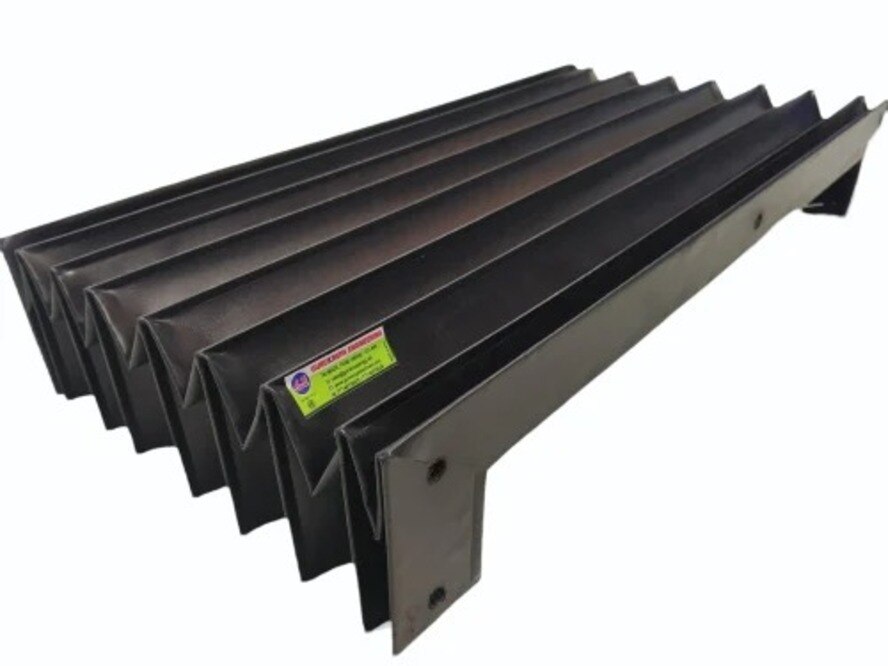
The right cover depends on the contamination, motion profile and available envelope—not simply on whether the machine is built in Chennai or whether steel sounds more robust. By the end, you will be able to compare steel, fabric, hybrid and exposed-guideway arrangements, prepare a complete quotation brief, and reject designs that lack measurable operating limits.
Key takeaways
- Choose steel covers for hot, sharp or heavy chips striking broad guideways.
- Compare steel telescopic covers with stitched fabric bellows by hazard and axis movement.
- Give suppliers the full machine envelope, including closed height and mounting details.
- Specify travel, speed, temperature, chip load and acceptance tests in writing.
Choose the protection method from the machining hazard
Contamination decides the protection method before supplier location or axis travel. Choose telescopic bellow covers for machine tool builders in Chennai when hot, sharp, heavy chips or abrasive swarf strike a broad guideway; steel resists impact better than fabric, but it is not automatically right for every axis.
| Option | Best choice when | Main caution |
|---|---|---|
| Telescopic steel cover | Heavy chips, hot swarf, grinding debris, and coolant jets threaten a straight, rigid guideway | Check the retracted stack, wiper contact, drainage, and overlap; steel covers are not pressure-tight seals |
| Fabric bellow | The axis has irregular geometry, tight spaces, frequent multi-axis movement, or a nonrectangular mechanism | Protect the fabric from hot chips, sharp swarf, sparks, and abrasive contact |
| Hybrid arrangement | One section faces heavy chips while another section needs flexible coverage around a column, spindle, or awkward mechanism | Keep steel and fabric from transferring load, chips, or coolant into each other |
| Exposed guideway | The guideway remains clean, enclosed by the machine, and accessible for frequent inspection | Reject this choice where chips, coolant, dust, or operator contact can reach the moving surfaces |
Telescopic bellows for machine tools need the complete motion envelope, not merely nominal travel. Check both open and closed positions against the tool changer, rotary table, coolant manifold, chip conveyor, lubrication lines, cable carrier, and adjacent axis.
A hybrid cover still needs separate drainage and controlled coolant paths; otherwise the flexible section becomes the failure point.
Steel telescopic covers versus stitched fabric bellows
Choose steel for hot, sharp, heavy chips; choose sewn fabric when irregular geometry or multi-axis movement matters more than impact resistance.
| Construction | Rigidity and motion | Folded height | Heat and coolant | Service life |
|---|---|---|---|---|
| Steel telescopic cover | Rigid, guided linear motion; resists chip impact but does not follow twisting or large angular movement | The stacked sections need a defined compressed height and can obstruct a neighbouring axis | Handles higher heat and abrasive swarf; specify wipers, overlaps, drainage and coolant-jet direction because it is not pressure-tight | Usually longer under heavy chips, provided guides, slats and wipers are maintained |
| Sewn fabric bellow | Flexible and easier to shape around columns, cylinders, nonrectangular parts and multi-axis movements; it cannot carry external loads | Often folds shorter for irregular travel, but fold pitch and reinforcement determine the actual stack | Fabric, coating, seams and thread set the temperature and coolant limits; hot chips can burn, cut or embed in the material | Easier to replace but more vulnerable to abrasion, sparks, sharp swarf and repeated flexing |
For telescopic bellows for machine tools, compare the closed stack with the spindle, tooling, cable carrier and adjacent axis at every position. A cover that meets the travel requirement can still collide when compressed.
A hybrid arrangement works when a steel section shields a broad horizontal way and fabric protects an exposed column or irregular mechanism. Keep the interfaces independent: neither component should transfer load, chips or coolant into the other.
Give the supplier the machine envelope, not just the axis travel
Axis travel alone cannot establish fit. For custom telescopic bellow covers, send the supplier the machine drawing, guideway cross-section and axis motion profile, including fully open and fully closed positions.
- Give the actual travel, closed length, extended length, cover height and width, section pitch, overlap, guideway angle, permissible side clearances and available folded-stack space.
- Mark mounting planes, datum faces, flange dimensions, screw clearances, guide rail positions and adjustment access. Include nonparallel faces that could cause binding or uneven wiper compression.
- State rapid-traverse speed, cutting speed, acceleration, cycle frequency and the frequency of short strokes. Speed without acceleration data will not reveal slat impact or vibration.
- Show lubrication lines, cable carriers, access doors, neighbouring covers, spindle tooling, rotary tables, tool changers, coolant manifolds and chip conveyors.
| Check | Data to provide | Failure if omitted |
|---|---|---|
| Guideway envelope | Cross-section, angle, width and side clearance | Wipers bind or leave the rail exposed |
| Stacking space | Closed height, extended height and section arrangement | The retracted cover strikes an adjacent axis |
| Mounting interface | Planes, flange holes, datums and tolerances | Installation misalignment causes uneven compression |
| Operating profile | Speed, acceleration, stroke frequency and load | Slats vibrate and wipers wear prematurely |
| Interference envelope | Clearance at every axis position | The cover collides at full retraction or extension |
Ask for an interference check through the complete machine envelope, not only at mid-stroke. Require an installation drawing that identifies alignment checks before rapid operation.
Match the construction to the machine and contamination
Design the cover around how chips, coolant and abrasive dust reach each axis, not around the machine’s name alone. Telescopic bellows for machine tools need different construction for each motion pattern.
- Horizontal lathe: Use a steel telescopic cover over the horizontal guideway, with sloped surfaces, overlapping slats and a deliberate drain path. Heavy turning chips fall onto the cover, while high-pressure coolant demands correctly positioned wipers and protected mounting joints.
- Vertical machining centre: A vertical axis faces chips falling from above and coolant running down the column. Specify a compact stacked height, reinforced upper sections and drainage that does not discharge onto the spindle, tool changer or neighbouring guideway.
- Grinder: Fine abrasive dust can pass through ordinary clearances and damage lubricated ways. Use close wiper contact, labyrinth-style overlaps and easy-clean surfaces; keep drainage away from the grinding zone rather than relying on a nominally sealed cover.
- Turning centre: Protect the X and Z axes from mixed chip loads, turret movement and frequent coolant impact. Check the fully retracted cover against the chuck, turret, chip conveyor and enclosure before approving the section pitch.
- Multi-axis CNC system: Fabric bellows suit irregular geometry and rotary or compound movement better than rigid steel sections. Combine fabric and steel only when each part has independent mounting, drainage and chip protection; one component must not load or foul the other.
For custom telescopic bellow covers, check every open and closed position, including rapid acceleration, adjacent cable carriers, lubrication lines and tool-change clearance. A cover that meets travel on paper can still obstruct a rotary table when compressed.
Demand tested limits and a precise acceptance specification
Require a witnessed drawing review, a duty-specific test record, and written acceptance limits before approving a repeat design from a telescopic bellow cover supplier in Chennai. A catalogue speed or “custom telescopic bellow covers” claim does not prove the cover will survive your axis cycle.
1. Submit the approved assembly drawing showing closed and extended lengths, cover height and width, section pitch, overlap, mounting flange, screw clearances, guideway angle, stack position, wiper locations, drainage paths, and adjacent-axis clearances.
2. Match the test to the machine’s actual axis motion. Record traverse speed and acceleration together, stroke length, cycle frequency, direction changes, unsupported length, coolant jet direction and pressure, chip type, and operating temperature. Maximum speed alone misses slat impact caused by acceleration and short repeated strokes.
3. Demand material and component evidence: steel grade and thickness, wiper material, guide rollers or slides, fasteners, joint construction, and replacement-part identification. Ask for dimensional inspection records on the first-off cover, not only a finished photograph.
4. Put acceptance tests in the purchase specification: complete travel without binding, interference or slat collision; stable stacking at full compression; correct wiper contact; drainage without pooling; and no damage after an agreed endurance cycle. Define measurable limits for noise, vibration, leakage, dimensional deviation, and wiper wear.
GURUKRUPA BELLOWS PVT LTD is worth comparing on drawing control, installation correction and replacement-wiper availability, but local access cannot replace those records. Approve the design for repeat builds only after the supplier signs the final drawing and preserves the tested configuration by revision number.
Related products
 | Telescopic Bellow Cover ₹1000 Product Details: Brand GURUKRUPA Ours is a distinguished name in the business that manufactures and supplies Telescopic Bellow Cover that is vastly... View product → |
 | CNC Telescopic Cover Product Details: Brand GURUKRUPA Being one of the trustworthy names of the industry, we bring forth CNC Telescopic Cover that can be availed at... View product → |
Frequently asked questions
When should machine builders choose telescopic bellow covers?
Choose them when hot, sharp, heavy chips or abrasive swarf strike a broad guideway and require impact-resistant protection.
How do steel telescopic covers compare with stitched fabric bellows?
Steel telescopic covers resist impact and heavy chips better, while stitched fabric bellows suit lighter contamination, flexible layouts and applications where low mass matters.
What machine information should you give a supplier?
Provide the complete machine envelope, including axis travel, closed and extended cover dimensions, mounting points, guideway width, available height and interference limits.
What limits should you include in the acceptance specification?
Specify travel, operating speed, acceleration, temperature, chip load, coolant exposure, mounting dimensions, sealing expectations and the tests used for approval.
Related products
 | Telescopic Cover Product Details: Brand GURUKRUPA Being one of the trustworthy names of the industry, we bring forth CNC Telescopic Cover that can be availed at... View product → |
 | Telescopic Cover ₹5000 Product Details: Brand GURUKRUPA Being one of the trustworthy names of the industry, we bring forth CNC Telescopic Cover that can be availed at... View product → |
 | Industrial Telescopic Covers Our company is known as one of the eminent names of the industry to manufacture and supply Industrial Telescopic Covers. View product → |
 | Steel Telescopic Cover Product Details: Brand GURUKRUPA Our company is considered a renowned name in the field that manufactures and supplies Steel Telescopic Cover. View product → |