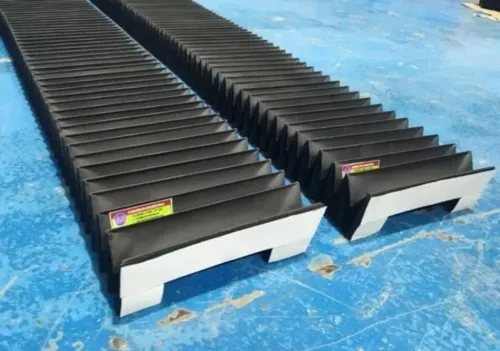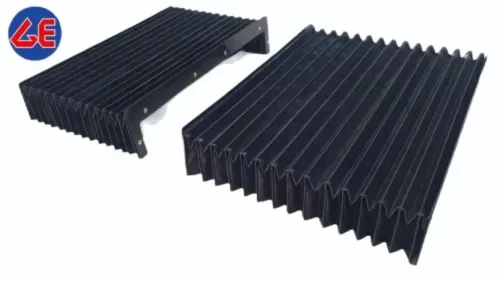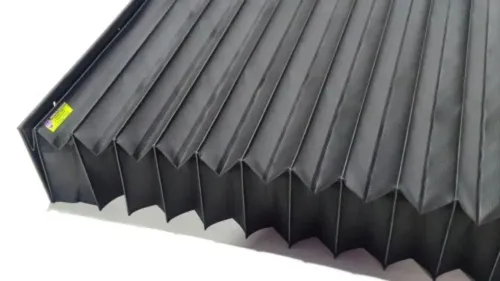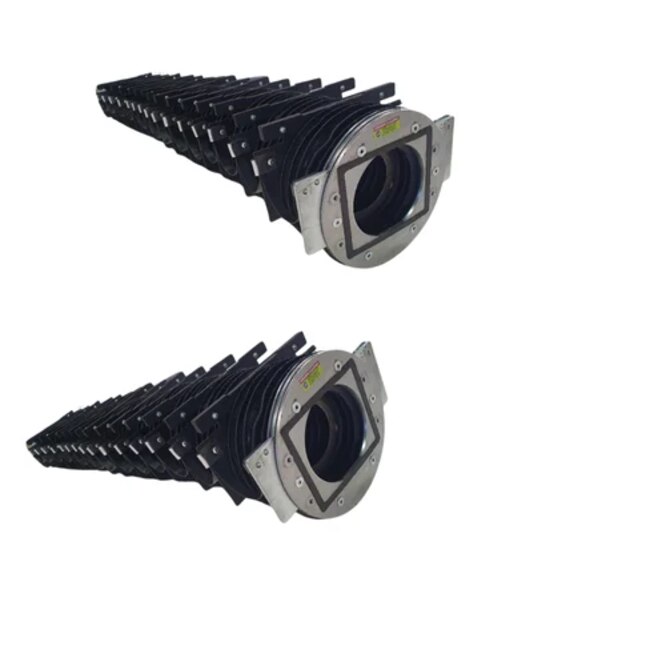
A torn, burned, swollen, or binding bellow can expose a Trumpf machine’s guideways and drive components to chips, coolant, heat, and abrasive dust. You will learn how to diagnose the damage, decide between a temporary repair and a complete replacement, collect the dimensions needed for a correct quotation, and verify safe operation after installation.
Key takeaways
- Inspect folds, stitching, seals, and movement before ordering.
- Replace bellows with burned fabric, delamination, or structural collapse.
- Send extended, compressed, and mounting measurements for a proper fit.
- Test full axis travel after installation before returning the machine to production.
How to Diagnose Laser Bellow Cover Damage Before Ordering
A cover needs attention when it has torn folds, pinholes, burned fabric, loose stitching, delamination, collapsed folds, coolant saturation, or shiny abrasion marks. Laser bellow cover damage can also appear as binding, twisting, ballooning, or uneven compression during axis travel.
Inspect both faces, the fold valleys, underside, end skirts, slats, seals, and mounting frames. Outer-face inspection alone can miss a tear that reaches the guideway.
- Photograph the installed cover from both sides, including each end frame and damaged area.
- Record the Trumpf machine model, serial number, protected axis, travel direction, and cover position.
- Measure extended length, compressed length, width, height, fold pitch, travel distance, and internal clearance.
- Measure mounting-frame length, width, hole spacing, orientation, and the type and position of each end attachment.
- Check whether folds contact guideways, cable carriers, hoses, sensors, lubrication points, or limit switches.
- Keep the removed cover for comparison; do not force chips from folds with sharp tools or pressure washing.
| Sign | What it indicates | Check before ordering |
|---|---|---|
| Torn or burned fabric | Mechanical or thermal failure | Damage depth, affected folds, and nearby heat sources |
| Swollen or peeling layers | Coolant or chemical attack | Coolant type, cleaning chemicals, and delaminated area |
| Binding during travel | Distortion or incorrect mounting | Slow full-stroke movement, clearances, and frame alignment |
Trumpf laser protection covers protect machinery mechanically; opacity alone does not prove laser safety. Confirm the wavelength, enclosure classification, viewing-window rating, interlocks, and safety validation separately.
Repair or Replace: Choosing the Right Response to a Damaged Trumpf Bellow
A patch is acceptable only for isolated laser bellow cover damage: one small puncture or short tear in otherwise flexible, dry material, away from a fold crest, mounting skirt, seam, wiper, and end frame.
Use a compatible repair patch and adhesive or stitching specified for the bellow fabric and exposure; a random tape patch can peel into the travel path.
| Condition | Repair patch | Complete replacement |
|---|---|---|
| Damage pattern | Single pinhole or short isolated tear | Multiple punctures, cracked fold lines, burned fabric, delamination, or broken slats |
| Material condition | Flexible, bonded layers intact, no coolant swelling | Hardened, saturated, swollen, abraded, or separating layers |
| Location | Flat panel away from folds and attachments | Fold crests, mounting skirts, seams, wipers, or end frames |
| Movement | Full stroke remains smooth after repair | Bellow binds, twists, balloons, collapses unevenly, or touches the guideway |
Choose a Trumpf machine bellow replacement when damage reaches a repeated fold line, exposes the guideway, or returns after a previous patch.
A distorted frame, missing clamp, damaged rail, contaminated mounting surface, or torn adjacent seal can destroy a new cover, so state whether end frames, guide strips, fasteners, wipers, and seals will be reused, refurbished, or replaced.
A damaged bellow is not automatically a failed laser-safety enclosure. The bellow protects moving components; enclosure panels, viewing windows, doors, interlocks, and their validated safety design address laser radiation. After installation, complete power and clearance checks, then jog slowly through the full stroke to confirm safe movement.
The Measurement Drawing a Supplier Needs for a Model-Specific Fit
A Trumpf model number alone cannot produce a dependable quotation. Send a dimensioned sketch in millimetres, marked with the machine serial number, protected axis, cover position, and mounting orientation. A trumpf laser bellows supplier in delhi can then distinguish a model-specific replacement from a generic accordion cover that only looks compatible.
Include these measurements and identifiers:
- Machine model, serial number, axis name, and axis travel in millimetres
- Fully extended length and fully compressed length, measured between mounting faces
- Overall bellows width and height, plus folded or stack height when compressed
- Fold pitch, number of folds, and the direction of travel
- Clearances to the guideway, ball screw, rack, linear motor, sensors, hoses, and cable carrier
- Mounting-frame length, width, hole spacing, hole diameter, and frame thickness
- End attachment type: bolted flange, angle frame, slide plate, sewn strip, or another arrangement
- Attachment position at each end, including offsets from the bellows centreline
- Photos of both ends, the surrounding axis, and any damaged or distorted frame
Mark fixed and moving ends on the drawing. State whether the cover expands horizontally, vertically, or along an inclined axis; the wrong orientation can cause uneven folding and binding.
For a Trumpf machine bellow replacement, compare travel, stack height, attachment method, clearances, and resistance to the actual coolant, chips, heat, and dust—not the word “compatible” in a catalogue. GURUKRUPA BELLOWS PVT LTD can use these details to identify missing dimensions before fabrication, reducing revisions caused by an incomplete sketch.
Related products
 | Trumpf Laser Bellows Product Details: Minimum Order Quantity 1 Number Brand GE Color Black Size any We offer bellows made specifically for your Trumpf® laser machine. View product → |
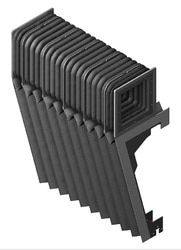 | Laser Cutting Machine Bellows ₹1000 We offer Laser Cutting Machine Bellows made specifically for your laser machine. View product → |
Selecting Construction for Heat, Sparks, Coolant, Chips, and Laser Fumes
Heat, sparks, coolant, chips, and fumes should determine the cover construction; the Trumpf model alone cannot do that. Record coolant chemistry, abrasive dust, chip temperature and shape, laser-generated fumes, cleaning agents, ambient temperature, and spark frequency before choosing materials.
- Use coated fabric for ordinary chips, dust, and coolant when the coating resists the actual fluid and does not swell, soften, or delaminate.
- Choose aramid fabric where hot particles or intermittent sparks can reach the folds; add a heat-resistant coating when coolant exposure is also present.
- Use stainless-steel slats or foil-reinforced construction where sharp chips puncture fabric, sparks are frequent, or fold crests suffer repeated abrasion. Check that slats cannot reduce the required travel or clearance.
- Specify sealed, heat-resistant seams and reinforced end skirts when coolant can wick through stitching or attack adhesive joints. A stitched seam alone is not protection against fluid ingress.
- Match fold pitch and reinforcement to the bend radius and stroke. Tight folds that bind, rub, or collapse will fatigue quickly even with the correct fabric.
- Treat chemical fumes separately: confirm resistance to the cleaning chemical and laser-process residue, not just coolant compatibility.
A Trumpf laser bellows supplier in Delhi should compare an OEM-equivalent custom cover with a generic accordion cover by travel, stack height, attachment method, clearance, and environmental resistance. Trumpf laser protection covers protect machine components; they do not establish laser radiation safety for the enclosure, doors, windows, or interlocks.
Safe Removal, Installation, and Full-Stroke Testing on a Trumpf Machine
Isolate the Trumpf machine before removal: stop the laser, remove the key, disconnect electrical power, apply lockout/tagout, and release pneumatic or hydraulic energy. Keep hands clear of the axis and never defeat a door interlock or limit switch.
Photograph the installed bellow, mark its travel direction, and compare the replacement with the approved drawing before unfastening the end frames.
During installation, check each point:
- Clean chips and hardened coolant from the guideway, mounting faces, and fasteners; debris under a frame can shift the bellow out of alignment.
- Confirm the serial number, protected axis, compressed and extended lengths, fold pitch, frame dimensions, and end-attachment positions match the Trumpf machine bellow replacement.
- Secure both ends without stretching the cover, then inspect clearance from cable carriers, hoses, sensors, lubrication points, limit switches, and moving hardware.
- Find the damage source—sharp edges, excessive heat, misalignment, coolant spray, or trapped chips—and correct it before commissioning.
Restore power only after guards and covers are secure. In setup mode, jog the axis slowly from one limit to the other, watching the bellow at both fully compressed and fully extended positions. Stop if it snags, twists, balloons, collapses unevenly, rubs the guideway, restricts travel, or pulls at a frame.
Trumpf laser protection covers are mechanical contamination barriers, not automatically laser-safe enclosures. Keep wavelength assessment, viewing-window ratings, door interlocks, and safety validation under the machine’s separate laser-safety review.
Frequently asked questions
How do you diagnose damage to a Trumpf laser bellow cover?
Inspect for torn folds, pinholes, burned fabric, loose stitching, delamination, coolant saturation, shiny abrasion, collapsed folds, binding, twisting, ballooning, and uneven compression during axis travel.
Should you repair or replace a damaged Trumpf machine bellow?
Repair minor, local stitching or attachment damage when the fabric, coatings, and fold geometry remain sound. Replace the bellow when heat has burned the fabric, layers have delaminated, folds have collapsed, or travel is restricted.
What measurements does a supplier need for a model-specific Trumpf bellow replacement?
Provide the machine and axis details, mounting-hole pattern, overall length when extended and compressed, width, height, fold pitch, end-frame dimensions, travel direction, and photographs or a measurement drawing.
How should you select construction for a Trumpf laser protection cover?
Match the construction to exposure: heat-resistant materials for hot zones, spark-resistant layers for cutting debris, coolant-resistant coatings for wet machining, chip-resistant outer fabric, and suitable sealing for fumes and dust.
How do you safely install and test a Trumpf laser bellow cover?
Isolate power, support the moving axis, remove the old cover without damaging guideways, align the mounting points, check fold orientation, and run slow full-stroke tests before production.
Related product
 | Laser Machine Bellows ₹1000 We are committed to manufacture, export, and supply a qualitative range of Laser Machine Bellows for our esteemed clients. View product → |