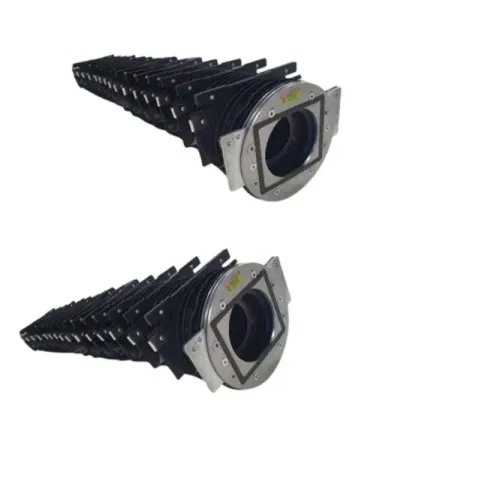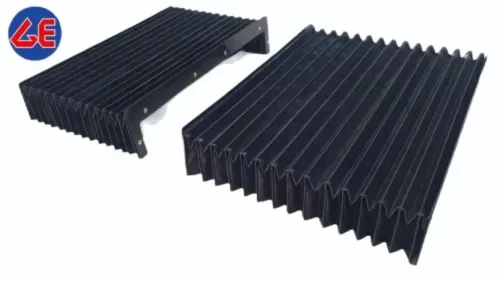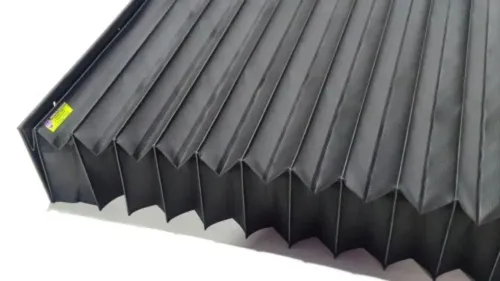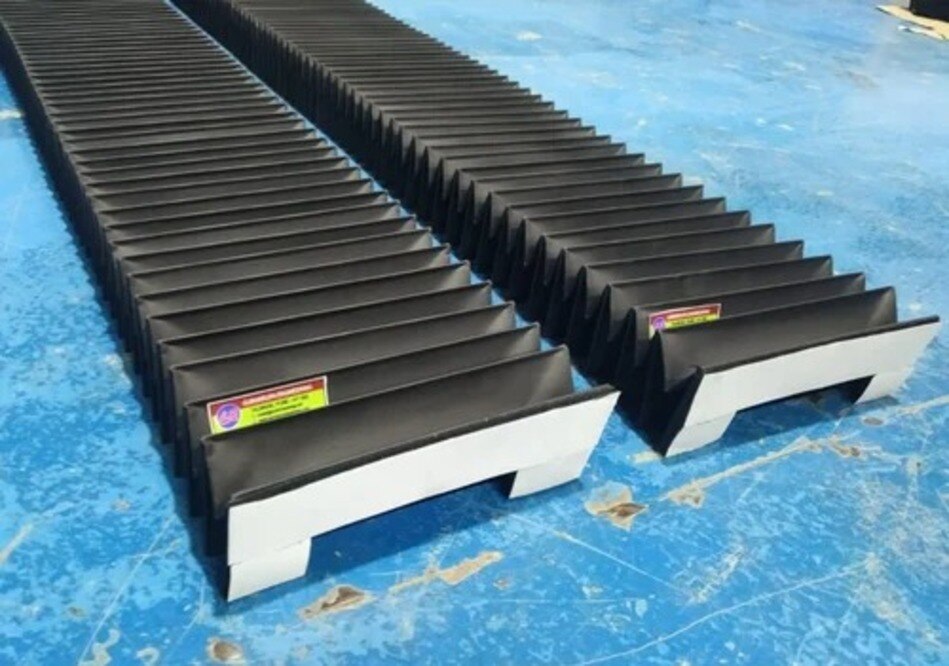
An uncovered laser machine exposes its motion system to more than ordinary dust: dross, abrasive metal particles, smoke residue, coolant and hot spatter can reach rails, screws, sensors and cable routes. By the end, you will be able to identify what a bellow protects, inspect an existing machine for contamination damage, compare alternative guards and specify a cover without restricting axis travel.
Key takeaways
- Uncovered axes expose rails, screws, encoders, cables, and hoses to debris and impact.
- Inspect residue, scoring, wiper damage, and repeated cleaning as signs protection is needed.
- Specify compressed length, travel, mounting space, heat exposure, and process residue before buying.
- Use heat-resistant or chemically compatible materials when sparks, hot chips, or fumes reach the axis.
What a bellow protects that an uncovered laser axis leaves exposed
With no cover, a laser axis leaves its guideways, linear rails, ball screws, racks, rollers, encoders, wipers and other moving parts open to contamination and impact. The same exposure reaches cables and hoses when they run beside the axis.
The hazards include:
- Metal dust, dross and abrasive debris
- Smoke residue and condensed process deposits
- Coolant, oil and contaminated lubricant
- Hot sparks and molten spatter
A correctly positioned bellow creates a local barrier around the guideway. It can also shield nearby cables and hoses inside its protected envelope, while protecting motors and sensors indirectly by keeping contamination away from their moving or sensing interfaces.
Unprotected debris raises friction, and gritty grease becomes an abrasive paste. The result can be rail scoring, vibration, noise, positioning error, poorer repeatability, backlash symptoms and accelerated wear. These are central laser machine bellows benefits compared with no cover, although the cover adds folds, seams and parts that require inspection.
The boundary matters: a conventional axis bellow does not cover the laser head, focusing lens, mirrors, nozzle or work area unless a separate guard surrounds them. It is not a laser-radiation enclosure. Openings, wipers, seams and mounting interfaces remain ingress paths, so it does not make the machine contamination-proof.
That is the practical distinction in laser machine bellow covers compared with no cover: local contamination control, not complete isolation.
How to tell whether an uncovered machine already needs protection
Lock out the machine before inspection, then clean only accessible surfaces without moving the carriage into an unprotected area. An uncovered axis already needs protection when contamination or wear appears on the rail, carriage, cables, or sensors rather than only on the surrounding sheet metal.
1. Photograph the exposed axis before and after cleaning. Record the rail length, axis with the worst contamination, current guideway-cleaning frequency, and any dross trapped beside the carriage.
2. Inspect the rail and carriage closely, not by visual glance alone. Look for longitudinal scoring, pitted running surfaces, black grit or metal flakes in grease, seized rollers, and torn or hardened wipers.
3. Check repeated bend points on cable jackets for rubbing-through, inspect hose fittings for looseness, and review intermittent limit-switch or encoder faults. A sensor fault after cutting strongly supports contamination control.
4. Check movement only under the machine’s approved safe procedure. Rising axis friction during a slow manual or controlled jog, unusual noise, vibration, backlash symptoms, increasing motor load, or loss of positioning repeatability indicates developing damage.
Visible debris on the rail, dross beside a carriage, or gritty grease is direct evidence that contamination is reaching the motion system. Laser machine protection covers can reduce new contamination, but they cannot restore a scored rail, replace a seized bearing, repair a damaged cable, or correct a failed sensor.
Use the inspection record to show the supplier where laser machine protection covers need to start, end, and clear the carriage. Inspect existing damage first; specify prevention second.
How cover design changes protection, travel and interference risk
A bellow that matches the drawing can still fail in service if its compressed package, folds or mounting frame conflicts with the machine. Laser machine protection covers must be specified for the complete motion profile, not nominal stroke alone.
Require the supplier drawing to show:
- Guideway width and height, axis stroke, extended and compressed cover length, fold pitch and minimum fold height
- Mounting-hole pattern, mounting clearance, moving-axis speed and acceleration
- Bend radius, support details, and nearby cable or hose routes
Compare the cover’s motion envelope with the carriage at both travel limits. An over-compressed cover can rub, heat up, collapse its folds or push debris into the rail. An unsupported cover can sag into the laser head path, a mounting frame can restrict stroke, and a fold can snag a cable carrier.
A bellow and an energy chain solve different problems: the bellow shields an axis; the carrier controls cable bend radius and routing. Combining them requires clearance and fatigue checks.
| Option | Protection and space trade-off | Main risk |
|---|---|---|
| Exposed wipers or brush seals | Less space, more surface exposed | Contamination reaches moving parts |
| Telescopic steel covers | Impact resistance | Added mass and packaging |
| Rigid guards | Protect a fixed zone | Limited coverage during travel |
| Full enclosure | Larger contamination and safety boundary | More space and installation effort |
These laser machine bellows benefits apply only when the design avoids interference and fits the actual axis.
When heat and process residue require more than a general bellow
A “heat resistant” or “flame retardant” fabric claim is not enough near a cutting zone. Outside the direct process area, laser machine protection covers mainly need resistance to dust, coolant, oil and repeated flexing; near the cut, they face radiant heat, hot sparks, molten metal, dross, smoke condensate and cleaning chemicals.
Specify a shield or sacrificial layer.
- Ask for the actual construction, operating temperature range, flame test or rating, chemical-resistance data, liquid-spray limits, abrasion performance, laser-wavelength and radiant-heat exclusions, expected flex life and service conditions.
- Confirm whether the cover suits the cutting distance, radiant exposure and particle direction. A thicker fabric alone will not solve repeated dross deposits; improve extraction, airflow, shielding, scraper geometry or cover position when residue keeps landing on it.
- Treat a bellow as a local barrier, not a repair. It cannot correct poor fume extraction, an incorrect cutting table, misaligned rails, damaged seals, excessive heat exposure or a defective enclosure, and it cannot evacuate process residue.
Maintenance determines whether the laser machine bellows benefits continue. Clean folded sections, remove trapped particles, inspect stitching or welds, check wipers and mounting points, and watch for tears, pinholes, delamination, cracked coatings and changed motion resistance. Cleaning is enough while the cover remains intact.
Replace a fold, mounting plate, seam or attachment when it no longer holds position or leaves the rail exposed.
How to specify and buy a cover without paying for the wrong protection
Preventive installation earns its cost when recurring rail cleaning, replacement wipers, repairs and unplanned stoppage exceed the cover’s installation and planned-cleaning burden. For laser machine bellow covers in Delhi, compare that total rather than accepting “suitable for laser machines” as a specification.
Give the supplier:
- Laser type and wavelength; axis name; rail length; guideway width and height; stroke; compressed and extended cover length; maximum speed and acceleration.
- Mounting-hole pattern, orientation, ambient temperature, dust level, coolant and oil exposure, hot-particle exposure, cleaning chemicals, cable and hose routes, and required service life.
- Photographs of both travel limits, the carriage underside, rail ends and nearby cable carriers. Arrange a site inspection or supervised measurement before fabrication.
Ask for a dimensioned drawing, material and construction description, test method, temperature range, flame rating, chemical-resistance evidence, liquid-spray limits and exclusions. Reject a generic IP number unless the complete cover-and-mounting arrangement was tested. A flexible bellow is not automatically an IP-rated enclosure or laser-safety enclosure.
| Option | Main cost | Suitable decision |
|---|---|---|
| Bellow installation | Purchase, fitting and planned cleaning | Repeated contamination already consumes labour |
| No cover | Rail cleaning, wipers, repairs and downtime | Exposure is low and access is easy |
GURUKRUPA BELLOWS PVT LTD can be evaluated by whether it checks clearances and travel limits instead of quoting only from nominal stroke. After initial operation, reinspect full travel, rubbing, fold stability and debris pushed inward.
Related products
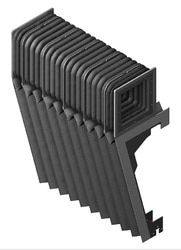 | Laser Cutting Machine Bellows ₹1000 We offer Laser Cutting Machine Bellows made specifically for your laser machine. View product → |
 | Laser Machine Bellows ₹1000 We are committed to manufacture, export, and supply a qualitative range of Laser Machine Bellows for our esteemed clients. View product → |
Frequently asked questions
What does a bellow protect on a laser machine?
It shields guideways, linear rails, ball screws, racks, rollers, encoders, wipers, cables, and hoses from dust, debris, impact, and process residue.
How can you tell whether an uncovered laser axis needs protection?
Look for debris on moving parts, scoring, damaged wipers, residue buildup, exposed cables or hoses, frequent cleaning, and contamination-related positioning problems.
How does bellow design affect laser-axis travel?
The cover must collapse within the available space while providing the required travel. Incorrect compressed length, mounting dimensions, or interference clearance can restrict movement.
When does a laser machine need more than a general bellow?
Choose a specialised design when the axis receives sparks, hot chips, high radiant heat, coolant, oil, aggressive fumes, or abrasive process residue.
What should you specify when buying a laser machine protection cover?
Provide axis travel, extended and compressed lengths, cross-section, mounting points, moving speed, temperature exposure, residue type, and clearance around the moving assembly.
Related product
 | Bellow Cover The range of CNC Bellow Cover is manufactured on our premises, under the guidance of our expert professionals. View product → |