The right cover depends on the axis duty, contamination, available envelope, and the cost of failure—not on nominal travel alone. By comparing cover types, collecting the correct machine data, and demanding written operating limits, you can decide whether telescopic protection justifies its price for your machine design.
Key takeaways
- Choose steel covers for hot chips, abrasive dust, and high-pressure coolant.
- Send travel, dimensions, speed, temperature, and coolant details for an accurate quotation.
- Check scraping, binding, corrosion, and collapsed sections during machine trials.
- Compare tested fit, service support, and documented operating limits—not price alone.
When does telescopic protection justify its cost?
Telescopic protection for machine tools earns its cost when contamination threatens a costly failure, not merely because an axis moves. A custom steel cover suits CNC turning centres and machining centres exposed to hot, sharp chips, abrasive cast-iron dust, or high-pressure coolant that can damage guideways, ballscrews, racks, or linear scales.
Are telescopic bellow covers worth it for machine tool makers in Gurgaon? Use this comparison:
| Option | Cost case | Best fit |
|---|---|---|
| Steel telescopic cover | Justified by chip impact resistance and protection against coolant ingress | High-duty CNC turning centres and machining centres |
| Fabric or elastomeric telescopic bellows | Justified when low moving mass, short collapsed length, or flexible geometry matters more than impact resistance | Compact or irregular axes with limited chip exposure |
| Fixed guard, way wiper, rolling curtain, or partial shield | Better value when contamination, travel, and cycle frequency are low | Inspection machines, robotic enclosures, low-cycle axes, or protected ballscrews |
Compare the quotation with installation changes, replacement wipers, cleaning time, service access, and one contamination-related stoppage. Wipers wear out; obtain their replacement dimensions and material specification before approval.
A positive decision requires the cover to stop a known failure mode without exceeding the axis moving-mass or space limits. Gurgaon builders should also price commissioning support and replacement availability. A cheaper cover that delays installation or leaves you waiting for a wiper can cost more than the original saving.
Which cover type matches the machine environment?
Match the cover to the chip load, coolant pressure, geometry, and available space—not to the machine name alone.
| Option | What it means | When it applies |
|---|---|---|
| Telescopic steel cover | Overlapping rigid sections with guides, rollers or sliding interfaces, end frames, scrapers, and drainage paths | Long linear axes exposed to hot, sharp, heavy, or stringy chips |
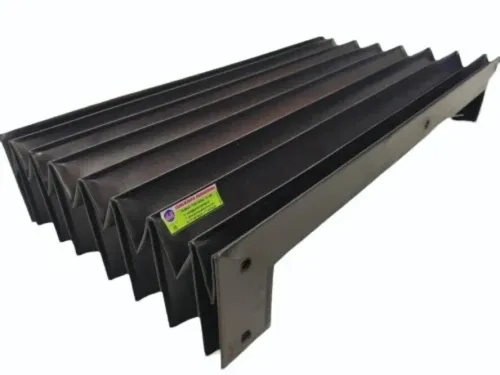
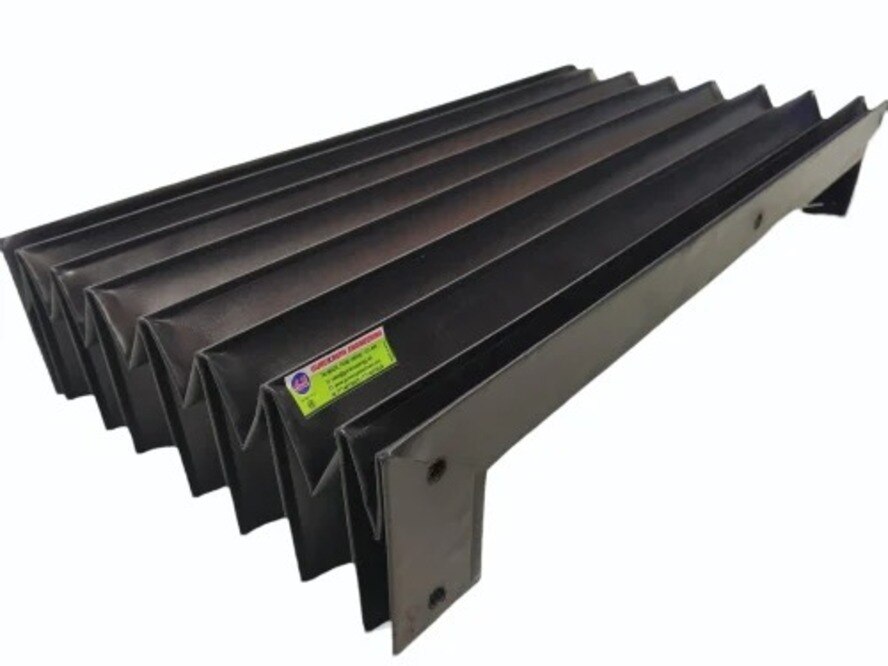
| Telescopic machine bellows | Fabric or elastomeric folds with low mass and compact collapse | Irregular shapes, tight spaces, or limited chip impact; folds can be cut, burned, clogged, or abraded |
| Conventional sewn bellows | Flexible stitched cover, not an interchangeable telescopic system | Simple moving protection where the geometry and exposure suit its construction |
| Rolling curtain | Flexible curtain that winds along a defined path | Broad openings with room for a reliable winding and return route |
| Way wiper | Wear strip that removes residue at an exposed sliding interface | Light contamination; it does not replace a cover when chips strike the guideway |
| Fixed guard | Rigid stationary barrier | Robust separation around a non-moving zone; it cannot follow an axis |
For telescopic bellow covers, choose coated sheet or stainless steel where coolant and corrosion matter. Specify fabric, internal liners, seals, and wiper compounds against the actual oil, coolant, abrasive dust, welding spatter, and temperature. High-pressure coolant demands inter-section seals, end sealing, and drainage tested with the real nozzle direction.
Use a hybrid when steel must absorb chip impact but flexible material must follow an irregular, space-limited section.
What machine data must you send before requesting a quotation?
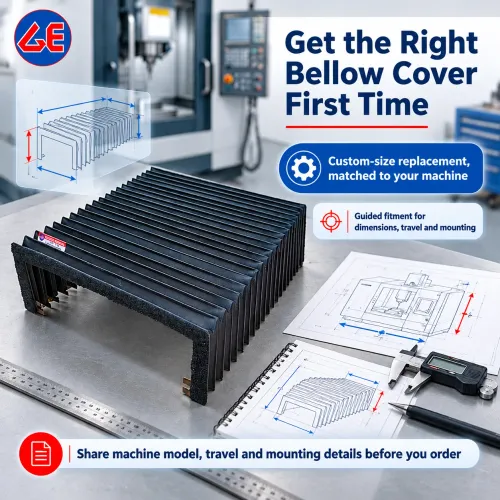
1. Send the axis geometry, not only nominal travel: maximum and minimum travel, required closed and extended lengths, cover height and width, guideway geometry, mounting-hole pattern, expansion direction, available installation envelope, adjacent obstructions, allowable collapsed length, and the axis moving-mass limit. Include the maximum traverse speed, acceleration, cycle frequency, stopping behaviour, and axis orientation.
These figures size telescopic protection for machine tools correctly; collapsed length can obstruct a tool changer or enclosure door even when extended travel is adequate.
2. Mark the tool changer, workholding, enclosure door, chip conveyor, neighbouring axis, and service access on drawings at fully closed and fully extended positions. Show every clearance and the mounting face.
Describe chip type and size, hot-chip temperature, abrasive dust, coolant name and concentration, oil exposure, nozzle pressure, spray direction, vibration, and expected folding or sliding cycles. A cover rated for a speed is not automatically rated for your acceleration profile, section weight, or cycle frequency.
3. Request a dimensional approval drawing showing the complete envelope, section overlap, mounting details, wiper material, and drainage arrangement. Require written permissible limits for speed, acceleration, temperature, coolant exposure, chip impact, and vibration, plus the supplier’s test method. Ask for replacement-wiper dimensions and wear-part details.
If no documented test method supports a stated limit, treat it as unresolved rather than accepting a generic rating.
How do telescopic covers fail during real machine operation?
Dry travel can hide failures that appear only under load, coolant, chips, and acceleration. Telescopic bellow covers need controlled overlap, straight guides, correctly loaded rollers or sliding interfaces, rigid end frames, effective scrapers, and drainage that stops coolant and chips collecting between slats.
Misalignment twists the sections, raises friction, overloads connections, and creates rattling or resonance at particular speeds. Machine-frame distortion can pass through mounting brackets into the cover, while loose slat links can let a section lift during travel.
Inspect or demand evidence for:
- Chips packing into telescoping gaps, wipers hardening or tearing, and wipers losing contact with the slats.
- Inter-section seals, end seals, and a drainage route tested with the actual high-pressure coolant nozzle direction and pressure.
- A machine-specific trial using the intended chip mix, coolant, speed, acceleration, and cycle frequency—not dry travel alone.
- Replacement wiper dimensions, compound or material specification, inspection intervals, and safe access instructions.
- Grinding protection specified separately for abrasive dust and sparks. ISO 16089 addresses stationary grinding-machine safety; ISO 12100 and ISO 14120 support risk assessment and guarding decisions where applicable.
- A clear boundary between telescopic protection for machine tools and operator guarding: the cover protects guideways, ballscrews, racks, or scales, but it is not automatically a personnel guard.
If alignment is wrong, even undamaged slats can fail through friction, vibration, seal wear, or connection overload. Judge the design under the machine’s real duty.
How should Gurgaon builders compare suppliers and approve the purchase?
Compare telescopic bellow cover suppliers in Gurgaon on commissioning and service risk, not distance or maximum travel. The question “are telescopic bellow covers worth it for machine tool makers in Gurgaon” is answered by evidence: does the proposed design survive the duty, fit the machine, and receive support when it fails?
Ask every supplier for:
- A dimensional approval drawing showing the closed and extended envelope, section construction, mounting points, and drainage route.
- Material grades, wiper and seal specifications, spare wear parts, inspection intervals, and installation instructions.
- Documented speed, acceleration, temperature, coolant, chip-load, and cycle-frequency limits, plus the test method used.
- Warranty exclusions, a statement covering chip or coolant ingress, the conditions that void coverage, and the response time for site correction.
Compare the submissions against the same approval test.
| Evidence | Approval question | Reject when |
|---|---|---|
| Drawing | Does it clear the tool changer, chip conveyor, enclosure, workholding, and adjacent axis at both positions? | It shows travel but not the complete envelope. |
| Operating data | Does the cover stay within the axis moving-mass limit and your acceleration profile? | The quotation gives only a generic speed claim. |
| Service plan | Are replacement wipers available with defined material and dimensions? | Wear parts, installation support, or correction time is unspecified. |
GURUKRUPA BELLOWS PVT LTD can be evaluated beside other suppliers using this checklist; local value lies in faster dimensional correction, commissioning support, and replacement-wiper access. Approve after a machine-specific trial records travel, acceleration, coolant spray, chips, temperature, noise, and drainage. Reject the purchase when foreseeable wear has no documented service response.
Related products
 | Telescopic Bellow Cover ₹1000 Product Details: Brand GURUKRUPA Ours is a distinguished name in the business that manufactures and supplies Telescopic Bellow Cover that is vastly... View product → |
 | Telescopic Cover Product Details: Brand GURUKRUPA Being one of the trustworthy names of the industry, we bring forth CNC Telescopic Cover that can be availed at... View product → |
Frequently asked questions
When do telescopic bellow covers justify their cost?
They justify the cost when chips, dust, coolant, heat, or corrosion could damage guideways, ballscrews, racks, or linear scales.
Which cover type matches a machine-tool environment?
Use custom steel covers for hot sharp chips, abrasive cast-iron dust, and high-pressure coolant. Select fabric or flexible bellows when the application needs lighter, compliant protection.
What machine data should you send before requesting a quotation?
Send machine and axis details, closed and extended lengths, width and height limits, travel speed, acceleration, mounting points, stroke, chip load, coolant type, temperature, and available installation space.
How do telescopic covers fail during machine operation?
Common failures include scraping, binding, inadequate support, coolant or chip ingress, corrosion, torn wipers, loose fasteners, and incorrect sizing for the axis movement.
How should Gurgaon machine-tool builders compare suppliers?
Compare engineering drawings, material and finish, tested travel performance, wiper design, delivery capability, warranty terms, installation support, and documented operating limits before approving a purchase.
Related products
 | CNC Telescopic Cover Product Details: Brand GURUKRUPA Being one of the trustworthy names of the industry, we bring forth CNC Telescopic Cover that can be availed at... View product → |
 | Telescopic Cover ₹5000 Product Details: Brand GURUKRUPA Being one of the trustworthy names of the industry, we bring forth CNC Telescopic Cover that can be availed at... View product → |
 | Steel Telescopic Cover Product Details: Brand GURUKRUPA Our company is considered a renowned name in the field that manufactures and supplies Steel Telescopic Cover. View product → |
 | Industrial Telescopic Covers Our company is known as one of the eminent names of the industry to manufacture and supply Industrial Telescopic Covers. View product → |