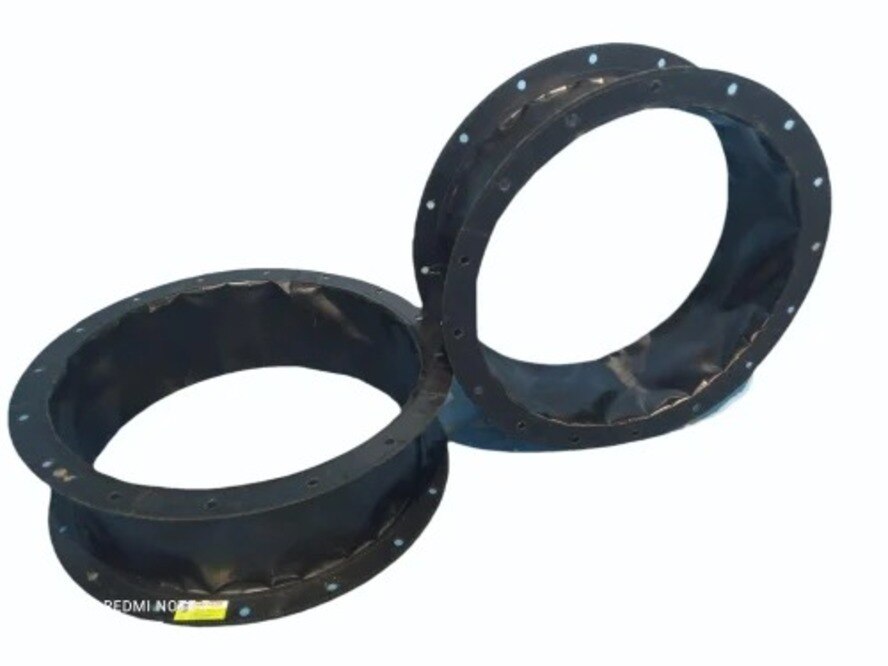
Choose the cover from the joint’s full movement, thermal, chemical, pressure, and abrasion duty—not from the nominal opening or a headline temperature rating. By the end, you will have a specification and measurement checklist that distinguishes an internal liner, external protective cover, and flexible sealing element, and gives a supplier enough information to design the assembly correctly.
Key takeaways
- Define axial, lateral, angular movement and temperature before selecting a cover.
- Choose fabric and coating for heat, chemicals, abrasion, moisture, and fire exposure.
- Measure fabric bellow cover sizes from the complete drawing, not the nominal opening.
- Approve the assembly only after checking fit, movement, seals, and installation clearances.
Start with the complete movement and service envelope
Define the complete movement and service envelope before comparing fabric expansion joint bellow covers. The practical answer to how to choose bellow covers for a fabric expansion joint starts with what the assembly must survive, not its nominal opening.
1. Record installed length, minimum and maximum length, axial compression and extension, lateral offset, angular movement, torsion, vibration, and cycle frequency. Evaluate combined movements together: lateral offset can reduce available axial stroke and concentrate strain in the folds.
2. State operating pressure, pressure excursions, vacuum, gas velocity, pulsation, and fan start-up and shutdown conditions. Positive pressure can inflate the joint and cause frame rubbing or leakage; vacuum can collapse it.
3. Separate continuous temperature, short peak temperature, cycling rate, and heat conducted through the frame. The coating rating does not automatically rate the assembly; thread, adhesive, insulation, liner, fasteners, and corners can fail first.
4. Describe the exposure and duty: chemicals, oil, moisture, weather, fire risk, chips, dust, coolant, and abrasion. Identify whether the cover protects a machine component or also controls duct leakage, pressure, temperature, vibration, or insulation.
5. Specify orientation and maintenance conditions. Horizontal folds can retain chips, condensate, or dust, while vertical covers load their attachments differently; include drainage, fold direction, cleaning access, and resistance to packing.
Give the supplier this envelope in writing, with expected cycle count and any permissible leakage or deformation. A cover selected from opening size alone can fit at rest and fail during its first combined movement.
Match the fabric and coating to the actual exposure
Specify the laminate from the worst exposure, not the nominal temperature alone. Fabric expansion bellow selection must distinguish continuous heat, short peaks, thermal cycling, and heat conducted through the frame; thread, adhesive, liner, fasteners, seams, and corner details can fail before the fabric does.
A 1000°C rating for one layer does not make the finished cover suitable for 1000°C service.
Match the construction to these conditions:
- Chemicals: choose PTFE-coated glass fabric for aggressive gases and solvents; verify concentration, temperature, permeation, and chemical attack on the seam or adhesive.
- Heat and fire: use silicone-coated glass fabric or a multilayer heat shield when hot surfaces, sparks, or flame exposure governs. Add insulation where radiant or conducted heat reaches the attachment.
- Weather: specify UV-, ozone-, moisture-, and freeze-resistant coatings for outdoor service. A coating that survives heat may crack after repeated cold-weather flexing.
- Pressure: treat positive pressure, vacuum, gas velocity, pulsation, and fan start-up separately. Internal pressure can inflate the joint and rub the frame; vacuum can collapse it. Use clamping bars, welded seams, or another defined attachment rather than naming only the base fabric.
- Abrasion: add a sacrificial outer layer or high-toughness elastomer where dust, chips, folds, or flow-borne particles strike the cover. Chemical resistance alone does not prevent cut-through.
- Movement: check fold-flex life at operating temperature, because a stiff coating can crack or delaminate at repeated axial, lateral, or angular movement.
Fabric expansion joint bellow covers for ducting may control leakage and pressure, unlike a machine enclosure intended only to block debris. Specify the seam construction and test the complete assembly, not just its fabric coupon.
Specify the cover’s job, construction, and life requirements
Classify the part by what failure would expose: a liner shields the joint from heat, dust, chemicals, or abrasion; an external cover protects the moving assembly from the surroundings; a sealing element controls leakage across the joint.
Do not specify a machine-tool enclosure as a pressure boundary unless it has been designed and tested for that duty.
Set the life requirement from the hardest movement, not the static opening. Fabric expansion bellow selection should include the smallest fold radius, stroke frequency, acceleration, dwell time, expected cycle count, and minimum bend radius throughout travel. A cover that survives slow manual movement can crack or tear under rapid reciprocation.
Put the complete movement envelope on the specification:
- Axial compression and extension, lateral offset, angular movement, vibration, and torsion
- Combined movements at maximum travel, because offset can reduce axial stroke and concentrate fold strain
- Positive pressure, vacuum, pressure pulsation, gas velocity, and fan start-up and shutdown conditions
- Required service cycles, inspection interval, and replacement-life target
Build the cover with enough fold depth and clearance to move without rubbing the frame, adjacent folds, cables, or insulation. Identify the seam and attachment method on the drawing: sewn, welded, heat-sealed, bonded, clamped, or bolted constructions differ in flex life, permeability, temperature limit, and tear-out resistance.
Reinforce corners, bolt holes, and load-bearing edges where wear starts.
For bellow covers for machine systems, add replaceable wear strips or sacrificial rubbing layers when chips or guideway contact is unavoidable. Require the supplier to state the finished assembly’s cycle rating, not merely the base fabric specification.
Measure fabric bellow cover sizes from a drawing, not a nominal opening
A nominal opening is not a usable size. Fabric bellow cover sizes depend on installed geometry, attachment points, and the space consumed at the worst combined position. Dimension the assembly from fixed datums; never ask a supplier to scale a sketch or infer the length from the opening alone.
Put these details on the purchasing drawing:
- Clear opening width and height at the attachment plane.
- Installed face-to-face length, plus minimum and maximum operating lengths.
- Fold depth, number of folds, and the compressed fold stack.
- Flange or frame width, thickness, corner radii, and bolt-hole pattern.
- Hole diameters, slot details, bolt-circle dimensions, and the attachment datum.
- Axial compression and extension, lateral offset, angular movement, and torsional movement.
- Minimum bend radius and the direction of each movement.
- Required clearance from folds, frames, guideways, cables, duct walls, insulation, and nearby hardware at maximum combined travel.
- Manufacturing tolerances, seam locations, and any area that must remain accessible for cleaning.
Show the clearance envelope in plan, elevation, and section views. An offset can consume axial stroke and force a tighter fold radius, so do not check each movement separately.
Mark the installed orientation as well: horizontal fabric expansion joint bellow covers need fold orientation and drainage provisions, while vertical covers need attachment points that carry the cover’s weight without restricting movement.
Include operating position, travel limits, cycle direction, and the clearance at start-up, shutdown, and full stroke. A drawing that shows only the opening can produce a cover that fits at rest but rubs, packs with debris, or tears during operation.
Validate the finished assembly before approving it for service
Approval depends on a witnessed cycle that reproduces the installed assembly’s real duty, not a slow hand movement on an unloaded sample. Define acceptance limits before testing: no fabric tear, seam opening, delamination, fastener loosening, fold contact, or permanent deformation that reduces clearance.
Treat a machine cover as a protective enclosure, not a pressure boundary, unless the design specifically assigns it that role.
1. Measure the installed opening, face-to-face length, fold depth, and clearances at minimum and maximum travel. Confirm that axial stroke, lateral offset, angular movement, torsion, and vibration occur together without rubbing the frame or adjacent hardware.
2. Run the expected cycle count at the specified speed, acceleration, dwell time, and smallest bend radius. A cover that passes ten slow strokes can fail rapidly under continuous reciprocation.
3. Test pressure and vacuum excursions when the joint carries flow. Check inflation, collapse, frame leakage, and stability during fan start-up, shutdown, and pulsation; use a leak test only when sealing is part of the duty.
4. Inspect horizontal folds for trapped chips, coolant, condensate, or dust, then verify drainage and cleaning access. Confirm vertical attachment loads and inspect every seam, corner, bolt, and clamp after cycling.
5. Record temperature exposure and examine the cover while hot and after cooling. Approve it only when the documented results match the drawing and acceptance limits.
This is the evidence needed for how to choose bellow covers for a fabric expansion joint and for selecting bellow covers for machine systems. GURUKRUPA BELLOWS PVT LTD can use those recorded movement, clearance, and test limits to distinguish a suitable custom assembly from a nominal-size substitute.
Related products
 | Fabric Expantion Bellow ₹1000 Make in Heavy duty Fabric’s View product → |
 | Bellow Cover We are considered a well-known name in the business that manufactures and supplies Bellow Cover. View product → |
Frequently asked questions
What movement information is needed before choosing a fabric expansion joint bellow cover?
Record axial compression and extension, lateral offset, angular deflection, operating temperature, pressure, vibration, installation movement, and the available clearance around the joint.
How do you match fabric and coating to the service environment?
Identify the highest continuous and peak temperature, chemical contact, dust, moisture, abrasion, ultraviolet exposure, and fire requirements, then select a fabric and coating rated for those conditions.
What should a fabric bellow cover specification include?
Specify the cover’s purpose, fabric and coating, construction layers, attachment method, movement range, temperature range, sealing details, inspection points, and expected service life.
How should you measure fabric bellow cover sizes?
Use the assembly drawing to record opening dimensions, flange or mounting locations, compressed and extended lengths, corner geometry, bolt patterns, and clearance to nearby machine parts.
How do you validate a finished fabric expansion joint bellow cover?
Check dimensions, material certificates, seams, fasteners, seals, clearance, movement through the full range, and resistance to the stated service conditions before release.
Related products
 | Fabric Joints Product Details: Brand GURUKRUPA With its dimensional accuracy and durability, the offered range of Fabric Joints is known to be amongst the finest... View product → |
 | Product Details: Brand Gurukrupa Material Nylon Fabric coated with polyurethane Max Temp Resistance 1000 C Offered in the market at the most... View product → |