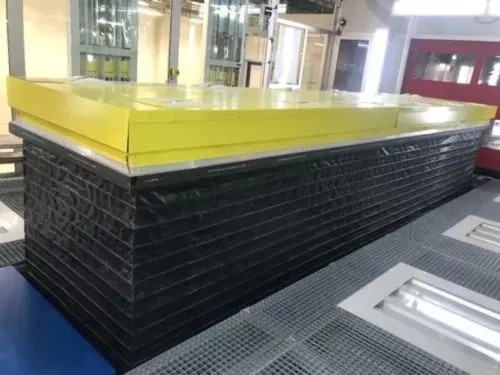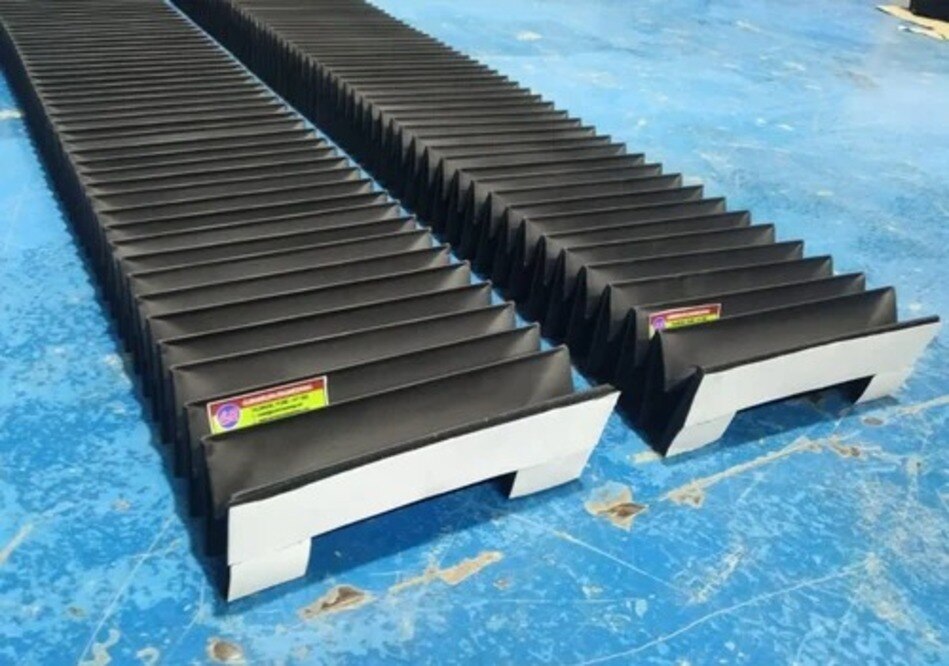
A laser-axis bellow cover must survive a specific combination of radiant heat, sparks, molten-metal spatter, smoke residue, abrasive dust, coolant, and repeated folding. By the end, you will know how to select the material and seam construction, measure a replacement on site, and prepare a custom specification that a Gurgaon manufacturer can quote accurately.
Key takeaways
- Choose fabric from wavelength, heat, sparks, coolant, oil, and cleaning chemicals.
- Use thermal welding for sealed seams when dust and coolant ingress matter.
- Specify compressed length, extension, folded height, travel, speed, and acceleration.
- Measure the laser layout before ordering a custom cover in Gurgaon.
Choose the material from the hazard set, not the machine name
Start with the hazard set, not the machine name: identify laser wavelength and exposure risk, chip type, coolant or oil, radiant heat, sparks, cleaning chemicals, travel speed, acceleration, and required service life. A flame-retardant fabric is not automatically resistant to direct laser radiation.
For laser machine bellow covers for materials in Gurgaon, match the construction to the contamination and movement at the installation site. Gurgaon dust, monsoon moisture, and coolant residue matter, but they do not select one universal fabric.
| Material construction | Best fit | Main limitation |
|---|---|---|
| PU- or PVC-coated polyester | Chips, dust, coolant, oil, and repeated high-speed travel | Coating can soften, crack, or burn under radiant heat and sparks |
| Silicone-coated fiberglass | Hot chips, sparks, and higher radiant heat | Abrasion, flex-fatigue, and chemical compatibility require verification |
| Aramid or glass-fibre fabric | Heat and spark exposure where tear resistance matters | Not proof against direct laser-beam exposure; inspect coating and seams |
| PTFE-coated glass fabric | Aggressive chemicals, oils, and elevated temperatures | Higher cost and reduced flexibility can limit tight folds |
| Stainless-steel lamella or strips | Severe abrasion, sharp chips, and impact | Added mass can increase drive load and reduce acceleration |
Choose the lightest construction that survives the actual hazard set. Ask for the coating type, operating temperature range, chemical-resistance data, abrasion performance, and allowable laser-radiation exposure; the fabric name alone is not a specification.
Then confirm that the seam and fold design suits the required travel, because a heat-resistant material can still fail through cracked coatings, torn stitching, or excessive fold friction.
Compare thermal welding, sewn seams, and folded constructions
A specification stating laser machine bellow covers thermal welding names a joining process, not a heat rating. Thermal welding can seal dust and coolant paths, but an incompatible coating, excessive heat, or repeated sharp folding can still cause cracking, delamination, or seam opening.
| Construction | Laser heat and sparks | Coolant and dust | High-speed travel |
|---|---|---|---|
| Thermal welding | Clean sealed joints reduce exposed thread and spark-catching edges; radiant heat can damage the heat-affected seam. | Strong sealing when the coating accepts hot-air, hot-wedge, or radio-frequency welding. | Smooth joints reduce snagging, but repeated folds require flex testing at the actual geometry. |
| Sewn seams | Thread and needle holes remain vulnerable to sparks, radiant heat, and abrasion. | Coolant can wick through stitching, while fine dust enters unsealed punctures. | Flexible and repairable, but thread wear and seam flutter increase with speed and acceleration. |
| Perforated folds | Relief holes reduce fold stiffness, yet open perforations admit sparks and direct heat. | Poor choice for fine dust or coolant unless a sealed backing closes every opening. | Folds compress easily, but perforation edges can tear during rapid cycling. |
| Combination folds | Heat-resistant outer panels can shield sewn or relieved fold zones from sparks. | A welded perimeter with stitched reinforcement balances sealing and repair access. | Suits demanding travel when each transition avoids rubbing, buckling, and excessive fold compression. |
Ask for a representative seam sample and test it through repeated flexing, chip or spark exposure, coolant contact, and inspection for pinholes, coating separation, cracking, and seam opening. A fabric name alone cannot prove performance.
Specify the dimensions and performance limits that control fit
Record the complete stroke, not only the extended length. Reliable laser machine bellow covers specifications must show the axis travel, compressed length, extended length, folded length, fold height, fold pitch, number of folds, cover width and height, and mounting-frame dimensions.
Measure clearance in both end positions. A cover that clears the guideway when extended can crush against tooling, cable carriers, or the enclosure when compressed.
- Axis travel and travel orientation: state horizontal, vertical, or inclined movement.
- Fold geometry: record minimum fold radius, fold height, fold pitch, and number of folds.
- Motion limits: provide maximum speed, acceleration, acceleration distance, and cycle frequency.
- Interfaces: dimension mounting holes, frame thickness, flange positions, and fixed-versus-moving ends.
- Operating conditions: record ambient temperature, radiant heat, coolant or oil type, cleaning chemicals, dust, chips, and sparks.
- Laser exposure: identify wavelength, irradiance, exposure duration, beam movement, and whether direct or reflected radiation can reach the cover.
| Position | Measurements to verify | Fit risk if missed |
|---|---|---|
| Compressed | Folded length, minimum height, width, and nearby obstructions | Folds collide with guides, tooling, or carriers |
| Extended | Full length, straightness, mounting alignment, and end clearance | The cover pulls tight or restricts travel |
| Throughout stroke | Minimum fold radius, moving envelope, speed, and acceleration | Seams fatigue, folds buckle, or the cover snags |
Include a clearance drawing with compressed and extended outlines. Confirm the material and joint construction against the recorded temperature, contaminants, and laser exposure instead of treating a flame-retardant rating as proof of laser resistance.
Match the cover to the laser layout and safety risk
Identify the part being protected before specifying fabric: a guideway cover, cable carrier, and laser-head shield solve different failures.
| Part | Primary job | Check before selection |
|---|---|---|
| Guideway cover | Keeps chips, coolant, dust, and sparks off rails and moving axes | Confirm compressed clearance, mounting frames, stroke, and collision risk |
| Cable carrier | Routes cables and hoses while controlling bend radius | Check cable fill, minimum bend radius, travel, acceleration, and separation from the bellows |
| Laser-head shield | Protects the head, optics, nozzle, and nearby parts from spatter or debris | Check head geometry, beam path, heat, access, and whether direct or reflected radiation can reach it |
Do not force cables into a moving bellow. Use a separate carrier, hose, or cable-management system unless an interference check confirms the cable bend radius and full-stroke clearance.
Treat the bellow as one part of the machine enclosure, not as proof of laser safety. If direct or reflected radiation can reach it, document the wavelength, irradiance, exposure duration, beam movement, and required enclosure classification. A metallicized surface alone proves nothing.
Use this evidence checklist before accepting protection claims:
- Ask for the flame or heat test standard, specimen construction, temperature, exposure time, and result.
- Require chemical-compatibility and abrasion or flex-cycle evidence for coolant, oil, dust, and repeated travel.
- For “laser-resistant” claims, demand a report covering the actual wavelength and exposure conditions.
- Verify that any safety claim applies to the complete enclosed machine and its interlocks, not merely the cover fabric.
Order a measured custom cover in Gurgaon
A measured custom cover starts with a machine drawing and a site check, not a request for extended length alone. For laser machine bellow covers custom sizes in Gurgaon, give the supplier:
1. A dimensioned drawing showing machine datum, axis travel, compressed and extended lengths, cover width and height, fold direction, fold height, number of folds, minimum clearance, mounting-hole pattern, flange or frame design, access openings, wipers, scrapers, reinforcement zones, and cable or coolant penetrations.
2. Site measurements covering the complete travel envelope, including obstructions at both ends, the guideway’s height changes, mounting-face flatness, minimum fold radius, travel orientation, maximum speed, and acceleration. Measure the installed machine; do not rely on CAD dimensions alone.
3. Clear photographs from both end positions and mid-travel, with a scale or ruler visible. Photograph mounting faces, holes, clamps, nearby hot surfaces, laser-head movement, chips, coolant lines, cable carriers, and any rubbing or spark marks.
4. A hazard note stating wavelength and beam-exposure risk, radiant heat, sparks, chip type, coolant or oil, cleaning chemicals, ambient temperature, and required service life. A bellows supplier does not certify the complete laser enclosure or its interlocks.
Ask whether the quote includes a production drawing, representative seam sample, declared speed and acceleration, tested temperature and chemical limits, spare frames, replacement lead time, and warranty exclusions. GURUKRUPA BELLOWS PVT LTD can be included in the comparison when its drawing and test limits are reviewed against competing quotations.
Related products
 | Laser Machine Bellows Product Details: Minimum Order Quantity 1 Number Brand GURUKRUPA Color BLACK, SILVER Size ALL Specifications: Capabilities Applied/Processes: Thermal... View product → |
 | Laser Cutting Machine Bellows ₹1000 We offer Laser Cutting Machine Bellows made specifically for your laser machine. View product → |
Frequently asked questions
How do you choose materials for laser machine bellow covers?
Start with laser wavelength and exposure risk, then check chip type, coolant, oil, radiant heat, sparks, cleaning chemicals, travel speed, acceleration, and service life. Flame-retardant fabric alone does not prove resistance to direct laser radiation.
When should you choose thermal welding for laser machine bellow covers?
Choose thermal welding when you need sealed joints that resist dust, coolant, oil, and repeated flexing. Compare the weld with sewn seams and folded constructions against the machine’s heat and contamination hazards.
Which laser machine bellow cover specifications control fit?
Provide compressed length, extended length, folded height, width, mounting dimensions, travel distance, speed, acceleration, clearances, bend geometry, and the required service life.
How do you order custom laser bellow cover sizes in Gurgaon?
Send a measured layout showing guideway dimensions, travel limits, mounting points, nearby cables and hoses, heat sources, laser exposure zones, and the cleaning environment. A manufacturer such as GURUKRUPA BELLOWS PVT LTD can use those measurements to assess a custom cover.