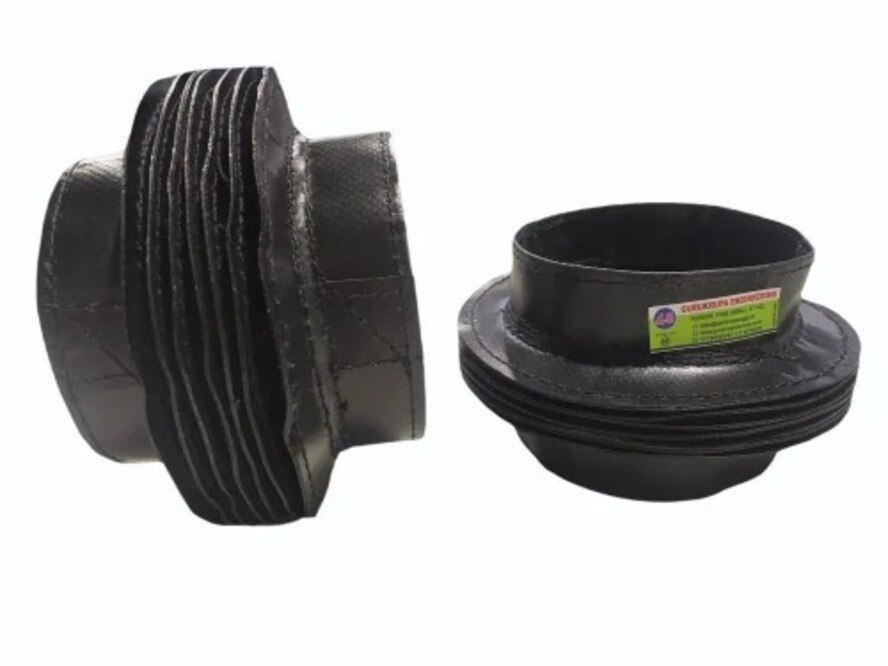
Choosing a cover for a moving shaft, cylinder, slide, cable, or guideway requires more than matching a diameter and stroke. By comparing motion, space, contamination, temperature, material, and test evidence, you can identify when a round rubber bellow is suitable and when another cover will last longer.
Key takeaways
- Measure closed length, extended length, bore, flange diameter, and mounting space.
- Choose rubber for axial motion with dust, coolant, and light chip exposure.
- Use steel or rigid guards when impact resistance matters more than flexibility.
- Specify stroke, cycle rate, temperature, chemicals, debris, and required service life.
Where a round rubber bellow fits among machinery covers
A round rubber bellow protects a moving rod, shaft, slide, joint, or cylinder from dust, coolant, light chips, and general shop contamination. Its molded or fabric-reinforced elastomer convolutions expand and collapse along the axis, enclosing a round member while allowing stroke.
It does not guide the shaft, carry side loads, or absorb torsion unless specifically designed and tested for those duties. The key question in round rubber bellow covers versus other covers is whether you need enclosed axial protection around one moving member, rather than a shield for a machine guideway.
| Option | What it protects | Main difference |
|---|---|---|
| Round rubber bellow | Rods, shafts, cylinders, joints | Close enclosure with axial extension and compression |
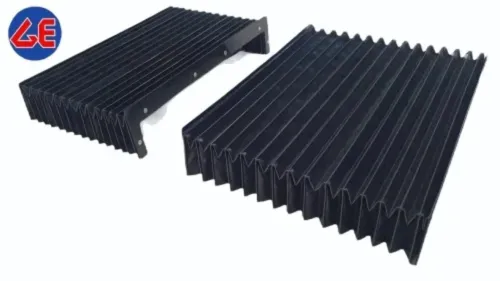
| Sewn fabric or accordion bellow | Slides, guideways, irregular assemblies | Flexible and lightweight, but seams and fabric need protection from sharp chips |
| Telescopic or guideway cover | Machine beds and linear guideways | Handles broad surfaces and long travel, not a round shaft |
| Spiral or roll-up cover | Rotating or translating round members | Can provide long travel with little axial stack, but depends on guiding and winding |
| Rubber boot | Joints, bearings, short exposed sections | Compact sealing, but limited stroke and shape flexibility |
| Rigid guard | Operators and large machine zones | Resists impact, but does not follow close axial movement |
A round bellow is the wrong starting point for large lateral movement, severe abrasion, sharp hot chips, high heat, pressure, vacuum, or aggressive chemicals. Long horizontal bellows and vibrating assemblies need guidance from the protected component or an internal support; otherwise convolutions can buckle, rub, twist, or tear.
Measure the moving assembly before choosing a cover
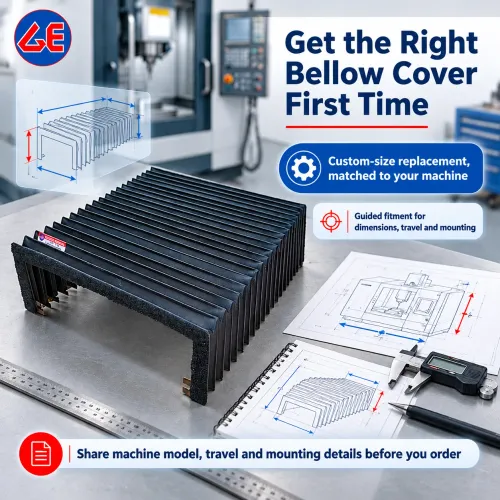
Measure the assembly at full extension and full compression before choosing a round bellow. The protected member’s diameter is only one part of the fit: the cover also needs clearance for its folds, end fittings, guides, and any sideways movement.
Record these measurements from the machine, not from a drawing:
- Minimum and maximum inside diameter around the rod, shaft, joint, or cylinder
- Maximum outside diameter available at every point along the travel
- Extended length, compressed length, and required stroke
- End-flange diameter, bolt circle, clamp width, or thread size
- Radial clearance to nearby guards, brackets, hoses, and moving parts
- Mounting orientation and the position of any guide or support
| Movement detail | What to measure | Failure if omitted |
|---|---|---|
| Axial stroke | Travel between hard end positions | Folds over-compress or the cover stays stretched |
| Lateral movement | Maximum sideways offset during travel | Folds rub the shaft or buckle against a guide |
| Angular movement | Joint angle at each end position | End fittings pull out or distort the first convolution |
| Speed and cycles | Travel rate and cycles per hour | Heat and fatigue shorten service life |
| Torsion | Degrees of rotation during one stroke | The bellow twists instead of flexing axially |
A long horizontal bellow, a vibrating assembly, or any design with lateral offset needs guidance from the protected component or an internal support. Do not use the bellow to carry side load, guide a shaft, or absorb torsion unless the supplier has tested that exact motion.
Match the cover to motion, contamination, and temperature
Axial movement on a shaft, rod, cylinder, slide, or joint favours a round rubber bellow. It handles extension and compression in a small radial envelope, runs quietly, and tolerates modest angular misalignment better than a rigid telescopic cover.
For round bellow covers for machinery, confirm the compressed length, stroke, speed, and convolution compression limit rather than relying on overall length.
| Condition | Round rubber bellow | Prefer another construction when |
|---|---|---|
| Axial stroke, dust, coolant, light chips | Good fit on a guided shaft or cylinder | Use a guideway or telescopic cover for a machine bed |
| Large lateral or torsional movement | Use only with internal or external guidance designed for that motion | Choose a flexible fabric or engineered sliding cover when movement exceeds the bellow’s tested range |
| Hot surfaces or radiant heat | Select a heat-rated compound after checking continuous temperature | Use metal, heat shields, or a high-temperature fabric construction when rubber approaches its rating |
| Sharp, heavy, or abrasive chips | Limited resistance; punctures and cuts shorten life | Choose telescopic steel or reinforced chip-resistant protection |
| Pressure differential or vacuum | Suitable only with a qualified wall, compound, and anti-collapse design | Use a pressure-rated boot or purpose-built vacuum bellows |
| Aggressive chemicals | Confirm compatibility with the exact fluid and concentration | Choose PTFE-lined, coated-fabric, or chemically resistant construction |
A round bellow should not carry side loads, guide a shaft, or absorb repeated torsion unless cycle testing proves it. High-volume machining with hot, sharp chips is the clearest case for another cover: rubber can shield coolant while still failing under chip impact. A static sample cannot reveal that fatigue.
Compare rubber, fabric, steel, plastic, and rigid protection
Choose molded rubber when a moving round member needs a quiet, enclosed seal and the contamination is light to moderate. A useful round rubber bellow covers comparison separates sealing, travel, impact resistance, and geometry rather than treating every cover as interchangeable.
| Option | What it means | When it applies |
|---|---|---|
| Molded rubber bellows | Repeatable convolutions, good fluid sealing, axial compression and extension | Rods, shafts, cylinders, dust, coolant, and irregular or angular movement |
| Sewn fabric bellows | Lightweight, repairable, and easier to make in large or unusual shapes | Rectangular assemblies, large dimensions, and low-load protection |
| Telescopic steel or guideway covers | Sliding metal sections resist hot, sharp, heavy, and impact-driven chips | Machine ways and high-volume machining; they are heavier and less tolerant of misalignment |
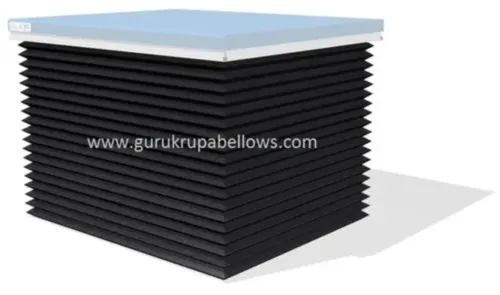
| Scissor-lift bellows | Fabric or elastomer protection shaped for vertical lift mechanisms | Lifts and platforms where the cover must expand without obstructing the scissor action |
| Rubber boots | Short, close-fitting seals around joints or shafts | Ball joints, couplings, and limited angular movement, not long axial stroke |
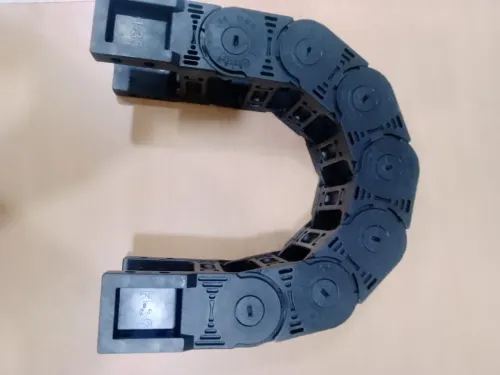
| Plastic spiral or roll-up covers | Long travel with limited axial stack length | Space-restricted movement; sealing depends on guiding and winding |
| Rigid guards | Fixed barriers that do not follow the moving part | Impact zones, access protection, and areas where a gap-free moving seal is unnecessary |
Do not substitute a round rubber bellow for a steel way cover without testing the actual chips and coolant. For any long, horizontal, vibrating, or laterally moving installation, specify a guide or internal support; the bellows should not carry side loads or torsion. Compare installed-length cycle results, not a static sample.
Build a supplier specification that proves service life
A quotation request must describe the machine duty, not just the shaft diameter. Otherwise, a rubber bellow cover supplier can quote a similar-looking cover with a very different service life.
- State shaft or protected-part diameter, axial stroke, compressed and extended lengths, mounting direction, available radial and axial envelope, speed, cycle rate, and expected cycles per shift.
- Identify chip type and size, chip impact, coolant or oil, chemical exposure, continuous and intermittent temperatures, and whether sealing or puncture resistance is the primary objective.
- Specify lateral movement, misalignment, vibration, bending, torsion, pressure or vacuum, and whether an internal guide or support is available.
- Require the compound designation, wall thickness, temperature basis, chemical-compatibility data, and attachment design: bonded flange, clamped cuff, wire-reinforced end, or molded bolt flange.
- State whether the cover must be removable without dismantling the machine and whether the joint must resist coolant pressure.
Ask GURUKRUPA BELLOWS PVT LTD, or any competing supplier, to state the unsupported length and side load limits rather than assuming the bellows will guide the shaft.
The cycle test must reproduce the actual stroke, speed, cycle frequency, mounting orientation, temperature, coolant, oil, chip size, vibration, and pressure differential. Set an agreed cycle count based on the machine’s required service interval, then inspect for cracks, pinholes, delamination, permanent set, convolution collapse, rubbing, leakage, and attachment failure.
Record dimensions before and after testing; a pass needs written acceptance limits, not merely “no visible damage.”
Related product
 | Round Bellow Covers ₹1000 To match with our reputation in the market, we are here to present an unparalleled assortment of Round Bellow Covers. View product → |
Frequently asked questions
Where do round rubber bellow covers fit among machinery covers?
They enclose round rods, shafts, joints, slides, and cylinders while expanding and collapsing along the axis. They suit dust, coolant, light chips, and general shop contamination.
What measurements are needed before choosing a round bellow cover?
Record the protected member’s diameter, closed length, extended length, stroke, flange or mounting diameter, attachment method, and available clearance.
How do motion, contamination, and temperature affect cover selection?
Match the cover to axial stroke, cycle frequency, speed, debris size, coolant or chemical exposure, ambient temperature, and heat from nearby processes.
How do rubber bellows compare with fabric, steel, plastic, and rigid protection?
Rubber provides flexible sealed protection for round moving members; fabric handles flexible shapes, steel resists impact, plastic offers low-friction shielding, and rigid guards protect fixed hazard zones.