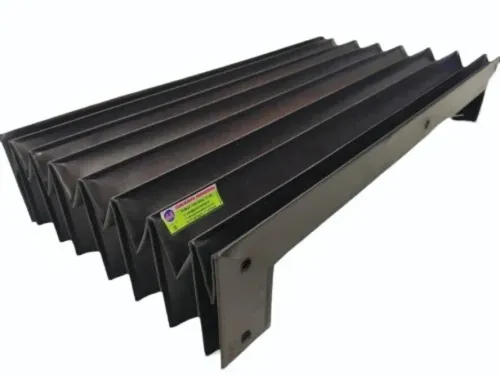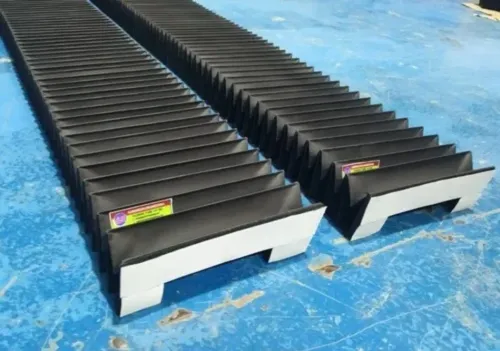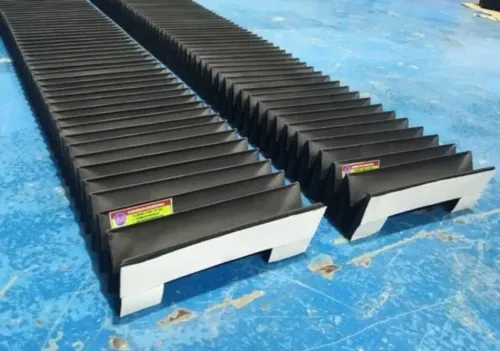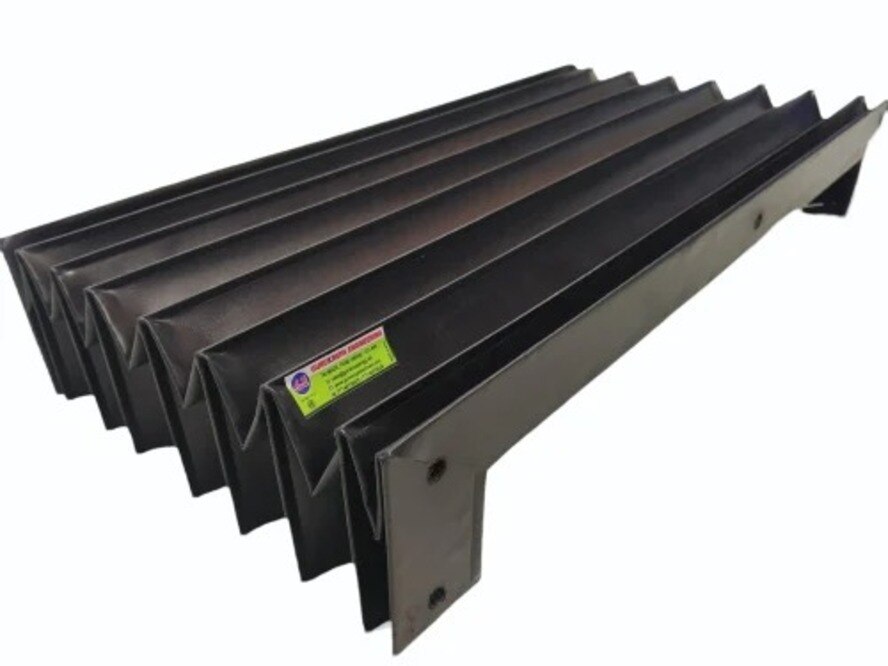
A telescopic steel cover is a moving assembly, not a universal replacement for every machine protection solution. By checking the axis geometry, contamination, machine dynamics, service access, and supplier evidence, you can decide whether it belongs on your machine design before approving a quotation.
Key takeaways
- Measure full travel, closed length, height, width, and mounting points.
- Match steel construction and wipers to chips, coolant, heat, and speed.
- Request drawings, material details, travel data, and test results before approval.
- Use commissioning checks to confirm smooth motion, sealing, alignment, and end stops.
How a telescopic cover moves—and when it is the right protection
A rigid telescopic machine protection cover uses nested steel boxes that slide over one another as the machine axis extends and retracts. Wipers seal each overlap, while guides and stops control alignment, speed, and end position.
Choose it for long travel, frequent cycles, hot chips, heavy chip loads, and coolant exposure when the machine provides enough space for the cover’s nested height, width, and mounting structure.
| Protection option | Strength | Choose it when |
|---|---|---|
| Telescopic steel cover | Resists hot, heavy chips and coolant | The axis has long travel, high cycle frequency, or severe cutting debris |
| Fabric bellows | Flexible and light | You need low moving mass, compact folding, or protection from dust and light chips |
| Roller shutter | Rolls into a compact housing | Space behind the opening is limited and chip loading is moderate |
| Apron cover | Handles broad, flexible movement | The path is irregular or a steel box cannot follow the available geometry |
| Way wiper | Scrapes contamination from a surface | You need supplementary sealing, not full coverage of an exposed axis |
Do not treat a way wiper as a substitute for a cover. Select fabric when hot chips would burn or cut it, and reject steel when its nested stack cannot clear nearby tooling or guards. Check travel, closed and extended lengths, mounting orientation, opening direction, acceleration, traverse speed, and surrounding clearance.
For export machines, include the assembly in the machine-specific risk assessment and guarding design; ISO 14120 addresses guard construction, not that assessment.
Measure the axis before requesting a custom cover
Measure the full axis envelope, not just travel: record closed length, maximum extension, cover width, height, and the machine’s coordinate direction. Include the fixed and moving mounting points, flange dimensions, mounting-hole pattern, guideway envelope, and the required opening direction. These dimensions form the basis for custom telescopic bellow covers in Kolhapur.
- Photograph and sketch every nearby obstruction: spindle housings, tables, guards, lubrication lines, coolant pipes, cable carriers, limit switches, and access doors.
- Check clearance at both ends of travel and through the entire stroke. Allow space for the nested end box, wipers, sliding movement, fasteners, drain holes, and maintenance access.
- Record axis speed, acceleration, deceleration, cycle frequency, and mounting orientation. Dynamic loads during acceleration can exceed loads at steady travel, so request the supplier’s permitted speed and acceleration for the complete assembly.
- Mark which box is fixed and which moves. A reversed arrangement can leave the guideway exposed or drive the cover into the machine.
- Request an approved drawing showing the closed and extended envelope, section dimensions, mounting points, wiper locations, drains, access panels, and service clearances before fabrication.
| Check | Measure or confirm | What goes wrong if missed |
|---|---|---|
| Guideway | Width, height, adjacent shoulders | Chips or coolant bypass the cover |
| Stroke | Actual travel plus end positions | Sections bottom out or leave exposed way |
| Mounting | Flanges, holes, offsets | Installation requires drilling or relocation |
| Clearance | Nested height and all nearby parts | Cover collides during retraction |
| Service | Wiper access and replacement space | Routine maintenance becomes unsafe or impossible |
Match the construction to chips, coolant, heat, and motion
Chip energy, coolant chemistry, and axis dynamics should set the construction—not a catalogue thickness. Telescopic bellow covers for machine tool manufacturers in Kolhapur need different materials for dry milling, flood coolant, abrasive cast-iron fines, and hot forged chips.
- Choose painted or coated carbon steel for dry cutting and ordinary coolant. Choose stainless steel such as 304 for persistent moisture; use 316 when chloride-bearing coolant or washdown creates a corrosion risk. Confirm compatibility with the actual coolant safety data sheet.
- Set box thickness from chip impact, unsupported span, cover size, acceleration, and cycle frequency. Thinner boxes reduce moving mass; thicker panels, folded edges, and reinforced corners resist denting from heavy chips.
- Fit heat-resistant, replaceable wipers when chips or coolant can enter the overlap. Use a softer sealing lip for fine dust and a tougher scraper for sharp chips; excessive pressure increases drive load and wear.
- Use low-friction sliding strips or rollers on surfaces that cannot tolerate metal-to-metal contact. Keep guide rails rigid, aligned, and protected from chip packing.
- Add positive end stops sized for the moving mass. Do not let the machine axis act as the cover’s stop.
- Slope covers toward clear drain outlets. Eliminate horizontal pockets where coolant, fines, and chips can collect between boxes.
- Match paint, powder coating, plating, or stainless construction to heat and coolant exposure. Mask sliding faces and wiper tracks so coating buildup does not cause binding; specify replacement wipers and inspectable wear surfaces.
What to demand from a telescopic cover supplier before approval
Do not approve a quotation from a telescopic bellow cover supplier in Kolhapur until the supplier submits controlled technical evidence. The price and cover length do not show whether the assembly will clear the machine, travel correctly, or remain serviceable.
1. Demand an approved installation drawing showing machine-coordinate direction, fixed and moving mounting points, closed and extended envelopes, mounting-hole locations, flange dimensions, nested height, access panels, wiper positions, drain holes, and service clearances. Reject “made to sample” unless it is converted into a revision-controlled drawing.
2. Ask the telescopic bellow cover manufacturer to state section dimensions, steel grade, box thickness, guide and sliding materials, wiper compound, surface treatment, weld method, and rated speed, acceleration, stroke, cycle frequency, and temperature. Identify every operation—forming, welding, grinding, coating, wiper production, assembly, and testing—as in-house or subcontracted.
3. Require a dimensional inspection record listing closed and extended length, width, height, mounting-hole centres, flange dimensions, and drain-hole locations. The inspector should sign and date the record against the approved drawing.
4. Require a documented full-stroke test before dispatch. It must confirm free movement, wiper contact, drainage, mounting alignment, and absence of abnormal noise, binding, or interference.
5. Obtain spare-wiper specifications, replacement intervals, cleaning instructions, service response terms, and a parts list. Ask GURUKRUPA BELLOWS PVT LTD for the same evidence when comparing its proposal.
For export machines, record the cover within the machine risk assessment and check guarding against ISO 14120; that standard does not replace the machine-specific assessment.
Related products
 | Telescopic Bellow Cover ₹1000 Product Details: Brand GURUKRUPA Ours is a distinguished name in the business that manufactures and supplies Telescopic Bellow Cover that is vastly... View product → |
 | Industrial Telescopic Covers Our company is known as one of the eminent names of the industry to manufacture and supply Industrial Telescopic Covers. View product → |
Use commissioning results to make the go-or-no-go decision
Approve telescopic machine protection covers only after they survive a production-equivalent commissioning run. Test the cover on the actual axis, not by moving it slowly by hand, because speed, acceleration, chip impact, and coolant exposure reveal failures that a static check hides.
- Run the longest programmed travel at maximum specified speed and acceleration, including rapid reversals and repeated cycles.
- Use the production coolant or lubricant, with representative chip size, temperature, and volume.
- Check smooth extension and retraction, stop impact, resonance, wiper drag, vibration, and abnormal noise.
- Inspect every nested box for coolant leakage, trapped chips, fines, heat damage, and contact with guides, flanges, or machine structures.
- Confirm that the closed and extended envelopes retain the designed clearance and that drain holes empty without pooling.
Release the cover when the test produces consistent motion, complete guideway shielding, no leakage onto protected surfaces, and no damage after the planned cycle count. Record travel settings, coolant, chip condition, inspection results, and corrective actions in the commissioning file.
For export machines, include the cover in the machine risk assessment and guarding review against ISO 14120; that standard does not replace a machine-specific assessment.
Redesign the cover when you find stop impact, repeated resonance, wiper wear, coolant pooling, box interference, or exposed guideway sections. Select fabric bellows, a roller shutter, apron cover, or way wiper when the steel assembly cannot meet the axis motion, clearance, heat, chip-load, or drainage requirements without damaging the machine.
Frequently asked questions
When are telescopic machine protection covers the right choice?
Use them when a rigid, guided cover must protect machine-tool guideways from chips, coolant, heat, and mechanical impact during linear axis movement.
What measurements are needed for a custom telescopic bellow cover?
Provide axis travel, open and closed lengths, available height and width, mounting locations, guideway geometry, and clearance around the moving assembly.
How should you match a telescopic cover to machine conditions?
Specify construction and wipers according to chip size, coolant exposure, operating temperature, axis speed, acceleration, stroke frequency, and required sealing.
What should you request from a telescopic bellow cover supplier in Kolhapur?
Request a dimensional drawing, material and finish details, wiper specifications, guide and stop design, rated motion data, inspection records, and commissioning support.
Related products
 | Telescopic Cover Product Details: Brand GURUKRUPA Color Steel Material Steel Size Customised We are one of the pre-eminent names of the industry to manufacture and... View product → |
 | Steel Telescopic Cover Product Details: Brand GURUKRUPA Our company is considered a renowned name in the field that manufactures and supplies Steel Telescopic Cover. View product → |