
Pune’s laser-cutting workshops face two different cover problems across the year: abrasive dust during dry periods and water, condensation, and corrosion during the monsoon. By the end, you will be able to match a bellow cover to the machine’s exposure, specify measurable operating limits, and check whether a replacement will travel without rubbing or trapping contamination.
Key takeaways
- Use drainage, sealed mounting, and anti-condensation checks during Pune’s monsoon.
- Choose abrasion-resistant bellows for dry-season dust and laser-cutting debris.
- Specify temperature, travel, speed, fold, and chemical-resistance limits before ordering.
- Test full travel, clearances, sealing, and water ingress before accepting a replacement cover.
Why Pune’s dry and wet seasons create different cover failures
Pune creates two distinct failure seasons for a laser-machine bellow. From June through September, monsoon rain raises humidity and wets mounting areas and folded sections. Outside those months, hotter, drier conditions carry more airborne dust. That changes the design priority from dampness and condensation to abrasive contamination. The failure mechanism changes with the season.
In dry workshops, dust and metal fines settle in pleats and move deeper as the cover cycles. Grit can score a guideway and stiffen the folds. Heat from cutting accelerates material ageing; coolant mist or oil deposits bind particles to fabric. This creates more rubbing and higher traverse resistance. Inspect pleat valleys before work.
During monsoon shutdowns, humid air condenses when a machine surface cools below the local dew point, encouraging mould and corrosion. The cover can shield a guideway without being watertight. Size laser machine bellow covers for conditions in Pune to travel, compressed and extended lengths, folded height, and cycle rate. Oversizing causes rubbing; support long spans.
How to manage humidity, condensation, and monsoon water
During Pune’s June-to-September monsoon, a bellow cover protects guideways, linear bearings, ballscrews, and drive components from rain droplets, damp grit, and splash carried onto the machine. It does not make the machine watertight: seams, pleats, end frames, mounting gaps, and cable penetrations can still admit humid air or water.
Condensation forms when a machine surface falls below the local dew point, especially after an overnight shutdown. Laser machine bellow covers used for humidity protection need support from:
- A sloped machine base and clear drain paths so water cannot pool beneath folded pleats.
- Protected end mountings, sealed or shielded fasteners, and corrosion-resistant spring steel or hardware.
- Ventilated enclosure panels that reduce trapped wet air without exposing the guideway to direct spray.
- A shutdown routine that removes standing water, wipes accessible surfaces, and leaves the cover positioned for airflow and drying.
- Inspection for mould, damp seams, rust stains, and wet fabric before the next production cycle.
Laser machine bellow covers in monsoon conditions should not be called watertight unless the complete assembly has passed an enclosure test. A wet, unsupported horizontal cover can sag, rub, and overload its folds; provide guides or intermediate support. The cover also cannot replace a sealed electrical cabinet, machine-room ventilation, or controlled drainage.
| Measure | Risk reduced | Action |
|---|---|---|
| Drainage | Pooling and corrosion | Keep low points open and sloped |
| Drying | Mould and trapped moisture | Ventilate and inspect after shutdown |
| Enclosure | Spray and splash ingress | Shield joints and cable entries |
How dust, fumes, coolant, and hot particles damage moving bellows
Fine abrasive dust settles in pleat valleys and works into fold interfaces as the cover moves. The grit increases folding resistance, cuts the coating during repeated flexing, and reaches the guideway when a seam or edge lifts.
Laser machine bellows for dusty workshops need defined cleaning access, fold geometry, bend radius, and inspection intervals—not only a fabric name.
- Lock out the machine and inspect the compressed and extended cover; check pleat valleys, end frames, seams, underside, and mounting edges.
- Look for trapped metal fines, pinholes, polished rubbing marks, hardened residue, loose stitching, and dust trails on the protected way.
- Vacuum loose contamination with a soft nozzle before wiping. Do not blast grit deeper with compressed air.
- Wipe with a clean, lightly damp, lint-free cloth and use only the fabric maker’s approved cleaner. Dry the folds fully before cycling the axis.
- Stop and investigate any new drag, bunching, uneven extension, or scraping sound; contamination that remains after cleaning can indicate damaged geometry.
Assist gas changes where residue travels: high-velocity oxygen or nitrogen can drive fine dust and hot particles beneath a poorly sealed edge, while effective extraction reduces suspended contamination without protecting a damaged cover. Coolant wets dust into an abrasive paste; oil mist creates a sticky film that holds fines and can attack coatings or adhesives.
Slag and sparks are more severe: hot spatter can fuse to pleats or burn pinholes. A replaceable spark shield, sacrificial flap, or heat-rated construction is needed when the cover lies in the spatter path.
Which construction and operating limits should you specify
Specify the exposure at the machine, not a label such as “dustproof.” Record peak radiant heat, spark direction, chemical contact, abrasive residue, humidity, and the axis travel, speed, acceleration, cycle count, and folded length.
| Exposure | Construction to specify | Operating limit or evidence |
|---|---|---|
| Heat and sparks | Heat-rated coated fabric with a replaceable spark shield, metallic lamellae, or sacrificial flap | State maximum temperature, stand-off distance, and permitted exposure; reject pinholes, burns, or delamination |
| Chemicals and coolant mist | Coating compatible with the named coolant, oil, solvent, and cleaning agent; sealed or protected seams | Test a coupon or confirm chemical compatibility; swelling, tackiness, and cracking are failures |
| Dust, metal fines, and abrasion | Smooth outer coating, reinforced wear zones, protected edges, and guided support | Run representative traverses after controlled contamination; check rubbing, trapped grit, and increased drive load |
| Humidity and monsoon wetting | Corrosion-resistant fasteners and springs, sealed joints, and a low-point design that cannot hold water | Inspect water tracks, rust, odour, biological growth, and coating loss after wet exposure and drying |
| Repeated movement | Pleat pitch, fabric flex rating, guides, and support sized for full stroke and acceleration | Cycle the cover through its complete travel without buckling, snagging, or excessive sag |
Do not let a bellows bridge an unsupported span. Wet fabric and dust make a marginal horizontal span sag into the guideway, so specify support rails or guided construction.
Add a shutdown rule: open and dry a folded cover after prolonged stoppage, then inspect pleat valleys and seams. If it sits near the beam, assess the wavelength, irradiance, exposure time, and failure mode separately; opaque fabric is not a laser safety barrier.
How to fit-check and acceptance-test a replacement cover in Pune
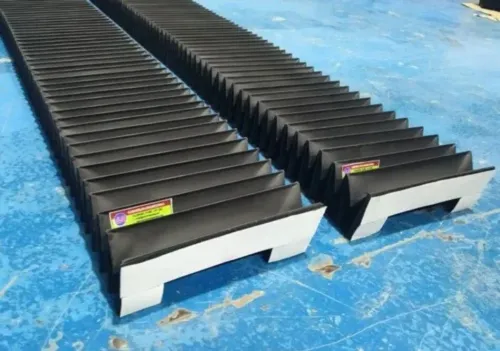
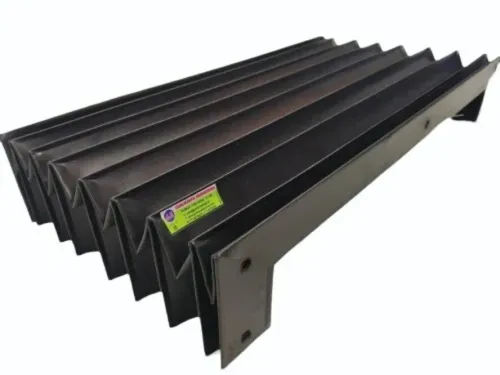
Before ordering laser cutting machine covers in pune, record the machine’s actual geometry, not only the guideway length. Measure travel, compressed length, fully extended length, folded height, mounting-hole pattern, end-frame position, and the cover’s distance from the laser head, nozzle, workpiece, cables, and adjacent guards. Include space for thermal expansion and grit trapped between folds.
1. Fit the uncompressed cover and move the axis through its full stroke by hand or at inspection speed. Confirm that no pleat rubs the guideway, sags into the work envelope, catches on a bracket, or contacts hot parts.
2. Check the manufacturer’s compressed and extended lengths against the measured stroke. Reject a cover that reaches its limit before the axis does, or leaves excess folded material that increases traverse force.
3. Verify support for every horizontal span. A bellows is not a structural bridge; wet fabric and accumulated dust increase sag, rubbing, and drive load.
4. Run representative dry cycles after applying the agreed quantity and type of workshop dust, metal fines, and cutting residue. Record cycle count, drive-load change, trapped grit, pleat cracking, coating delamination, and damage to end frames.
5. Apply controlled wet exposure for an agreed duration, then cycle the axis after drying and inspect water tracks, seam leakage, corrosion on fasteners, mould, and retained moisture. Define pass/fail limits before testing; “dustproof” and “monsoon-proof” are not test criteria.
GURUKRUPA BELLOWS PVT LTD should receive the machine drawing, stroke data, cycle rate, and photographs of the spark path before preparing a replacement.
Related products
 | Laser Machine Bellows ₹1000 We are committed to manufacture, export, and supply a qualitative range of Laser Machine Bellows for our esteemed clients. View product → |
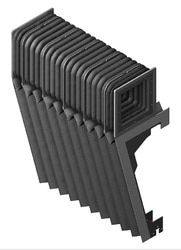 | Laser Cutting Machine Bellows ₹1000 We offer Laser Cutting Machine Bellows made specifically for your laser machine. View product → |
Frequently asked questions
Why do laser machine bellow covers fail differently in Pune’s dry and wet seasons?
June through September brings humidity, rain, condensation, and wet mounting areas. The drier months increase airborne dust and abrasive contamination, shifting the main failure risk.
How can you protect laser machine bellows from humidity, condensation, and monsoon water?
Seal mounting interfaces, prevent water from pooling in folded sections, provide drainage where needed, and inspect damp areas for corrosion, swelling, mildew, and adhesive failure.
How do dust, fumes, coolant, and hot particles damage moving bellows?
Dust abrades fabric and enters folds, fumes attack coatings and adhesives, coolant degrades materials, and hot particles burn or puncture exposed surfaces. Match construction to each contaminant.
Which limits should you specify for a laser machine bellow cover?
Document travel length, compressed and extended dimensions, fold height, movement speed, acceleration, operating temperature, particle exposure, coolant or chemical contact, and mounting constraints.
How do you acceptance-test a replacement laser machine bellow cover in Pune?
Run the machine through its complete travel, check clearance and fold compression, inspect mounting seals, confirm smooth movement, and perform a controlled water-ingress inspection before sign-off.