A cover that jerks, scrapes, rattles or stops short can damage wipers, guideways and the machine axis, but the cover is not always the cause. You will learn how to isolate the fault, inspect the cover, collect the measurements for a replacement and choose between rigid telescopic sections and flexible bellows.
Key takeaways
- Inspect guides, rollers, wipers, and fasteners before replacing the cover.
- Match cover dimensions to slide travel, nested height, and machine clearances.
- Specify speed, acceleration, chips, coolant, heat, and installation limits.
- Test smooth extension, retraction, overlap, and end stops after replacement.
How a telescopic cover protects a moving slide
A telescopic cover protects a moving slide by extending and retracting in linked, overlapping sections. As the machine axis travels, the larger outer boxes pull the smaller inner boxes forward; during return, the sections nest inside one another.
Their overlap keeps chips, coolant and dust away from guideways, ball screws, hydraulic parts and other moving assemblies without blocking the slide’s stroke.
Guide rails, rollers or guide shoes control each section’s path, while wipers scrape contamination from the sliding surfaces. Correct mounting keeps the cover square with the axis.
If a wiper is swollen, torn or pressed too tightly, it adds drag; if a section is dented or a bracket is twisted, the boxes can scrape, bind or fail to close fully.
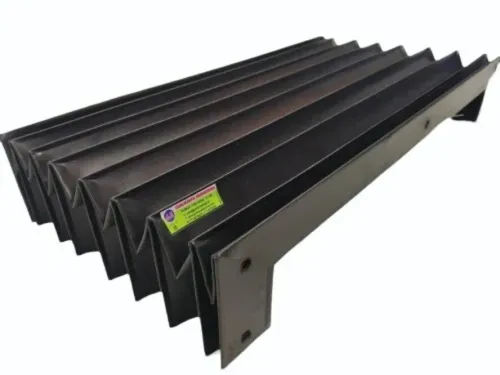
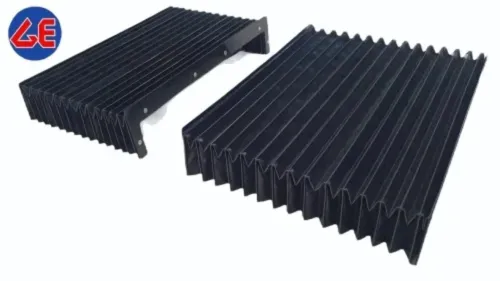
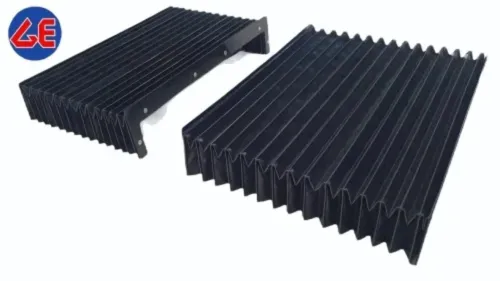
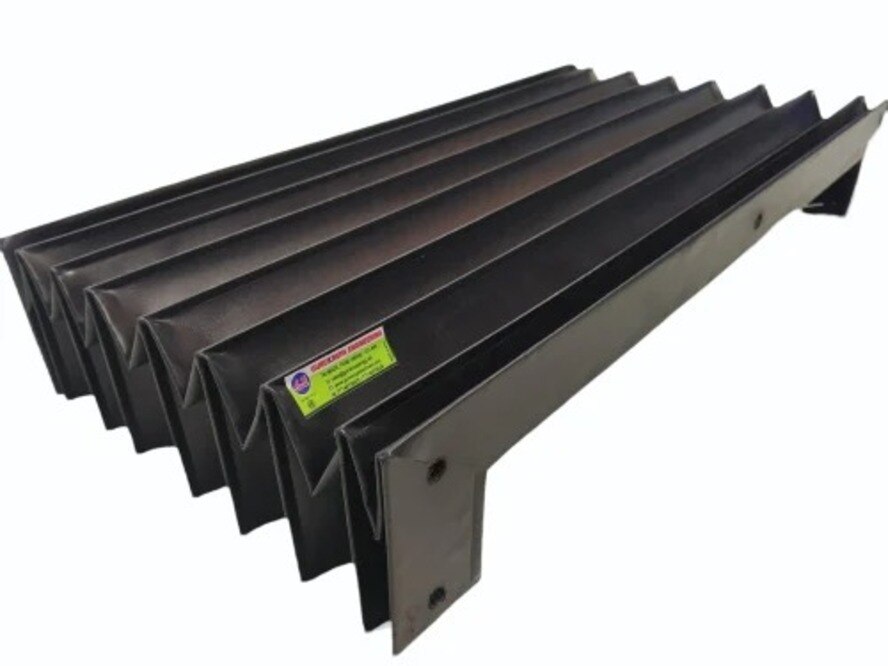
Steel telescopic covers suit rigid chip and coolant shielding, but they need enough clearance for section overlap and drainage. Flexible fabric or elastomer bellows compress and expand instead, fitting movements where a rigid box cannot.
That distinction matters when searching for telescopic bellow covers for sliding problems in pune: the replacement must match the slide’s stroke, mounting points, envelope and clearances. A cover that is too heavy or has excessive wiper preload can increase axis load, reduce acceleration and trigger servo following errors.
Diagnose the sliding fault before replacing the cover
A telescopic bellow cover sliding issue comes from the cover when it binds with the machine axis stationary. Move the axis to a safe position, isolate power, and test the cover by hand before changing parts.
1. Clean swarf from every guide channel, drain opening, and section overlap. Packed chips or dried coolant can make one box stop while the others continue, causing jerky travel, scraping, or incomplete closing.
2. Inspect the wipers and scrapers along each leading edge. A torn, hardened, swollen, or over-compressed wiper creates drag and can pull chips into the guide path.
3. Check each telescopic section for dents, lifted corners, unequal overlap, rattling, and contact marks. Examine rollers or guide shoes for damage, then verify that mounting bolts are tight without distorting the frame.
4. Measure the cover’s closed and extended positions against the machine drawing. Unequal section travel, a skewed mounting bracket, or changing clearance at intermediate positions indicates cover misalignment.
5. Restore safe operation and jog the machine axis slowly without cutting. If the cover moves freely by hand but binds, vibrates, or shifts sideways under axis motion, inspect guideway alignment, damaged rollers, lubrication, acceleration, and lateral loading.
A cover that remains stiff after cleaning and alignment needs repair; a straight cover with worn wipers may need only wiper replacement. If the axis itself feels tight without the cover connected, investigate the slide, guideways, drains, or mounting before ordering a replacement.
A local replacement must preserve the original interfaces; a retrofit can require brackets or revised travel limits.
Choose the cover from machine geometry and operating conditions
Stroke alone does not size a cover. Record the closed length, fully extended length, available width and height, mounting-hole pattern, travel direction, and clearance around the saddle at every point in the stroke.
| Option | What the machine data means | When it applies |
|---|---|---|
| Steel telescopic cover | Rigid nested sections need room to overlap, extend, and drain; mass rises with size and panel thickness. | Use for straight-axis travel with sharp chips, coolant, abrasion, and high mechanical exposure. |
| Stainless-steel telescopic cover | The same geometry applies, but material selection must account for corrosion, washdown, and aggressive coolant. | Choose it where carbon-steel panels would rust or contamination control demands a more resistant surface. |
| Flexible bellows | Measure folded length, extended length, bend radius, axis directions, and attachment points; allow for compression and lateral movement. | Use where space is too short for nested boxes, motion has multiple axes, or the cover must follow complex geometry. |
| Accordion protection | Fabric folds need stack height, fold pitch, fabric or coating temperature limit, and resistance to chips, oil, sparks, and abrasion. | Use for enclosure-style protection with moderate exposure; reject it where sharp hot swarf can cut or burn the folds. |
Then check maximum axis speed, acceleration, cycle frequency, chip temperature, coolant type, and expected debris size. A long or heavy steel cover can increase servo following error, while tight wipers add friction. A flexible cover fits more layouts but fails sooner under impact, scraping, or hot-chip attack.
Include orientation and drainage direction, because trapped coolant and swarf can make a correctly sized cover bind.
Repair or replace: what to check before requesting a Pune quotation
A cover is repairable when the damage is local: replaceable wipers are worn, a guide shoe or roller needs renewal, or one panel has a small dent that does not reduce overlap.
Replace it when panels are twisted, frames or welds are cracked, corrosion has perforated the skin, mounting points have moved, or the cover still binds after alignment and cleaning.
For a reliable telescopic bellow cover replacement in Pune quotation, send:
- Closed length, maximum extended length, usable width and height.
- Machine orientation, travel direction, axis stroke, maximum speed and acceleration.
- Mounting-hole pattern, bracket dimensions, end-frame photographs and available clearance at intermediate positions.
- Guideway type, roller or guide-shoe arrangement, wiper profile and drainage locations.
- A drawing or marked-up sketch showing the cover envelope and mounting interfaces.
- The failure cause, including collision, chip packing, coolant ingress, scraping, vibration or axis misalignment.
- Photos of both end frames, guideway access and any damaged panels; photographs alone cannot support a dependable quotation.
State whether you need a local replacement or a retrofit. A local replacement keeps the original stroke, envelope and interfaces; a retrofit can require new brackets, revised drainage or altered travel limits. Ask a telescopic machine cover supplier in Pune to confirm these differences in writing.
GURUKRUPA BELLOWS PVT LTD can use the measured geometry and failure evidence to distinguish a repair from a replacement scope.
Related products
 | Telescopic Bellow Cover ₹1000 Product Details: Brand GURUKRUPA Ours is a distinguished name in the business that manufactures and supplies Telescopic Bellow Cover that is vastly... View product → |
 | Bellow Cover The range of CNC Bellow Cover is manufactured on our premises, under the guidance of our expert professionals. View product → |
Test the replacement and prevent another sliding failure
Run the replacement through its complete stroke before returning the machine to production. Test it dry and with the actual coolant application, using the machine’s representative speed and acceleration rather than moving it slowly by hand.
Check each item during both tests:
- Sections open and close in sequence without jerking or overlap loss.
- No panel collides with another panel, saddle, way, or nearby fixture.
- Wipers contact evenly without abnormal rubbing or folded edges.
- The cover remains parallel to the protected way throughout travel.
- Drain paths remain open, with no coolant pooling inside the sections.
- No chips or coolant reach the guideway after the wet test.
- The cover reaches its full closed and extended positions without forced stops.
After approval, clean chips from the cover and its drainage channels at each shift or after heavy cutting. Inspect wipers, scrapers, rollers, guide shoes, and mounting bolts for wear or looseness; replace a hardened wiper before it starts scraping a panel.
Do not use mounting bolts to pull a distorted frame into alignment. Verify the bracket height, side clearance, and parallelism at several points along the stroke, then tighten fasteners evenly. If the cover is a retrofit, confirm revised travel limits, drainage, and acceleration settings before production.
Record the test speed, coolant condition, clearances, and any replaced parts so the next sliding fault has a reference point.
Frequently asked questions
How do you diagnose a telescopic bellow cover sliding issue?
Inspect the guides, rollers, wipers, fasteners, alignment, debris, and signs of section distortion before replacing the cover.
What machine details are needed for a telescopic bellow cover replacement in Pune?
Provide slide travel, closed and extended dimensions, section sizes, mounting points, clearances, speed, acceleration, and operating contaminants.
When should you repair or replace a telescopic machine cover?
Repair isolated issues such as loose fasteners, debris, or damaged wipers; replace the cover when sections are distorted or travel remains obstructed.
How do you test a replacement telescopic bellow cover?
Run the slide through its full travel and check smooth extension, retraction, section overlap, clearances, end stops, and interference.
Related product
 | SS Telescopic Cover Product Details: Brand GURUKRUPA We are among the celebrated names of the business to bring forth SS Telescopic Cover in standardized packaging. View product → |