
A spot bellow cover is engineered around a moving interface, not selected by width alone. To order the right cover, you need accurate open and compressed dimensions, a clear contamination profile, a defined mounting arrangement, and inspection checks that prove the cover works through the full machine motion.
Key takeaways
- Measure travel, compressed length, mounting space and hazard exposure before design.
- Match bellows geometry and fabric to motion, temperature, coolant and chip conditions.
- Inspect folds, seams, frames and mounting holes against the approved drawing.
- Confirm dimensions, documentation and installation access before accepting delivery.
What a Spot Bellow Cover Protects on a Machine
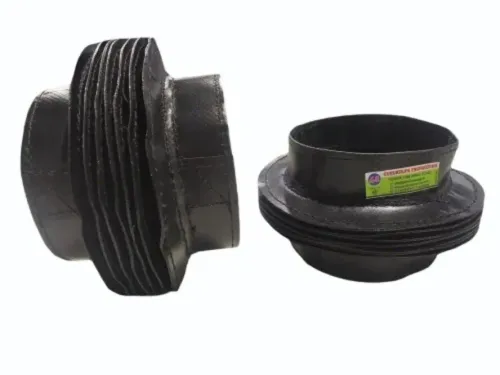
A spot bellow cover shields a small, exposed machine interface from chips, dust, coolant, oil mist, heat and mechanical wear while allowing the protected part to move. It is point protection, not a replacement for a long telescopic way cover.
Compact bellows earn their place at interfaces such as:
- Spindles, where chips and coolant can reach a rotating shaft or bearing area.
- Actuators and rods, where contamination can score seals or enter the guide.
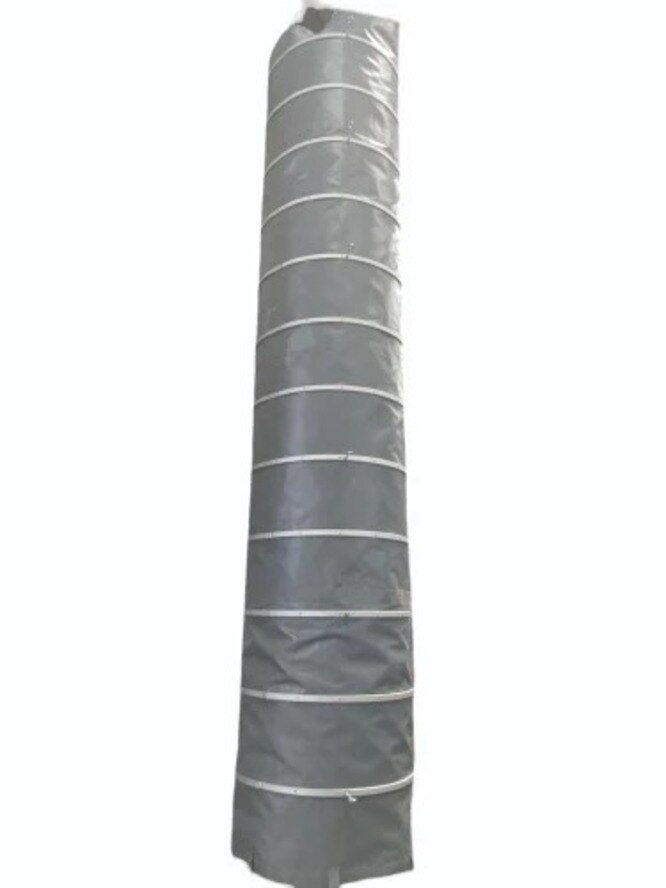
- Loading nozzles, where repeated approach and retraction expose a short moving section.
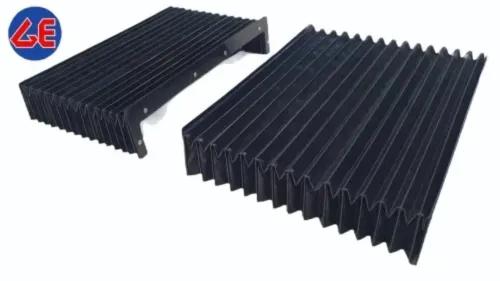
- Guideways and slides, where abrasive debris can damage precision surfaces.
- Other exposed moving points with limited installation space.
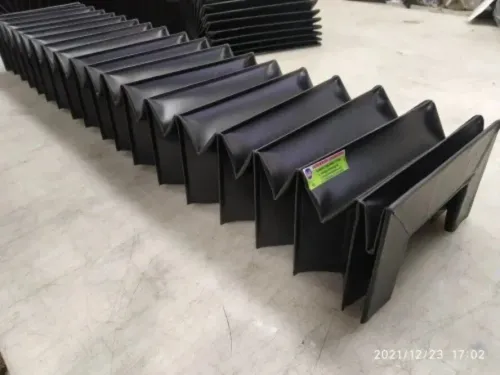
The folds expand as the axis opens and compress as it closes. Their pitch, depth and reinforcement must let the cover follow the full travel without twisting, rubbing against adjacent parts, buckling or forcing the seams into a tight radius.
A cover that contacts a tool holder, cable carrier or machine frame can fail even when its nominal length is correct.
Describe the application by its motion and contamination: linear or diagonal travel, rotating movement, stroke, speed, chips, coolant, hot swarf, welding sparks or washdown. The search term alone is not enough. “Spot bellow” is not a universal technical category; suppliers may mean a compact fabricated cover, a spot-joined fabric construction or a catalogue-specific design.
Send a photograph, dimensioned drawing or sample, and define the required material, joining method and mounting construction when requesting industrial spot bellows.
Which Measurements the Manufacturer Needs Before Design
Before design, give the manufacturer the complete motion envelope, not just the gap you can see. For custom spot bellows, measure the machine with the cover fully open and fully compressed; exposed travel alone can produce a cover that bottoms out, stretches its seams or collides with the structure.
Record these dimensions and conditions:
- Fully open length, fully compressed length and stroke.
- Width and height at both mounting faces.
- Flange length, width and thickness, plus the complete mounting-hole pattern.
- Fixed end, moving end, travel direction and machine-axis orientation.
- Available clearance around the cover, including the allowable bend radius.
- Nearby tool holders, cable carriers, chip conveyors and access doors.
- Diagonal travel, rotation, changing gap width and any offset between mounting faces.
| Measurement | Record this | Why it matters |
|---|---|---|
| Visible gap | Distance between machine faces | Does not define the compressed package |
| Fully open length | Maximum installed cover length | Confirms required extension |
| Fully compressed length | Smallest permitted package | Prevents bottoming and crushed folds |
| Stroke | Difference between open and compressed lengths | Sets fold count and usable travel |
Check the entire motion envelope, not only its two end positions. A rotating or diagonal axis can load one side, while a cable carrier or chip conveyor can require a relief, guide strip or unequal fold arrangement.
Send a dimensioned sketch, clear photographs of both ends and the surrounding machine, and the axis orientation with the RFQ. Identify the required construction because “spot bellow covers” is not a universal design category.
How Geometry and Materials Are Chosen for the Motion
The stroke does not equal the number of folds. From the open and closed lengths, the designer selects fold pitch, fold count and reserve material so the cover reaches full travel without stretching seams or bottoming out.
The closed package must also leave an allowable compressed radius; forcing a tighter radius causes buckling, rubbing and premature cracking.
Design review for industrial spot bellows should record:
- Speed, acceleration, cycle frequency and duty cycle
- Horizontal, vertical or inverted orientation
- Unsupported length and expected service life
- Ambient and process temperature
- Diagonal travel, rotation and changing gap width
- Uneven side loading, nearby obstructions and rubbing points
Test the full motion envelope, not only the two end positions. Slats, lamellae, wire or deflector strips can stop hot swarf from puncturing folds, but their extra mass increases noise, inertia and drive force.
Material choice follows the hazard, not the word “industrial.” Coated fabrics suit dust and coolant; elastomers handle repeated flexing and oil mist; films reduce thickness; foil resists heat and welding sparks but sacrifices flexibility. Reinforcement fabric supports high-cycle folds, while wire adds shape retention.
Alkaline washdown, corrosion, UV exposure and static control require compatible coatings or conductive layers.
| Option | Main benefit | Main trade-off |
|---|---|---|
| Coated fabric | Balanced protection and flexibility | Limited resistance to severe hot swarf |
| Elastomer or film | Low friction and compact folds | Chemical or temperature limits |
| Foil, wire or lamellae | Heat and puncture resistance | More noise, mass and compressed length |
| End-frame metal or polymer | Stable mounting | Drive load and corrosion considerations |
For custom spot bellows, approve these choices against the actual motion and cleaning method before release.
How Cutting, Forming, Joining and Inspection Turn the Design into a Cover
After the approved drawing is released, the factory cuts panels to the nesting pattern, marks fold lines and orientation, and prepares reinforcement fabric, wire, slats or deflector strips. Panels are folded or formed to the specified pitch, then joined around the fixed and moving end frames.
The assembly must match the mounting faces, not merely the nominal open length.
| Construction | Strength, sealing and flexibility | Chemical resistance and repair |
|---|---|---|
| Stitched | Flexible and repairable; needle holes reduce leak resistance | Thread and coating must suit coolant and cleaning agents |
| Heat-welded | Consistent seams with strong leak resistance; welds can stiffen folds | Good when the materials are weld-compatible |
| Adhesively bonded | Smooth seams and useful for dissimilar materials; surface preparation controls strength | Adhesive selection determines resistance to oil, coolant and washdown |
| Mechanically assembled | Replaceable panels and simple field repair; fasteners can leak or protrude | Hardware must resist corrosion and avoid reducing the bend radius |
The mounting interface is part of the design. Specify clamping frames, sewn or welded flanges, screw strips, hook-and-loop fastening or custom plates, along with fixed and moving ends, hole locations, allowable protrusion and maintenance access.
Final inspection checks:
- Open and compressed dimensions, fold count and uniformity
- Hole locations, flange alignment and fastener security
- Seam quality, reinforcement placement and surface damage
- Full-stroke movement on the machine or a motion-equivalent fixture
That trial exposes twisting, rubbing, trapped chips and coolant, or folds that collapse unevenly—failures missed by inspecting spot bellow covers only in the open position. Industrial spot bellows should leave inspection with a recorded drawing revision and any agreed test record.
What to Approve Before Delivery and Installation
Approve the controlled drawing before you approve shipment. It must carry a revision number, open and compressed dimensions, material and coating identification, joining method, fixed and moving ends, mounting details, acceptance criteria and any test record.
1. Define the protection requirement in the operating specification: chip protection, splash resistance, washdown resistance or a named leak test. Do not call a folded cover pressure-tight unless the supplier specifies and tests that performance.
2. Run prototype approval through the complete machine travel. Check every fold for even opening and collapse, twisting, trapped chips or coolant, loose fasteners, rubbing and contact with adjacent machinery. An open-position inspection will miss interference at compression.
3. Plan delivery around the compressed shipping volume. Pack the cover so folds cannot be crushed, sharply creased or permanently deformed, then compare dimensions, hole locations, flange alignment, material marking and revision against the approved drawing at receiving.
4. Put the machine axis, open and compressed dimensions, travel, speed, acceleration, contamination, temperature, mounting arrangement, delivery date, quantity, spare requirement and inspection documents into the RFQ. Attach a photograph, sample or dimensioned drawing because “spot bellow” is not a universal construction.
For buyers comparing bellow covers in Pune, GURUKRUPA BELLOWS PVT LTD belongs on the same technical shortlist as other vendors when those details are supplied. The search phrase “spot bellow covers for manufacturing process in Pune” helps locate bellow covers in Pune, but it cannot replace the specification.
Related products
 | Spot Bellows Product Details: Minimum Order Quantity 1 Number Brand GURUKRUPA Color Black-Blue Size Customised The Gurukrupa Engineering offers Spot Bellows which... View product → |
 | Fly Ash Bulk Loading Spot Bellow Fly Ash Bulk Loading Spot Bellow ₹10000 Product Details: Minimum Order Quantity 01 Number Brand GURUKRUPA Size ANY We manufacture a wide range of Fly Ash Bulk Loading Spot Bellow in various... View product → |
Frequently asked questions
What does a spot bellow cover protect on a machine?
It shields a small moving machine interface from chips, dust, coolant, oil mist, heat and mechanical wear without stopping movement.
Which measurements does a manufacturer need before designing a spot bellow cover?
Provide the protected component’s travel, extended and compressed lengths, width, height, mounting method, available clearance and attachment-hole details.
How are geometry and materials chosen for spot bellows?
The design matches fold geometry, fabric, coatings, reinforcement and mounting components to the motion, speed, temperature, coolant, chips and required flex life.
What should you approve before delivery and installation?
Compare the finished cover with the approved drawing, checking dimensions, travel, seams, folds, frames, mounting holes, materials and installation access.