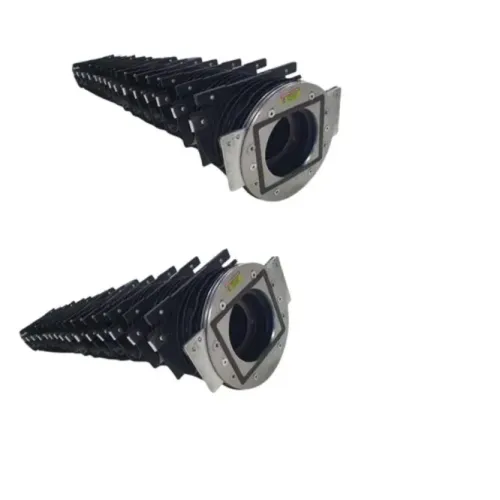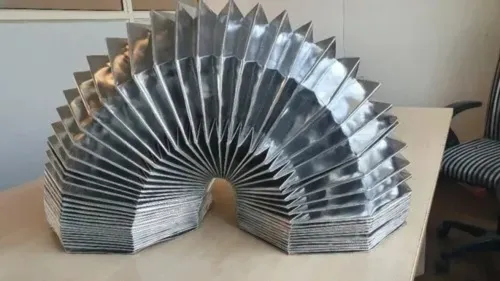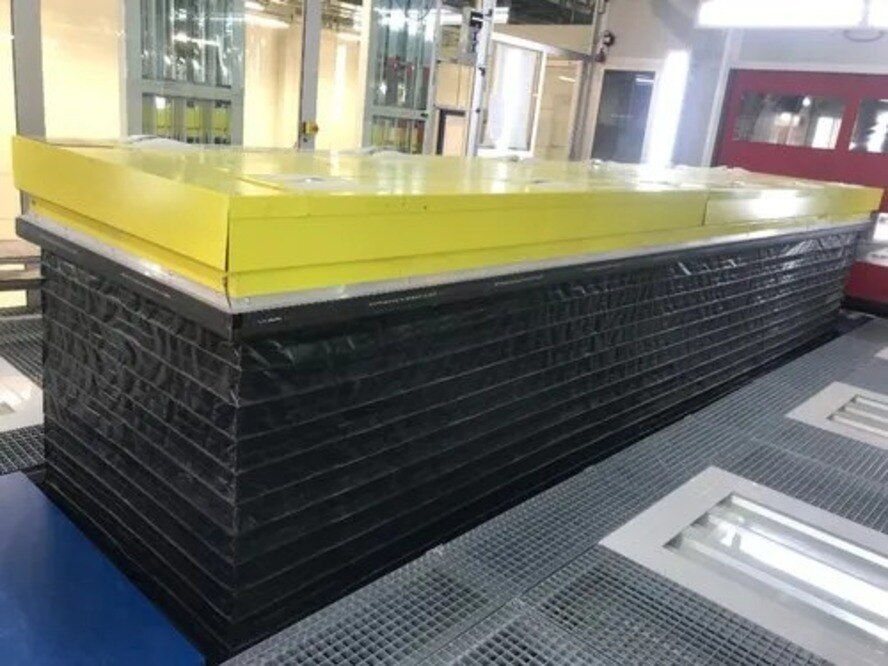
A scissor lift cover must follow folding arms, changing clearances, and repeated compression without creating new pinch points or failing under chips, oil, heat, or washdown. By the end, you will be able to match the cover design and material to the lift, collect the dimensions a supplier needs, and test replacement covers before delivery or installation.
Key takeaways
- Define compressed and extended lengths before requesting a quote.
- Use bellows for enclosed moving parts; choose skirts for broader open-area coverage.
- Match fabric, coating and construction to chips, coolant, heat and sparks.
- Approve replacement covers against movement, mounting and dimensional checks.
What a scissor lift bellow protects—and what it must not do
A bellow shields exposed hydraulic cylinders, guide mechanisms, bearings, rollers, moving joints, hoses, and cables from chips, dust, coolant, oil, sparks, and abrasive debris. These scissor lift cover applications keep contamination away from sliding and rotating surfaces, reducing premature wear and contamination-driven seizure.
| Protection target | Main exposure | Bellow’s proper role |
|---|---|---|
| Hydraulic cylinder and guide mechanism | Chips, coolant, dust, oil | Seal the moving interface without carrying lift loads |
| Bearings, rollers, and joints | Abrasive debris and sparks | Reduce ingress while allowing designed movement |
| Hoses and cables | Chips, oil, heat, and rubbing | Provide a shield, not a substitute for motion-control hardware |
A scissor lift bellow is a contamination barrier. It is not load-bearing, fixed guarding, or a restraint for a person or failed mechanism. Do not rely on it to block a pinch point unless that safety function has been separately engineered, tested, and validated.
Crossed arms create changing pinch and shear zones as they fold. Inspect the installed cover through the complete stroke, not only when fully raised or lowered; check folds, fasteners, frames, rollers, and guides for new entrapment points.
A bellow that protects a cable from chips does not automatically meet its minimum dynamic bend radius, torsion limit, or bend-cycle rating. Specify a separate drag chain, guide, or cable carrier when the service requires it. Ensure the compressed pack also avoids fold contact, arm rubbing, frame crushing, and interference with hoses or cables.
Choose a bellow, skirt, telescopic cover, or combined arrangement
A broad, open-sided lift table usually needs a full-perimeter scissor lift skirt. It blocks underside access, contains general debris, and reduces exposure around crossed arms. Use a local bellow when contamination threatens one concentrated component, such as a hydraulic cylinder, guide, joint, or moving mechanism.
| Option | Best fit | Main trade-off |
|---|---|---|
| Local bellow | Cylinder, guide, joint, or other concentrated moving part | Protects the component but leaves perimeter access and general debris pathways open |
| Full-perimeter skirt | Lift table with broad open sides and underside access concerns | Improves containment but can reduce inspection access, visibility, drainage, and serviceability |
| Telescopic cover | Guided linear travel with room for nested rigid sections when retracted | Needs stack space and accurate guidance; poorly suited to changing scissor geometry |
| Simple accordion cover | Predictable straight-axis movement | Compact and economical, but lateral or twisting motion can cause fold inversion, rubbing, or early failure |
Choose both when the lift needs perimeter control and component protection: the skirt manages access and general contamination while the bellow follows a cylinder, guide, or joint. Check the skirt’s compressed envelope against crossed arms and pivots; a tight design can bind or crush during folding.
Provide drain paths where coolant or washdown can collect, and retain inspection openings where they do not expose a hazard. A cover must never conceal a required safety interlock or make an unguarded hazardous area appear guarded. Treat these distinctions as core scissor lift cover applications, not interchangeable product labels.
Build the dimensional and motion brief before requesting a quote
A quote needs a dimensional and motion brief, not just a machine name and nominal stroke. Collect the following before contacting a cover manufacturer:
1. Record the machine model and revision, then photograph the mounting arrangement from several angles. Measure the fully extended and compressed cover lengths, closed and fully extended lift heights, working width, available height, cylinder diameter, stroke, fold pitch, mounting-face geometry, attachment-hole pattern, flange orientation, and mounting footprint.
2. Map every obstruction: clearance at each scissor pivot and the positions of hydraulic ports, fittings, rollers, fasteners, hoses, cables, crossed arms, and the platform. Mark fixed and moving references on a drawing or inspection sheet.
3. Describe the complete cycle, including cover compression, extension, lateral movement, twisting, and the minimum bend radius. Check the compressed pack for fold-to-fold contact, rubbing against arms, crushing at the attachment frame, and interference with nearby services.
Do not specify only a nominal stroke. Two lifts with identical stroke can require different covers because their pack heights, offsets, and mounting faces differ.
Request a trial cover or three-dimensional fit check when the frame is asymmetrical, the cylinder is offset, or space beneath the platform is limited. That check exposes binding and interference before production, when correcting a hole pattern or compressed envelope is still inexpensive.
Match the material and construction to the contamination profile
Specify the material against the contaminant and temperature profile, not the vague word “industrial.”
| Material | Best fit | Limits or design caution |
|---|---|---|
| PVC-coated fabric | General dust, moderate oil or coolant, cost-sensitive covers | Confirm coating chemistry; oil-resistant does not mean resistant to every coolant or cleaner |
| Neoprene | Flexible service with oil and weather exposure | Verify chemical compatibility and flex-cycle performance |
| Silicone | Higher-temperature service | Check its mechanical strength, abrasion resistance, and chemical limits |
| Polyurethane | Abrasive chips and rubbing contact | Confirm temperature range and flex performance |
| Leather or composite heat shield | Hot chips and welding spatter | Use sacrificial layers or shields; do not rely on elastomeric coating alone |
Give the supplier the actual coolant, cutting-oil, hydraulic-oil, UV, washdown, and cleaning-chemical details. Request the exact fabric construction, coating chemistry, temperature range, chemical-compatibility data, and abrasion or flex-cycle results.
Specify the seam construction, reinforcement layers, replaceable wear strips, attachment method, inspection windows, drain points, and ventilation openings where trapped heat or fluid is a concern. Hot particles can burn through elastomeric coatings or collect in folds, so use geometry that sheds debris and shields exposed folds.
Treat “fire-resistant,” “flame-retardant,” and “heat-resistant” as separate claims. Require the test method, rating, exposure conditions, and written confirmation that the rating covers the assembled cover, including seams, adhesives, windows, and reinforcements—not only the base fabric.
Qualify a supplier and control replacement-cover acceptance
Reject any replacement cover that is identified only by a photograph or nominal stroke. Two similar covers can differ in pack height, hole pattern, flange direction, or material, making them non-interchangeable.
Scissor lift bellow covers for equipment resellers in Pune need an application-specific comparison:
| Application | Main exposure | Supplier evidence to require |
|---|---|---|
| Machine-tool service | Coolant, chips, washdown, oil, high repetitive cycles | Chemical compatibility, flex-cycle capability, sealed seams |
| Mobile elevating work platform | UV, rain, road dust, hydraulic oil, transport vibration | Weathering data, oil resistance, attachment security |
| Mixed or uncertain use | Combined indoor and outdoor exposure | Written material selection and trial-cover results |
Put these fields in every procurement brief:
- Machine model and revision, raised and lowered dimensions, stroke, working width, available height, and expected cycles per shift
- Mounting-hole locations, mounting-face geometry, flange orientation, and mounting footprint
- Contaminants, temperature range, cleaning chemicals, material identification, and required fold pitch
- Photographs, a drawing, and an obstruction map showing arms, pivots, rollers, cylinders, hoses, fittings, and adjacent structures
When evaluating a scissor lift bellow supplier in Pune, score drawing quality, material-compatibility confirmation, trial-cover production, documented mounting dimensions, and replacement identification alongside unit price. GURUKRUPA BELLOWS PVT LTD is worth considering on that engineering response when its specification matches the machine.
Before stocking replacement scissor lift protection covers, approve one installed sample. Cycle it through the full stroke and record binding, fold inversion, arm or platform contact, compressed height, attachment security, and clearance after repeated representative cycles. Keep the inspection sheet with the part number and revision.
Related products
 | Bellow Cover ₹5000 Product Details: Brand GURUKRUPA Color Black-Blue Size Customised With the support of our excellent team workers, we have been delivering the best... View product → |
 | Product Details: Brand GURUKRUPA Color Black-Blue Size Customised With support of our excellent team workers, we have been delivering the best... View product → |
Frequently asked questions
What does a scissor lift bellow protect?
It shields hydraulic cylinders, guide mechanisms, bearings, rollers, joints, hoses and cables from chips, dust, coolant, oil, sparks and abrasive debris.
When should you choose a bellow, skirt or telescopic cover?
Choose a bellow for flexible enclosure around moving components, a skirt for broader open-area coverage, and a telescopic cover for guided protection along a defined travel path. Combine them when one cover cannot protect every exposure.
What dimensions and motion details should resellers provide?
Provide the protected component dimensions, compressed and extended lengths, stroke, mounting clearances, travel direction, bend or folding limits, attachment method and operating conditions.
How should replacement scissor lift protection covers be accepted?
Check dimensions, mounting-hole locations, attachment fit, full travel without binding, material and construction against the contamination profile, and clearance from cylinders, hoses and moving joints.
Related product
 | Bellow Cover The range of CNC Bellow Cover is manufactured on our premises, under the guidance of our expert professionals. View product → |