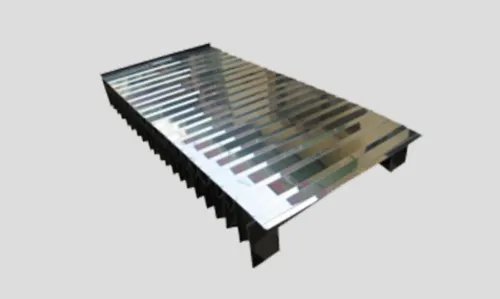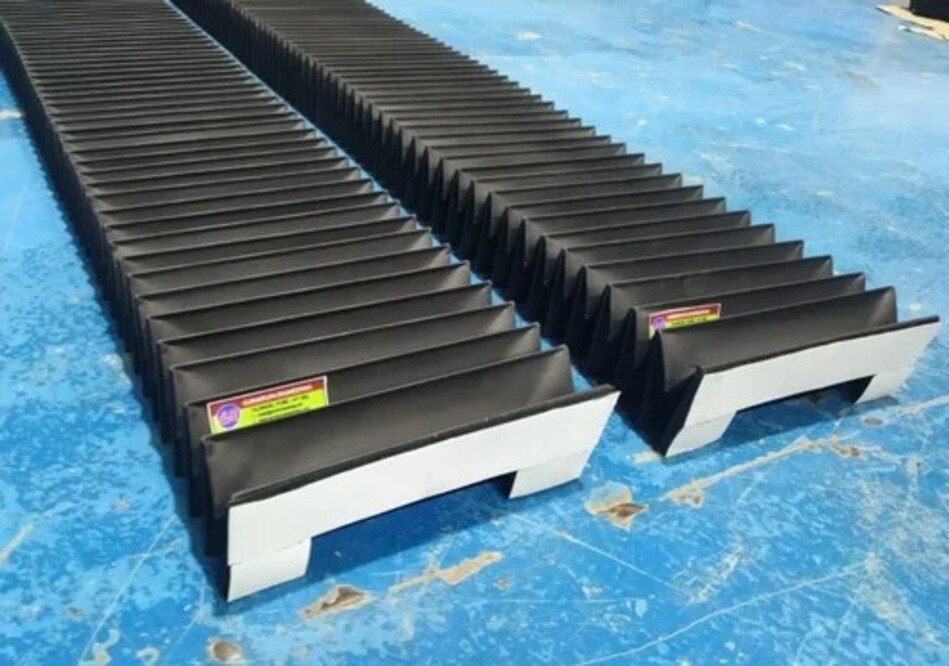
Laser cutting exposes guideways, screws, cables, hoses, and moving assemblies to hot dross, sparks, smoke, dust, and abrasive metal particles. By the end, you will be able to identify whether your Pune operation needs a bellow, choose the right protection arrangement, prepare a usable specification, and test a supplier’s claims before purchase.
Key takeaways
- Protect exposed guideways when smoke, dust, slag, or coolant can reach moving parts.
- Specify travel, compressed length, speed, temperature, laser exposure, and mounting details.
- Compare suppliers on drawings, materials, testing, service access, and replacement lead time.
- Isolate power and laser sources before inspecting or replacing a machine bellow.
Which Pune businesses face enough laser contamination to need bellows?
Laser contamination justifies protection wherever Pune’s laser cutting job shops, sheet-metal fabricators, automotive and auto-component plants, aerospace manufacturers, appliance and electrical-enclosure makers, engineering workshops, contract manufacturers, and machine builders run CO₂ or fiber-laser systems with exposed moving parts. These are common laser machine bellow cover applications.
| Location | Contamination or heat exposure | Protection focus |
|---|---|---|
| X and Y gantry axes | Dry dust, smoke residue, dross, sharp scrap | Guideways, linear rails, racks, and ball screws |
| Z-axis laser head | Sparks, molten spatter, radiant heat | Vertical guide, head assembly, and ancillary positioning axis |
| Shuttle table | Slag, scrap, coolant mist, abrasive particles | Table mechanism, rails, cables, and hoses |
| Cable and hose routes | Bending, hot debris, abrasion | Separate cable carrier or energy chain; check bend radius |
Hot dross, sparks, molten spatter, smoke residue, dry metal dust, coolant mist, sharp scrap, and radiant heat attack exposed rails and screws. Specify heat-resistant or flame-retardant fabric, protective lamellae, or a spark deflector rather than choosing by dimensions alone; an enclosed linear module may need a different arrangement.
A bellow is a mechanical contamination barrier, not fume extraction, laser-beam guarding, an interlocked door, fire control, or housekeeping. Fume systems remove smoke, enclosures and interlocks control access and radiation, and cleaning removes accumulated debris.
For laser machine protection for manufacturers, assess each axis separately: a sealed guideway does not automatically need a bellow, while an exposed rack or ball screw often does.
How do you choose a bellow instead of another machine-protection system?
Choose by the hazard, moving geometry, and protection function—not by cover width alone. For laser machine bellow cover applications, select a flexible bellow when a guided rail, ball screw, or moving head needs protection from dust, dross, sparks, and heat while travelling through a defined path.
| Option | Best fit | Main limitation |
|---|---|---|
| Flexible bellow | Guided moving elements exposed to contamination | Needs clearance and correct folded-pack dimensions |
| Apron cover | Broad areas requiring flexible shielding | Less suitable for tightly guided, compact travel |
| Telescopic steel cover | Rigid, heavy-duty protection against chips and impact | Adds substantial mass and needs installation space |
| Cable carrier | Controlling the bend radius of cables and hoses | Does not shield guideways or rails from contamination |
| Full machine enclosure | Sealed access, fume control, and laser-radiation guarding | Requires doors, extraction, interlocks, and more floor space |
Do not use a bellow as a substitute for an enclosure, fume extraction, or laser controls under ISO 11553-1 and ISO 12100. A cable carrier solves bend-radius control; combining it with a bellow requires separation checks to prevent cable fatigue.
Heat-resistant fabric or metal lamellae improve spark and abrasion resistance but increase moving mass, folded-pack size, and acceleration load on a high-speed fiber-laser axis. Match that load to the servo and mounting structure. Thermal-welded, perforated-fold, combination-fold, and sewn construction offer different heat resistance, abrasion behaviour, flexibility, and cycling performance; the construction name alone proves nothing.
What measurements and operating data must a laser bellow specification include?
A reliable specification starts with the axis, not the machine model or cover width. Record protected-axis travel, extended and compressed lengths, folded height, cross-section, mounting-hole pattern, mounting-frame dimensions, minimum bend radius, available clearance, attachment orientation, movement path, speed, acceleration, cycle frequency, and lateral guidance. This is the core of laser machine protection for manufacturers.
1. Draw the cover fully extended and fully compressed. Show clearance to the guideway, rack, cable carrier, workpiece, and adjacent structure in both positions. Incorrect compressed-length allowance, fold collapse, a nonparallel mounting frame, or weak lateral guidance can make the cover rub, jam, or tear.
2. Record process conditions: laser type, cutting material, maximum temperature exposure, spark and dross direction, cycle time, travel speed, cleaning chemicals, and contaminant type. State whether the design needs a scraper, wiper, spark deflector, or protective lamella. Specify heat-resistant or flame-retardant fabric when hot dross, sparks, spatter, or radiant heat exceed ordinary machine-tool-cover conditions.
3. Ask for exact limits and evidence, not “heat resistant” as a standalone claim: temperature range, flame-performance test, cycle life, permitted speed and acceleration, chemical-resistance data, and material traceability. Check folded-pack size and moving mass against the axis servo and mounting structure; thicker materials and lamellae add protection but also acceleration load.
This template gives the supplier enough information for a drawing, fit review, and acceptance test rather than a quotation based only on cover area.
How should Pune buyers compare a laser cutting bellow cover supplier?
A reliable laser cutting bellow cover supplier in Pune proves fit at the machine, not through catalogue adjectives. Require a site measurement, accurate reproduction of the mounting interface, a dimensional drawing, and a prototype or trial fitting.
Approve the drawing before manufacture, then test the cover through the complete machine stroke in both extended and compressed positions.
| Supplier evidence | What to check | Why it matters |
|---|---|---|
| Site survey | Stroke, clearance, movement path, speed, acceleration, and mounting faces | Prevents rubbing against rails, racks, cable carriers, or the workpiece |
| Material recommendation | Compatibility with dross, sparks, smoke, dry dust, coolant mist, or abrasive powder | Nominal heat resistance does not prevent chemical or abrasion failure |
| Trial and acceptance test | Prototype fit, parallel mounting, unrestricted full-stroke movement | Finds fold collapse and interference before production |
- Dimensional drawing showing extended length, compressed length, folded height, cross-section, hole pattern, and mounting details.
- Material specification, exact temperature rating, flame-retardant test evidence, and the inspection procedure.
- Warranty terms, replacement-part availability, quotation lead time, and repair or refurbishment arrangements.
Local support has practical value for laser machine bellow covers for businesses in Pune: installation assistance reduces interface errors, fast after-sales response limits downtime, and replacement measurement restores fit after a machine modification. GURUKRUPA BELLOWS PVT LTD belongs in the comparison only after its capabilities and documents are checked against the machine’s operating conditions.
Related products
 | Laser Machine Bellows ₹1000 We are committed to manufacture, export, and supply a qualitative range of Laser Machine Bellows for our esteemed clients. View product → |
 | Laser Cutting Machine Bellows ₹1000 We offer Laser Cutting Machine Bellows made specifically for your laser machine. View product → |
How do you operate, inspect, and replace a laser machine bellow safely?
Treat the bellow as a wear component, not a permanent shield. The operating discipline behind laser machine bellow covers for businesses in Pune starts with cycle-based inspection, especially on multi-shift machines exposed to workshop dust, monsoon humidity, condensation, and mixed production residues.
- Before cutting or piercing, confirm that the cover moves freely through its full stroke. Check for burned or cracked fabric, delamination, pinholes, loose seams, detached lamellae, distorted mounting plates, trapped swarf, chemical damage, and rubbing against rails, screws, cables, hoses, or nearby parts.
- During loading and unloading, keep sharp scrap and hot dross off the folded pack. Do not force the axis when travel is restricted; stop the machine and find the obstruction.
- After cleaning, inspect again. Remove dry dust and swarf using the method specified for the cover material, then use only approved chemicals. Unapproved solvents, coolant residue, and aggressive degreasers can attack coatings, seams, or adhesives.
- Record cycle count, exposure type, defect location, and downtime. Replace the cover before debris reaches a guideway, ball screw, rack, or cable.
- During maintenance, isolate power and laser emissions, support moving parts, and verify the replacement’s clearance, mounting, travel, and folded height. A replacement must preserve enclosure gaps, interlocks, visibility, and fire protection under ISO 11553-1 and IEC 60825-1.
Direct flame, severe molten-metal impact, inadequate clearance, or contamination demanding a sealed enclosure indicates a poor-fit application. This is the core of laser machine protection for manufacturers: a bellow is not fume extraction, an enclosure, or laser-beam control.
Frequently asked questions
Which Pune businesses need laser machine bellow covers?
Laser cutting job shops, sheet-metal fabricators, automotive and auto-component plants, aerospace manufacturers, appliance makers, electrical-enclosure producers, engineering workshops, contract manufacturers, and machine builders need them when exposed moving parts face smoke, dust, slag, heat, coolant, or abrasive debris.
When should you choose a bellow instead of another machine-protection system?
Choose a bellow when a flexible, guided cover must follow linear or telescoping movement while shielding guideways, screws, cables, or hoses. Compare it with telescopic steel covers, roller shutters, wipers, and cable carriers when rigidity, high impact resistance, access, or cable routing is the primary requirement.
What information must a laser machine bellow specification include?
Give the supplier axis travel, closed and extended lengths, width and height, mounting points, folded height, movement speed and acceleration, cycle frequency, orientation, bend direction, nearby heat sources, laser exposure, smoke and debris type, coolant or oil exposure, and required service access.
How should Pune buyers compare a laser cutting bellow cover supplier?
Request a dimensioned drawing, material and coating details, fastening method, operating limits, inspection or test records, installation instructions, warranty terms, replacement-part availability, lead time, and references for comparable laser machines. Compare the complete service and replacement cost rather than only the quoted cover price.
How do you inspect and replace a laser machine bellow safely?
Stop the machine, isolate electrical, pneumatic, hydraulic, and laser energy, wait for stored energy to dissipate, and follow the machine maker’s lockout procedure. Inspect stitching, folds, mounting frames, wear strips, fasteners, trapped debris, and interference during full travel; replace the cover when damage exposes protected components or restricts movement.