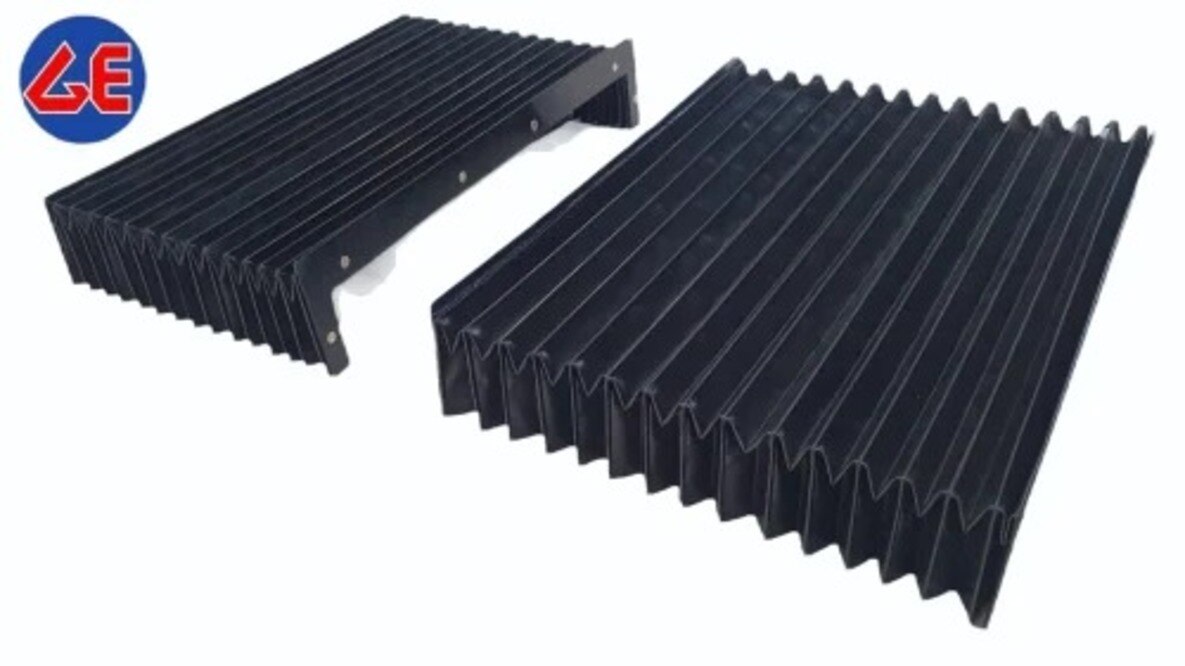
Metal chips, coolant, grinding dust and welding spatter can reach guideways, ball screws and telescoping mechanisms within seconds of a machining cycle. You will learn how flexible bellows and rigid steel covers manage that contamination, how to size them for real axis movement, and which signs show that protection has failed.
Key takeaways
- Use folded bellows to block chips, coolant, dust and welding spatter.
- Match cover length to axis travel, compressed length and mounting space.
- Choose steel telescopic covers for heavy chips, heat and severe impact.
- Inspect folds, seams, wipers and mounting points before contamination enters.
How a bellow cover keeps contamination away from moving components
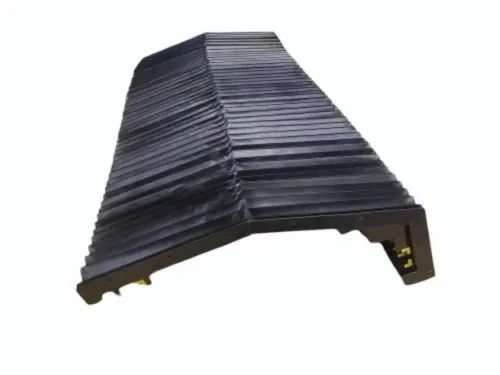
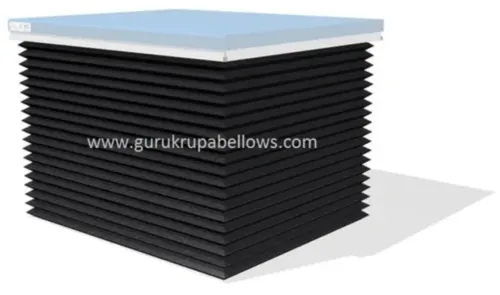
A folded fabric or elastomer bellow moves with the CNC axis, opening and compressing without exposing the protected zone. Its folds form a flexible barrier that stops metal chips, coolant, grinding dust, abrasive particles and welding spatter before they reach the telescopic mechanism and precision motion parts.
The protection is indirect: the cover keeps contamination out rather than absorbing the machine’s cutting load.
- Guideways: the bellow prevents chips and sludge from settling on running surfaces, where they can score or obstruct movement.
- Ball screws: it limits abrasive dust and coolant contact with the screw, nut and lubrication film.
- Linear rails: it keeps particles away from the rail and bearing blocks, reducing grinding damage and drag.
- Hydraulic cylinders: it shields the rod and seals from chips that could cut or embed in the sealing edge.
- Cables and hoses: it separates flexible lines from swarf, coolant spray and welding spatter that can cause abrasion or chemical attack.
A bellows cover is not a replacement for a steel telescopic cover when chips strike with impact-level force or arrive incandescent. Choose rigid overlapping steel sections for that load; use flexible bellows where compact, guided movement and moderate contamination are the priority.
The CNC machine bellow cover benefits in Ludhiana include less contamination, fewer unplanned guideway-cleaning interruptions and longer service intervals, especially on dusty, multi-shift production lines. Keep lubrication schedules, wiper replacement and enclosure maintenance in place; a bellow cannot correct neglected servicing.
How flexible bellows and steel telescopic covers behave during axis movement
Choose a flexible bellows for an axis that needs a compact, compliant cover through acceleration, deceleration and reversal; choose a steel telescopic cover when chips, heat and coolant demand impact-resistant protection.
| Option | Movement behaviour | Best fit |
|---|---|---|
| Flexible fabric or elastomer bellows | Folds into a compact package and follows the axis; no sliding box travel | Irregular, restricted spaces; dust, moderate coolant and protected motion parts |
| Steel telescopic cover | Overlapping boxes extend and retract over one another; scrapers or wipers maintain contact while drainage removes coolant and chips | Heavy chip loads, hot swarf and severe coolant exposure |
A bellows is not a pressure vessel. During fast reversals, its folds can surge, balloon, collapse or rub against nearby machine parts if the motion profile exceeds the design. Add internal frames, guide strips or protective slats when the cover needs shape control; specify low-friction construction where rubbing or rapid travel is expected.
A telescopic cover also depends on correct section travel, sufficient overlap between boxes and uninterrupted wiper contact. Hardened or damaged wipers let contamination pass underneath, while blocked drainage adds weight and drag.
For CNC telescopic cover protection in Ludhiana, provide axis speed, acceleration, chip temperature, coolant type, drainage direction and cleaning method—not only travel and width.
How to size a cover for the machine’s actual travel and contamination
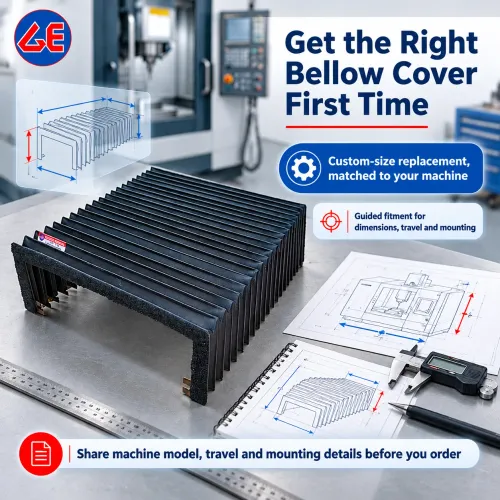
Size the cover from the machine’s actual guideway and surrounding envelope, not from the CNC model name, catalogue width or nominal stroke. Measure the fixing points, obstructions and clearance at full extension and retraction. For anyone asking how cnc machine bellow covers for protect telescopic components in ludhiana, this is the starting point.
- Record axis travel, folded length, extended length, closed height, extended height, section count and the supplier’s specified minimum fold height.
- Measure the guideway, mounting faces, fixing-hole pattern, nearby tools and available clearance. Confirm horizontal or vertical mounting, drainage direction and whether the cover can move freely through its complete travel.
- Provide maximum speed, acceleration, deceleration and reversal pattern. Rapid reversals can make folds surge, rub or collapse unless the construction supports that motion.
- Describe the contamination: chip form and load, stringy swarf, grinding dust, abrasive particles, coolant or cutting-oil chemistry, cleaning chemicals, operating temperature, vibration and impact.
- Confirm that the cover will not bottom out at full retraction. Compressing folds below the specified minimum fold height causes fatigue, seam failure, guideway rubbing and premature loss of travel.
Hot chips and high-volume swarf need heat- and abrasion-resistant construction; incandescent or impact-level loads require more than ordinary fabric protection. Ordinary coated fabric suits dust or moderate coolant exposure only after chemical and temperature compatibility is checked. Include drainage in the design, because trapped coolant and chips add weight, drag and corrosion.
Where these covers are used in Ludhiana workshops and factories
CNC machine bellow covers applications in Ludhiana depend on the machine’s movement and contamination, not simply its location or industry. They protect moving axes on CNC turning and milling machines, machining centres, grinding machines, special-purpose machines and transfer equipment.
Automotive-component and bicycle-component plants may generate steel chips, stringy swarf and coolant spray, while general-engineering shops may face cast-iron dust or rapid-traverse movement. Grinding machines add abrasive sludge, and foundry-related equipment can expose covers to heavy dust, heat and welding spatter.
A flexible bellow suits moderate contamination and restricted installation space; impact-level or incandescent chips call for a steel telescopic cover instead.
Provide these details when requesting a quotation:
- Measure the guideway, fixing points, available installation envelope, axis travel, closed length, extended length and required orientation.
- State the rapid-traverse speed, acceleration, reversal pattern and whether the axis moves horizontally, vertically or at an angle.
- Identify the contamination: cast-iron dust, steel chips, stringy chips, grinding sludge, coolant spray or welding spatter.
- Record chip temperature, coolant or cutting-oil type, cleaning chemicals and cleaning method.
- Explain the required mounting arrangement, drainage path and minimum clearance around the moving cover.
GURUKRUPA BELLOWS PVT LTD can be useful when its quotation review uses these machine-specific measurements and process conditions rather than a city, industry or model name alone.
Related products
 | CNC Telescopic Cover Product Details: Brand GURUKRUPA Being one of the trustworthy names of the industry, we bring forth CNC Telescopic Cover that can be availed at... View product → |
 | Telescopic Cover Product Details: Brand GURUKRUPA Color Steel Material Steel Size Customised We are one of the pre-eminent names of the industry to manufacture and... View product → |
How to inspect the cover before contamination reaches the machine
Inspect the cover before contamination reaches the machine, then repeat the check during a slow axis cycle. A cover that looks sound at rest can pull sideways, drag or open a gap while moving.
1. Examine every fabric fold, coating and stitch for tears, cracks, lifting, abrasion or chemical attack. Check lamellae, internal frames, fasteners and fixing plates for distortion, looseness, detached edges or movement. Poor mounting can pull a bellows sideways and cut its folds.
2. On a steel telescopic cover, inspect each wiper or scraper for hardening, splits and continuous contact. Look for gaps between overlapping boxes; worn wipers can let chips and coolant underneath even when the cover remains structurally intact.
3. Remove accumulated chips and check that drainage channels and openings are clear. Blocked drainage adds weight and drag, holds coolant against steel and accelerates corrosion. A telescopic cover is not a sealed pressure vessel, so coolant must reach the machine’s intended drainage path.
4. Run the axis slowly through its full travel. Stop for uneven telescopic movement, abnormal drag, sideways pulling, coolant leakage or a fold that fails to extend and compress evenly. Stop the machine and repair a failed fold or wiper before guideways or ball screws are contaminated.
Treat the cover as a machine-protection component, not automatically as a personnel safety guard. ISO 12100 covers risk assessment and risk reduction; ISO 14120 covers general guard requirements. The cover does not replace the machine’s required safeguarding.
Frequently asked questions
How do CNC bellow covers protect telescopic machine components?
Their folded fabric or elastomer sections move with the axis and form a barrier against chips, coolant, grinding dust, abrasive particles and welding spatter.
How do flexible bellows differ from steel telescopic covers during axis movement?
Flexible bellows open and compress with the axis while shielding the moving zone. Steel telescopic covers use sliding metal sections for tougher chip, heat and impact exposure.
How do you size a CNC machine bellow cover?
Measure the machine’s full travel, required compressed length, expanded length, available mounting space and the contamination the cover must resist.
What should you inspect on a CNC bellow cover?
Check folds, seams, mounting plates, fasteners, guide surfaces and wipers for tears, gaps, distortion, loose parts or contamination paths.
Related products
 | Telescopic Cover ₹5000 Product Details: Brand GURUKRUPA Being one of the trustworthy names of the industry, we bring forth CNC Telescopic Cover that can be availed at... View product → |
 | Industrial Telescopic Covers Our company is known as one of the eminent names of the industry to manufacture and supply Industrial Telescopic Covers. View product → |
 | Bellow Cover ₹1000 Product Details: Brand GE Color Black-Blue - Gray -White Size ANY ( C shape, Square, Round, Rectangular) Ours is a trustworthy name in the business... View product → |
 | Steel Telescopic Cover Product Details: Brand GURUKRUPA Our company is considered a renowned name in the field that manufactures and supplies Steel Telescopic Cover. View product → |