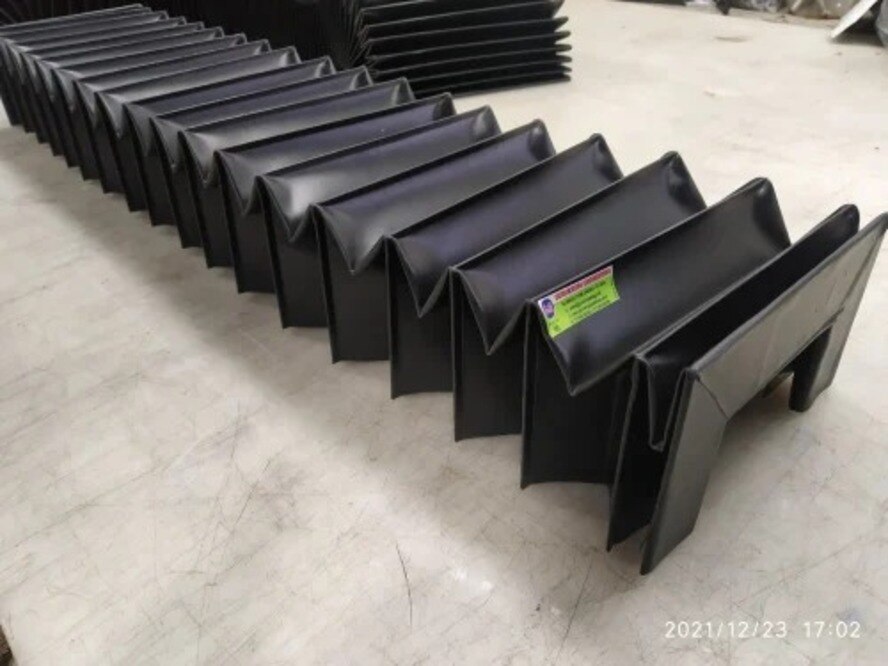
Metal dust, slag, smoke residue, spatter and cleaning fluids can reach guideways, screws and moving axes long before a machine fault becomes visible. By the end, you will be able to identify whether your process needs a bellow cover, compare it with other protection options and prepare the measurements and exposure details a supplier needs for a safe fit.
Key takeaways
- Protect guideways exposed to metal dust, slag, heat, and daily motion.
- Measure travel, mounting points, folds, clearance, and compressed length before ordering.
- Specify fabric, temperature resistance, flexibility, and fire-risk requirements in writing.
- Track wear, clean covers correctly, and replace them before guideways become exposed.
Which production businesses face the highest need for bellow covers?
Sheet-metal fabricators, laser job shops, automotive suppliers, appliance manufacturers, aerospace suppliers, laser service centres, tube and profile laser users, and high-volume contract manufacturers face the strongest demand. The practical question is who needs laser machine bellow covers: businesses where daily debris reaches moving parts, not every company that owns a laser.
| Business or process | Contamination reaching moving parts | Why demand is high |
|---|---|---|
| Fiber or CO2 flatbed cutting | Metal dust, slag, smoke residue and abrasive particles | Guideways, racks, linear motors or ball screws sit inside the cutting zone |
| Tube and profile laser cutting | Chips, scale and falling debris as the workpiece rotates | Chuck movement, tube supports and changing clearances create openings and rubbing risks |
| Laser welding or cladding cells | Weld spatter, hot particles, grinding dust, metal vapor or powder residue | Linear slides near the plume need protection during repeated cycles |
| 3-, 4- and 5-axis machines | Debris across angled, rotary and compound-motion paths | A simple accordion cover can buckle, twist or strike the machine |
| Robotic laser cells | Spatter, dust and residue around articulated joints | Multiple axes increase folding, interference and abrasion points |
Fiber and CO2 flatbed cutters create especially high demand because rapid, multi-shift operation repeatedly drives contamination toward exposed axes. Marking or engraving in a clean enclosure may need less protection; welding, cladding and cutting need more when the slide sits close to the process. Exposure and duty cycle—not the laser source alone—determine the need.
How do you decide whether a machine actually needs protection?
Decide by tracing contamination, not by the laser source alone. A cover earns its place when guideways, linear rails, ball screws or rack-and-pinion drives sit inside the contaminated work envelope and cannot be relocated outside it. A fully sealed existing guard can make an added bellows unnecessary and add only another wear item.
Inspect with power isolated, then move each axis through its full travel:
- Check exposed rails, screws, racks, cable carriers and moving axes for metal dust, slag, smoke residue, coolant, cutting oil, hot chips and scale.
- Look for deposits on seals, staining inside folds, impact marks and contamination that returns immediately after cleaning.
- Record whether the cutting head, fixture or workpiece throws debris directly toward the component.
Laser machine bellow covers for production suit moving protection where a fixed shield cannot follow the axis.
| Option | Main function | Best fit |
|---|---|---|
| Telescopic steel cover | Rigid heavy-duty shielding | Fixed paths with severe, concentrated contamination |
| Apron cover | Overlapping flexible shielding | Straight travel with moderate debris |
| Flexible enclosure | Isolates a larger zone | Broad access or splash containment |
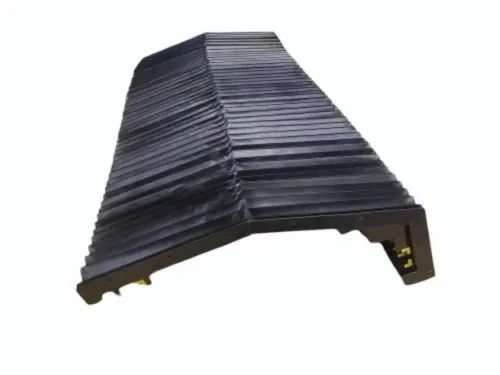
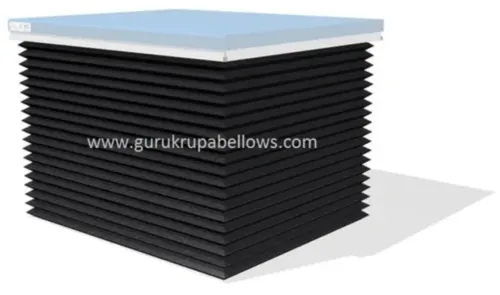
| Laser bellows | Follows moving slides and screws | Compact axes inside the process zone |
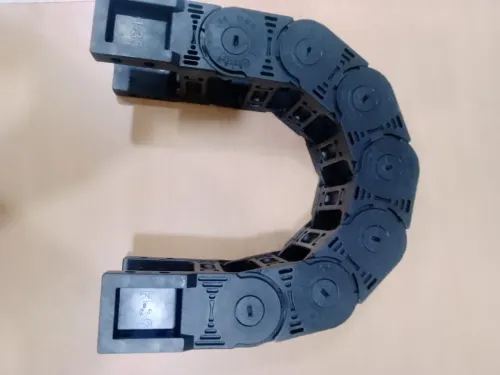
| Cable carrier | Routes utilities | Controlled bending of cables and hoses, not guideway shielding |
Bellows and cable-management systems often work together. Never make a bellows carry power, signal, gas, fiber, coolant or extraction lines; use a carrier for those services. That separation prevents overloaded folds, uncontrolled bending and premature failure.
What must a daily-production cover withstand?
A daily-production cover must tolerate acceleration, rapid axis travel, short cycles, reversals and continuous folding without buckling, tearing or restricting motion. Heat near the cutting head, abrasive dust and frequent cleaning add different failure risks; specify the cover from the actual process, not the word “laser.”
| Process | Debris near the slide | Heat and particle exposure |
|---|---|---|
| Fiber cutting | Fine metal dust, dross and smoke residue | High local heat, sparks and occasional molten ejecta |
| CO2 cutting | Scale, dust, dross and smoke residue | Heat and sparks near the cutting zone |
| Marking or engraving | Fine powder and light debris | Lower bulk contamination, but reflected radiation still matters |
| Welding | Spatter, hot particles, vapor and grinding dust | Molten spatter and intense radiant heat |
| Cladding | Powder residue, spatter and grinding dust | Hot particles and sustained process heat |
Compare coated technical fabrics, heat-resistant fabrics, sewn or bonded constructions, and internal slats or guards against radiant heat, sparks, molten spatter, oil, coolant, alkaline wash fluids, cleaning chemicals, abrasion and the required bend radius. Demand written heat-resistance, flame-retardance and chemical-compatibility data, including each test method; reject generic “laser-resistant” labels.
Specify the laser wavelength and reflected-beam exposure, especially for aluminum, copper, brass and polished stainless steel. A fabric can burn or perforate under direct or reflected radiation. Laser cutting bellow covers provide mechanical protection only; they are not a laser-safety enclosure, beam barrier, interlock or fume-extraction system.
What information proves that a proposed cover will fit?
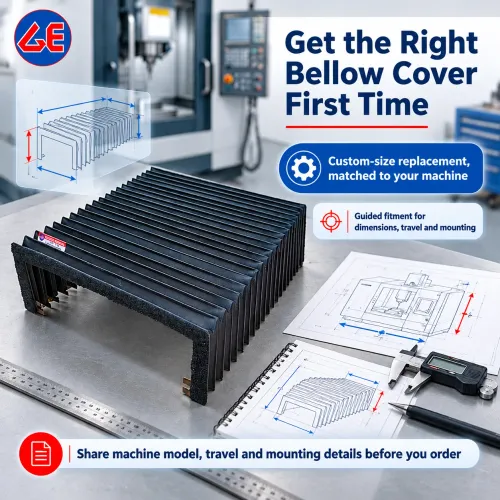
A proposed cover fits only when its geometry matches the machine’s real motion, mounting space and hazards. Laser machine bellow cover users must submit a dimensioned drawing with the quotation, not request a cover selected from nominal machine stroke alone.
1. Provide collapsed length, extended length, protected travel, width, height, mounting-hole pattern, travel direction, clearance at full compression, attachment points, installation orientation, motion speed, acceleration, minimum bend radius and the nearby interference envelope.
2. Check the cover at both travel ends and through the complete motion path. Confirm that it does not restrict axis travel, rub the frame, buckle at an angled or rotary joint, obstruct optics, strike the cutting head, or collide with the workpiece, chuck, tube support or fixture.
3. For flatbed machines, verify straight-axis folding and end clearances around the cutting head. For tube and profile machines, check rotary motion, changing chuck and tube-support clearances, and falling chips or scale; copied flatbed geometry can bind or leave openings.
For articulated and multi-axis machines, test every compound angle because an accordion can twist, buckle or collide.
4. Record clearances with the machine at full compression, full extension and intermediate positions. A dimensioned drawing must show each attachment point and obstruction, so the supplier can calculate fold spacing, bend radius and mounting tolerances before quoting.
How should production buyers justify, source and maintain the cover?
Production buyers should justify a cover by comparing its inspection and replacement cost with guideway replacement, alignment work, accuracy loss and contamination-related downtime. The strongest case is a multiple-shift machine running high-acceleration cutting, short cycles and frequent cleaning.
| Option | Cost or consequence | Decision use |
|---|---|---|
| Periodic inspection and cover replacement | Planned maintenance with controlled downtime | Choose when a cover prevents repeated contamination |
| Guideway replacement and alignment | Major repair, setup work and lost accuracy | Compare against the cover’s service life |
| Contamination-related stoppage | Unplanned downtime, rejected parts and emergency cleaning | Use the machine’s hourly production cost |
Prototype users and clean-environment users may need no custom cover when guideways and drives remain outside the process zone. Do not add a bellows that creates clearance problems without reducing exposure.
Set an operator check each shift and a maintenance inspection at a defined service interval. Look for:
- Torn or pinholed folds, detached end frames and loose hardware
- Crushed folds, contamination buildup or lost axis travel
- Contact with the machine structure or workpiece
Request a written quotation with a dimensioned drawing, material and exposure data, attachment details, service access and cleaning instructions. Give GURUKRUPA BELLOWS PVT LTD the machine drawings and process hazards so the proposed cover is reviewed as a production service part, not treated as a generic accessory.
Related products
 | Laser Machine Bellows ₹1000 We are committed to manufacture, export, and supply a qualitative range of Laser Machine Bellows for our esteemed clients. View product → |
 | Laser Cutting Machine Bellows ₹1000 We offer Laser Cutting Machine Bellows made specifically for your laser machine. View product → |
Frequently asked questions
Which businesses need laser machine bellow covers?
Sheet-metal fabricators, laser job shops, automotive and appliance suppliers, aerospace suppliers, service centres, tube laser users, and high-volume contract manufacturers face the strongest need when debris reaches moving parts daily.
How do you decide whether a laser machine needs protection?
Inspect whether metal dust, slag, smoke residue, coolant, heat, or abrasive debris can reach guideways, screws, rails, cables, or other moving components during normal production.
What must a daily-production laser bellow cover withstand?
Specify resistance to the machine’s debris, heat, sparks, chemicals, repeated compression and extension, abrasion, and cleaning method. Match the construction to the actual cutting process.
What information proves that a proposed cover will fit?
Provide guideway dimensions, travel length, cover width and height, mounting details, compressed and extended lengths, fold size, clearance, motion speed, and photographs or drawings of the installation area.
How should production buyers maintain laser machine bellow covers?
Set inspection intervals, remove debris using the approved cleaning method, check stitching and mounting points, record damage, and replace the cover when tears or exposed guideways compromise protection.