Guideways, ball screws, linear rails, slides, cables, and hoses face chips, coolant, heat, and abrasive dust during every cutting cycle. By the end, you will know how to choose the cover type, calculate its travel envelope, specify its construction, and brief a Mumbai supplier without relying on a guideway-width guess.
Key takeaways
- Match bellows material and folds to chips, coolant, heat, and cutting force.
- Measure travel, compressed length, mounting points, and clearances before ordering.
- Specify orientation, sealing, construction, and protection for cables or guideways.
- Test full axis travel, clearance, sealing, and motion on the machine.
Match the cover to the cutting operation
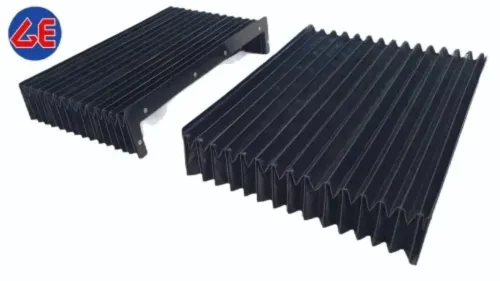
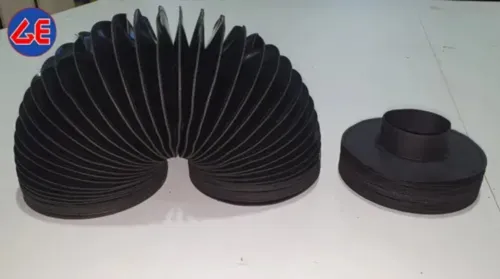
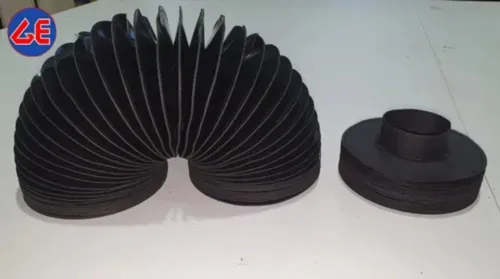
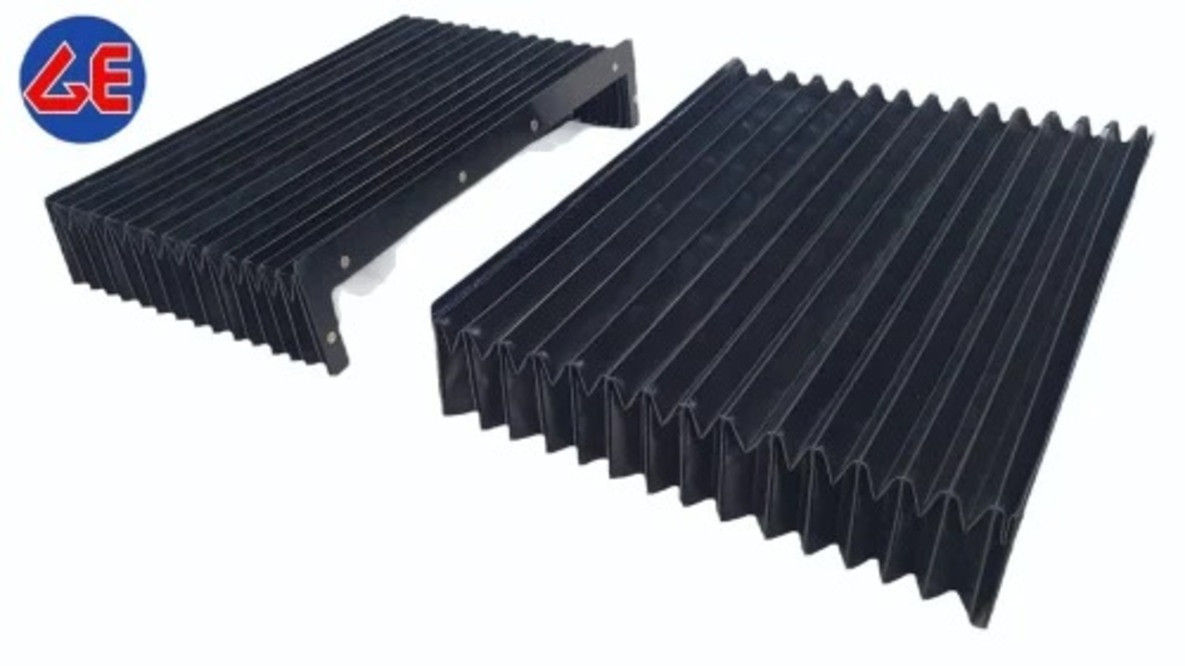
A CNC machine bellow forms a flexible chip-and-coolant barrier around guideways, ball screws, linear rails, slides, hoses, and cables as the axis moves. Its folded fabric expands and compresses with the travel, shielding the protected surface without adding much moving mass.
It is not a structural enclosure or pressure seal; mounting frames, overlaps, wipers, or supports must handle those duties.
| Option | Best fit | Limitation |
|---|---|---|
| Fabric bellows | Compact or irregular spaces, low moving mass, hoses, cables, and moderate chips | Sharp or hot swarf and high-pressure impact can tear, burn, or puncture the fabric |
| Steel telescopic cover | Heavy sharp chips, hot swarf, grinding debris, and high-pressure chip impact | Heavier, bulkier, and less tolerant of unusual geometry |
| Roller shutter | Low-profile protection where space is restricted | Needs controlled guidance and does not suit every chip direction |
| Apron cover | Broad slide protection against chips and coolant | Requires room to stack or roll; moving mass is higher |
| Wiper | End-gap protection and removal of chips or coolant from a cover | It cannot shield a long exposed travel by itself |
| Brush seal | Light debris exclusion around edges and openings | It is not a pressure seal and can clog with packed chips |
CNC machine bellows for machine tools and bellows for CNC guideways protect surfaces; a cable carrier performs a different job by controlling the bend radius and routing of cables and hoses. Choose the bellows for contamination and geometry, then add end-gap protection where fixed and moving frames, mounting plates, or rail openings leave leakage paths.
Measure the machine before ordering custom bellows
Guideway width alone cannot size custom cnc machine bellows. A cover also has to fit the axis envelope, mounting geometry, fold movement, and surrounding hardware without rubbing or running out of travel.
1. Record the machine make and model, axis name, minimum and maximum travel positions, and axis stroke.
2. Measure the distance between the fixed and moving attachment planes at both limits. Calculate required extension as axis stroke plus the fixed and moving mounting geometry or offsets.
Set the fully extended length to reach the far limit without stretching, and reserve compression allowance at the near limit so folds never bottom out, sag, rub, or run out of travel.
3. Measure cover width and height, fully compressed length, fully extended length, fold pitch, and the smallest permissible fold radius. The radius is a design limit; forcing a tighter bend causes fatigue, seam cracking, and coating separation.
4. Supply fixed and moving end-frame dimensions, mounting-hole pattern, guideway clearance, movement direction, and attachment orientation. Include clearance for clamps, lubrication fittings, cable carriers, hose loops, and adjacent moving parts.
5. Give the supplier the operating speed, acceleration or jerk, cycle frequency, and frequency of rapid reversals. Flutter and buckling depend on motion, not just nominal rapid-traverse speed.
Ask for a dimensioned drawing or site photographs showing both travel limits. Confirm that the proposed cover moves freely through the complete stroke and that its frames align with the machine before ordering; a visually similar cover can still fail through tension, snagging, or over-compression.
Specify construction for chips, coolant, heat, and orientation
Specify the actual contamination, not a generic “industrial cover.” State whether the bellows will face dry dust, cast-iron chips, abrasive swarf, flood coolant, cutting oil, oil mist, alkaline cleaner, washdown water, welding heat, sparks, or high-temperature chips.
- Ask for written limits and test information for the complete construction: face material, coating, thread, adhesive, seam method, edge treatment, inspection window, reinforcement, internal frames, sliding plates, and metal or polymer end frames.
- Use a sacrificial wear layer for sharp chips or concentrated impact. Choose metal slats for severe chip loading, and heat-resistant construction for welding sparks or hot swarf; a chip-rated fabric can still burn, crack, or delaminate.
- Check chemical compatibility against coolant concentration, operating temperature, tramp oil, and cleaning chemicals. The frame, thread, adhesive, window, edge treatment, and coating must survive too.
- State whether installation is horizontal, vertical, inverted, inclined, or multi-axis. Orientation changes the required support, fold stability, chip accumulation, drainage, and risk of trapped water.
- Treat the smallest fold radius as a design limit, not a cosmetic preference. Exceeding it causes fold fatigue, seam cracking, coating separation, or loss of compression length.
- For cnc machine bellow covers for machine tool operators in mumbai, record humidity, monsoon washdown, coastal salt exposure, and contaminated coolant; request corrosion protection and drainage details for frames and fasteners.
A complete specification prevents a cover that looks suitable but fails after the first abrasive, hot, or chemically aggressive cutting cycle.
Prove clearance, sealing, and motion on the machine
Prove clearance, sealing, and motion on the machine before accepting bellows for CNC guideways. A cover that clears at rest can snag during reversal, while an end gap can admit chips and coolant.
- Record photographs, a drawing, or measured coordinates with the tool holder, spindle nose, chip conveyor, coolant lines, lubrication fittings, clamps, guide rails, cable carrier, hose loops, and every adjacent moving component at both travel limits.
- Run the axis slowly without cutting. Watch the cover through full travel, including acceleration, reversal, and stopping; confirm that folds do not bottom out, stretch, sag, rub, flutter, or snag.
- Check sealing at fixed and moving end frames, mounting-plate gaps, adjoining covers, and guide-rail openings. Mismatched frames leak at the ends; fit separate wipers or overlapping features wherever surfaces do not meet.
Treat cable management as a separate design task. Use each cable and hose manufacturer’s minimum dynamic bend radius, fill ratio, separation requirements, and allowable unsupported length; never substitute a universal bend-radius multiple. The bellows shields the machine surface, while a cable carrier controls cable and hose movement.
Inspect the cover stopped and moving. Look for:
- Cracked or hardened coating, torn folds, loose stitching, delamination, and distorted frames.
- Rubbing marks, coolant penetration, chip accumulation, restricted extension, flutter, and snagging.
Clear chips before they pack into folds, then repeat the dry run. Motion matters: restricted extension or flutter can disappear when the machine is stopped and return at production speed.
Prepare a Mumbai supplier brief that can be checked on site
A purchase brief for a cnc bellow cover supplier in mumbai must describe the machine, motion, contamination, and maintenance conditions—not just the guideway width.
1. Record the machine make and model, axis name, minimum and maximum travel, compressed and extended envelope, fold width, height and pitch, smallest fold radius, end-frame dimensions, mounting-hole drawing, movement direction, attachment orientation, guideway clearance, speed, acceleration or jerk, and cycle frequency.
2. Attach photographs and site measurements at both travel limits. Mark tool-holder, spindle, chip-conveyor, coolant-line, lubrication-fitting, cable-carrier, hose-loop, and adjacent-component clearances. State chip type, coolant type and concentration, tramp-oil contamination, ambient temperature, and washdown practice.
3. Ask every supplier for documented limits covering fabric, coating, thread, adhesive, seams, frames, fasteners, coolant chemicals, cleaner, temperature, sparks, and hot chips. Require corrosion protection for Mumbai’s humidity, monsoon moisture, contaminated coolant, and coastal airborne salts; also request drainage details, trapped-water prevention, storage packaging, replacement procedure, and inspection support.
4. GURUKRUPA BELLOWS PVT LTD can be considered alongside other suppliers only after its proposed cover is checked against this dimensional, motion, contamination, and maintenance brief. Compare confirmed fit and serviceability, not a visually similar catalogue item.
Before installation, perform a slow dry run through full travel, then inspect compressed and extended positions for rubbing, snagging, flutter, buckling, restricted movement, frame distortion, and drainage failure. These checks suit cnc machine bellow covers for machine tool operators in mumbai.
Related products
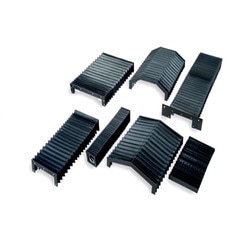 | CNC Bellow Cover Product Details: Brand GURUKRUPA Color BLACK Size ANY We are considered a well-known name in the business that manufactures and supplies CNC Bellow... View product → |
 | Bellow Cover The range of CNC Bellow Cover is manufactured on our premises, under the guidance of our expert professionals. View product → |
Frequently asked questions
How do you match CNC machine bellows to a cutting operation?
Assess chip size and impact, coolant type, operating temperature, cutting direction, and the required axis travel before selecting the cover construction.
What must you measure before ordering custom CNC machine bellows?
Record the protected length, travel, compressed length, width, height, mounting points, folded height, and nearby obstructions throughout the axis movement.
What should a Mumbai supplier brief specify for CNC bellows?
State the machine and axis, dimensions, material exposure, heat, coolant, chip load, orientation, mounting method, sealing needs, and site-test requirements.
How do you prove a CNC bellow cover fits correctly?
Run the axis through its complete stroke and check clearance, compression, extension, mounting security, sealing, and unrestricted movement.