
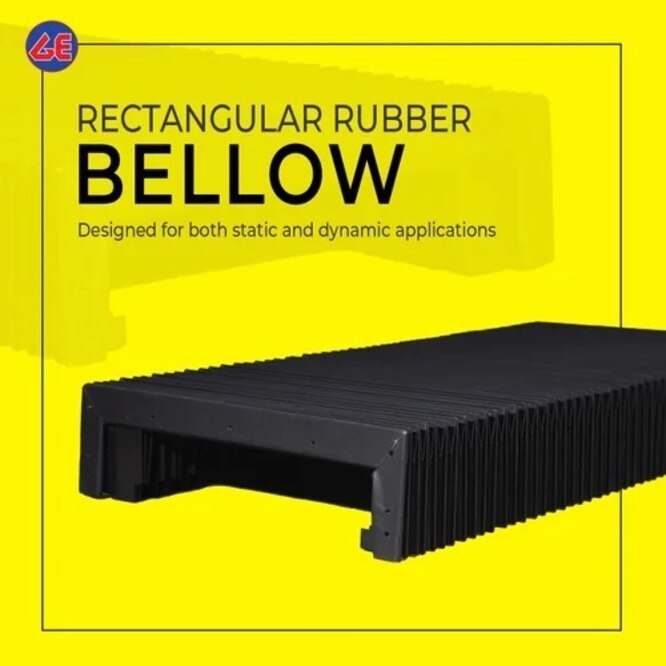
A machine-tool bellow begins as a travel and clearance problem, not as a piece of fabric cut to guideway length. By following the drawing, material, joining, forming, and inspection stages, you can understand how a cover is built and compare quotations using specifications that affect service life.
Key takeaways
- Calculate travel, collapse, fold pitch, clearances, and mounting allowances together.
- Choose coated fabric and reinforcement for heat, abrasion, oils, chips, and movement.
- Join folds, frames, and flanges without creating leakage or stress points.
- Specify stroke, compressed length, fold height, speed, temperature, and test results.
How the Machine Travel Becomes a Bellows Drawing
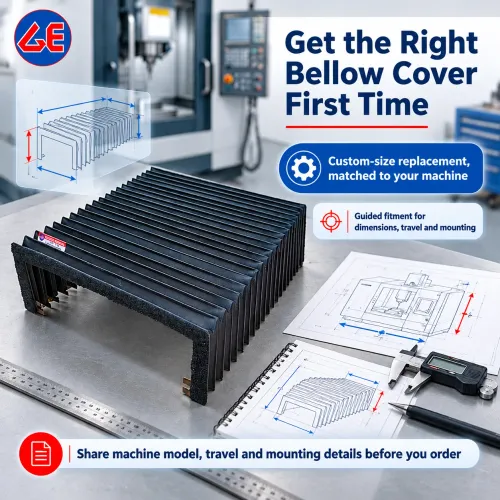
The drawing starts with the machine’s actual travel envelope, not the guideway length. For soft material bellow covers for machine tools, usable travel, extended length, collapsed length, maximum fold height, fold pitch, number of folds, guideway width, height clearance, lateral movement, mounting allowances, and maximum compressed envelope must be calculated together.
1. Mark the fixed and moving attachment points at both travel limits. Measure the guideway width, available height, lateral clearance, attachment-face spacing, and required mounting allowances. Record the ballscrew, linear guides, sensors, cable carriers, lubrication lines, clamps, swarf paths, drainage direction, and every obstruction along the complete stroke.
2. Convert those measurements into fold geometry. The extended length must cover usable travel; the collapsed length must fit inside the maximum compressed envelope. Divide the required movement by the usable fold stroke to establish fold pitch and number of folds, then check fold height against height clearance and nearby components.
3. Test the motion as a system. Check whether the cover needs internal or external support, guide strips, rails, or frames. Horizontal folds can sag, collide, or slap during reversal, while misaligned attachment faces twist the first and last folds. A cover measured only from guideway length may reach full travel yet buckle when compressed.
Tighter fold pitch saves installation space but increases crease severity and wear. Larger folds improve stability, bending radius, and resistance to hard creasing, at the cost of a larger compressed package. These dimensions define reliable bellow covers for machine tools.
How Fabric, Coatings, and Reinforcement Form the Protective Layer
A soft material bellow is a flexible layered cover, not a load-bearing structure. Fabric bellow cover manufacturing starts with a base textile—polyester for everyday use, aramid for high tear or temperature demands, or another heat-resistant fabric—then adds an outer coating.
PVC, polyurethane, silicone, PTFE-based coatings, and laminated constructions change flexibility, friction, chemical resistance, and heat behaviour.
The protective layer can include:
- Sewn or bonded reinforcement that limits tearing and stretching.
- Wear strips that take contact from chips or guideway edges.
- Corner pieces that protect high-stress fold junctions.
- Stitching thread selected for heat, oil, and abrasion exposure.
- Flexible or semi-rigid fold strips that keep folds open.
- Mounting plates or profiles that control the ends and attachment faces.
| Option | Best fit | Main consideration |
|---|---|---|
| Coated polyester | General coolant and chip exposure | Economical, but not a hot-chip solution |
| Polyurethane-coated fabric | Abrasion and repeated flexing | Check coating fatigue and chemical compatibility |
| Silicone-coated fabric | Higher heat exposure | Confirm seam and adhesive limits |
| Aramid reinforcement | Severe tearing or temperature | Can increase stiffness and cost |
| PTFE-based fabric | Low friction or chemical resistance | Joining and flexibility require careful design |
Do not treat the fabric rating as the cover rating. Seams, adhesives, edge treatments, frames, and mounting hardware can fail first, especially under hot-chip contact.
Request finished-assembly data for:
- Continuous temperature, peak contact temperature, and exposure duration.
- Coolant or oil compatibility, UV resistance, and washdown tolerance.
- Flame classification, antistatic performance, and test results.
How the Flat Pattern Becomes an Accordion Cover
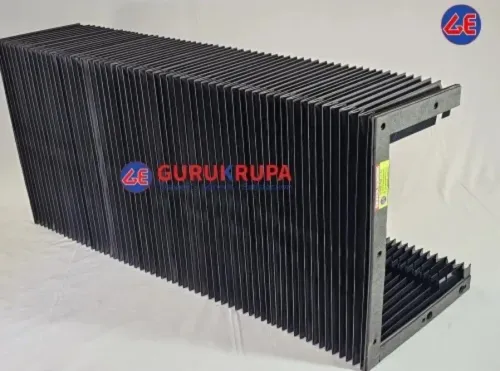
The flat pattern determines whether the finished cover folds cleanly or fights the machine. Fabric bellow cover manufacturing begins with fold depth, inner and outer fold lengths, corner radii, seam allowances, end-frame geometry, and mounting features; forcing a flat rectangle into folds creates diagonal tension and uneven corner compression.
1. Develop the pattern from the extended and collapsed envelope, then mark fold pitch, fold height, corners, attachment holes, and clearance zones.
2. Cut the selected textile, mark every fold line, and match panels so corresponding marks remain consistent. A shifted mark produces unequal folds and premature corner wear.
3. Form the accordion with a jig, press it into shape, or assemble it around guides that establish pitch and height. Shape the corners while the material is controlled.
4. Add internal or external frames, guide strips, rings, edge profiles, or wear strips to keep folds open and prevent rubbing on the guideway. Long horizontal covers need support against sagging and fold collision.
5. Control reinforcement rather than simply adding more. Too little causes sagging, collision, and slapping during reversal; too much increases compressed stack height, mass, friction, and actuator load.
6. Align every fold, check the compressed pack, and prepare the fixed and moving ends for plates, rails, profiles, or flanges. Misaligned attachments twist the first and last folds and overload them.
For soft material bellow covers for machine tools, the final forming check must confirm free articulation without preload, with adequate clearance for the guideway and nearby components.
How Seams, Frames, and End Flanges Are Joined
After cutting and forming, the joining method is chosen for the coating, not simply the fabric name. In fabric bellow cover manufacturing, the wrong process creates leaks, peeling, or a joint too stiff to articulate.
1. Sew coated fabrics when flexibility and practical repair matter. Needle holes can admit coolant, while thread can abrade or weaken under repeated folding. Seal the stitching or add a bonded cover strip where liquid ingress matters.
2. Use hot-air, hot-wedge, impulse, or radio-frequency welding for compatible thermoplastic-coated textiles. These processes produce a more continuous joint, but they are not interchangeable: silicone-coated fabrics and dissimilar laminates may not weld reliably.
3. Bond selected silicone or laminate combinations only after cleaning, roughening, and confirming chemical compatibility. Control adhesive thickness, cure time, and temperature; poor preparation causes peeling. Vulcanised construction suits elastomeric materials and requires a compatible compound plus controlled heat and pressure.
4. Attach plates, profiles, rails, or clamped frames to the fixed and moving ends. Align both ends before bonding or mechanically securing them, then cycle the cover and check that it articulates without twist.
Misalignment or installation preload overloads the first and last folds, so an otherwise suitable bellow cover for machine tools can tear at its ends. Leave no open mounting path: close gaps with seals, overlaps, wipers, labyrinth-like transitions, or secondary shields against coolant and fine dust.
How the Finished Cover Is Tested and Specified for Service
Accept soft material bellow covers for machine tools only after they pass both dimensional inspection and installed motion testing. A drawing match does not reveal a cover that twists, collides, or overloads the axis.
1. Measure extended length, collapsed length, fold height, fold pitch, mounting dimensions, and maximum fold height. Confirm the compressed pack clears ballscrews, guides, sensors, carriers, clamps, lubrication lines, and every obstruction along the stroke.
2. Inspect the first and last folds, seams, corners, stitching or welds, wear strips, end attachments, and frame retention. Check flange alignment and confirm that no mounting preload twists the cover. Inspect the coating for cuts, bubbles, lifted edges, or incomplete bonding.
3. Run repeated full-stroke cycles after installation. Watch for fold collision, rubbing, twisting, loss of tracking, progressive seam peeling, and excessive force at reversal; static inspection will miss these failures.
Select the construction for the contamination, not just the machine size. Use wear strips and robust folds for metal chips or abrasive dust, compatible coatings for cutting oil and coolant, heat shields or special textiles for sparks and welding spatter, UV-stable materials outdoors, and washdown-tolerant joints. Continuous heat and brief hot-chip contact require separate limits.
Specify continuous temperature, peak contact temperature, exposure duration, seam and coating limits, fire classification, antistatic performance, and grounding provisions where required. Fabric bellow cover manufacturing should document the complete assembly, not only the fabric.
When comparing quotations, ask GURUKRUPA BELLOWS PVT LTD or another manufacturer for the drawing, material stack, joining process, compressed length, reinforcement, test method, and cycle evidence. A fabric name or nominal size alone cannot establish service life.
Related products
 | Bellow Cover We are considered a well-known name in the business that manufactures and supplies Bellow Cover. View product → |
 | Bellow Cover Product Details: Brand GE Color Black-Blue - Gray -White Size ANY ( C shape, Square, Round, Rectangular) Ours is a trustworthy name in the business... View product → |
Frequently asked questions
How does machine travel become a bellows drawing?
The drawing uses the actual travel envelope, including usable travel, extended and collapsed lengths, fold pitch, fold count, clearances, lateral movement, mounting allowances, and compressed envelope.
What materials form a soft material bellow cover?
A soft material bellow combines a flexible fabric base with a coating selected for the machine environment, plus reinforcement where folds, edges, or mounting areas need greater strength.
How is a flat pattern turned into an accordion cover?
The flat pattern is marked for fold pitch and shaped into repeated pleats, then formed and secured so the cover reaches its required extended and collapsed dimensions.
How are seams, frames, and end flanges joined?
Manufacturers join the coated fabric at seams and attach frames or end flanges at the mounting ends, while controlling alignment, sealing, and stress around attachment points.
What should you specify when ordering a machine-tool bellow cover?
Specify travel, extended and collapsed lengths, fold height and pitch, fold count, guideway dimensions, clearances, movement, mounting details, speed, temperature, contaminants, and test requirements.