The right cover depends less on the label “rubber” or “fabric” than on how the assembly moves, what strikes it, and how its ends seal. By comparing construction, geometry, operating limits, measurement, and maintenance, you can specify protection that does not add axis friction, restrict travel, or create avoidable downtime.
Key takeaways
- Match the cover material to heat, sparks, coolant, chips and travel speed.
- Choose round rubber bellows for compact, repeated motion with compatible temperatures.
- Choose fabric bellows for large travels, irregular geometry or high-temperature protection.
- Measure travel, compressed length, opening size, clearance and attachment points before ordering.
Which cover construction survives your machine’s actual hazards?
Construction decides whether round rubber bellow covers versus fabric covers survive the hazard. A rubber machine bellows may be a moulded or formed elastomer with continuous convolutions and bonded collars, a rubber-coated textile assembly, or a reinforced elastomer design.
Nitrile, EPDM, neoprene, polyurethane, and silicone each suit different oils, coolants, temperatures, ozone exposure, and flex cycles; none is universally suitable.
Fabric machine bellows use PVC-, polyurethane-, silicone-, neoprene-, or PTFE-coated textile layers joined by sewing, heat sealing, welding, adhesive bonding, or combinations. Needle holes, thread, adhesive, seams, corner transitions, backing, reinforcement, and end frames can limit service before the coating does.
| Construction | Typical behaviour | Main risk or advantage |
|---|---|---|
| Continuous rubber wall | Higher sealing continuity, predictable return motion, stronger resistance to fine chips and splash | Greater flexing force; hot swarf or welding sparks can burn, cut, or embed in folds |
| Coated sewn fabric | Low moving mass, long travel, complex shapes, easier large envelopes | Tear propagation, seam leakage, abrasion, and frame or thread failure |
| Welded or bonded fabric | Better sealed joints than basic sewing | Heat cycling, chemical attack, or poor adhesion can open a seam |
Compare compression force, return motion, abrasion, tear growth, chip impact, oil and coolant compatibility, chemical exposure, heat cycling, UV, and expected service life. Fabric is not automatically more heat-resistant, and rubber is not automatically spark-safe; the weakest attachment detail governs. Rubber often forms a continuous cylindrical seal, while fabric needs deliberate seam and frame design.
When does the machine geometry favour round rubber or fabric?
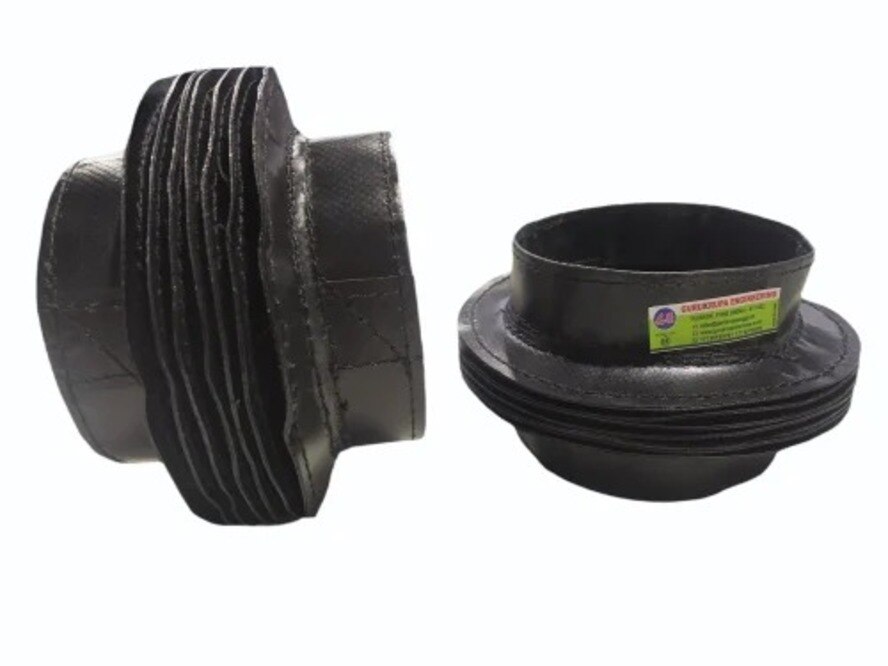
Match the cover to the protected motion, not to the material name. Round rubber bellow covers suit shafts, guide columns, ballscrews, cylinders, rotary components, and other circular moving parts when a compact, continuously closed barrier follows axial travel.
| Geometry or motion | Better fit | Reason |
|---|---|---|
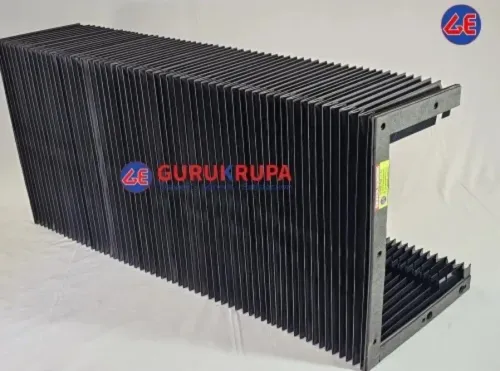
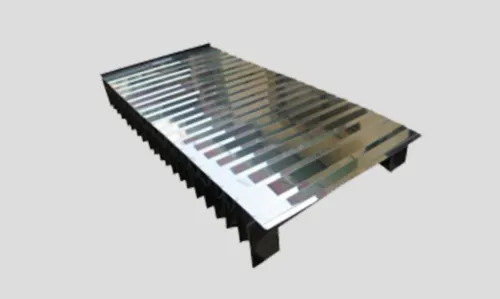
| Broad guideway or rectangular work area | Rectangular, square, C-shaped, formed, or telescopic fabric machine bellows | Covers wide, multi-sided envelopes |
| Irregular profile, long stroke, or fast low-mass assembly | Fabric cover with frames, hoops, or support strips | Reduces moving mass and follows complex travel |
| Cylindrical part with compact axial motion | Round rubber bellow covers | Seals continuously around the component |
Round rubber bellows are limited by mounting diameter, convolution geometry, compression ratio, minimum bend radius, and unsupported length. They are a poor substitute for guided telescopic protection across a wide work area or large lateral offset.
1. Rank the decision in this order: protection level, flexibility, moving mass, available space, expected travel, then shape. Select the construction only after those constraints agree.
2. Check convolution pitch, wall thickness, reinforcement, and unsupported length. These determine bending force, return motion, sag, buckling, and machine-axis load; tighter pitch or thicker reinforcement can increase stiffness and friction.
3. Treat neither construction as a cable carrier. Use an energy chain or engineered internal routing when bend radius, torsion, strain relief, coolant ingress, or unsupported length demands controlled cable and hose movement.
What dimensions and attachment details must you measure before ordering?
Measure the installed motion at both limits before choosing a replacement: a catalogue diameter alone will not prevent collapse, rubbing, or restricted travel.
1. Record free length, fully compressed length, fully extended length, actual stroke, inside diameter, outside diameter, mounting diameter, number and pitch of convolutions, flange or collar dimensions, minimum bend radius, and allowable clearance around the moving path.
Measure the protected component at its minimum and maximum diameter, including clamps, nuts, couplings, fittings, and every changing section.
2. Move the axis through its complete stroke and check clearance at every point, not only at rest. Check adjacent guideways, covers, tooling, chip conveyors, sensors, sharp edges, and any lateral offset. Photograph both mounting ends, mark the direction of motion, and note where twisting, sag, compression, or contact occurs.
3. Identify the retention method: clamps, flanges, bonded collars, sewn ends, stitched rings, welded frames, bolted rings, or another arrangement. Record bolt-circle dimensions, fastener access, sealing-surface width and condition, and whether existing hardware can be reused.
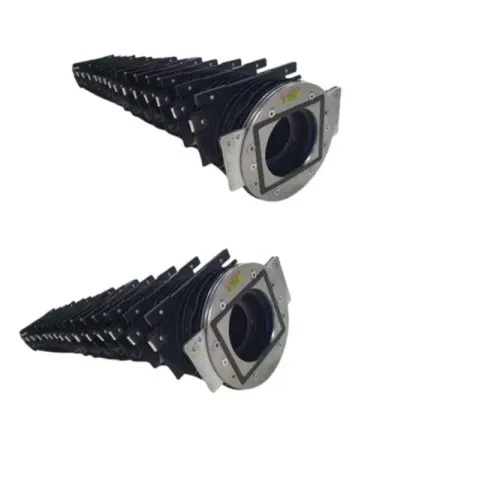
Round rubber machine bellows commonly seal with collars or clamps around cylindrical parts; fabric machine bellows may need end frames, clamping bars, stitched rings, or bonded and welded collars.
4. Require a drawing showing compressed and extended profiles before approval, including attachment details and clearances. A machine tool bellow covers drawing must show the full motion envelope, not just the nominal length.
How do you prevent rubbing, collapse, and early failure in service?
Most early failures come from interference, not the material label. Align mounts, control the bend radius, prevent twisting, over-compression, buckling and snagging, and leave clearance from sharp edges. Use support strips where folds could rub, and keep cables or hoses in a separate energy chain when their bend radius or torsion demands it.
| Control | Round rubber machine bellows | Fabric machine bellows |
|---|---|---|
| Collapse | Anti-collapse rings, internal supports, vents or reinforced construction | Hoops, end frames, vents or support strips |
| Motion | Check convolution compression, return force and unsupported length | Check sag, seam movement, frame alignment and unsupported span |
| Contamination | Remove embedded chips before folds close | Prevent chips entering pleats, seams and frame gaps |
Compare continuous and peak temperature, coolant formulation, mineral or ester oils, cutting fluids, cleaning chemicals, ozone, UV, chip impact, welding sparks, pressure, vacuum and air movement with a material-specific data sheet or test result. Reject “heat-resistant” or “corrosion-resistant” claims without the compound, coating, seam, reinforcement and named test method.
Request the fire or spark rating and its safe-use boundary.
Set inspection intervals from stroke cycles and hazard severity. Check for cuts, pinholes, burned folds, embedded chips, delamination, loose stitching, cracked collars and coolant leakage. Remove chips with the approved cloth, brush or mild cleaner; sharp tools, aggressive solvents and high-pressure washing can damage folds or drive fluid through seams.
Replace the cover when damage reaches a working fold, exposes reinforcement, compromises a seal or cannot be isolated from moving parts. Patch only to the supplier’s specified repair method, then plan shutdown time, verify dimensions and confirm that clamps or flanges remain serviceable.
What should you demand from a supplier before choosing the lower-risk option?
A lower-risk purchase is one backed by machine-specific evidence, not a catalogue label. Before approving machine tool bellow covers, request this written checklist:
- Exact elastomer or coated-textile designation; reinforcement and wall construction.
- Continuous and peak temperature data; coolant and chemical compatibility.
- Abrasion results, flex-cycle results, and the spark or flame test method.
- Pressure and vacuum limits, plus a dimensional drawing showing allowable compressed and extended lengths and minimum bend radius.
- Mounting-end photographs and inspection records from comparable covers.
Treat an IP or splash-protection claim as applying to the complete assembly, not the material alone. Check seams, overlaps, frames, access openings, drains, and fold orientation.
| Option | Strength to verify | Main purchase risk |
|---|---|---|
| Fabric | Long travel, low moving mass, irregular or supported rectangular envelopes | Pleat rubbing, snagging, seam leakage, or oscillation |
| Round rubber | Compact sealing around shafts, ballscrews, guide columns, and cylinders | Excessive stiffness, compression, bend force, or fluid incompatibility |
Compare the cost of a wrong choice: axis friction, restricted travel, chip- or rub-induced tearing, coolant contamination, guideway damage, replacement labour, and unplanned downtime. Choose fabric when travel, shape, low mass, or a supported rectangular envelope dominates; choose round rubber bellow covers when a cylindrical part needs compact sealing and repeated flexing under compatible fluids.
Ask GURUKRUPA BELLOWS PVT LTD for the drawing, material evidence, attachment proposal, and inspection or replacement guidance for your specific machine.
Related products
 | Bellow Cover We are considered a well-known name in the business that manufactures and supplies Bellow Cover. View product → |
 | Round Bellow Covers To match with our reputation in the market, we are here to present an unparalleled assortment of Round Bellow Covers. View product → |
Frequently asked questions
Which cover construction survives a machine tool’s actual hazards?
Choose by exposure: rubber bellows suit compatible coolant, dust and repeated motion, while fabric constructions suit larger travel, irregular shapes or specified heat and spark protection.
When does machine geometry favour round rubber or fabric bellows?
Round rubber bellow covers suit compact cylindrical or guided movements. Fabric machine bellows suit wide openings, rectangular ways, long travel and shapes that need custom transitions.
What dimensions and attachment details must you measure before ordering?
Record maximum and minimum extension, compressed length, outside and inside diameters, travel, mounting faces, bolt patterns, clearance and nearby moving parts.
How do you prevent rubbing, collapse and early failure?
Check clearances through the full stroke, support unsupported spans, prevent twisting, keep folds aligned and confirm that attachments do not transfer side loads into the bellows.
What should you demand from a supplier before choosing a cover?
Request material and temperature limits, chemical compatibility, travel-cycle data, drawings, mounting details, inspection requirements and a sample or dimensional approval drawing.