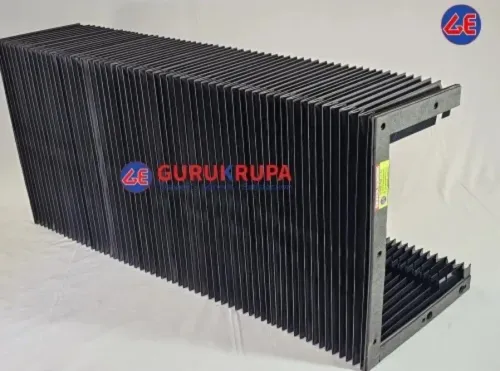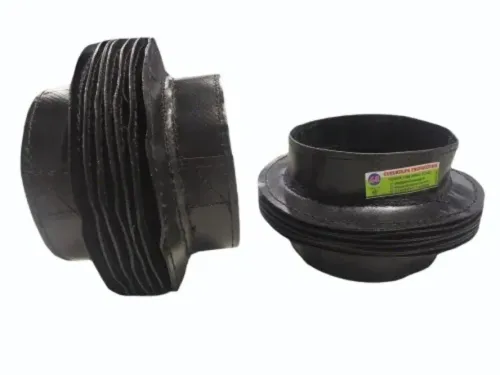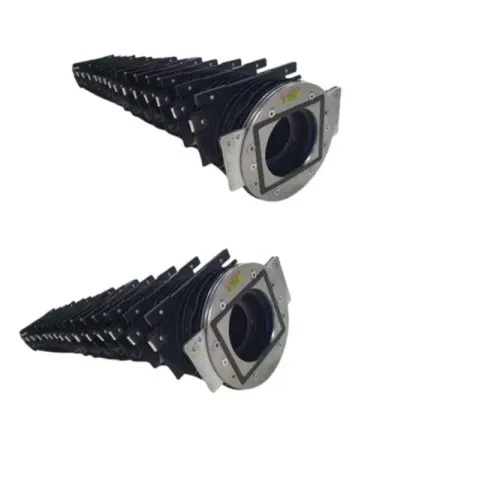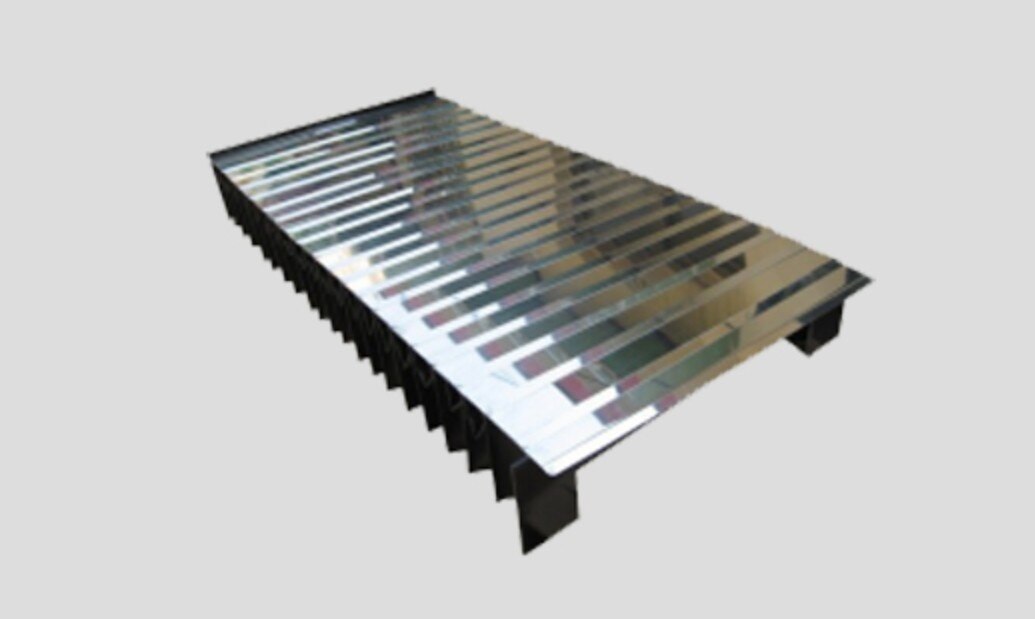
An SS lamella cover combines a flexible bellows body with overlapping stainless-steel flaps that shield a moving machine axis from chips, swarf and abrasion. By the end, you will know which parts belong in the specification, how to size the cover for a Rome installation, and when another protection method is safer or more practical.
Key takeaways
- Use stainless lamellae, flexible bellows fabric and secure side guides.
- Specify steel grade, lamella thickness, travel, speed and environmental exposure.
- Measure compressed length, extended length, width, height and mounting points.
- Choose another cover when tight-radius motion, low weight or chemical exposure dominates.
What parts make up an SS lamella bellow cover?
An SS lamella bellow cover is an accordion body made from elastomer-coated fabric or another flexible fabric, fitted with stainless-steel lamellae, slats, or flap segments on its exposed folds. The bellows supplies the folding movement; the metal supplies the primary barrier against chips and abrasion.
A quotation or drawing should identify these parts:
- Accordion body, stainless leaves, and their overlap
- Separate hinge or rivet joints, or strips fixed directly to the folds
- Lamella carriers and guide components
- Wipers or seals at joints and fold transitions
- End frames, mounting plates, and fasteners
“Metal flap bellow” and “lamella bellows” are often interchangeable terms, but suppliers may use them differently. Check the drawing to confirm whether it shows separate hinged flaps or continuous or segmented stainless strips attached to the bellows folds; do not rely on the product name.
The cover shields a guideway or axis from dust, swarf, and other contamination. It is not a pressure vessel, liquid-tight enclosure, safety guard, or machine enclosure. Coolant can pass through flap joints or mounting edges unless extra sealing and drainage are designed in.
Stainless parts do not guarantee electrical bonding. Fabric, adhesive, coatings, and oxide films can interrupt continuity, so specify and test a dedicated bonding path.
Which stainless steel and cover construction suit Rome service conditions?
AISI 304 (EN 1.4301) suits general machine-tool service; review AISI 316L (EN 1.4404) when chloride contamination, salt-laden air or aggressive cleaning fluids threaten corrosion. Check coolant chemistry, detergent ingredients and humidity instead of treating “SS” as a complete specification.
| Exposure or construction | Suitable choice | What to confirm |
|---|---|---|
| General chips, dust and standard coolant | AISI 304 | Flap thickness, segment width and overlap |
| Chlorides, coastal air or harsh cleaners | Review AISI 316L | Chemical compatibility and corrosion exposure |
| Hot chips, sharp swarf, grinding dust or welding sparks | Stainless lamellae over a flexible bellows | Peak temperature, exposure duration and contact frequency |
| Sustained flame, molten metal or heavy falling impact | Separate protection | Fire, heat-shield and impact requirements |
SS lamella bellows suit intermittent contact because overlapping flaps shield the fabric or elastomer body. They do not automatically stop coolant: flap joints, fold transitions, end frames and mounting edges need suitable wipers, seals, gutters and drainage. Specify each feature on the drawing.
For metal flap bellow covers Rome installations, record continuous and peak temperature exposure, flap thickness, segment width and overlap. Keep flame barriers and impact guards separate; a flexible cover is not a liquid-tight enclosure.
How do lamella covers behave at speed, under chips and on different axes?
Speed is not set by stainless-steel grade alone. Specify travel speed, acceleration, reversal frequency, fold compression, unsupported span, mounting orientation and the mass of the lamella assembly; a cover reliable on a slow horizontal slide can fail on a rapidly reversing vertical axis.
| Orientation or geometry | Typical behaviour | Design response |
|---|---|---|
| Horizontal | Chips collect on the upper surface | Add scraper access and prevent entry at travel ends |
| Vertical | Folds can sag and load unevenly | Use guide frames, support rails or intermediate guides |
| Flat or V-shaped way | Edges and transitions can expose the guideway | Match seals and fold geometry to the profile |
| Rectangular way | Wider faces increase unsupported span | Check clearances and support the moving pack |
A lifted flap traps chips, prevents full compression, increases drive load, scores the bellows fabric and raises adjacent flaps. Specify these together:
- Chip direction, scraper geometry, fold pitch and cleaning access
- Maximum extension, folded length, unsupported span and compression
- Support rails, guide frames or special fold geometry for long or wide covers
- Clearance through every travel direction, including beside or beneath a cable carrier
A metal flap bellow shields the guideway; a cable carrier manages cable and hose bend radius. Check their full-travel clearance because rubbing can restrict compression or transfer dynamic loads into SS lamella bellows.
What measurements must you take before ordering a metal flap bellow?
Take a complete machine-measurement set before ordering a metal flap bellow. A search for metal flap bellow covers rome does not replace axis data or an installation drawing.
1. Record the guideway width and height, axis travel, fixed and moving mounting points, open length, compressed or folded length, and cover height. Check maximum extension, folded length and height together: a cover that reaches full travel can still collide with the machine when compressed.
2. Measure clearance above and beside the axis, including space for end frames, carriers, guide hardware, mounting plates, and overlap at both fixed and moving ends. Include cable and hose clearance; a cable carrier beside or beneath the cover can rub, restrict folding, or transfer loads during full travel.
3. Identify the installation orientation and guideway shape: flat, V-shaped or rectangular. Note service access and cleaning access, because a vertical metal flap bellow can sag while a horizontal cover can collect chips on its upper surface.
4. Confirm speed, acceleration, cycle frequency, chip type, chip temperature, coolant or oil exposure, cleaning method and ambient conditions. Record these before accepting a drawing; stainless-steel grade alone does not establish a safe operating speed.
5. Request a dimensioned sketch showing open and closed positions, mounting points, clearances and overlap. Compare every dimension against the machine, including cable-carrier movement at both extremes.
When is an SS lamella cover the wrong choice?
An SS lamella bellow is the wrong choice when low mass, quiet motion, tight sealing, or extreme flexibility matters more than resistance to hot chips and sharp swarf. Compared with ordinary fabric, it adds stainless-steel flap weight, noise, and inertia, and bends less freely.
It is not automatically liquid-tight: flap joints, fold transitions, and mounting edges need wipers, seals, or drainage.
| Option | Main advantage | Choose it when |
|---|---|---|
| Ordinary fabric | Lowest weight and flexibility | Contamination is light and chips are cool |
| Elastomer-coated fabric | Better resistance to oil and coolant | Flexible sealing matters more than sharp-chip protection |
| Sewn or accordion bellows | Simple repeated folding | The axis has modest heat and abrasion |
| Flexible lamella | Strong chip and abrasion barrier | A moving axis faces hot chips, sharp swarf, or grinding dust |
| Telescopic steel | Rigid, heavy-duty enclosure | Space permits a rigid cover over a heavily protected axis |
A metal flap bellow does not replace guarding for thrown parts, operator access, or interlocked safety functions. Stop the axis if you find:
- Lifted or bent flaps
- Cracked fabric at fold roots
- Loose attachments
- Abnormal rubbing
- Retained coolant
- Changed compressed length
Running after a flap folds underneath can damage the cover pack and machine way.
What should a Rome purchase specification include?
A purchase brief must describe the machine, not just the city. “Metal flap bellow for Rome” is a location requirement; it does not select a cover. Use the following data for an installation in Rome or elsewhere in Lazio:
1. Identify the machine axis, flat, V-shaped or rectangular guideway geometry, travel, open and closed lengths, width, height, orientation, speed, acceleration and cycle frequency.
2. Specify stainless-steel grade, flap thickness, segment width and overlap, plus the bellows fabric or elastomer. State chip type and temperature, coolant or oil exposure, cleaning chemicals, ambient temperature, humidity and corrosion conditions.
3. Give fixed and moving mounting points, end-frame and mounting-plate dimensions, guide and support locations, service access, cable or hose clearance, and required delivery and installation dimensions.
4. Require a dimensioned drawing in open and compressed positions. It must show flap overlap, guides, supports, seals, drainage, fold pitch and compressed clearance, including space for adjacent cable-management equipment.
Ask GURUKRUPA BELLOWS PVT LTD to review the dimensioned machine data, state whether the quotation describes a true lamella assembly or another flap construction, and check carrier-to-cover clearance at full travel.
Before approval, ask: Which grade is supplied? What temperature and load limits apply? Is this orientation approved? How is coolant drained? Where can technicians inspect, clean and replace the cover?
Frequently asked questions
What parts make up an SS lamella bellow cover?
It combines a flexible accordion body, stainless-steel lamellae or flap segments, attachment points and guides or frames that control movement.
Which stainless steel and cover construction suit Rome service conditions?
Specify the stainless-steel grade, surface finish, lamella thickness, fabric coating and sealing details against the machine’s chips, coolant, heat and corrosion exposure.
How do lamella covers behave at speed, under chips and on different axes?
Lamella covers resist abrasive chips, but their mass, guide design, fold geometry and mounting affect acceleration, noise, sag and reliable travel on horizontal, vertical and inclined axes.
What measurements must you take before ordering a metal flap bellow?
Record compressed and extended lengths, protected width and height, travel, mounting-hole positions, clearance, fold direction and the axis speed and acceleration.
When is an SS lamella cover the wrong choice?
Choose another design when the axis needs very low mass, tight-radius bending, unrestricted multi-axis motion or resistance beyond the selected metal and fabric construction.