The correct cover starts with the movement envelope, not the nominal opening or a temperature figure copied from a catalogue. By the end, you will be able to define the movement, size the folds and clearances, test material compatibility, and write a purchase specification for your site conditions.
Key takeaways
- Measure the shortest and longest operating positions before sizing the cover.
- Specify compressed, extended, and lateral movement—not only the nominal gap.
- Match fabric and liner materials to heat, chemicals, abrasion, and flame exposure.
- State pressure, vacuum, leakage, and installation requirements in the supplier brief.
Define the movement before selecting the cover
Start with the movement envelope, not the nominal gap. A practical answer to how to choose bellow covers for fabric expansion in vadodara starts with the cover’s shortest and longest operating positions, then checks every movement between them.
- Record minimum and maximum installed length, axial compression and extension, lateral offset, angular movement, torsion, movement speed, and expected cycle count.
- State whether these movements occur separately or simultaneously. Axial travel combined with offset can make folds rub, bottom out, or overstretch even when each movement looks acceptable alone.
- Mark the installed orientation and nearby fixed parts. A cover needs clearance for its bending radius, mounting hardware, inspection, and replacement access.
- Identify the attachment: clamping bars, flanges, frames, hook-and-loop fasteners, zippers, snaps, or sewn pockets. An inaccessible fastener can make a correctly sized cover impossible to maintain.
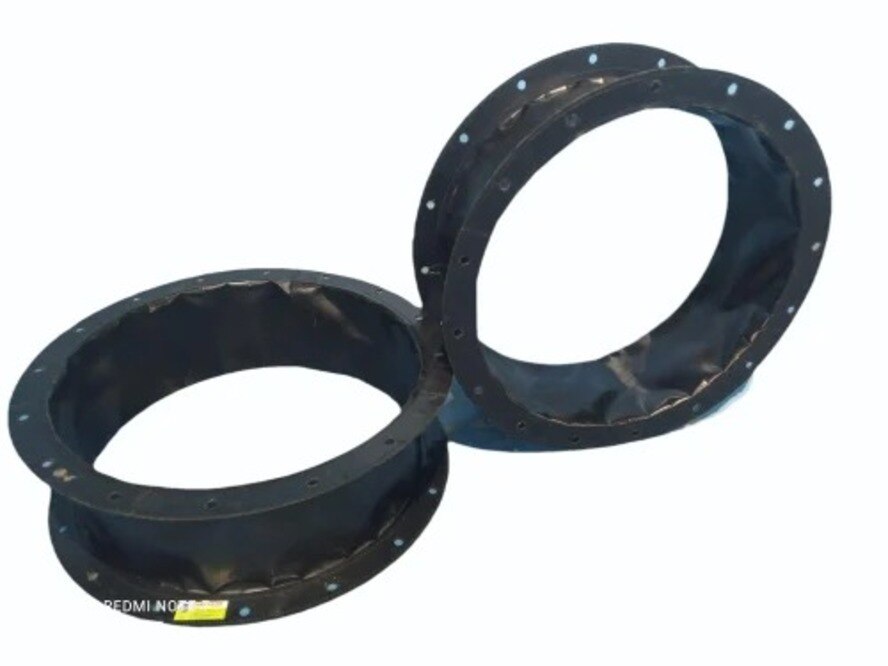
A machine-guideway bellows is a flexible guard that follows moving carriages, slides, spindles, cables, or hoses and protects them from chips, dust, coolant, and abrasion. A duct expansion joint connects fixed duct or pipe sections and absorbs thermal growth, vibration, or pressure movement; it may require liners, belts, retaining hardware, thrust calculations, or tie rods.
Do not substitute one for the other. A fabric machine cover is not automatically a pressure boundary, while a duct joint may be too stiff, bulky, or poorly accessible for a moving machine. Specify the application before requesting dimensions.
Turn the movement envelope into fabric bellow cover sizes
Fabric bellow cover sizes must come from the complete movement envelope, not the nominal gap between two machine parts. Record the minimum and maximum installed lengths, axial compression and extension, lateral offset, angular movement, torsion, movement speed, cycle count, and whether these movements occur simultaneously.
A cover sized only for the static length can bottom out at compression, overstretch at extension, or rub a guideway during combined motion.
Send the supplier a dimensional schedule containing:
- Inside opening, outside envelope, installed length, fully compressed length, and fully extended length
- Number of folds, fold pitch, bending radius, and the required clearance from rails, cables, chips, and adjacent guards
- Mounting-flange dimensions, hole pattern, attachment method, and installed orientation
- Seam location, reinforcement zones, and access space for clamps, frames, zippers, snaps, hook-and-loop fasteners, or sewn pockets
| Movement condition | Dimension or construction decision | Failure prevented |
|---|---|---|
| Axial compression and extension | Set fold depth and pitch from compressed and extended lengths, with operating clearance at both limits | Fold collision or fabric overstretch |
| Lateral or angular travel | Size the outside envelope and bending radius around the maximum offset, not the centreline gap | Rubbing, wrinkling, and edge tearing |
| Simultaneous travel, speed, and cycling | Check the combined envelope, reinforcement, seam direction, and cycle requirement | Premature fatigue during real motion |
Request a drawing showing free, installed, fully compressed, and fully extended states. It exposes missing clearances before fabrication.
Check temperature, chemicals, abrasion, and flame exposure
A nylon fabric with polyurethane coating suits the complete process environment only when its temperature, chemical, abrasion, and flame limits cover every exposure—not just room temperature. Do not treat a stated 1000°C rating as proof that the nylon, polyurethane, thread, seam seal, and adhesive withstand continuous 1000°C service.
1. Ask the supplier to state separate continuous, intermittent-peak, and low-temperature limits for the complete assembled cover. Identify the temperature at the bellows, including radiant heat, hot chips, exhaust air, steam, and flame contact. Clarify what “1000°C” means: a brief radiant exposure, hot gas, flame resistance, or direct material contact.
Direct 1000°C exposure normally requires a purpose-designed high-temperature barrier, not an unprotected nylon-polyurethane laminate.
2. Record each chemical separately: coolant, hydraulic oil, cutting-fluid mist, acids, alkalis, solvents, washdown agents, and process chemicals. Confirm compatibility for the coating, thread, seam seal, adhesive, and any liner; a compatible fabric can still fail through swollen thread or a softened seam.
3. Describe abrasion from chips, abrasive dust, cable contact, cleaning tools, and repeated folding. Add spark shields or sacrificial layers where welding sparks or hot swarf can land. Test flame exposure separately from heat exposure.
4. State whether the cover is indoors, outdoors, or semi-outdoors in Vadodara. Include monsoon humidity, standing water, UV, ozone, dust, drainage, and corrosion protection. This environmental record is essential to fabric expansion bellow selection. Reject the nylon-polyurethane option until the supplier documents the full laminate against the worst simultaneous exposure.
Set pressure, vacuum, leakage, and liner requirements
Specify differential pressure, vacuum, flow velocity, and pulsation before choosing the fabric. A machine bellows is not automatically a pressure boundary; a duct expansion joint requires pressure, thrust, temperature, and movement calculations.
Ask the supplier to verify:
- Maximum positive pressure and full vacuum or negative pressure, with safety margin and the direction of loading.
- Pressure-pulsation amplitude, frequency, cycle count, and expected fatigue life. Pulsation can flex seams until a cover that passes a static test leaks.
- Air velocity, gas temperature, dust loading, particle size, moisture, oil, corrosive constituents, and static-charge risk.
- Liner material, thickness, attachment, and replaceability. Use a liner when high-velocity gas, abrasive dust, sparks, or condensate can erode the fabric; confirm that it will not restrict the specified movement.
- Reinforcement, retaining belts, clamps, control rods, tie rods, or other hardware needed to resist pressure thrust and prevent overextension.
Define the permitted leakage rate and test method, not merely “airtight.” For dusty or washdown service, specify exclusion performance at seams, corners, mounting flanges, drains, and access openings. The fabric alone proves no IP rating; evaluate the installed assembly.
For vacuum service, verify collapse resistance at the worst temperature and fold position. A cover that survives pressure can buckle under suction. Record whether the joint must remain flexible during pressure cycles or only seal at rest.
Write a supplier specification for Vadodara service conditions
Send the supplier a service brief, not just a photograph and a width-by-length measurement. For custom fabric bellows in vadodara, state whether the installation is indoor, outdoor, or semi-outdoor, then identify heat, monsoon humidity, standing water, dust, UV, ozone, washdown, welding sparks, coolant, hydraulic oil, cutting-fluid mist, abrasive dust, solvents, acids, and alkalis separately.
“Vadodara service” alone does not define the environment.
Include these four information blocks:
- Quotation: service movement type, travel, installed orientation, temperature range, pressure or vacuum, gas or dust, air velocity, pulsation, material compatibility, and replacement lead time.
- Drawing: free, installed, compressed, and extended states; inside opening; outside envelope; installed, compressed, and extended lengths; fold count and pitch; bending radius; flange dimensions; hole pattern; seam position; clearances; and cable or hose routing.
- Construction: fabric, coating, thread, seam method, seal or adhesive, liner, reinforcement, mounting hardware, drainage, retaining belts, and corrosion protection. Specify whether the cover carries only motion protection or forms part of a pressure-qualified duct joint.
- Test plan and maintenance: dimensional inspection, seam and coating checks, pressure or vacuum testing where designed for it, movement cycling, temperature exposure, leak criteria, inspection access, cleaning method, wear indicators, fastener replacement, and storage instructions.
GURUKRUPA BELLOWS PVT LTD can use this schedule to produce a maintainable custom cover rather than an interchangeable-looking cover that lacks strain relief or rubs cables, hoses, or guideways.
Related products
 | Fabric Expantion Bellow ₹1000 Make in Heavy duty Fabric’s View product → |
 | Bellow Cover We are considered a well-known name in the business that manufactures and supplies Bellow Cover. View product → |
Frequently asked questions
What movement should you define before choosing a fabric bellow cover?
Record the cover’s shortest and longest operating positions, axial compression and extension, lateral offset, angular movement, cycle rate, and available installation space.
How do you convert the movement envelope into fabric bellow cover sizes?
Give the supplier the minimum and maximum length, closed and extended dimensions, flange or frame dimensions, internal clearance, fold depth, and required number of convolutions.
Which environmental conditions affect fabric expansion bellow selection?
Specify continuous and peak temperature, chemical exposure, abrasive particles, oil or coolant contact, outdoor weather, sparks, and flame exposure before selecting the fabric and coating.
What pressure and leakage information belongs in a fabric bellow cover specification?
State positive or negative pressure, pressure peaks, airflow, allowable leakage, required liner, venting needs, and whether the cover must resist suction or collapse.
What should you include when requesting custom fabric bellows in Vadodara?
Include operating dimensions, movement data, materials, temperature and chemical conditions, pressure, cycle frequency, mounting details, inspection access, drawings, and the service location.
Related product
 | Product Details: Brand Gurukrupa Material Nylon Fabric coated with polyurethane Max Temp Resistance 1000 C Offered in the market at the most... View product → |