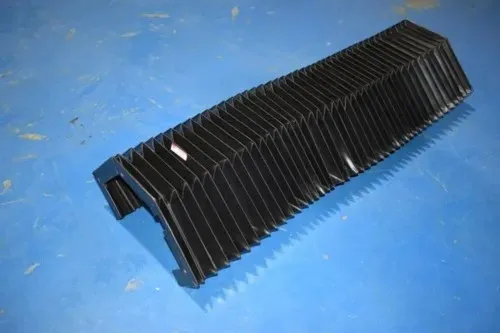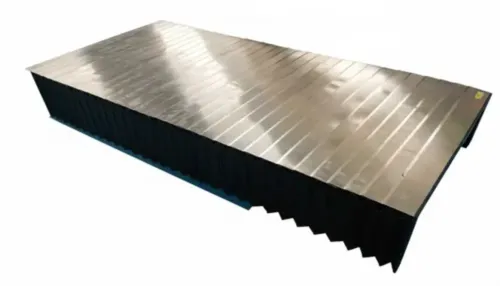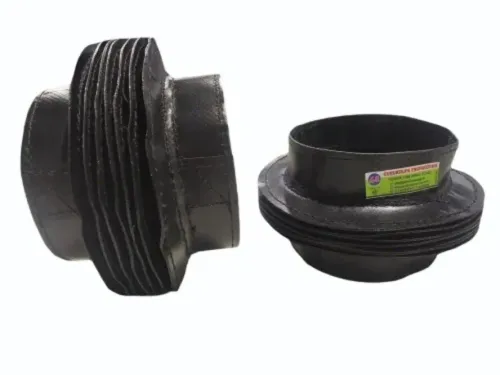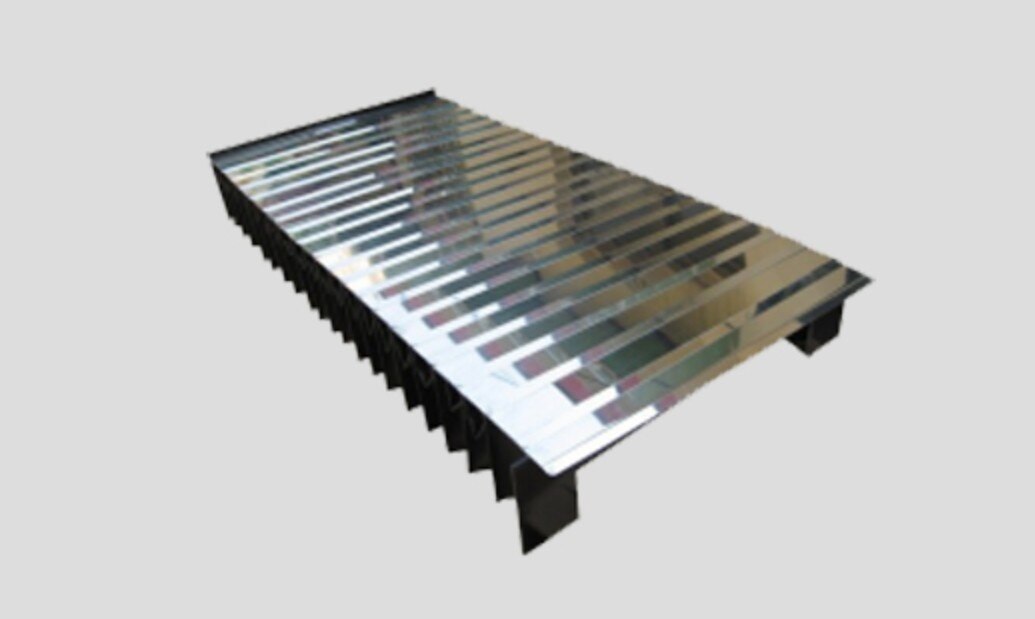
An SS lamella bellow cover combines a flexible folding body with overlapping stainless-steel flaps that shield moving guideways from chips, coolant and heat. By the end, you will know how the cover is built and moves, where it fits, which measurements to provide, and how to test a proposed design on your machine.
Key takeaways
- Overlapping stainless-steel flaps shield moving guideways from chips and hot debris.
- Choose metal flap bellows for rigid protection, not maximum flexibility or tight bends.
- Measure travel, compressed length, height, width and mounting points before ordering.
- Accept the cover only after checking movement, clearances, seals and attachment alignment.
What an SS lamella bellow cover is and how it is assembled
An SS lamella bellow cover combines a flexible bellows carrier with overlapping stainless-steel strips, or flaps, on its exposed face. End frames connect the cover to the moving axis and fixed machine structure, while guides, attachment points and sometimes reinforced edges keep the assembly aligned.
The cover expands and compresses with the guideway instead of carrying machine loads.
The ss lamella bellow cover process starts with the machine envelope and motion data, not a nominal width:
1. Record travel, closed and extended lengths, installation height, lateral offset, mounting orientation, minimum fold radius, speed, acceleration and cycle frequency.
2. Select the carrier material and stainless-steel grade for the coolant, chips, heat and cleaning chemicals present. Stainless steel resists hot chips, abrasion and corrosion, but chlorides, aggressive cleaners, trapped coolant at overlaps and contact with dissimilar fasteners can still cause staining or corrosion.
3. Set the flap pitch, overlap and strip thickness. These choices balance sealing, flexibility, mass and noise; excessive overlap adds weight and can increase drive loads.
4. Design the end frames, guides and attachment points around the full expanded and compressed envelope. Leave clearance from cables, hoses and neighbouring parts, and provide access for cleaning.
5. Assemble the carrier, attach the stainless flaps in sequence, fit the end frames and mount the cover without twisting it. Check that no flap bears structural or walkway loads; a person, chip conveyor or heavy workpiece can permanently deform the assembly.
How the metal flaps protect a moving guideway
The overlapping flaps protect the guideway by forming a sliding metal skin while the flexible carrier folds and unfolds beneath them. Each stainless-steel flap overlaps its neighbour, so dust, chips and coolant cannot reach the guideway through a straight open seam.
- During acceleration, the moving end pulls the carrier into controlled pleats. The flaps lift and slide over one another in sequence, preventing a sudden bend from concentrating force at one fold.
- During deceleration, the pleats compress progressively rather than collapsing together. Correct flap pitch and overlap keep the metal edges aligned and stop them from catching on adjacent flaps.
- During reversal, the direction of folding changes at the moving end. The carrier absorbs the change in motion while the overlapping flaps settle back into their protective pattern.
The guideway remains covered across the full stroke only when the cover has enough clearance for its expanded envelope, compressed pack and minimum fold radius. Side guides and end frames help keep the metal flap bellow aligned; a poor mounting angle can cause rubbing, buckling or uneven wear.
Do not treat the cover as a load-bearing guard. An operator standing on it, a chip conveyor pressing against it or a workpiece striking it can permanently bend the flaps and overload their attachment points. Validate speed with acceleration, fold frequency, travel direction and contamination rather than relying on a generic maximum speed.
Where metal flap bellows work—and where another cover fits better
Choose a metal flap bellow for CNC machining centres, turning centres, grinders and other axes where guideways face hot chips, coolant splash, abrasive swarf or radiant heat. Stainless flaps tolerate impacts and repeated wiping better than an exposed fabric surface, while the flexible carrier handles the axis travel.
Typical metal flap bellow applications are linear guideways and slides with frequent acceleration, deceleration and reversal. Do not select one from a generic speed figure: the supplier must check speed with acceleration, fold frequency, travel direction and contamination.
| Option | Strength | Better choice when |
|---|---|---|
| Metal flap bellow | Stainless flaps resist chips, coolant and abrasion | The guideway needs flexible protection with a tougher exposed face |
| Fabric bellow | Low mass, quiet movement and flexible geometry | The hazard is dust, light coolant mist or limited chip impact |
| Rubber bellow | Elastic, sealed folds and good splash resistance | You need compact protection around irregular moving parts |
| Telescopic steel cover | Rigid enclosure and strong chip deflection | Heavy swarf, severe abrasion or a broad flat way demands structural shielding |
| Thermally bonded cover | Welded seams reduce stitched leak paths | You need a lightweight cover with improved liquid resistance |
A metal flap bellow is a poor fit for continuous high-temperature welding spatter, very sharp heavy swarf, severe abrasive dust or a completely pressure-tight enclosure. Add scrapers, shields or telescopic steel where those hazards dominate. Use a different high-temperature construction when heat attacks the carrier, adhesive, thread or edge seal—not just the stainless flaps.
Which measurements determine whether the cover will fit
A nominal width is not enough to specify SS lamella bellow covers. Measure the machine envelope, axis motion and surrounding hazards across the complete stroke; otherwise the cover can bind, sag, or leave the guideway exposed.
Record these measurements before requesting a drawing:
- Machine: guideway width and length, closed length, extended length, available installation height, mounting orientation, end-frame space and mounting-hole pattern.
- Motion: travel, lateral offset, travel direction, speed, acceleration, reversal rate, cycle frequency and minimum fold radius.
- Clearance: expanded envelope, compressed pack height, neighbouring slides, tooling, cable and hose routes, cleaning access and any unsupported horizontal span.
- Contamination: water-soluble coolant, neat oil, alkaline wash, chloride-bearing water, abrasive dust, hot chips or welding spatter. Note temperature and whether chips can lodge between the flaps and guideway.
| Measurement | What to compare | Fit risk if missed |
|---|---|---|
| Guideway and mounting | Cover width, end-frame dimensions and hole centres | Gaps, drilling conflicts or a cover that cannot be secured |
| Motion envelope | Extended length, compressed length, stroke and fold radius | Binding at full compression or insufficient travel |
| Operating duty | Speed with acceleration, reversal and cycle frequency | Premature fatigue despite an acceptable quoted speed |
| Exposure and routing | Contaminants, heat, cables and hoses | Corrosion, seal damage, trapped debris or interference |
For a metal flap bellow in Vadodara, provide these figures with photographs and a scale drawing. That lets the supplier validate the actual envelope rather than assume a generic size.
How to specify and accept a lamella bellow cover in Vadodara
Require a quotation and a witnessed full-stroke trial on the target machine before accepting a lamella bellow cover supplier. The trial must use the real coolant and representative chips, not an empty-axis demonstration.
The quotation for a metal flap bellow in Vadodara should state:
- Stainless-steel grade, flap thickness and width, overlap, bellows fabric, thread, adhesive and edge-seal materials.
- End-frame material, attachment method, mounting-hole pattern, compressed length, extended length and tested stroke.
- Validated speed together with acceleration, fold frequency, travel direction and contamination; reject a generic maximum-speed claim.
- Exclusions, including operator loading, unsupported horizontal spans, cable or hose interference and cleaning access.
Use the following acceptance checks at both ends and through the complete stroke:
| Check | Pass condition | Failure to record |
|---|---|---|
| Flap movement | No interference, abnormal folding or chatter | Marks, binding or lifted flaps |
| Guideway protection | No trapped chips; no coolant path to the guideway | Debris pockets or leakage |
| End frames | Seals remain closed without distortion | Visible gaps or coolant leakage |
| Mounting | No excessive load, deflection or loose fastener | Frame movement or strained attachment |
| Service access | You can clean the cover and guideway safely | Blocked access or inaccessible folds |
Confirm the expanded envelope, compressed pack height, fold radius and cable routing before sign-off. GURUKRUPA BELLOWS PVT LTD can be included in your comparison, but ask it for these same drawings, exclusions and machine-trial evidence rather than accepting a catalogue description.
Related product
 | Bellow Cover ₹1000 Product Details: Brand GE Color Black-Blue - Gray -White Size ANY ( C shape, Square, Round, Rectangular) Ours is a trustworthy name in the business... View product → |
Frequently asked questions
What is an SS lamella bellow cover?
It is a flexible bellows carrier fitted with overlapping stainless-steel strips, end frames and mounting points to protect a moving machine guideway.
How do metal flaps protect a moving guideway?
The flaps overlap across the exposed face, creating a sliding shield that resists chips, dust, heat and mechanical impact while the cover extends and compresses.
Where do metal flap bellows work best?
They suit machine tools and other axes exposed to sharp chips, hot swarf, abrasion or demanding guideway conditions. Use another cover when the axis needs very tight bends, low weight or extreme flexibility.
Which measurements are needed for a lamella bellow cover?
Provide axis travel, usable extension, compressed length, cover height and width, guideway clearance, mounting-hole positions and the required flap or bellows material.
How should you accept a lamella bellow cover in Vadodara?
Check the supplied dimensions against the drawing, then test full travel for rubbing, binding, gaps, misalignment, overstretching and secure attachment at both ends.