A successful order begins with more than a machine name and a requested length. You will learn what to send in the enquiry, how the supplier converts measurements into a design, what gets approved before production, and how to verify the finished cover before installation.
Key takeaways
- Provide axis travel, speed, exposure and mounting details at enquiry.
- Share accurate closed, open and compressed dimensions for the custom drawing.
- Approve material, construction, guides and prototype requirements before production.
- Use first-article checks to confirm fit, movement and protection before installation.
1. The enquiry starts with the machine, axis and working conditions
A supplier needs the machine, axis, movement and exposure details before preparing a laser-machine bellow cover quotation. The phrase “laser machine bellow covers for ordering process in vadodara” is not a specification; a nominal axis size alone cannot define a usable cover.
1. Identify the machine make and model, axis or guideway location, travel direction, cover orientation, and whether the fixed and moving ends attach to the machine frame, table or carriage. State travel length, installed length, maximum extended length, folded height, outside dimensions and clearance around the moving member.
2. Send a drawing or clear photographs of both mounting ends. Include flange thickness, bolt spacing, hole pattern and available clearance. Add operating speed, acceleration and the machine’s working environment: fine metal dust, fume condensate, hot particles, assist-gas flow, coolant, chemicals and sharp chips.
3. For a replacement, provide measured compressed and extended lengths, fold pitch or fold count, internal and external dimensions, mounting pitch, damage photographs and the failure cause. Abrasion, heat, coolant swelling, seam separation and collision can require a design change rather than a duplicate.
The supplier can then confirm what “custom size” means in practice and prepare a drawing for approval. Do not describe the assembly as a laser-safety enclosure unless its material, joints, attachments and complete enclosure have been assessed for the laser wavelength and hazard class under IEC 60825-1.
2. Measurements become a drawing for the custom cover
A replacement is checked against a dimensional drawing, not a photograph or a nominal axis size. The drawing records the cover’s fixed end, moving end, travel direction and the space available around the guideway, carriage or laser head.
Measure the existing cover while it is installed and removed, then send photographs showing the mounting interface and damage. Record:
- Compressed length and maximum extended length
- Fold height, fold pitch or total fold count
- Internal opening and external width and height
- Fixed and moving flange dimensions
- Flange thickness, hole diameter, bolt spacing and hole pattern
- Required clearance from the moving member, table and nearby machine parts
- Axis orientation and direction of travel
Do not copy a failed cover without stating why it failed. Abrasion, heat, coolant swelling, seam separation and collision point to different design changes, even when the replacement has the same overall dimensions.
Laser machine bellows custom size means a cover made to this complete interface and movement data, not simply a bellows cut to the requested travel length. The supplier should return a drawing showing every critical dimension, mounting arrangement and tolerance for approval.
Check it against the machine before production; a small error in bolt pitch or folded height can make a correctly manufactured cover impossible to install.
If existing drawings are incomplete, request a site measurement and confirm who will take responsibility for the recorded dimensions. A signed drawing becomes the reference for the quotation, inspection and any repeat order.
3. Material, construction and prototype choices are fixed before production
A cover that survives axis travel can still fail in a week if hot spatter burns its folds or coolant swells the fabric. The supplier must match the material, fold design, seams, wipers and end attachments to the actual heat, fine metal dust, fumes, assist-gas flow, solvents, coolant, abrasion and collision risk.
| Construction choice | Main advantage | Main risk or limit | Best fit |
|---|---|---|---|
| Coated fabric bellows | Flexible, compact and suitable for repeated travel | Direct hot spatter, sharp chips or aggressive chemicals can cut or attack the coating | Enclosed guideways with controlled exposure |
| Sewn or welded multi-layer bellows | Adds insulation, strength and a replaceable outer layer | Extra thickness can reduce clearance and folded height | Heat, dust and moderate spatter |
| Steel or segmented protective cover | Resists sharp chips and severe mechanical contact | Adds mass and can restrict high-speed movement | Heavy spatter or collision-prone zones |
The drawing must show fold pitch, compressed and extended lengths, folded height, internal and external dimensions, mounting-hole pattern, travel direction and clearance around the moving member. A duplicate replacement is unsafe when the old cover failed from seam separation, abrasion, heat, coolant swelling or collision; that failure demands a design change.
Request fabric or coating data for the stated temperature, chemicals and abrasion, then approve a sample or first article through the full machine stroke. Inspect interference, mounting tension, fold recovery and hot-particle protection before production. Flame-retardant fabric alone does not qualify the assembly against laser radiation.
IEC 60825-1 addresses laser-product safety; laser machine bellow cover manufacturing must not represent a bellows as a laser-safety enclosure without assessing its material, joints, attachments and complete enclosure.
4. The quotation defines scope, approval stages and delivery
An approved drawing is not a dispatch instruction. The supplier should issue a quotation that repeats the agreed travel, installed and extended lengths, folded height, outside dimensions, mounting-hole pattern, clearances, material, quantity, price, tax, freight, delivery destination and installation responsibility.
The usual sequence is:
- Confirm the final drawing and written acceptance criteria.
- Approve a sample or first article when the geometry, heat exposure or failure history creates uncertainty.
- Release production against the approved revision, not an email sketch.
- Inspect dimensions, mounting holes, fold movement and workmanship against that revision.
- Pack the cover to prevent crushed folds, moisture damage and flange distortion, then dispatch with the drawing, identification and inspection record.
For a Vadodara purchase, include the machine location, site-measurement requirement, packing method, tax and freight treatment, and installation support in the RFQ. Local supply can shorten measurement and replacement lead time; it does not replace a dimensional drawing. GURUKRUPA BELLOWS PVT LTD should be assessed by the same evidence as any other supplier.
| laser machine bellow covers supplier | Compare this evidence | Reject the quotation when |
|---|---|---|
| Comparable capability | Axis sizes, speeds, travel and clearance records | Only “custom size” is stated |
| Technical control | Material data, tolerances and replacement-part identification | No revision-controlled drawing is supplied |
| Acceptance and risk | First-article approval plus warranty exclusions for cuts, burns, chemicals and incorrect installation | Responsibilities remain verbal |
| Safety boundary | Clear statement that a way cover is not laser-beam containment | Bellows are presented as an IEC 60825-1 safety enclosure without assessment |
Related products
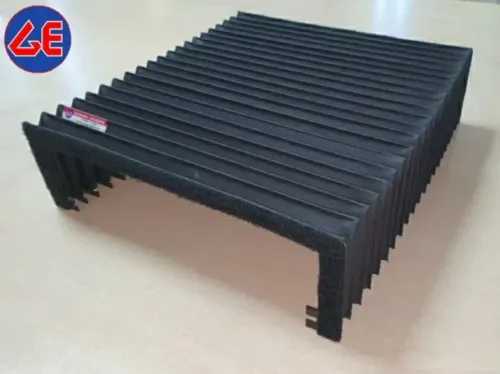
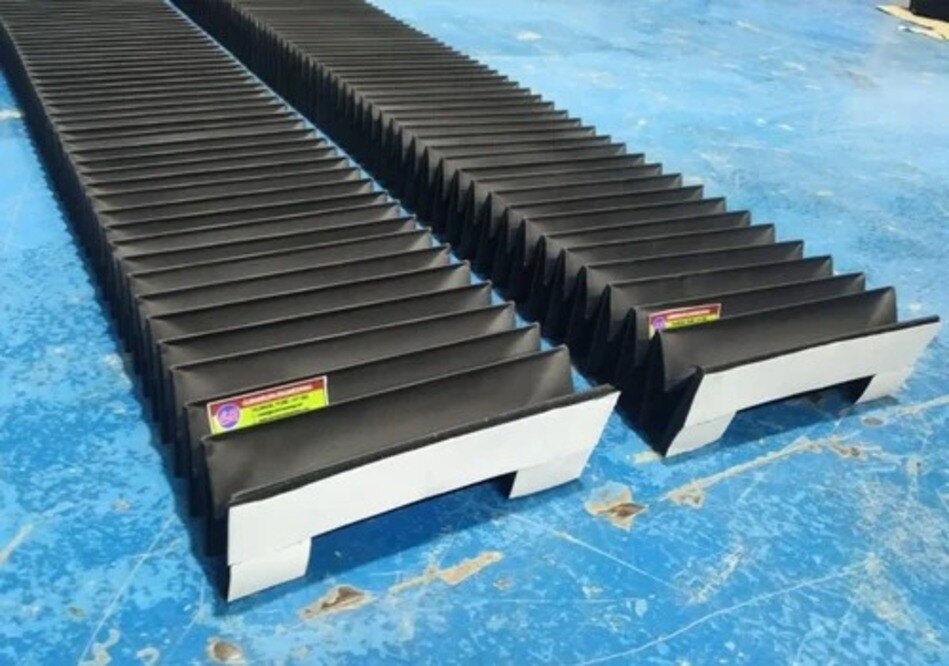
 | Laser Machine Bellows Product Details: Minimum Order Quantity 1 Number Brand GURUKRUPA Color BLACK, SILVER Size ALL Specifications: Capabilities Applied/Processes: Thermal... View product → |
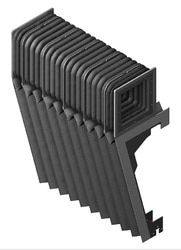 | Laser Cutting Machine Bellows ₹1000 We offer Laser Cutting Machine Bellows made specifically for your laser machine. View product → |
5. First-article checks determine whether the cover is ready for installation
Do not accept the first article until it has been installed or rigged on the machine and moved through the full axis travel. A cover that matches the drawing can still bind, rub, compress unevenly or block maintenance access.
1. Check both ends of travel for interference with rails, guards, cable carriers, nozzles and the moving member. Confirm the cover reaches its specified compressed and extended lengths without stretching or buckling.
2. Inspect every fold for rubbing, trapped chips, sharp edges, pinholes, loose stitching, coating damage and uneven compression. Chips lodged between folds can cut the fabric during the next cycle.
3. Check end frames, mounting holes, bolt pitch, attachment alignment and supplied hardware against the approved drawing. Confirm the opening around the moving member and access for lubrication, inspection and component removal.
4. Run the machine at its stated speed and acceleration, then inspect the cover while moving. Record photographs, measured clearances, material details, dimensions and any corrections in a signed first-article report.
5. Before repeating the order, obtain a replacement-part number, revision-controlled drawing, dimensional tolerances and installation instructions. Confirm whether the quoted assembly includes the bellows body, end frames, guides, wipers and mounting hardware.
Compare suppliers through this evidence, not the phrase “laser machine bellow covers supplier”: ask for comparable axis applications, material data and warranty exclusions covering cuts, burns, chemical attack and incorrect installation. Do not call the cover a laser-safety enclosure unless the complete assembly has been assessed for the wavelength and hazard class under IEC 60825-1.
Frequently asked questions
What information does a supplier need to quote a laser machine bellow cover?
Provide the machine type, protected axis, travel length, speed, acceleration, installation space, mounting points and exposure to laser dust, heat, sparks, coolant or oil.
What measurements are required for laser machine bellows in a custom size?
The supplier needs closed, open and compressed lengths, width, height, available clearance, mounting-face dimensions and the required folds or guides.
What decisions must be fixed before laser machine bellow cover manufacturing?
Confirm the bellows material, coated fabric, fold construction, reinforcement, frame or mounting method, guide arrangement, wipers and whether a prototype is required.
What should a quotation for laser machine bellow covers supplier include?
Check that it states the approved drawing revision, dimensions, materials, quantity, included hardware, prototype and approval stages, packaging, delivery schedule and exclusions.
How do you check a laser machine bellow cover before installation?
Inspect the first article against the approved drawing, then check mounting-hole positions, travel, compression, extension, clearance, fold movement and protection of the laser-machine guideway.
Related product
 | Trumpf Laser Bellows Product Details: Minimum Order Quantity 1 Number Brand GE Color Black Size any We offer bellows made specifically for your Trumpf® laser machine. View product → |