A rotary spindle, chuck, table, or indexing head imposes forces that a linear-axis cover never sees: shaft runout, centrifugal loading, torsion, balance, and repeated cycling. By the end, you will know which cover design to specify, which dimensions and operating data to send for quotation, and how to verify the fitted assembly before production approval.
Key takeaways
- Define rotation, runout, torsion, and speed before selecting a cover.
- Measure the full compressed, extended, and moving envelope.
- Match fabric, coating, folds, and clearances to heat and debris.
- Require balance, installation, service-life, and inspection evidence.
Start with the rotary interface, not the cover shape
Choose the rotary interface before choosing a round profile. Washington machine tool builders need bellow covers for rotary equipment matched to shaft rotation, angular misalignment, torsion, eccentricity, runout, speed, centrifugal loading, and continuous cycling. A spindle, rotary table, chuck, indexing head, or cable bundle creates a different clearance and attachment problem.
Rotary equipment bellows designed for a fixed shaft opening are not interchangeable with shaft-mounted rotating bellows, and a cover intended for linear compression cannot be assumed suitable for continuous rotation or oscillation.
| Option | What it does | When it applies |
|---|---|---|
| Stationary round bellows | Surrounds a rotating shaft without rotating | Chips, dust, and spray where radial and axial clearance can be maintained |
| Shaft-mounted bellows | Rotates with the shaft | A protected rotating interface requiring dynamic balance verification |
| Coupling guard | Contains a coupling and moving hardware | Personnel protection around exposed drive components |
| Rotary union cover | Shields a rotary fluid connection | Coolant or hydraulic connections at a rotating interface |
| Bellows seal | Limits leakage across a moving interface | A separately engineered sealing duty, not ordinary contamination protection |
| Telescopic steel cover | Resists heavy chips and impact | Hot, abrasive swarf or severe mechanical exposure |
| Brush seal or wiper | Scrapes or blocks contamination | Small gaps and light debris, with limited sealing |
| Split guard or energy chain | Provides access protection or routes cables | Guarding a serviceable drive, or guiding a cable bundle |
A bellows blocks incidental contamination; it is not automatically a pressure vessel, vacuum seal, personnel guard, or compliant machine guard. Use risk-assessed guarding for hazardous motion, and specify separately rated designs for pressure or vacuum.
Measure the complete operating envelope before requesting a quotation
A reliable quotation starts with the complete operating envelope, not the nominal shaft diameter. For bellow covers Washington builders should record:
1. Measure the shaft or spindle diameter, inside diameter, maximum outside diameter, compressed length, extended length, available installation space, end-flange dimensions, mounting-hole pattern, stroke or axial movement, minimum bend radius, and allowable radial and angular movement. Take measurements at full extension, full compression, and the largest rotating envelope.
2. Record the coupling, keyway, chuck, tooling, brake, nearby guard, and every eccentric position. Clearance must include shaft runout, thermal growth, assembly misalignment, trapped chips, and fold movement; otherwise round bellow covers for machinery can rub, jam, or tear during operation.
3. State whether the cover is stationary, intermittently rotating, or continuously rotating, and provide maximum operating speed. Identify coolant, oil, chips, and washdown exposure, plus any shaft-removal restriction.
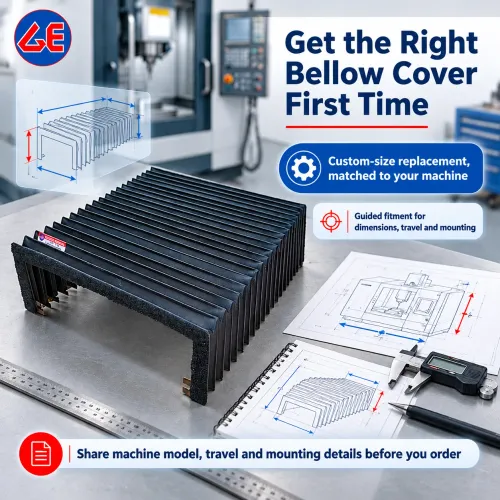
Supply a drawing showing the installed and compressed profiles, seam orientation, end fittings, travel direction, clearance envelope, and every shaft-removal requirement. Include the coupling and guard in the drawing, not just a circle representing the shaft. That information distinguishes a stationary cover from a shaft-mounted design and prevents a quotation based on an unusable envelope.
Match materials, folds, and clearances to the machine environment
Specify construction from the machine environment, not nominal diameter or the phrase “oil resistant.” For round bellows for machine tools and rotary equipment bellows, require the supplier to name the elastomer, coated fabric, reinforcement, seam construction, convolution profile, folded height, and minimum and maximum operating temperatures.
Ask whether each temperature rating covers continuous exposure, radiant heat, hot chips, or brief sparks and molten particles. Request a chemical-compatibility chart covering your coolant, cutting oil, hydraulic oil, alkaline cleaner, solvent, ultraviolet exposure, ozone, and washdown process.
- Describe fine abrasive swarf, chip size, coolant mist, end-flange ingress, seam exposure, drainage, venting, and low-point coolant collection.
- Require fold support that prevents rubbing, ballooning, collapse, and chip trapping during rotation and travel.
- Add a heat shield, deflector, sacrificial outer layer, or telescopic steel protection where hot swarf can cut, puncture, abrade, or burn fabric.
| Construction choice | Specify | Main risk if mismatched |
|---|---|---|
| Stationary fabric bellows | Supported folds, sealed flanges, drainage, venting | Coolant retention, fold collapse, and trapped chips |
| Shaft-mounted rotary bellows | Reinforcement, balance, speed limit, radial clearance | Vibration, shaft contact, overheating, and premature fatigue |
| Heat-protected assembly | Shield or sacrificial layer beside hot swarf | Local burning despite an acceptable overall temperature rating |
| Flexible profile | Compressed and extended lengths with bend radius | Restricted travel, ballooning, interference, or rubbing |
A cover that is too tight contacts the shaft; one too long restricts travel; one too short exposes the protected component; one too flexible collapses or traps chips. Record continuous and peak temperatures separately, then verify clearances at runout, eccentricity, full compression, and full extension.
Prove balance, speed, installation, and service life before release
A shaft-mounted bellows needs balance and dynamic verification before release; a stationary cover needs radial and axial clearance at the worst runout and eccentric position. Obtain a stated rotational-speed limit and confirm whether it applies to continuous duty, intermittent duty, or both.
- Confirm the installation method: clamping rings, adhesive bonding, bolted flanges, or split installation. Record whether shaft removal is necessary and whether the chosen joint can withstand torque, heat, coolant, and vibration.
- Add independent strain relief when cables or hoses pass through rotary equipment bellows. Control the specified bend radius; never let the fabric carry connector loads or clamp the bundle directly to the bellows.
- Rotate through the full operating range, including axial travel and eccentric positions. Run at operating speed, then inspect for vibration, rubbing, heat, fold collapse, and interference.
- Confirm that chips and coolant do not reach the spindle, shaft, bearing, or other protected component. Stop the test if contact occurs.
Inspect round bellow covers for machinery for fold fatigue, delamination, pinholes, oil swelling, abrasion, heat damage, and trapped chips. Clean with the approved method; do not scrape or cut the fabric. Service life depends on cycle count, speed, contamination, temperature, and contact, so request the cycle-test duration, replacement guidance, and warranty exclusions before approval.
Build a procurement file for Washington OEM and replacement work
A standard unit reduces drawing effort and can speed replacement; choose it only when its dimensions, speed rating, fittings, and clearance match the machine. A custom cover takes longer to approve but improves fit, runout clearance, balance, and integration with the spindle, rotary table, coupling, or surrounding guard.
| Option | Advantage | Risk |
|---|---|---|
| Standard bellows | Faster quotation and replacement | Wrong folded height or clearance can cause rubbing and early failure |
| Custom bellows | Exact fit, fittings, balance, and machine-envelope integration | Requires drawing approval, sample fitting, and longer production lead time |
Request a dimensioned drawing showing installed and compressed profiles, end-frame dimensions, hole pattern, travel direction, seam orientation, and clearance envelope. Also obtain the material specification, chemical-compatibility data, minimum and maximum temperatures, installation instructions, inspection record, seam and reinforcement details, and stated rotational-speed limit.
Ask about regional delivery expectations, drawing review, sample or prototype submission, replacement-unit records, revision control, and support for OEM machine builders. GURUKRUPA BELLOWS PVT LTD becomes relevant when a Washington builder needs OEM integration or replacement support, but documented fit and operating data should decide the supplier.
Put these items on the purchase order:
- Machine assembly; stationary or rotating construction; speed; runout; travel; environment; end fittings; test method; acceptance criteria
- Spare-unit quantity, production lead time, approved drawing revision, and replacement identification
Record revisions whenever the machine envelope changes. Searches for bellow covers washington do not replace an approved specification.
Related products
 | Bellow Cover Product Details: Brand GE Color Black-Blue - Gray -White Size ANY ( C shape, Square, Round, Rectangular) Ours is a trustworthy name in the business... View product → |
 | Round Bellow Covers To match with our reputation in the market, we are here to present an unparalleled assortment of Round Bellow Covers. View product → |
Frequently asked questions
What should you define before choosing bellow covers for rotary equipment?
Define the rotary interface, including shaft rotation, angular misalignment, torsion, eccentricity, runout, speed, centrifugal loading, and cycling frequency.
What dimensions should you provide when requesting a quotation?
Provide the complete operating envelope: compressed and extended lengths, outside and inside diameters, stroke, attachment points, moving clearances, and nearby obstructions.
How do you match round bellows for machine tools to the environment?
Specify materials, coatings, fold geometry, and clearances according to coolant, chips, dust, heat, corrosion, fire exposure, and contact with moving components.
What should an OEM procurement file contain?
Keep the approved drawing, material construction, speed and balance limits, installation method, inspection criteria, service-life assumptions, and replacement identification details.