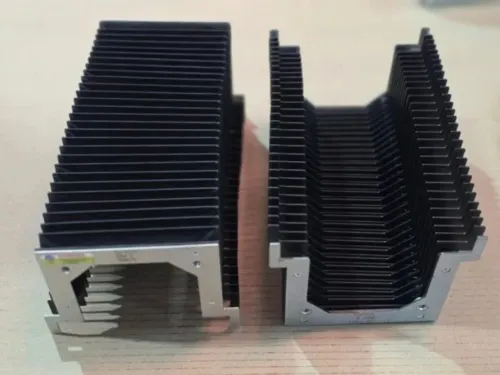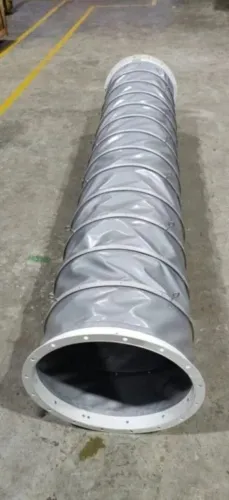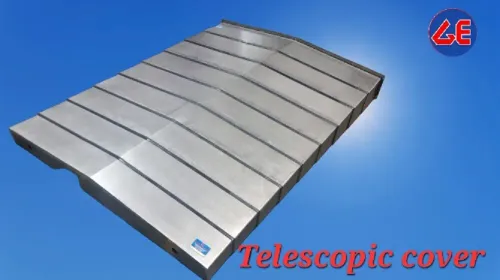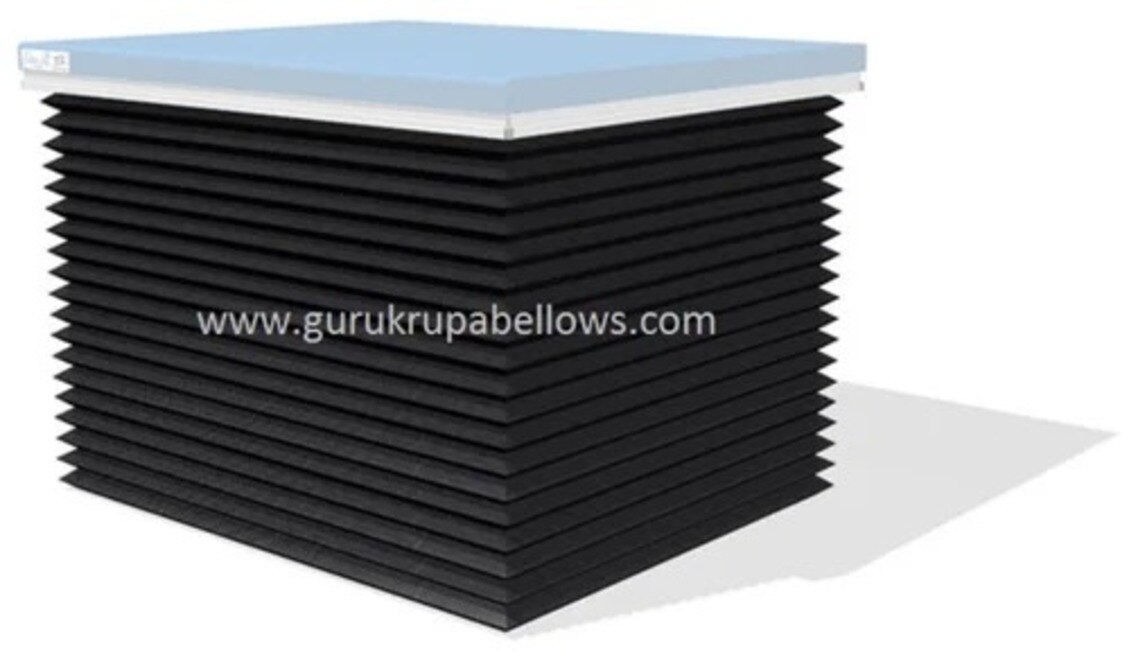
A bellow and a skirt solve different protection problems: one follows a defined moving gap through its stroke, while the other creates a flexible perimeter barrier. By comparing hazard exposure, space, dimensions, materials, inspection, and Washington safeguarding duties, you can select the design that fits the lift rather than treating the two as interchangeable.
Key takeaways
- Use bellows for enclosed moving gaps; use skirts for perimeter access and debris control.
- Measure stroke, folded height, mounting points, clearance, and interference before ordering.
- Specify material by heat, oil, abrasion, weather, and fire exposure.
- Require safeguarding details and documented inspection and acceptance tests.
How a bellow differs from a skirt on a scissor lift
A bellow follows the lift’s moving gap through concertina folds, while a skirt hangs as a flexible perimeter barrier around the platform or scissor assembly. The bellow attaches to moving and stationary structures so it expands and collapses with the stroke; the skirt mainly blocks access, falling debris, and outward splash.
| Design | Functional difference | Typical protection |
|---|---|---|
| Bellow | Encloses a defined gap or mechanism throughout movement | Stronger exclusion of chips, dust, coolant, washdown spray, and access to cylinders or pivots |
| Skirt | Drapes around the perimeter and deflects material without fully sealing the mechanism | Perimeter guarding, falling debris control, and low-cost retrofit protection |
| Either design | Works only when its clearances, attachment points, and movement are correct | A poorly fitted cover can snag, drag, tear, or create a new pinch point |
A skirt can leave openings at corners, panel overlaps, or beneath the platform. Choose a bellow when the cylinder, pivot points, or internal lifting mechanism require continuous enclosure; choose a skirt when rapid visual inspection, easy replacement, or a large perimeter opening matters more.
A bellow is the wrong choice if its folds over-compress through the stroke or rub against scissor arms. A skirt is the wrong choice if it drags on the floor, leaves the mechanism exposed, or its loose material can catch nearby equipment.
That distinction matters when comparing scissor lift bellows versus skirts and specifying scissor lift bellow covers versus scissor lift skirts Washington installations. Neither cover replaces guarding required by WAC 296-806.
Match the cover to the hazard and the lift motion
Choose a bellow for a defined moving gap that must stay enclosed through the stroke; choose a skirt for perimeter guarding and rapid visual access. The scissor lift bellows versus skirts decision depends on the hazard, not the product name.
| Design | Debris and liquids | Access, heat, and interference | Best fit |
|---|---|---|---|
| Bellow | Blocks chips, dust, and splash when folds, seams, and attachments form a continuous enclosure | Restricts access; needs heat-rated material and clearance from arms, stops, sensors, and service points | Protecting a cylinder, pivots, or internal mechanism through a controlled stroke |
| Skirt | Deflects falling debris and floor-level chips; leaves more openings for splash and dust | Preserves visibility and quick inspection; can drag, snag, or expose pinch zones | Perimeter guarding where easy replacement and visual access matter |
| Metal apron or heat-rated curtain | Handles hot chips and radiant heat better than ordinary fabric | Does not seal the mechanism and can add weight or sharp edges | High-temperature cutting areas with a defined deflection zone |
A bellow is the wrong choice when its folds will be compressed below their specified height, rub against scissor arms, or carry horizontal drag. A skirt is the wrong choice when the cylinder or pivots need enclosure, its lower edge will catch on the floor, or a loose curtain can enter a shear zone.
For reliable scissor lift protection, run the selected cover through full extension, collapse, rated load, emergency lowering, and representative cycling. Check for fold inversion, rubbing, snagging, blocked limit switches, hidden pinch points, obstructed lubrication, and loss of the operator’s view. A cover must follow the lift, not restrain it.
Measure the lift before ordering a custom cover
Platform dimensions alone cannot size a cover. Record the lift at its lowest and highest positions, then provide the clearance envelope around the moving mechanism.
- Minimum and maximum lift height, plus available collapsed height
- Platform length and width, opening size, and mounting-plane geometry
- Lateral movement, tilt, scissor-arm sweep, and required bend radius
- Fold pitch and the permitted compressed length for custom scissor lift bellows
- Operating speed, acceleration, cycle frequency, rated load, and off-centre loading
- Ambient and surface temperature, cleaning chemicals, oils, water, chips, and abrasive dust
- Locations of cylinders, pivots, guideways, limit switches, sensors, stops, lubrication points, and service openings
- Emergency-stop and emergency-lowering movement, including any sudden drop or rebound
| Cover choice | Measure closely | Failure if omitted |
|---|---|---|
| Bellow | Moving gap, fold direction, compression space, lateral travel, and attachment planes | Folds invert, rub against arms, or leave corner gaps |
| Skirt | Perimeter length, floor clearance, maximum platform travel, curtain overlap, and nearby obstructions | The curtain drags, snags, or exposes the mechanism at full height |
Send photographs and a dimensioned drawing showing the lift fully collapsed, mid-stroke, and fully extended. Include the operator’s line of sight and every point a cover could touch.
Before production, cycle the proposed design at representative speed and maximum rated load. Check rubbing, snagging, excessive force, fold inversion, sensor interference, emergency lowering, and access to inspection points. For scissor lift bellow covers washington installations, those records help distinguish a cover that fits on paper from one that survives the complete cycle.
Choose materials for Washington exposure and duty cycle
Choose by exposure and duty cycle, not by the material label alone. For scissor lift protection, specify the fluid, temperature, abrasion, cleaning method, UV exposure, and number of cycles before selecting a construction.
| Option | Strengths | Choose it when |
|---|---|---|
| PVC-coated fabric | Economical barrier against dust, chips, coolant, and ordinary splash | The lift is indoors or sheltered and temperatures, solvents, and folding cycles stay within the supplier’s data |
| Rubber- or polyurethane-coated fabric | Better flexibility, abrasion resistance, and resistance to oils or repeated flexing | The cover faces frequent strokes, oily mist, dragging debris, or washdown; verify resistance to the actual fluid concentration |
| Heat-resistant fabric | Silicone, PTFE, or aramid-reinforced versions tolerate higher heat or flame exposure | Hot chips, radiant heat, welding activity, or a specified temperature range exceeds standard PVC capability |
| Metal apron | Steel or stainless-steel slats resist sharp chips, impact, and abrasion | The mechanism needs rigid debris deflection; allow for weight, noise, corrosion, and pinch points |
For scissor lift bellow covers in Washington, specify the site rather than assuming indoor service. Western Washington installations need UV resistance, hydrolysis resistance, drainage, and corrosion-resistant fasteners for persistent moisture; eastern Washington sites may demand low-temperature flexibility and protection from heavier dust.
Obtain the supplier’s temperature and chemical-resistance chart, then compare it with the real fluid, concentration, cleaning agent, and cycle rate. A heat-resistant fabric still fails if coolant attacks its coating, while a metal apron can overload a light-duty lift.
Verify safeguarding, inspection, and supplier acceptance tests
Do not approve a cover because it looks closed at rest. Confirm that it remains safe through the entire stroke, including the points where scissor arms cross, collapse, and create changing pinch and shear zones.
Require the supplier to run and record an acceptance test covering:
- Fully collapsed and fully extended positions, plus intermediate positions
- Maximum rated load, representative operating speed, and repeated cycling
- Emergency stop and emergency-lowering operation
- Mechanical stops, limit switches, load-support members, and operator sightlines
- Inspection openings, lubrication points, and routine access without removing the cover
- Fold inversion, rubbing, snagging, bunching, excessive operating force, and corner gaps
- Deflection under contact, trapped spaces behind the cover, and access beneath or around its edges
A skirt that drags on the floor or folds into a pivot can become an entanglement hazard. A bellow that blocks visual confirmation of arm position can hide a pinch point; neither design makes the mechanism safe by assumption.
For scissor lift bellow covers versus scissor lift skirts in Washington, separate the equipment category first. Washington’s aerial-lift rules address operation, inspection, training, and fall hazards for personnel lifts; they do not approve a custom guard for an industrial machine lift.
Ask GURUKRUPA BELLOWS PVT LTD, or any supplier, to provide drawings showing attachment points, clearances, materials, and test results for custom scissor lift bellows before production use.
Related products
 | Scissor Lift Skirt Product Details: Brand GE Color Black,Blue Material PVC Coated Size Anyany Gurukrupa specializes in providing Scissor Lift Skirt for both standard... View product → |
 | Bellow Cover Product Details: Brand GURUKRUPA Color Black-Blue Size Customised With the support of our excellent team workers, we have been delivering the best... View product → |
Frequently asked questions
How does a bellow differ from a skirt on a scissor lift?
A bellow uses concertina folds between moving and stationary structures to cover a changing gap. A skirt hangs around the platform or scissor assembly as a flexible perimeter barrier.
How do you match a cover to the hazard and lift motion?
Choose a bellow for guideway, pinch-point, dust, debris, or splash protection across a moving stroke. Choose a skirt for access control, falling debris, and outward splash around the perimeter.
What should you measure before ordering a custom scissor lift cover?
Record the closed and extended positions, stroke, folded height, opening dimensions, mounting surfaces, attachment points, clearances, and nearby pinch or shear zones.
How should you choose materials for Washington exposure and duty cycle?
Specify fabric and coatings against the actual heat, oil, abrasion, moisture, UV exposure, chemicals, and fire hazards, then confirm the material suits the lift’s speed and cycle frequency.
What safeguarding and acceptance checks should you verify?
Confirm that the cover does not create new pinch, entanglement, or visibility hazards. Ask for inspection criteria and acceptance tests covering travel, fastening, clearance, wear, and access protection.
Related product
 | Product Details: Brand GURUKRUPA Color Black-Blue Size Customised With support of our excellent team workers, we have been delivering the best... View product → |