A machine sale can create a protection problem when chips, coolant, abrasive dust, or repeated axis movement threaten exposed guideways and moving components. By the end, you will know how to match a cover to the machine, collect the dimensions and operating data needed for a reliable quotation, and present protection as a practical replacement, retrofit, or uptime solution.
Key takeaways
- Collect compressed length, extended length, width, height, and travel direction.
- Match cover construction to chips, coolant, heat, speed, and available installation space.
- Request material details, drainage design, maintenance access, and acceptance-test criteria.
- Package machine protection with installation guidance, service intervals, and replacement planning.
Turn machine protection into a customer service advantage
A machine that stays clean and aligned after installation gives the reseller fewer damage complaints and more credible uptime support. Telescopic bellow covers shield guideways, ballscrews, hydraulic components, and other exposed moving parts from chips and coolant, helping the customer avoid premature wear and unplanned service calls.
For a reseller, the value continues after delivery. A cover sized around the machine’s mounting points, end-of-travel clearance, drainage path, and required overlap becomes a practical replacement or retrofit option rather than a generic accessory. That makes machine protection covers for resellers easier to specify during a repair, refurbishment, or upgrade.
- Reduce avoidable damage that can trigger warranty disputes or emergency visits.
- Offer a defined response when an original cover wears out, sags, jams, or no longer seals the guideway.
- Add protection to a machine package without redesigning the entire enclosure.
- Give service teams a clear inspection point: check box movement, retained overlap, drainage, rubbing, and access before the customer loses production.
The cover still needs to match its installation. A horizontal design can pool coolant or sag when mounted vertically, and combining it with a cable carrier without checking cable bend radius and maintenance access can create a new failure.
Resellers create lasting value by selling protection that fits the machine’s motion, environment, and service routine—not simply adding a cover to the quotation.
Match the cover construction to the machine and work environment
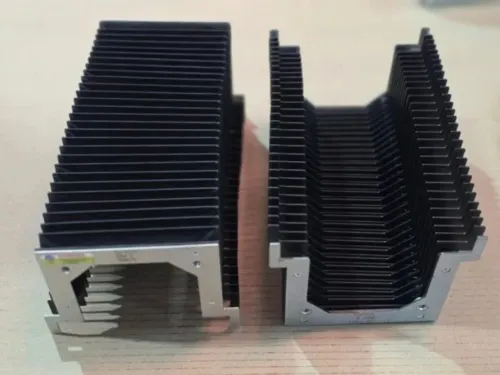
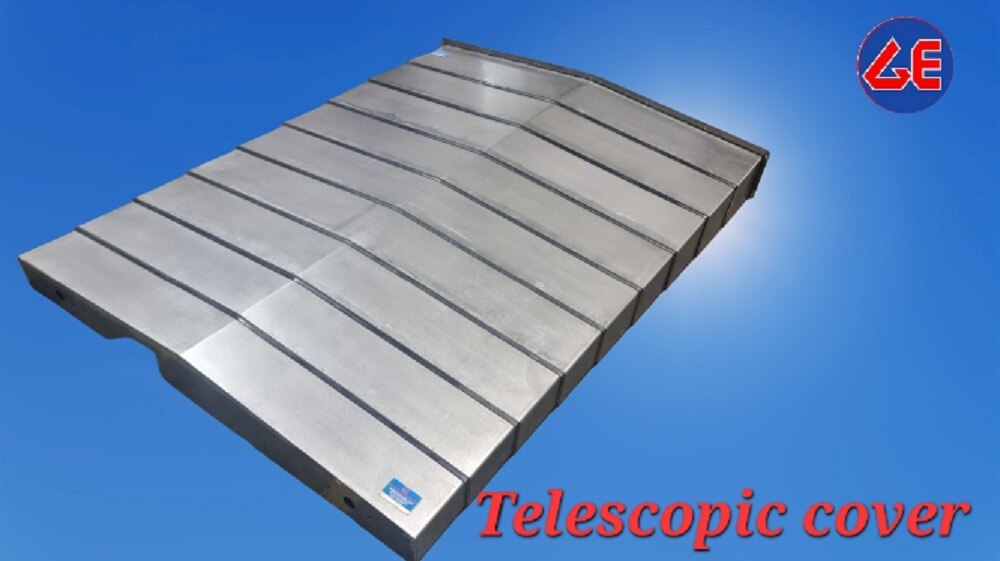
Steel telescopic covers suit CNC lathes, machining centres, milling machines, grinding machines, and transfer lines where hot, sharp chips and heavy coolant attack horizontal or vertical ways. “Telescopic bellow covers” is not a precise construction: steel covers use overlapping boxes or slats, while bellows use folded fabric, elastomer, or composite sections.
| Option | Best fit | Main trade-off |
|---|---|---|
| Steel telescopic covers | Straight machine ways facing large chips, heat, or spray | Strong protection, but added mass demands accurate guides, overlap, scraping surfaces, and alignment |
| Fabric bellows | Ball screws, hydraulic components, irregular paths, and low-mass axes | Compact and flexible, but vulnerable to cutting-edge impact and unsuitable materials |
| Accordion bellows | Short-to-medium travel on compact linear or non-linear axes | Small folded length, but folds need correct geometry and support against collapse or rubbing |
| Way covers | Exposed guideways on lathes, mills, grinders, and machining centres | Protect the way, not automatically the whole mechanism or a person |
| Simpler guards | Fixed screens, plates, or chip shields where motion is limited and access is predictable | Lower complexity, but they leave gaps around moving axes |
Choose industrial bellow covers with sliders, frames, or internal supports for high acceleration, vertical mounting, or long unsupported spans. A horizontal design can sag, pool coolant, or bind when installed vertically or inverted.
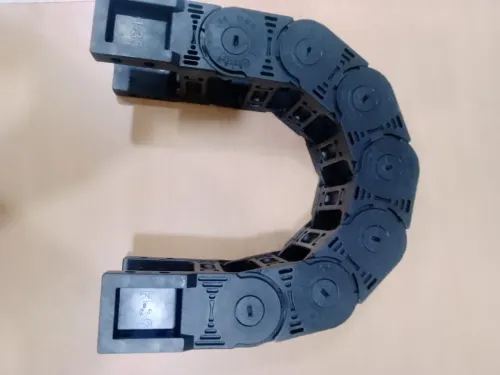
Do not use a way cover as a personnel guard; assess access protection against ISO 14120 and safety distances in ISO 13857. Keep cable carriers separate from covers: the carrier controls hose and cable bend radius, while the cover protects the machine way.
Collect the dimensions and motion data before requesting a quote
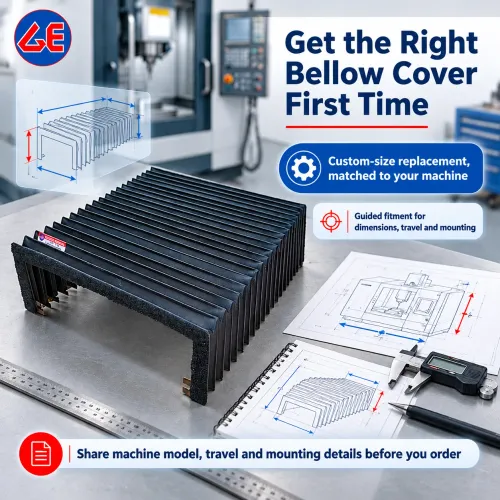
A machine travel figure is not enough to quote telescopic bellow covers. A cover with the correct stroke can still bottom out at the closed end, collide with a ballscrew or chip conveyor, or restrict access to a tool changer.
Ask the customer for a dimensioned drawing or photographs showing both ends of travel, mounting faces, and nearby components. Record:
- Closed length, open length, usable stroke, cover width, cover height, and guideway cross-section.
- Mounting-hole pattern, flange details, fixed and moving attachment points, and available clearance at each end of travel.
- Axis orientation, maximum speed, acceleration, cycle frequency, and whether the motion is horizontal, vertical, or inclined.
- Minimum overlap required between telescoping boxes. Do not calculate this from nominal dimensions; insufficient overlap exposes gaps and increases the chance of interference or jamming.
- Nearby ballscrews, lubrication lines, tool changers, chip conveyors, cable carriers, adjacent covers, and service panels that need clearance.
- Chip type, coolant or lubricant, operating temperature, and cleaning method, because these affect construction and access.
- Cable and hose bend radius, carrier travel, and maintenance access when a cable-management system shares the same space.
Check that the proposed telescopic covers for machinery leave room for lubrication, inspection, removal, and emergency access throughout travel. A way cover is not automatically a personnel guard; if it prevents access to hazardous motion, evaluate the complete safeguard under ISO 14120 and ISO 13857.
Check materials, drainage, maintenance, and acceptance performance
Do not approve a cover described only as “oil-resistant.” For industrial bellow covers, match the actual coolant, lubricant, cleaning chemical, concentration, temperature, exposure time, chip shape, and chip temperature to the proposed coated fabric, PVC, polyurethane, neoprene, silicone, or other elastomer.
Ask for compatibility data when the fluid or heat falls outside the supplier’s stated range.
Use this verification checklist before quoting machine protection covers for resellers:
- Confirm closed length, open length, stroke, width, height, mounting points, guideway shape, orientation, speed, acceleration, and cycle frequency. Check clearance at both ends of travel against ballscrews, lubrication lines, tool changers, chip conveyors, cable carriers, and adjacent covers.
- Specify drainage. Sloped surfaces, gutters, drain holes, or a defined drain direction must prevent coolant from collecting between telescopic sections or inside folds, without discharging onto the guideway.
- Identify the wiper material, contact pressure, expected wear, replacement-strip availability, and replacement method. A wiper removes chips and coolant; it is not a permanent seal.
- Review the customer’s cleaning interval and access. Confirm that technicians can inspect folds, clear trapped chips, replace wipers, and lubricate or reach nearby components without removing the complete cover.
- Separate cover protection from cable management. Verify cable bend radius, carrier travel, and service access instead of assuming one system solves both problems.
Acceptance should include a full-speed, full-stroke trial at operating acceleration and repeated cycles. Reject covers that bind, buckle, collide, retain coolant, expose the way, or shift their mounts. Capture photographs and clearance measurements for the handover record.
Build a protection package around the machine sale
A reseller searching for telescopic bellow covers for equipment resellers washington needs more than a part number. Ask a specialist supplier to create a replacement file containing the original mounting points, compressed and extended lengths, travel direction, installation orientation, end clearances, wiper specification, and drainage direction.
This turns a future breakdown into a controlled replacement rather than a rushed remake.
Use the supplier for four defined checks before promising delivery or performance:
- Compare the replacement against both ends of machine travel, checking ballscrews, lubrication lines, tool changers, chip conveyors, cable carriers, and adjacent covers for interference.
- Confirm whether horizontal, vertical, or inverted installation changes guide support, sag, friction, drainage, or coolant pooling.
- Identify wiper material and replacement-strip availability; a worn wiper does not mean the complete cover has failed.
- Record the cover’s limits, inspection interval, and exclusions, such as unsupported coolant chemistry, chip size, speed, temperature, or impact loading.
For machine protection covers for resellers, a retrofit survey should include photographs, measured clearances, axis orientation, and the customer’s maintenance access requirements. GURUKRUPA BELLOWS PVT LTD can be included as a specialist contact when a reseller needs those dimensions reviewed before fabrication.
Keep cable carriers separate in the specification: the cover shields the mechanism, while the carrier controls hose and cable bend radius. This prevents a protection upgrade from creating a new maintenance failure.
Related products
 | Telescopic Bellow Cover Product Details: Brand GURUKRUPA Ours is a distinguished name in the business that manufactures and supplies Telescopic Bellow Cover that is vastly... View product → |
 | Industrial Telescopic Covers Our company is known as one of the eminent names of the industry to manufacture and supply Industrial Telescopic Covers. View product → |
Frequently asked questions
How do telescopic bellow covers improve customer service for equipment resellers?
They protect guideways, ballscrews, hydraulic components, and other moving parts from chips and coolant, helping reduce damage complaints and service calls.
What information should resellers collect before requesting a cover quote?
Collect the protected component, compressed and extended lengths, width, height, travel direction, mounting points, speed, acceleration, and available installation space.
How do you match telescopic covers for machinery to the work environment?
Specify construction based on chip size, coolant exposure, heat, corrosion risk, motion speed, acceleration, and the machine’s space constraints.
What should resellers check before accepting industrial bellow covers?
Check materials, drainage, access for maintenance, mounting fit, travel performance, folded height, extension, and operation through the full machine stroke.
Related product
 | Steel Telescopic Cover Product Details: Brand GURUKRUPA Our company is considered a renowned name in the field that manufactures and supplies Steel Telescopic Cover. View product → |