A fabric expansion bellow cover is a complete movement-management assembly, not simply a piece of coated cloth. You will be able to identify the included parts, calculate the dimensions and travel, compare materials, and check whether a supplier’s quotation covers installation, testing and future replacement.
Key takeaways
- Provide travel, compressed length, extended length and operating speed.
- Match coated fabric and insulation to temperature, chemicals and fire exposure.
- Request drawings, material data, installation details and inspection criteria.
- Choose bellows, sliding covers or rigid guards according to the movement.
What the cover is and where it fits
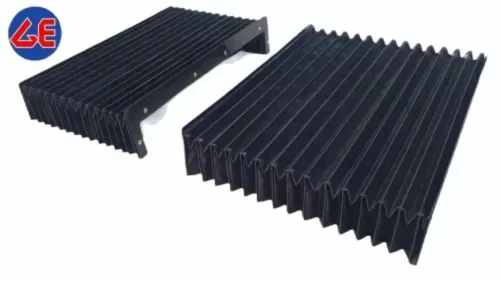
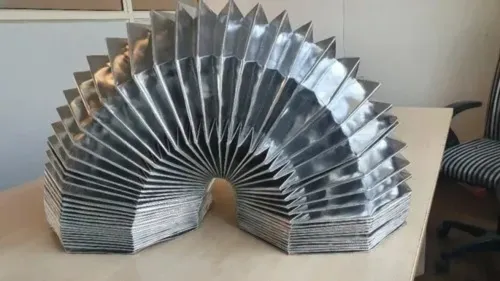
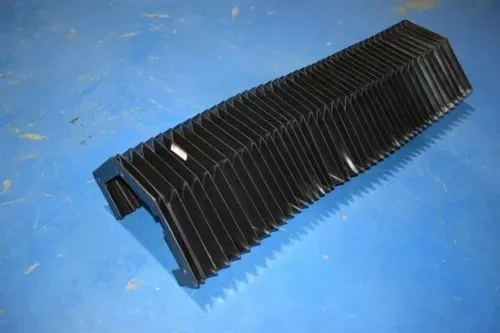
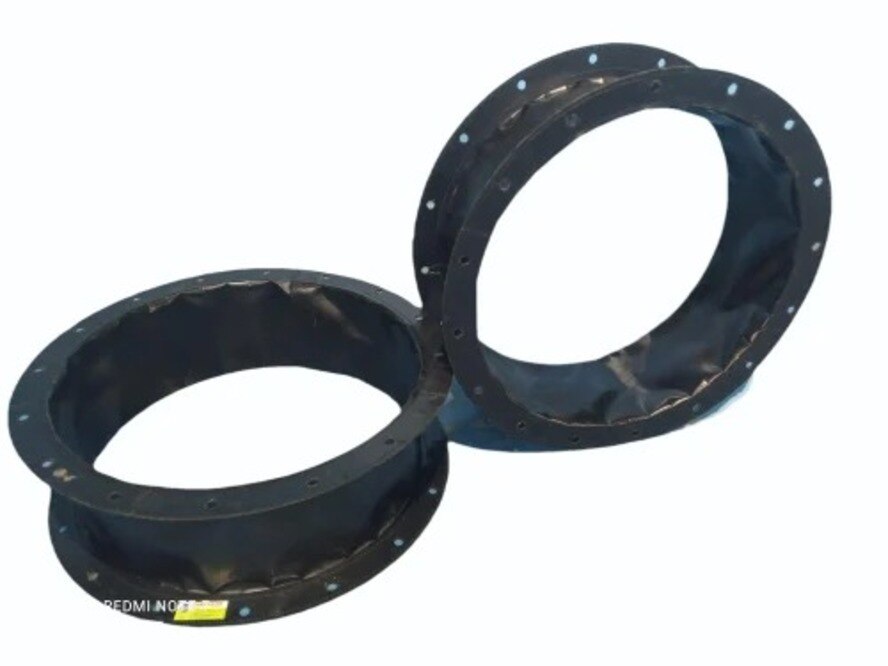
A fabric expansion bellow cover is a fabricated, flexible shield fitted over a moving gap, guideway, duct, pipe, or machine assembly. It normally includes coated technical fabric, stitched or welded folds, end frames or flanges, and, where required, support rings, baffles, guide strips, or sliding shoes.
The folds expand and compress as the equipment moves, while absorbing vibration and limited misalignment.
Common fabric bellow cover options include PVC-coated polyester for general coolant and chip service, polyurethane-coated fabric for improved abrasion resistance, and silicone-coated glass fabric for higher-temperature exposure. The coating, reinforcement, seams, and exposure duration determine performance; a temperature claim alone does not define the cover.
| Product | Main job | Difference |
|---|---|---|
| Fabric expansion bellow cover | Protects a moving gap or assembly | Lightweight, compact when folded, and suited to irregular geometry |
| Fabric expansion joint | Connects ducts or pipes across movement | Designed for system pressure and thermal movement, not usually machine-guideway protection |
| Fixed bellow cover | Shields a stationary enclosure or interface | Has little or no repeated extension and compression |
| Concertina or accordion cover | Describes a folded cover shape | May be fabric, rubber, or another material; the name does not specify construction |
| Telescopic cover | Protects guideways from chips and impact | Uses sliding metal sections and suits heavy hot chips and high-speed travel |
Confirm whether a quotation covers only the flexible element or the complete mounted assembly. External slats, lamellas, or an apron can add impact protection where a plain fabric cover is too exposed.
The dimensions and movement data you must provide
A travel figure alone cannot size the cover. Record fabric expansion bellow cover specifications for the fully compressed length, fully extended length, folded height, fold count, travel direction, allowable lateral movement, installation orientation and minimum bend radius.
| Measurement or input | Calculation or detail | Why it prevents failure |
|---|---|---|
| Compressed and extended length | Extended length minus compressed length must exceed axis travel, with running clearance | Prevents restricted travel and over-compression |
| Fold height and fold count | Check the folded package against nearby guards, sensors and chip conveyors | Stops folds from rubbing or snagging |
| Lateral movement and bend radius | Compare maximum offset and curvature with the cover’s allowable values | Prevents seam stress and guideway contact |
| Speed and acceleration | Provide peak velocity, acceleration and cycle frequency | A dimensionally correct cover can still fatigue during rapid reversals |
| Mounting geometry | Show end-frame profile, flange thickness, hole pattern, datums and fastener access | Avoids clashes with lubrication lines and machine guards |
Calculate the expansion ratio as extended length divided by compressed length. A high ratio demands carefully sized folds and sometimes internal frames or guides; forcing a long cover into a short package causes fold interference and seam fatigue.
Include the available installation envelope, axis travel, mounting orientation, required service life and a 3-D interface drawing or photographs. State whether each end is fixed, sliding or guided. Also provide the minimum clearance to the protected slideway, because nominal dimensions do not account for lateral drift during operation.
Choosing fabric, heat protection and the right alternative
Choose the construction for the combined hazard, not for the highest temperature printed on a datasheet. Provide the supplier with the coolant formulation and concentration, cleaning chemicals, chip temperature, dust level, machine speed, acceleration, mounting orientation and washdown conditions; fine abrasive dust, humidity and oil-based coolant can defeat a poorly sealed cover.
| Option | Best fit | Watch for |
|---|---|---|
| PVC-coated polyester | General chips, water-based coolant and weather | Verify resistance to the actual coolant and cleaning agent |
| Polyurethane-coated fabric | Higher abrasion, oil exposure or hydrolysis resistance | Coating, seams and temperature limit still control service life |
| Silicone-coated glass fabric | Hot surfaces, radiant heat and intermittent sparks | Protect it from direct flame, molten metal and sharp impact |
| Aramid- or glass-reinforced fabric | Severe abrasion, heat or repeated mechanical attack | Added stiffness can increase folded height and movement resistance |
High-cycle movement demands a flexible construction with reinforced seams, a suitable fold pitch and a bend radius that prevents creasing. A 1000°C claim is incomplete unless it states exposure duration, radiant heat versus direct flame, surface temperature and airflow; sparks or molten material often require an external heat shield.
Fabric is the wrong choice when heavy hot chips strike at high speed, sliding speed is very high, or sharp debris repeatedly impacts the cover. Use a telescopic steel way cover for those loads. A hybrid fabric bellows with slats, lamellas or a protective apron suits equipment needing compact folding with added impact protection.
These fabric bellow cover options must also leave clearance for lateral movement rather than merely matching axis travel.
What to request from a Bangalore supplier
A quotation is incomplete if it only says “custom-made.” Before ordering custom expansion bellow covers, require evidence that the design matches your machine, environment and maintenance plan.
If you are seeking fabric expansion bellow covers for details in Bangalore, send the supplier a 3-D interface drawing or clear photographs with machine axis travel, speed, acceleration, mounting orientation and available compressed length.
- Request a dimensioned drawing showing extended and compressed lengths, fold height, hole positions, end frames, clearances and mounting points.
- Ask for the material construction, reinforcement, coating, seam method and the test basis for temperature, fine abrasive dust, water-based or oil-based coolant, oil-based coolant, washdown and cleaning chemicals.
- Require compressed and extended photographs or a sample, plus inspection limits for fold squareness, travel, seam quality and hole location. “Custom” does not prove service life or interchangeability.
- Put local support in writing: site measurement, trial fitting, installation, response time for failures and availability of replacement sections. GURUKRUPA BELLOWS PVT LTD is one Bangalore supplier to ask about this service scope rather than assuming it is included.
- Separate the cover price from mounting frames, guide rails, wipers, inspection windows, drains, wear strips, spare fold sections and installation hardware. State lead time, warranty, taxes, freight and the price of future replacements.
A fabric expansion bellows supplier in Bangalore should also state whether its design handles your actual orientation and acceleration; a cover that fits at rest can rub, sag or wear during rapid travel.
Installation, inspection and replacement planning
Mount custom expansion bellow covers from the purchase drawing, not by stretching them to fit. Confirm the cover’s mounting orientation and leave clearance for guards, lubrication lines, sensors and chip conveyors. A correct travel calculation cannot rescue a frame that blocks access or forces the folds sideways.
Use this acceptance checklist:
- Match the end-frame profile, bolt-hole pattern, flange thickness and datum references to the machine.
- Confirm fasteners are reachable and that each end is fixed, sliding or guided as specified.
- Run the cover through a full compression-to-extension stroke on the actual machine, or on a dimensionally representative fixture.
- Check fold tracking, interference, noise, fastener clearance and lateral movement at operating speed.
- Inspect seams, attachment points and folded sections after the trial, not only before it.
Clean chips and coolant from the folds during scheduled machine maintenance. Look for abrasion, cracked coating, loose fasteners, distorted frames, pulled seams and folds that no longer open evenly. Rubbing, bunching, snapping noise or restricted travel indicates incorrect alignment, insufficient clearance or a design that cannot absorb the actual movement.
Replace the cover when wear reaches the reinforcement, a tear exposes the protected gap, or heat and chemicals have hardened the fabric. Record stroke cycles and inspection findings, then order replacement fabric sections, frames or installation hardware before failure stops production.
Frequently asked questions
What information must you provide for fabric expansion bellow cover specifications?
Give the supplier the opening dimensions, compressed and extended lengths, travel direction, movement speed, cycle frequency, mounting details and nearby temperature or contamination risks.
How do you choose among fabric bellow cover options?
Select the coated fabric, stitching or welding method, support rings, baffles and end fittings according to temperature, chemicals, abrasion, fire exposure and required movement.
When is a fabric expansion bellow cover the wrong choice?
Use a different protection system when the application requires rigid impact protection, unrestricted airflow, very high heat resistance or movement that the fabric design cannot accommodate.
What should you request from a fabric expansion bellows supplier in Bangalore?
Ask for a dimensioned drawing, fabric and coating details, temperature limits, movement rating, mounting method, inspection points, warranty terms and replacement guidance.