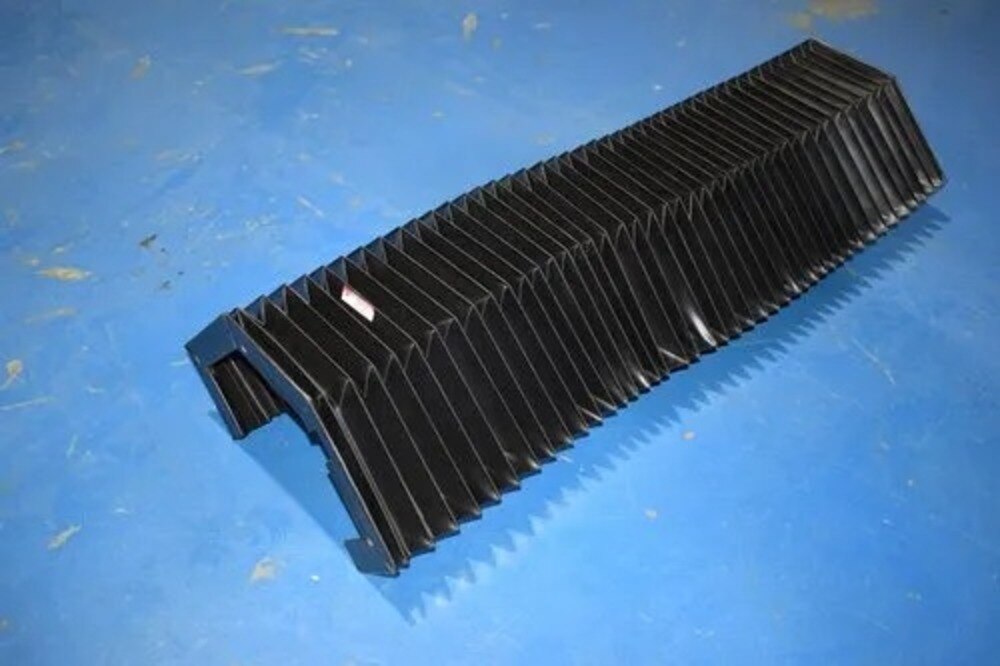
CNC dust reaches precision components through open guideways, moving-axis clearances, coolant airflow and poorly controlled chips, so one cover rarely solves the entire contamination problem. By matching the contaminant, motion and machine layout to bellows, steel covers, seals, extraction and chip handling, you can specify protection that works instead of buying by travel length alone.
Key takeaways
- Match protection to the dust path, coolant exposure and moving axis.
- Use steel covers for impact; use bellows where flexible travel needs protection.
- Measure travel, compressed length, open height, mounting points and clearances.
- Specify fabric, reinforcement, temperature resistance and cleaning access before ordering.
Where CNC dust travels and what a cover can actually protect
Chips and dust reach CNC components through cutting airflow, coolant splash, gravity, axis motion and gaps in the enclosure. They settle on guideways and linear rails, enter ball-screw threads through exposed sections, and collect around spindle noses, tool changers and chip trays.
Door seals, cable openings and cooling fans can carry fine dust into electrical enclosures.
A moving-axis cover protects parts physically close to the travel path:
- Use it to shield guideways, ball screws, linear rails and linear motors from abrasive particles, residual chips and coolant spray.
- Use spindle seals, labyrinths, air purge or dedicated guarding for spindle components; an axis bellows does not seal the spindle.
- Use tool-changer guarding and chip deflectors around pockets, arms and grippers; a bellows cannot stop chips arriving from above.
- Use a sealed electrical cabinet, filtered ventilation or positive pressure for controls; CNC bellow cover dust protection does not replace cabinet protection.
- Use extraction and an enclosed machine for airborne dry dust. A cover contains contamination at the moving axis but does not remove dust circulating through the work envelope.
| Option | What it protects or controls | Main limitation |
|---|---|---|
| Accordion bellows | Guideways, screws and rails during axis travel | Can be cut by hot or sharp chips; must not become a chip bin |
| Telescopic steel cover | Ways exposed to heavy, hot or impact-prone swarf | Adds mass and needs space for telescoping |
| Extraction and enclosure | Airborne dust and fine particles | Does not shield sliding surfaces from settled debris |
| Way wipers and seals | Residual particles at contact edges | Cannot handle large chip loads alone |
Accordion bellows versus steel covers, seals and extraction
Choose the cover by contaminant and motion: an accordion bellows shields moving precision parts, while seals and extraction handle different paths of contamination.
| Option | Best fit | Main limitation | Combine with |
|---|---|---|---|
| Accordion bellows | Dry dust, coolant splash, wood dust and residual graphite around moving axes | Fine abrasive dust wears fabric; sticky deposits can jam folds | Way wipers, brush seals and enclosure extraction |
| Telescopic steel cover | Sharp aluminium swarf, heavy chip loads and hot chips | Heavier, less flexible and space-hungry when folded | Chip conveyor, chip flush and scrapers |
| Way seals and wipers | Light dust, coolant film and particles at guideway edges | They do not cover the entire moving axis | Bellows or steel covers |
| Enclosure extraction | Airborne dry dust, wood dust, graphite and coolant mist | It does not protect a ballscrew or rail from direct chip impact | A moving-axis cover with pickup near the cutting zone |
For abrasive dry dust, use the bellows to protect guideways, linear motors and ballscrews, then extract air from the enclosure. A remote pickup leaves dust circulating. Large chip volumes belong in a conveyor or flush system, not inside bellows folds.
The wording accordion bellow covers for CNC dust problems in Berlin describes an application, not a performance class. Specify the axis, particle type, temperature, coolant chemistry, cleaning method and accumulation rate before comparing quotations. Use sealed construction and extraction for wood dust or graphite; choose steel for hot, sharp or heavy chips.
The measurements that decide whether a bellows will fit
Measure the axis envelope at both end positions, not just the travel. Record the fully extended length, compressed length, fold height, mounting width and height, and the clearance available above, below and beside the moving cover.
- Mark the fixed and moving mounting faces from a common machine datum. Measure bolt-hole spacing, hole diameter, flange depth, orientation and any offset.
- Photograph the installation with the axis fully retracted and extended. Include guideways, chip conveyors, guards, scrapers, lubrication tubes and coolant lines.
- Record the motion direction, travel, speed, acceleration, cycle frequency and minimum bend radius. Note every point where the folded pack could touch itself, the guideway or a fixed edge.
- Measure the space needed for lubrication, inspection and line movement. State whether hoses or tubes move with the axis, pass through the cover, or remain outside it.
- Document coolant type, chip material, temperature, cleaning method and dust load. Add the machine model, axis name, dimensioned drawing and existing-cover failures.
A search for accordion machine bellows in berlin is not a specification. The quotation request must show the complete envelope and operating cycle.
Ask the supplier to confirm extended and compressed dimensions, fold geometry, guides or supports, and clearance through the full stroke; a cover sized only by travel can rub, fold into the mechanism, or obstruct lubrication.
Construction details that determine service life
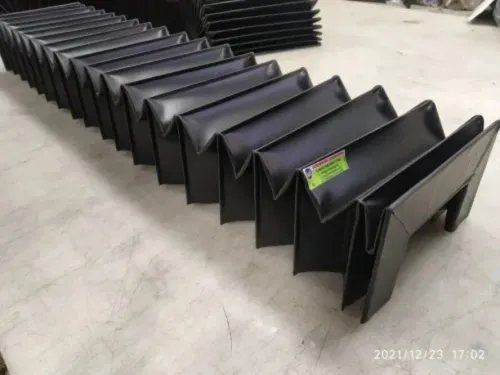
Fold geometry determines whether dust is shed or trapped. Use sloping, self-shedding folds with enough clearance to open fully; sticky coolant mixed with fine dust can pack the valleys and stop travel. CNC bellow cover dust protection is a function, not a construction specification.
Specify construction against the actual duty:
- Use reinforced fabric where abrasion, bending, or sharp chips could cut unsupported cloth; choose a coating compatible with the coolant, oil, solvent, and cleaning agent.
- State whether seams are stitched, welded, or sealed. A strong panel cannot compensate for leaking seams, fold corners, mounting flanges, or end frames.
- Add scrapers at exposed openings when chips ride onto the moving member, and supports when a long cover could sag into guideways or ball screws.
- Record continuous and peak temperature, because heat can embrittle coatings, weaken adhesives, and ignite unsuitable materials.
- Define pressure limits. A bellows cover is not a pressure vessel, and extraction or compressed air can collapse, inflate, or damage it.
- Treat combustible wood, aluminium, magnesium, or composite dust as a fire-risk design issue involving ignition sources, static, extraction, filters, and maintenance—not merely fire-retardant fabric.
- Specify cleaning tools, solvent restrictions, inspection access, and the maximum dust or sludge accumulation before cleaning. Aggressive compressed air can drive particles deeper into folds.
Choose steel or sacrificial protection where hot, heavy chips cause impact; choose flexible fabric where low mass and compact folding matter. Verify coolant chemistry with material samples before production.
A practical procurement and maintenance checklist in Berlin
Turn the survey into one metric RFQ, not a request for “CNC bellow cover dust protection.” Include a dimensioned drawing, photographs, axis envelope, travel, folded length, mounting-hole pattern, speed, acceleration, cycle frequency, material machined, coolant, temperature, and the required result: chip deflection, splash resistance, or defined dust-tightness.
1. State the machine axis and clearance at every position. Record guideway width, moving-member dimensions, fixed-edge gaps, lubrication lines, and coolant paths. Ask for a drawing showing fold direction, end frames, guides, sliders, and replacement access.
2. Add service conditions that affect the construction: dry dust, aluminium swarf, graphite, wood dust, hot chips, coolant chemistry, cleaning method, and inspection interval. Cite the machine risk assessment under EN ISO 12100 and workplace-dust controls such as TRGS 553 where wood dust applies.
3. Compare quotations against identical fields: fabric or laminate, reinforcement, seam method, operating temperature, allowable speed and acceleration, folded-pack length, mounting hardware, delivery drawings, and expected replacement parts. This makes accordion bellow covers in Berlin comparable instead of merely similar in appearance.
Inspect the installed cover through the complete axis cycle. Reject it if folds rub the guideway, conveyor, machine edge, or each other; chips pool on horizontal folds; end frames detach; seams open; or coated fabric cracks. Tape over a tear is not a repair.
Ask GURUKRUPA BELLOWS PVT LTD for a custom design when the envelope, mounting pattern, motion profile, dust hazard, or access needs differ from a standard size. Supply the survey, photos, and failure evidence; ask the supplier to return a signed drawing before manufacture.
Accordion machine bellows in Berlin should be ordered from that verified envelope, not a generic travel table.
Related products
 | Accordion Bellow Cover Ours is a trustworthy name in the business that brings forth Accordion Bellow Cover that is used for delivering controlled pressurized air to a... View product → |
 | Bellow Cover ₹1000 We are offering an excellent quality of Protective Bellows for all type Guideways. This design covers three sides of the rail. View product → |
Frequently asked questions
What do accordion bellows protect on a CNC machine?
They shield guideways, linear rails, ball screws, cables and other moving components from chips, dust, coolant splash and mechanical wear. They do not replace enclosure sealing or extraction where airborne dust escapes.
Are accordion bellows better than steel covers for CNC dust?
Accordion bellows suit flexible, space-constrained travel and irregular movement. Steel covers provide stronger resistance to hot, sharp chips and impact. Choose based on chip load, coolant exposure, axis travel and available space.
What measurements are needed for a CNC bellow cover?
Record axis travel, extended and compressed lengths, open and folded heights, width, mounting-hole pattern, guideway clearance, bend direction and nearby obstructions. Include temperature, coolant and chip conditions.
How do you extend the service life of CNC accordion bellows?
Specify fabric and reinforcement for the heat, coolant and abrasion involved. Inspect folds and mounting points, remove chips without forcing them into folds, and replace the cover when cracks, pinholes or permanent deformation appear.
Related products
 | CNC Bellow Cover Product Details: Brand GURUKRUPA Color BLACK Size ANY We are considered a well-known name in the business that manufactures and supplies CNC Bellow... View product → |
 | Round Bellow Covers ₹1000 To match with our reputation in the market, we are here to present an unparalleled assortment of Round Bellow Covers. View product → |
 | Protective Bellows We are offering an excellent quality of Protective Bellows for Hiwin EG and HG Guideways. This design covers three sides of the rail. View product → |
 | Bellow Cover We are considered a well-known name in the business that manufactures and supplies Bellow Cover. View product → |