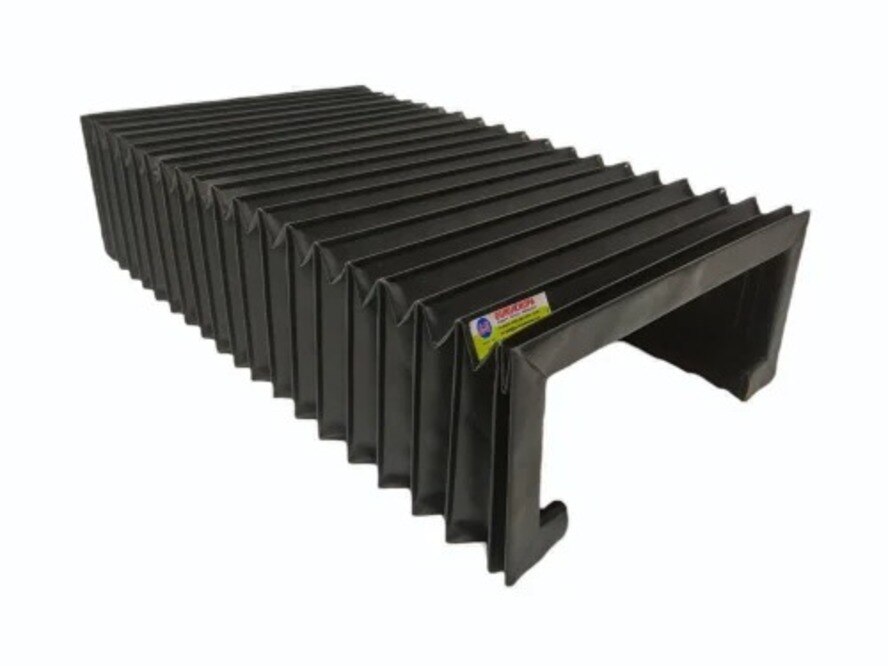
A guideway bellows limits contamination only when its construction, dimensions and interfaces match the machining process. By the end, you will know how to select the right protection for coolant, chips, dust and heat, verify a rail fit, and identify installation conditions that cause early failure.
Key takeaways
- Use a moving barrier, not a seal, to shield guideways from chips and coolant.
- Choose coated fabric, steel, or heat-resistant construction for the contamination load.
- Measure the full stroke, compressed length, mounting space, and guideway clearance.
- Require drawings, movement data, material details, and testing records before ordering.
How a bellows blocks contamination without sealing the guideway
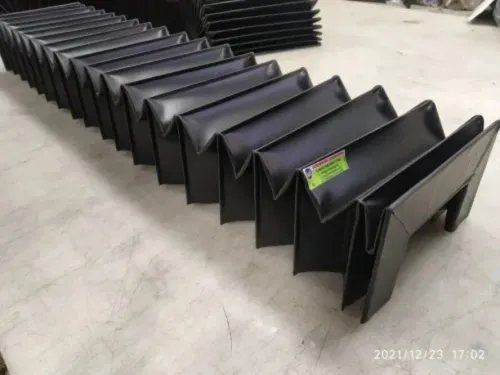
A bellows protects a moving guideway by forming a flexible barrier between the rail and the machining zone. One end attaches to the fixed machine structure and the other follows the carriage, while pleated sections expand and compress through the full stroke. Chips and spray hit the cover instead of the bearing surfaces.
The barrier is not hermetic. Contamination can enter at end interfaces, mounting flanges, fold valleys, or through a split coating. Effective cnc bellow cover protection therefore closes those paths with additional components:
- Fit end wipers or scrapers where the carriage exposes a gap during travel.
- Use guide frames to keep machine guideway bellow covers aligned and prevent folds from rubbing the rail.
- Add overlapping cover sections where one bellows cannot shield the full guideway width.
- Keep the guideway lubrication system operating; a cover does not replace the manufacturer’s oil or grease film.
- Inspect folds, corners, stitching, coatings and fasteners for damage before contamination reaches the bearings.
Check the compressed length as well as the travel. A bellows that reaches both ends but folds too tightly can buckle, invert or load the axis unexpectedly.
Treat access protection separately. A flexible cover is not automatically a machine guard, interlock or impact-resistant barrier. For EU machinery, assess the safety function under Directive 2006/42/EC or Regulation (EU) 2023/1230, according to the machine’s placing-on-the-market date.
Match the cover construction to the contamination load
Choose the coating and reinforcement for the actual contamination load, not for the generic label “coolant.” A cover that survives water-soluble coolant can soften, swell, or delaminate in neat oil, alkaline cleaner, or synthetic fluid.
| Contamination | Suitable construction | Support features and limits |
|---|---|---|
| Water-soluble coolant and spray | PVC-coated fabric for moderate duty; polyurethane-coated fabric for better abrasion and oil resistance | Use sealed end frames, overlapping flaps, and guide frames. Confirm compatibility with the exact fluid concentration. |
| Neat oil and tramp oil | Polyurethane-coated fabric or oil-resistant PVC compound | Specify resistant thread, adhesive, and end-frame materials. Add end wipers where oil can run beneath the folds. |
| Abrasive dust, grinding grit, and cast-iron fines | Polyurethane-coated, aramid-reinforced fabric | Use reinforced fold edges, guide frames, and scrapers. Keep grit from lodging in fold valleys, where it accelerates wear. |
| Welding spatter | Silicone-coated fabric with heat-resistant thread; aramid reinforcement for repeated exposure | Add a sacrificial spark shield or overlapping metal cover. Ordinary PVC can harden, crack, or burn. |
| Sharp chips and hot swarf | Metal-supported construction, or aramid-reinforced fabric with a metal slat shield | Use overlapping plates, rigid end supports, and scrapers. High-pressure coolant can drive chips through weak seams. |
CNC bellow cover protection is incomplete if contamination enters at the end interfaces or damaged folds. Ask for chemical-compatibility data for your fluid, temperature, pressure, and concentration, then inspect for coating cracks, torn corners, loose stitching, and fold inversion. A cover that binds is already imposing unwanted axis load.
Measure the guideway before checking rail compatibility
Measure the guideway, carriage and surrounding envelope before asking whether a cover suits the rail. A travel length alone proves little: a bellows can reach the stroke and still collide when compressed beside the carriage.
1. Record the rail’s usable width and height, the carriage width and height, and the exposed guideway length. Photograph the fixed and moving attachment points, including their distance from the rail centreline.
2. Measure the required stroke, maximum extended length and minimum compressed length. Include folded height, available side and top clearance, neighbouring covers, coolant lines, tooling and the machine’s hard stops.
3. Note the mounting orientation, lateral offset, bend radius and the distance between fixed and moving mounting faces. Measure the mounting-hole pattern and flange dimensions rather than relying on the rail series name.
4. Provide the fastest traverse speed, acceleration, cycle frequency and travel direction. These values determine fold pitch, support requirements and whether the cover will buckle during rapid reversals.
5. Identify the rail profile and carriage model, such as a Hiwin EG or HG, then compare the actual carriage envelope and attachment geometry with the supplier’s drawing. The series alone does not confirm compatibility.
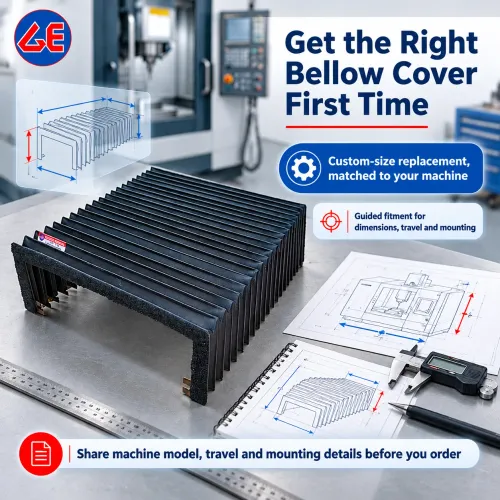
Request a drawing showing extended and compressed states, fold pitch, end frames, material layers, temperature and chemical limits, and the replacement method. For machine guideway bellow covers, these details expose collisions before fabrication. A search for cnc machine bellow covers in berlin should end with measured dimensions, not only a machine model or catalogue label.
Prevent compression, snagging and movement-related failure
A cover that reaches its minimum compressed length can collide with the carriage and overload the axis, even when its maximum travel is correct. Leave the specified compressed-length clearance at both ends; do not use the bellows as a stop.
| Fault | Installation or operating mistake | Result |
|---|---|---|
| Fold inversion | Fit the cover with the folds reversed, or allow a fold to catch on a frame | The fold buckles, tears, or pulls the mounting corner |
| Lateral binding | Mount fixed and moving ends off-axis, or ignore the stated lateral offset | Side loads rise and the axis works against the cover |
| Over-compression | Select a cover shorter than the available envelope | Fold valleys flatten, fabric delaminates, and the carriage can collide |
| Fastener failure | Use the wrong hole pattern, loose screws, or unsupported mounting flanges | Fasteners pull out and the cover snags neighbouring parts |
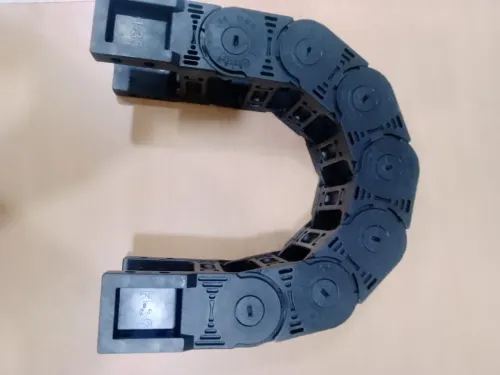
| Cable or hose snagging | Route a cable carrier, hose, chip conveyor, or scraper into the moving folds | The bellows stretches, tears, or stalls the traverse |
| Excessive dynamics | Exceed the specified traverse speed, acceleration, or cycle frequency | Repeated shock causes buckling, cracked coating, and loose stitching |
Before running the machine, move the axis slowly through its full stroke and watch every fold from the side. Then check that the cover opens fully, stays centred, and clears the carriage, rail, wipers, and adjacent hardware. Inspect machine guideway bellow covers after the first production cycles for torn corners, pulled-out fasteners, and fold inversion.
Stop immediately if the axis current rises or movement becomes uneven.
What to require from a Berlin supplier before ordering
Request a machine-specific, dimensioned drawing before accepting a quotation. “Fits the machine model” is not enough for CNC machine bellow covers for guideway contamination in Berlin because one model can have different rails, carriages and coolant arrangements.
The drawing must show extended and compressed lengths, fold pitch, mounting-hole pattern, end frames, material layers, temperature range, chemical limits and replacement method.
| Document | Ask for | Reject it if |
|---|---|---|
| Dimensioned drawing | Rail and carriage interfaces, fixed and moving attachment points, fold valleys, clearances, end wipers or scrapers, and the mounting sequence | It shows only an overall length or a product photograph |
| Test data | Travel cycles at your stroke, speed and acceleration, compression force, temperature, fluid concentration and chip exposure; request the test method and failure limit | It says “durable” without conditions, cycle count or measured results |
| Compliance file | German or English installation instructions, material and chemical-compatibility data, and confirmation of the legal framework for the complete machine’s placing-on-the-market date | It presents a bellows certificate as proof that the machine guard or interlock is compliant |
For CNC machine bellow covers in Berlin, ask how replacement sections, end frames and fasteners will be identified and supplied. GURUKRUPA BELLOWS PVT LTD should receive the same movement data and drawing requirements as any competing supplier.
If the cover forms part of a safety guard or blocks access to a hazardous zone, require a separate safety assessment; contamination protection alone does not prove guard strength, visibility or interlocking.
Related products
 | Bellow Cover ₹1000 We are offering an excellent quality of Protective Bellows for all type Guideways. This design covers three sides of the rail. View product → |
 | Protective Bellows We are offering an excellent quality of Protective Bellows for Hiwin EG and HG Guideways. This design covers three sides of the rail. View product → |
Frequently asked questions
How does a bellows block contamination without sealing the guideway?
It spans the gap between the fixed machine structure and moving carriage, intercepting chips, coolant, and debris while the pleated sections expand and compress through the stroke.
How do you choose bellows construction for a CNC guideway?
Match the cover material and construction to the contamination load, including chip shape, coolant exposure, heat, sparks, chemicals, and impact.
What measurements are needed before ordering machine guideway bellows?
Record the guideway width and height, full travel, compressed and extended lengths, mounting points, clearance, folding direction, and carriage movement.
What should you require from a Berlin CNC bellow cover supplier?
Request a dimensioned drawing, material and temperature details, mounting method, movement limits, inspection information, and confirmation that the cover fits the complete stroke.
Related product
 | CNC Bellow Cover Product Details: Brand GURUKRUPA Color BLACK Size ANY We are considered a well-known name in the business that manufactures and supplies CNC Bellow... View product → |