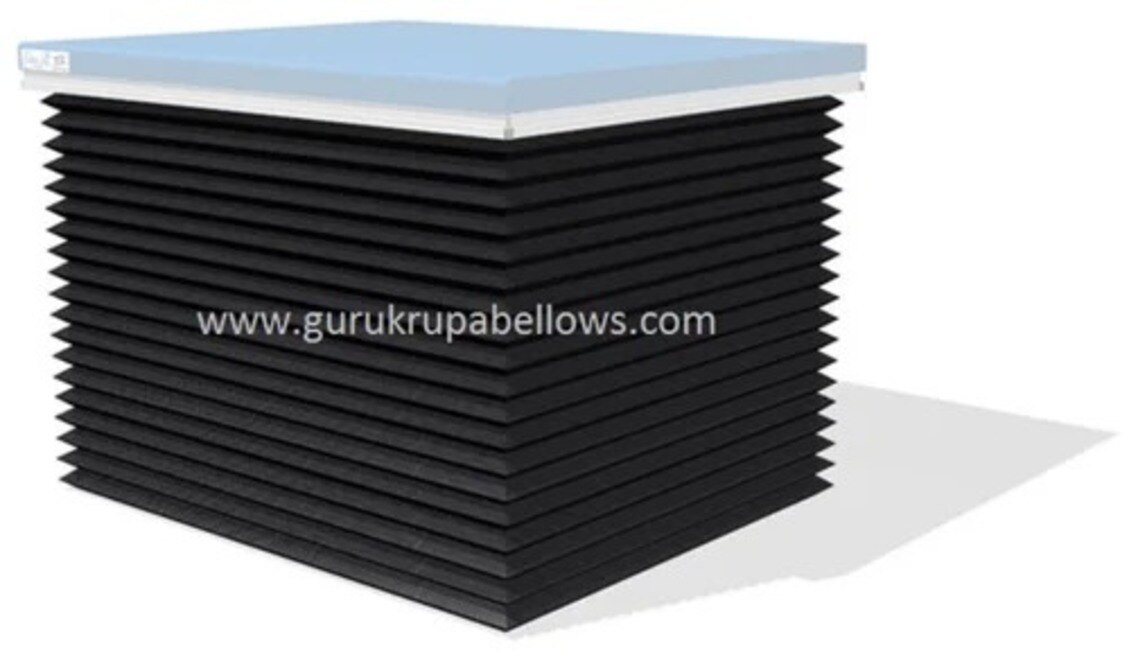
A scissor mechanism changes height, angle, clearance, and pinch points throughout every cycle, so a cover sized from stroke alone can fail quickly. By the end, you will know which coverage type you need, which dimensions to place on a quotation drawing, how to inspect the full travel, and what evidence to request from a Berlin supplier.
Key takeaways
- Define the complete protected area before selecting a bellow cover.
- Show closed height, extended height, mounting faces, and motion clearances on the drawing.
- Set a safety boundary around pinch points and the full travel envelope.
- Specify materials, cover type, inspection points, and acceptance tests in the RFQ.
Choose the coverage area before choosing the cover
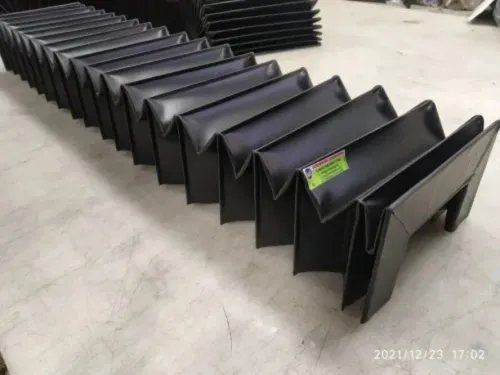
Choose the protected area before choosing the bellow: the cover must follow the complete motion envelope, not merely match the hydraulic stroke. As the lift opens, accordion folds extend between the mounting faces; as it closes, those folds compress into a defined stack.
Fold geometry, mounting overlap, end frames, and compression limits determine the finished length.
| Option | Coverage | When it applies |
|---|---|---|
| Cylinder bellow | Surrounds the cylinder barrel and rod, shielding seals from chips, dust, and fluid spray | Use when the cylinder needs local protection; it does not close gaps around scissor arms |
| Full lift-table skirt | Attaches around the platform or base and covers the moving assembly perimeter | Use when chips, hands, or loose material can reach the mechanism from several directions |
| Both | Combines cylinder protection with perimeter coverage | Use when the hydraulic cylinder and the wider scissor mechanism face separate exposure paths |
Scissor lift bellows for machines follow a lifting mechanism; machine tool bellow covers usually protect guideways, ballscrews, or slides. Do not substitute one for the other.
For scissor lift bellow covers in Berlin, state the protected assembly on the RFQ, including mounting faces, travel direction, loading, and whether the requirement is a cylinder enclosure, a full skirt, or both.
Measure the lift and build a quotation drawing
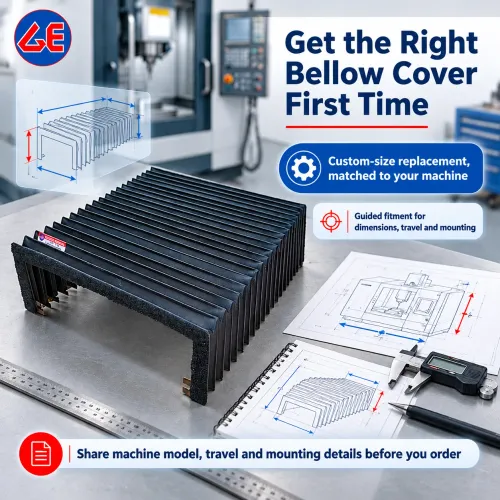
Measure the lift at both end positions, then turn those measurements into a controlled quotation drawing for scissor lift bellow covers for machine tools in Berlin. Do not give a supplier only the overall width and hydraulic stroke.
1. Record collapsed height, extended height, cylinder outside diameter, rod diameter, cylinder stroke, and clearance around the cylinder at minimum and maximum height. Add a tolerance to every height, diameter, and clearance.
2. Measure each mounting face’s length and width, corner radii, bolt-hole pattern, hole positions, and plan dimensions at both heights. State the attachment method: clamping strip, frame, bolted flange, or another arrangement.
3. Photograph the lift fully lowered and fully raised with a scale visible. Mark the scissor-arm sweep, diagonal movement, arm crossover, service-access zones, and every area where the cover must clear the platform or base.
4. Specify fold count, fold pitch, fold height, open length, closed length, minimum bend radius, maximum compression allowance, mounting overlap, and allowable lateral offset. Put tolerances on width, hole position, fold dimensions, and lateral offset.
5. Do not calculate finished cover length by subtracting collapsed height from extended height. Fold geometry, end frames, mounting overlap, lateral movement, and compression limits change the result.
Ask the supplier to return an approved dimensional drawing before fabrication. The drawing must show the mounting orientation and replacement access, not merely a price based on width and stroke.
Inspect the complete motion envelope and define the safety boundary
Define the safety boundary separately from contamination protection: a bellow is not automatically a personnel guard, load-bearing member, or machine-safety control. Unlike many machine tool bellow covers, a scissor skirt follows changing gaps and angles, so a static fit at the top and bottom proves very little.
1. Run the lift slowly through its complete travel. Observe the cover from both sides and from below where access is permitted, checking minimum height, maximum height, diagonal movement, arm crossover, end-of-stroke conditions, and lateral deflection.
2. Watch for pinching, rubbing, fold inversion, scissor-arm interference, loose fasteners, contact with hydraulic fittings, blocked grease points, and restricted emergency access. Stop if the cover becomes trapped or changes the lift’s movement.
3. Repeat the inspection over several cycles, then examine the moving end. Repeated extension and compression reveal failures that a single static check will miss.
4. Attach the cover with a purpose-designed clamp, frame, or bolted flange that distributes edge loads along the fabric. Unsupported punched holes and point fasteners concentrate stress and start tears.
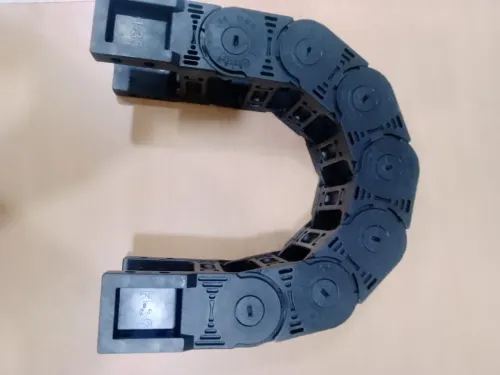
5. Route power, encoder, pneumatic, and coolant lines through separately rated energy chains, hose carriers, or guided service loops. A folding cover cannot replace cable management.
If the cover blocks access to crushing or shearing points, assess guarding, clearances, stopping performance, and access control separately. Verify the current edition and scope of EN ISO 12100, EN 1570-1, and EN ISO 13849-1 when the machine risk assessment and conformity documentation require them.
Match materials and cover types to the workshop hazard
Choose the fabric from the workshop hazard, not from a generic “heavy-duty” label. Record:
- Abrasive chip size and chip temperature
- Coolant type and concentration
- Hydraulic oil exposure
- Welding sparks or spatter
- Ultraviolet exposure
- Cleaning chemicals and cleaning frequency
- Wash-down pressure
- Cold-start temperature
- Whether chips fall vertically into folds or are driven laterally into them
PVC-coated material can suit some skirt applications, but confirm compatibility with the actual coolant, heat, abrasion, and cleaning regime. A coating name alone proves nothing. Hot chips or welding spatter may require heat-resistant coated fabric, a laminate, a sacrificial layer, or a separate chip deflector.
| Protection method | Strength | Limitation |
|---|---|---|
| Folding bellows | Compact, guided protection for cylinders and moving slides | Folds trap chips and can fail through fatigue, delamination, stitching damage, or rubbing |
| Full scissor-lift skirt | Covers the wider perimeter of a changing mechanism | Needs strong edge attachment and room to fold |
| Telescopic steel cover | Resists hot, sharp swarf on rigid slides | Heavy, costly, and unsuitable for many angular movements |
| Brush seal | Manages light debris and small gaps | Does not enclose a moving mechanism |
| Rigid guard | Creates a strong physical barrier | Requires hinges, access panels, and full-motion clearance |
For scissor lift bellows for machines, inspect the cover during diagonal travel and lateral deflection, not only at the end positions. Choose a cylinder bellow for local hydraulic protection; choose a full skirt for perimeter coverage, or both when each hazard exists.
Turn the RFQ into an acceptance specification
Make the RFQ an acceptance specification, not a request for a “heavy-duty” skirt.
Send the scissor lift skirt supplier in Berlin the existing skirt or a marked drawing, then request an acceptance drawing showing open and closed length, fold height and count, minimum bend radius, maximum compression, mounting orientation, lateral-offset limit, tolerances, attachment hardware, and replacement parts.
Include these operating inputs:
- Photos at minimum and maximum height
- Duty cycle, cycle rate, acceleration, failure history, contamination profile, and machine delivery date
- Temperature limits, chemical restrictions, and cleaning limits
- Whether testing included coolant, chips, repeated cycling, and the specified acceleration
- Inspection points and a replacement procedure that avoids dismantling the lift
Compare proposals against measurable evidence:
| Proposal item | Acceptance check | Reject when |
|---|---|---|
| Dimensional drawing | All motion and mounting limits are stated | It quotes from stroke alone |
| Life claim | Stroke, rate, acceleration, bend radius, temperature, chips, and coolant are identified | It gives cycles without test conditions |
| Serviceability | Inspection and replacement steps are supplied | Lift dismantling is required |
| Compliance documents | Applicable EU regime is identified for delivery and conformity-assessment date | A material declaration is presented as machine conformity |
GURUKRUPA BELLOWS PVT LTD belongs in the Berlin comparison only on these criteria, not colour. Regulation (EU) 2023/1230 applies from 20 January 2027 and replaces Directive 2006/42/EC subject to transitional provisions; the integrator remains responsible for the completed machine’s conformity assessment and technical file.
Related products
 | Bellow Cover ₹5000 Product Details: Brand GURUKRUPA Color Black-Blue Size Customised With the support of our excellent team workers, we have been delivering the best... View product → |
 | Product Details: Brand GURUKRUPA Color Black-Blue Size Customised With support of our excellent team workers, we have been delivering the best... View product → |
Frequently asked questions
How do you choose the coverage area for a scissor lift bellow?
Map the complete motion envelope and define the protected area before selecting the cover or skirt.
What measurements belong on a scissor lift bellow quotation drawing?
Include the lift’s closed and extended heights, mounting faces, available width and depth, compressed stack, and travel clearances.
Why inspect the complete motion envelope before ordering machine tool bellow covers?
The inspection identifies pinch points, interference risks, exposed gaps, and the safety boundary throughout the lift’s movement.
How should you match materials and cover types to workshop hazards?
Choose the construction after identifying dust, chips, coolant, heat, sparks, corrosion, and the required flexing frequency.
What should an RFQ for scissor lift bellows specify?
State dimensions, travel, mounting method, material, cover type, operating hazards, inspection access, testing, and acceptance criteria.
Related product
 | Scissor Lift Skirt Product Details: Brand GE Color Black,Blue Material PVC Coated Size Anyany Gurukrupa specializes in providing Scissor Lift Skirt for both standard... View product → |