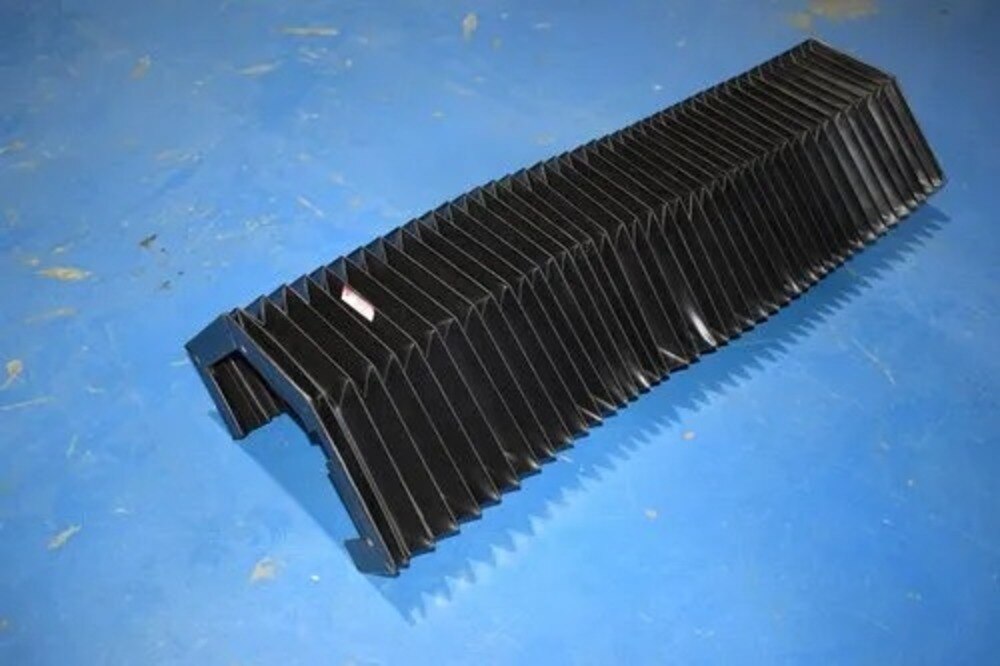
A nominal width or fold count does not prove that an accordion bellow cover will fit, survive the machine’s motion, or resist its coolant, chips, heat, and cleaning process. By the end, you will have a receiving checklist, a specification request, and an approval process for both catalogue parts and custom orders.
Key takeaways
- Identify the axis, travel direction, and component requiring protection.
- Request compressed length, extended length, travel speed, and cycle details.
- Match fabric, construction, and test evidence to the actual machine hazard.
- Approve mounting, clearance, access, and maintenance requirements before release.
Start with the machine, axis, and protected component
Application data is the real starting point for accordion bellow covers for distributors: a nominal width cannot show whether the folded pack clears the machine or protects the right part. Identify the axis and movement before comparing fabrics, frames, or prices.
- Name the machine tool, axis, and protected component: guideway, ball screw, linear motor, cable carrier, hose, or another moving part.
- Record the axis orientation and cover position—horizontal, vertical, inverted, stationary, telescoping, or moving with the axis. Gravity changes sag, drainage, and support needs.
- State usable stroke, end positions, and available installation envelope, including height and width limits, nearby guards, tool changers, and service panels.
- Provide the opening dimensions and mounting geometry: end-frame drawing, flange thickness, bolt pattern, hole tolerances, corner radii, and clamp or hook-and-loop clearance.
- Describe the operating cycle and hazard: travel speed, acceleration, cycle frequency, chips, coolant direction, heat sources, cleaning method, and whether people could reach the moving mechanism.
Treat accordion bellow covers as protection from contamination, not automatically as a complete safety guard. For exposed moving parts, the risk assessment under ISO 12100 must determine whether openings, attachment, construction, and resistance to removal satisfy the guarding principles in ISO 14120.
Ask for these facts before requesting like-for-like quotations; two accordion bellow covers can share a catalogue width yet fit different machines.
Request the figures that determine travel and movement
Request a dimensional drawing and motion data, not a nominal cover size. Accordion bellow cover specifications must show how much space the folded pack occupies, how far it travels, and how the mounting points align at both ends of the axis.
Ask for these figures:
- Usable stroke, fully compressed length, and fully extended length
- Fold height or pitch, overall width, and overall height
- Opening dimensions, mounting-frame dimensions, bolt spacing, and attachment orientation
- Travel speed, acceleration, and cycle frequency
- Minimum bend radius and total moving mass
- Horizontal span, guide-frame dimensions, and support points where sag or lateral movement is possible
Compare the figures against the installation envelope rather than the catalogue label.
| Figure | What to compare | Failure if missing |
|---|---|---|
| Usable stroke | Required axis travel plus end clearances | The cover reaches its limit before the machine does |
| Compressed length | Folded pack space at minimum travel | Folds strike a housing, chuck, or adjacent cover |
| Extended length | Available length at maximum travel | The cover stretches, pulls on mounts, or leaves the guideway exposed |
| Fold height and pitch | Fold geometry against nearby obstructions | Folds collide, invert, or rub during movement |
| Opening and mounting geometry | Guideway width, bolt pattern, and frame position | A correct-length cover cannot be installed squarely |
| Speed, acceleration, and cycle frequency | Actual motion profile, not speed alone | Rapid starts cause whipping, fold collision, and premature wear |
| Width, height, bend radius, and mass | Clearance, guidance, and drive capacity | The pack sags, binds, or overloads the moving axis |
Match construction and test evidence to the actual hazard
A cover marked “oil resistant” has not proved compatibility. Match the construction and test evidence to the exact coolant, lubricant, detergent, chip load, temperature, and exposure duration in your customer’s process.
- Material and construction: compare coated fabric, thermoplastic, elastomer, aramid-reinforced fabric, and stainless-steel lamella against the hazard. Ask whether folds are sewn or bonded, and inspect seam strength, adhesive compatibility, thread type, wipers, and frame materials.
- Fluids and cleaning: request immersion or repeated-exposure results for the named fluid, concentration, temperature, and cleaning cycle. High-pressure coolant and aggressive detergents can attack seams or drive contamination behind folds even when splash resistance passes.
- Temperature: obtain continuous and peak limits, low-temperature rating, heat-source distance, and the rating for the complete assembly. The adhesive, thread, frame, and wipers can fail before the fabric. Record the actual values in the accordion bellow cover specifications.
- Fire performance: demand the flame-spread or self-extinguishing test report for the finished construction, not only a fabric certificate. If moving parts remain exposed, complete the guarding assessment under ISO 12100 and ISO 14120; an accordion bellow cover is not automatically a safety guard.
- Chips and particles: match fold protection to chip size, sharpness, temperature, impact speed, and cleaning method. Stainless lamella can suit hot, sharp chips where fabric folds would cut; confirm attachment and overlap under actual travel.
For cleanrooms, request particle-generation, cleaning, and outgassing data for the finished cover. ISO 14644 classification alone does not approve its material or seam design.
Verify fit, mounting, guidance, and maintenance access
Before acceptance, install the accordion bellow covers on the actual machine or a full-scale fixture and move the axis through its complete stroke. A nominal width can still leave the folded pack rubbing the guideway, striking a stop, or sagging into the protected component.
- Check the reference position, datums, extended length, compressed length, fold height, opening size, and available envelope against the approved drawing.
- Inspect clearance at both travel limits and during acceleration; look for fold contact, pinching, twisting, uneven compression, and lateral drift.
- For horizontal covers, verify the specified guide frame, sliding shoes, rollers, internal supports, or supported-bellows arrangement carries the span without sag.
- Match the end-frame drawing to the machine: confirm bolt pattern, hole tolerances, flange thickness, corner radii, and clearance for clamps or hook-and-loop attachment.
- Confirm that fasteners or attachment strips seat evenly without distorting the frame, and that the mounting remains tight after repeated cycles.
- Check the seal at each end and along adjoining edges; gaps or lifted corners allow chips, coolant, and dust to reach the guideway.
Run representative cycles at production speed and acceleration, then inspect folds, seams, wipers, guides, and mounting points for fresh abrasion or leakage. Confirm that operators can reach the mounting hardware and clean the cover without forcing folds, scraping coated fabric, directing fluid into seams, or removing supports.
Record the cleaning method and inspection interval with the receiving documents.
Approve catalogue parts and custom designs before release
Do not release a catalogue part or custom accordion bellows on nominal dimensions alone. Require a controlled drawing, revision number, material and construction schedule, end-frame drawing, and inspection plan before placing the order.
1. Obtain the supplier’s approval drawing showing datums at both ends, stroke, compressed and extended lengths, width, height, fold pitch, mounting holes, flange thickness, corner radii, clearances, and tolerances. Record the machine axis, orientation, speed, acceleration, cycle rate, fluids, temperature range, and cleaning method on the purchase specification.
2. Require a representative sample or first-article unit, especially for custom designs. Inspect seam stiffness, fold memory, frame alignment, mass, fasteners, wipers, and interference at reversal points. A drawing will not reveal how the cover behaves under acceleration.
3. Run the sample through the actual stroke and installation envelope at operating speed and acceleration. Add coolant or oil exposure, the specified cleaning process, and the expected cycle count. Reject any rubbing, snagging, sag, delamination, leakage, mounting movement, or failure to reach either travel limit.
4. Sign an acceptance record with measurable limits for extended length, compressed length, mounting position, folded-pack clearance, hole location, and visible defects. Require material certificates, test reports for temperature, fire or fluid resistance, and particle generation or outgassing data for cleanroom use.
For exposed moving parts, treat the cover as a safety component only after the risk assessment addresses openings, attachment, and resistance to removal under ISO 12100 and ISO 14120. GURUKRUPA BELLOWS PVT LTD can be included on the approved-supplier list only after the same evidence passes your receiving checklist.
Related products
 | Accordion Bellow Cover Ours is a trustworthy name in the business that brings forth Accordion Bellow Cover that is used for delivering controlled pressurized air to a... View product → |
 | Soft Material Bellow Product Details: Brand GURUKRUPA Specifications:- Function of accordion machine shield: water-proof,oil-proof, anti-corrosion, fire-proof... View product → |
Frequently asked questions
What application information should distributors collect first?
Record the machine, axis, movement direction, and protected component before comparing accordion bellow covers or prices.
Which figures determine whether an accordion bellow cover will fit?
Request the required travel, compressed and extended lengths, available installation space, movement speed, cycle frequency, and clearance around the folded pack.
How should distributors compare construction and test evidence?
Match the cover material, frame construction, and documented test evidence to the actual exposure, including chips, dust, heat, coolant, corrosion, fire risk, or mechanical wear.
What fit and maintenance checks are needed before approval?
Check mounting points, guidance, folded-pack clearance, moving-part interference, access for cleaning and inspection, and the effect of maintenance on removal or replacement.
When should a distributor request custom accordion bellows?
Request custom accordion bellows when a catalogue part cannot meet the required travel, dimensions, mounting arrangement, clearances, movement, or hazard protection.