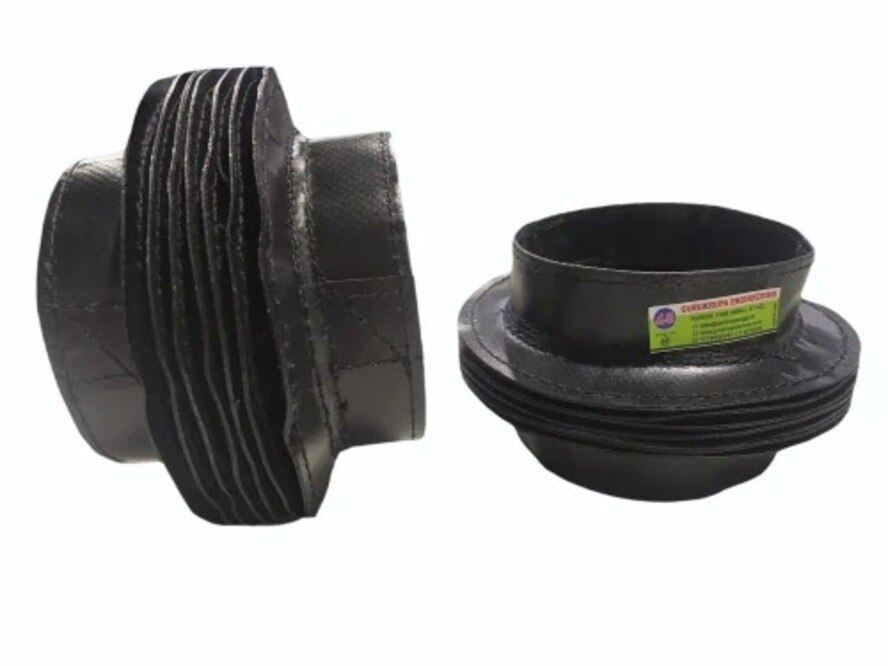
A nominal outside diameter cannot tell you whether a cylindrical bellows will clear a shaft, survive its motion, or fit the machine’s mounting faces. By the end, you will have the measurements, operating conditions, material evidence, drawing details, and acceptance checks needed to compare suppliers and request a workable design.
Key takeaways
- Measure compressed length, extended length, stroke, fold height and installed clearance.
- Specify shaft speed, travel rate, temperature, fluids, chips, sparks and cleaning chemicals.
- Define end attachments, seals, inspection access and acceptance tests before ordering.
- Send drawings, motion data, operating conditions and service-life expectations to the supplier.
What exactly must the cylindrical bellows protect?
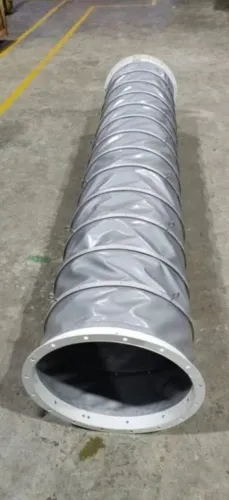
Define the application before requesting a price: a cylindrical bellow cover is a flexible enclosure for a round shaft, rod, spindle, guide, or fixed cylindrical component. “Round,” “accordion,” and “concertina” describe geometry or folding style, not a complete specification.
Fabric and rubber bellows behave differently. Fabric versions use coated textile layers, offer low weight and flexible folding, and suit selected chemicals and temperatures; they usually attach with sewn cuffs, bands, or clamps.
Rubber versions use elastomeric walls, provide greater elasticity and sealing, and require chemical and temperature checks for the specific compound; bonded, vulcanized, or clamped collars are common.
- State whether the cover travels and compresses with a moving rod, or encloses a stationary component. A fixed enclosure needs fixed collars and an access method.
- Record the protected shaft or guide diameter, minimum inside diameter, maximum outside diameter, collapsed length, extended length, usable stroke, travel direction, mounting diameter, wall clearance, and both end-flange dimensions.
- Mark every value as a nominal manufactured dimension or a maximum envelope. A supplier needs more than nominal outside diameter because maximum eccentricity, shaft runout, lateral movement, angular misalignment, nearby clamps, fittings, sensors, and machine structures determine whether the cover rubs or binds.
- Include fold pitch or fold count and use the phrase cylindrical bellow covers for specifications when requesting drawings or quotations. These cylindrical bellow covers need the full machine envelope, not a diameter alone.
How do you verify stroke, folds, and clearance before ordering?
1. Estimate the convolution count by dividing the available stroke by the manufacturer’s minimum permissible fold height. For a 120 mm stroke and a 15 mm minimum fold height, the first estimate is 8 convolutions.
Treat this only as a starting point: fold pitch, fabric or elastomer thickness, seam construction, end reinforcement, compressed length, compression stops, collars, and attachment zones determine the usable stroke. Travel is not simply fold count multiplied by fold height.
2. Require a dimensioned drawing or request form showing fixed and moving datums, collapsed and extended positions, tolerances, flange thickness, mounting-hole pattern, bolt-circle or clamp dimensions, allowable compression, and maximum outside envelope. Ask for a section view that identifies the minimum inside diameter and clearance to the shaft.
State whether each dimension is nominal or a maximum envelope.
3. Use round bellow cover specifications to separate theoretical geometric stroke from the usable stroke guaranteed by the design. Check the complete motion envelope at both stroke limits and during reversals, including clearance from the rod, spindle, chuck, fittings, sensors, clamps, guideways, chip conveyors, and nearby covers.
4. Check horizontal, vertical, and inverted orientations. Unsupported length can sag, rub, or buckle even when the static dimensions fit. Include shaft runout, eccentricity, lateral movement, and angular misalignment in the drawing; a concentric fit at rest does not prove clearance during motion.
What motion and environment must the material withstand?
Specify the operating profile before choosing material: a stroke figure cannot predict whether cylindrical bellow covers will survive. Record maximum and average speed, acceleration, deceleration, cycle frequency, dwell time, direction reversals, orientation, unsupported length, and target cycle life.
1. Match construction to the real contamination and cleaning process. Identify water-based coolant, neat cutting oil, hydraulic oil, chlorinated or alkaline cleaner, abrasive dust, sharp chips, hot swarf, welding sparks, ultraviolet light, ozone, steam, and washdown pressure. State chip size, shape, temperature, coolant direction, and whether folds must shed chips.
2. Request the complete material stack-up, not just a fabric name. Confirm the base fabric, coating, elastomer, thread, seam treatment, and external spark protection.
PVC-coated polyester suits general coolant and abrasion service; polyurethane-coated fabric offers higher abrasion resistance; neoprene-coated fabric addresses oil, ozone, and flame behaviour; silicone-coated glass fabric handles high heat; PTFE-coated glass fabric suits aggressive chemicals and elevated heat.
3. Put three temperatures on the specification: continuous operating temperature, short-duration peak temperature, and temperatures at seams, collars, adhesives, and adjacent metalwork. A base-fabric rating does not cover the finished joint. Request chemical-compatibility data, flame classification where relevant, abrasion evidence, and the stated service-life basis.
4. Do not equate liquid resistance with dust-tightness, pressure rating, or vacuum rating. For high acceleration, frequent reversals, hot chips, abrasive contamination, or tight compression, require a prototype or witnessed cycle test covering interference, fold collapse, mounting retention, washdown or leakage, and post-test seam and coating damage.
How will the cover attach, seal, and prove its performance?
Choose the end attachment with the cover design, because a poor interface can pull off, leak, or restrict the stroke even when the bellows body is suitable.
| Attachment | Installation and pull-off | Sealing and serviceability | Repeated-motion tolerance |
|---|---|---|---|
| Sewn cuff | Fast and light; limited pull-off resistance | Easy to replace; sealing depends on the interface | Good for flexible, low-load movement |
| Retaining band | Quick fitting; moderate retention | Serviceable; seal depends on band pressure | Good where small movement is expected |
| Clamp ring | Moderate fitting time; strong retention | Consistent seal with access for adjustment | Good if clamp access remains clear |
| Bolted flange | Slowest installation; high retention | Best for defined sealing faces | Good when alignment and bolt loading are controlled |
| Hook-and-loop closure | Fastest access; lowest pull-off resistance | Convenient but poor for dust or liquid exclusion | Suits inspection access, not high-load motion |
| Bonded or vulcanized collar | Requires controlled manufacture; high retention | Best integrated seal | Strong choice for frequent motion, but difficult to replace |
Give the supplier the mounting face, bolt pattern, flange thickness, clamp access, and allowable attachment load. State whether you need coolant exclusion, dust-tightness, positive-pressure purging, vacuum resistance, or a defined leakage rate. Never assume a flexible bellows is airtight.
Agree on the test method before production. Specify a prototype or witnessed cycle test covering full-stroke interference, fold collapse, retention, washdown or leakage, and post-test seam, coating, and material damage. Include chip size and shape, chip temperature, coolant direction, and washdown pressure when shedding matters. For a guard, assess the complete arrangement under ISO 14120.
This creates an acceptance standard instead of “quality tested.”
What should a custom supplier request contain?
A complete RFQ for custom cylindrical bellows must convert machine data into a controlled dimensional, environmental, and validation package; a photograph or nominal diameter alone cannot produce a reliable design.
Attach a dimensioned drawing and photographs as supplementary evidence. Show:
- Fixed and moving attachment geometry, shaft and obstruction dimensions, datum points, tolerances, mounting-hole patterns, flange or collar details, and the complete machine envelope.
- Collapsed and extended positions, allowable compression, orientation, motion profile, maximum eccentricity, and every clearance at both stroke limits.
- Each medium and cleaning agent, continuous and peak temperatures, spark or UV exposure, target cycle life, and the required test or inspection record.
Ask every supplier to return these design values in writing:
| Return item | Required response | Confirm explicitly |
|---|---|---|
| Inside and outside dimensions | Proposed inside diameter and maximum outside envelope | Nominal or guaranteed maximum |
| Travel geometry | Compressed length, extended length, usable stroke, fold pitch or fold count | Compression limit and stroke basis |
| Construction | Material stack-up, seam construction, attachment method | Finished-joint temperature limits |
| Validation | Chemical evidence and service-life assumptions | Test or inspection record |
Do not accept “custom size” without this response. Usable stroke is not simply fold count multiplied by fold height because collars, seams, reinforcement, and interference consume travel. GURUKRUPA BELLOWS PVT LTD belongs in the comparison only after it answers the same dimensional, material, motion, and validation questions as competing specialists.
Related product
 | Round Bellow Covers ₹1000 To match with our reputation in the market, we are here to present an unparalleled assortment of Round Bellow Covers. View product → |
Frequently asked questions
What must cylindrical bellow covers protect?
Identify the protected shaft, rod, spindle, guide or fixed cylinder, then list the hazards: dust, chips, coolant, oil, heat, sparks, corrosion and impact. State which surfaces require protection and which must remain accessible.
How do you verify stroke, folds and clearance before ordering?
Record the minimum and maximum cover lengths, required stroke, outside diameter, compressed fold height, guide clearances and nearby interference points. Check the cover through the full motion, including misalignment and access for maintenance.
What motion and environment must the material withstand?
Provide axial travel, speed, acceleration, cycle frequency, bending or lateral movement, temperature range, fluids, abrasive particles, sparks and cleaning methods. Select the fabric, coating, reinforcement and fold design from those conditions.
How should a cylindrical bellow cover attach and prove performance?
Specify flange, clamp, collar or sewn-end attachment, sealing requirements, shaft interface, inspection access and replacement method. Agree on dimensional inspection, motion testing, leak or ingress checks and the acceptance criteria before production.
What should a custom supplier request contain?
Send a dimensioned drawing, compressed and extended lengths, diameter limits, stroke, fold count or fold height, motion profile, operating environment, attachment details, quantity, delivery requirements and expected service life.