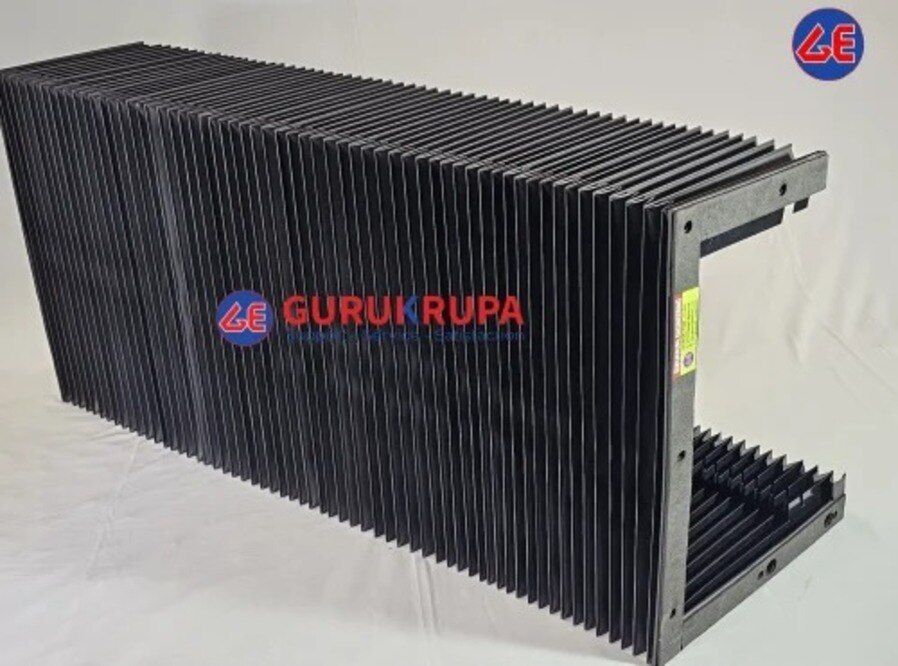
Choosing the wrong flexible textile component can cause premature fold wear, coolant leakage, fabric collapse, or a quotation that cannot be manufactured accurately. By the end, you will be able to identify the correct product type, record the dimensions and movements a supplier needs, compare material and seam options, and evaluate supply support beyond the initial price.
Key takeaways
- Choose the component by movement direction, speed and required flexing radius.
- Record compressed, extended and installed dimensions before requesting a quote.
- Specify temperature, chemicals, abrasion, fire exposure and seam requirements.
- Compare suppliers on construction drawings, installation support and replacement access.
Choose the Correct Flexible Component for the Movement
Choose the component by the movement it must absorb, not by the word “bellows” in a catalogue title.
| Type | What it does | When it applies |
|---|---|---|
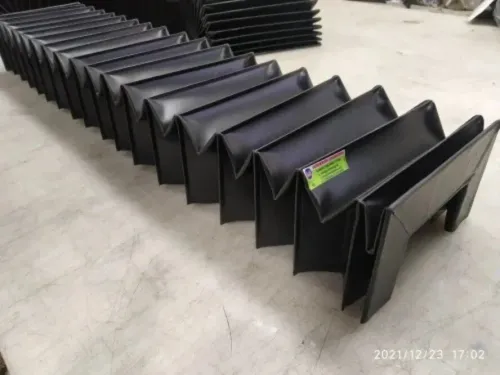
| Fabric bellow cover | Encloses a machine guideway, slide, spindle, or moving assembly against chips, coolant, dust, and operator contact. It follows guided compression, extension, or repeated high-speed reversal; it is not automatically pressure-rated. | Machine tools and linear equipment where contamination protection is the primary duty. |
| Fabric expansion bellow | Connects sections in a duct, exhaust, or thermal system while absorbing axial compression or extension, lateral movement, angular movement, vibration, thermal growth, or misalignment. | Flue gas, hot air, ventilation, and process systems. Specify pressure or vacuum, temperature, media, reinforcement, and flange design. |
| Industrial fabric joint | Acts as a flexible connector between rigid ducting, equipment, or piping. It needs enough slack for the stated movement without pulling tight. | Systems where the connection must tolerate vibration, movement, or alignment variation between fixed sections. |
Do not substitute one category for another. A machine cover built for coolant and chips can fail under hot gas or pressure, while a duct expansion bellow may not suit a fast reversing slide. Repeated acceleration and compression also generate heat and fatigue at cover creases.
Before requesting a quotation, state the movement cycle and whether the component faces contamination, thermal growth, pressure pulsation, vacuum, or torsion. For industrial fabric joints, prevent adjacent equipment weight from hanging on the fabric connector; unsupported load can tear seams even when the movement calculation is correct.
Record the Dimensions and Motion Before Requesting a Quote
A reliable quotation for fabric bellow covers needs the working geometry and motion cycle, not only the machine’s overall dimensions. Record compressed length, extended length, number of folds, fold height, internal and external dimensions, and minimum bend radius. Mark the fixed end, moving end, and reference direction of travel.
Provide these details in a drawing or site-measurement sheet:
- Stroke or total travel, including compression and extension limits
- Allowable lateral offset and angular movement at each end
- Mounting flange or frame dimensions, bolt-hole pattern, hole diameter, and fixing method
- Clearance from guideways, tooling, chips, coolant lines, and adjacent moving parts
- Travel speed, acceleration, reversal frequency, and cycles per hour
- Cable, hose, drain, inspection, or access openings and their locations
| Component | Movement and service | Quotation inputs |
|---|---|---|
| Machine-tool fabric bellow cover | Guided axial travel, lateral offset, angular movement, chips, coolant, or dust | Closed and extended length, fold pitch, stroke, clearance, speed, acceleration, and mounting pattern |
| Duct fabric expansion bellow or industrial fabric joint | Thermal growth, vibration, pressure pulsation, and misalignment | Operating temperature, pressure or vacuum, flange dimensions, axial and lateral movement, and angular deflection |
Send a dimensioned sketch, scaled photographs, or a sample component. Do not substitute machine-cover dimensions for a duct joint.
State the actual service. Repeated high-speed reversals can heat and fatigue fold creases even when the static size and chemical compatibility appear correct.
Calculate Movement, Pressure, and Clearance Requirements
Determine required travel from the equipment’s fixed points, not its overall size. For thermal growth, calculate ΔL = L × α × ΔT using the rigid-section length, material coefficient, and full temperature range. Add measured installation misalignment and vibration displacement; do not conceal either inside an arbitrary allowance.
- Axial compression or extension: compare the cold and operating positions, then specify the full stroke plus installation tolerance.
- Lateral offset: measure the parallel movement between connected points; do not treat it as axial travel.
- Angular movement: record the angle between flanges or machine sections and check that the resulting corner clearance remains open.
- Vibration: measure displacement, frequency, and acceleration at operating speed; continuous cycling can fatigue seams faster than slow thermal movement.
- Pressure pulsation: provide minimum, normal, and peak pressure, plus pulse frequency; repeated pressure reversals can loosen frames or split seams.
- Misalignment: measure offset and angular error before installation, because an industrial fabric joint pulled into alignment has no movement capacity left.
For a fabric expansion bellow, state internal pressure or vacuum, media, temperature, flange dimensions, and whether a flow sleeve or abrasion liner is needed. Leave enough slack for the specified movement; unsupported duct or equipment weight and torsion must not load the fabric.
For a machine-tool cover, verify compressed length, extended length, fold height, minimum bend radius, mounting-hole pattern, and travel clearance around guides, cables, and tooling. A cover intended for chips or coolant is not automatically suitable for pressure containment.
Match the Fabric, Coating, Seam, and Protection to the Service
A coolant-facing cover needs more than a compatible fabric: specify the coating, perimeter seal, and seam process. State whether performance means splash resistance, directed-spray resistance, or liquid-tight sealing. Repeated high-speed reversals also heat fold creases and accelerate fatigue, so the motion cycle belongs in the material decision.
| Service | Material and coating | Seam and protection |
|---|---|---|
| Coolant or oil | Oil- and coolant-resistant coated fabric | Welded, bonded, or clamped perimeter; verify the exact liquid and temperature |
| Chips | Abrasion-resistant fabric with a smooth, cleanable coating | Reinforced folds, wear strips, and guarded mounting edges |
| Welding sparks or hot chips | Heat-resistant fabric with documented spark and flame performance | Sacrificial outer layer or spark shield; request the test method, temperature, and exposure duration |
| High heat or exhaust gas | Rated textile, insulation, and reinforcement for the stated temperature | Expansion allowance, protected stitching, and heat-resistant flange hardware |
| Chemicals | Fabric and coating tested against the named chemical, concentration, and temperature | Sealed seams; do not rely on a generic “chemical resistant” label |
| Outdoor exposure | UV-, ozone-, and weather-resistant coating | Corrosion-resistant frames, sealed edges, and drainage where water can collect |
| Positive air pressure | Reinforced fabric, restraint, and pressure-rated attachment | Confirm pressure, pulsation, and safety factor; a cover is not automatically a pressure joint |
| Vacuum | Vacuum-rated reinforcement, support rings, or internal guides | Prevent collapse and fold rubbing; specify the vacuum level and duty cycle |
Ask for the proposed stitched, heat-welded, RF-welded, bonded, or mechanically clamped seam, plus evidence that the fabric bellow covers and joints supplier has tested the complete assembly—not just the fabric. A fire-retardant designation alone does not prove resistance to molten metal or flame impingement.
Compare Suppliers on Construction, Installation, and Lifecycle Support
Choose a bellow covers supplier on construction evidence and support, not distance or a catalogue photograph. A fabric bellow covers and joints supplier in Chhatrapati Sambhajinagar should confirm whether it builds machine-tool covers, fabric expansion bellows, or industrial fabric joints; these products are not interchangeable.
A duct joint pulled tight will fail when thermal movement arrives.
| Area | What to verify | Disqualifying gap |
|---|---|---|
| Construction | Request a drawing or sample showing fixed and moving ends, travel direction, closed and extended lengths, fold pitch, frames, seams, bolt holes, and cable or hose openings. Confirm the complete temperature limit, including thread, adhesive, retaining strips, stiffeners, and hardware. | The supplier quotes only fabric or coating ratings. |
| Installation | Ask whether technicians will measure the actual stroke, interference envelope, flange dimensions, and clearance. For a fabric joint, confirm slack, pressure direction, and independent support for adjoining duct or pipe. | Installation relies on nominal catalogue size, or equipment weight hangs from the connector. |
| Lifecycle | Obtain cleaning instructions, inspection points, repair method, replacement lead time, and a drawing revision for future orders. Require the exact fire test method and certificate; “fire-retardant” alone proves little against molten metal or flame impingement. | No traceable material record or replacement process. |
GURUKRUPA BELLOWS PVT LTD belongs in your comparison only after it documents the required fabric system, seam process, frames, mounting hardware, and local measurement, repair, and replacement capability. Compare those records with two alternatives before placing the order.
Frequently asked questions
How do you choose between fabric bellow covers, expansion bellows and industrial fabric joints?
Choose by the movement and service: use a cover for guideway or component protection, an expansion bellow for thermal or pressure movement, and a fabric joint for duct or equipment connections.
What dimensions should you provide to a bellow covers supplier?
Provide the installed length, compressed and extended lengths, opening dimensions, flange or mounting details, movement direction, stroke, speed, bend radius and available clearance.
What service conditions affect fabric bellow cover selection?
Specify operating temperature, chemicals, oil, coolant, dust, sparks, flame exposure, abrasion, cleaning method and the required cycle life before selecting the fabric, coating and seams.
How can you compare fabric bellow covers and joints suppliers?
Compare construction drawings, material and seam details, movement calculations, mounting hardware, installation instructions, inspection records, lead time and replacement support.