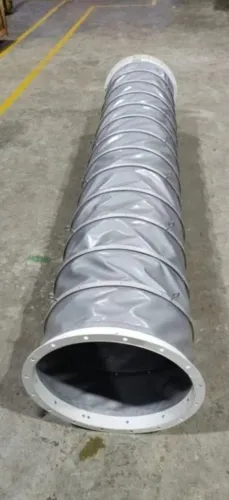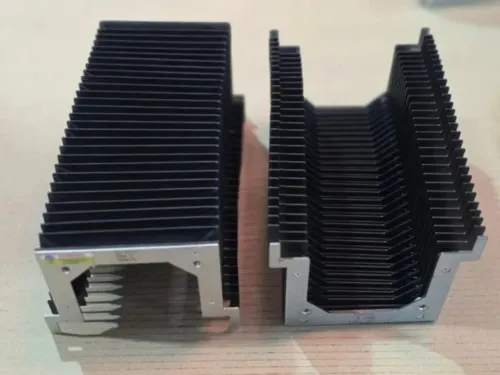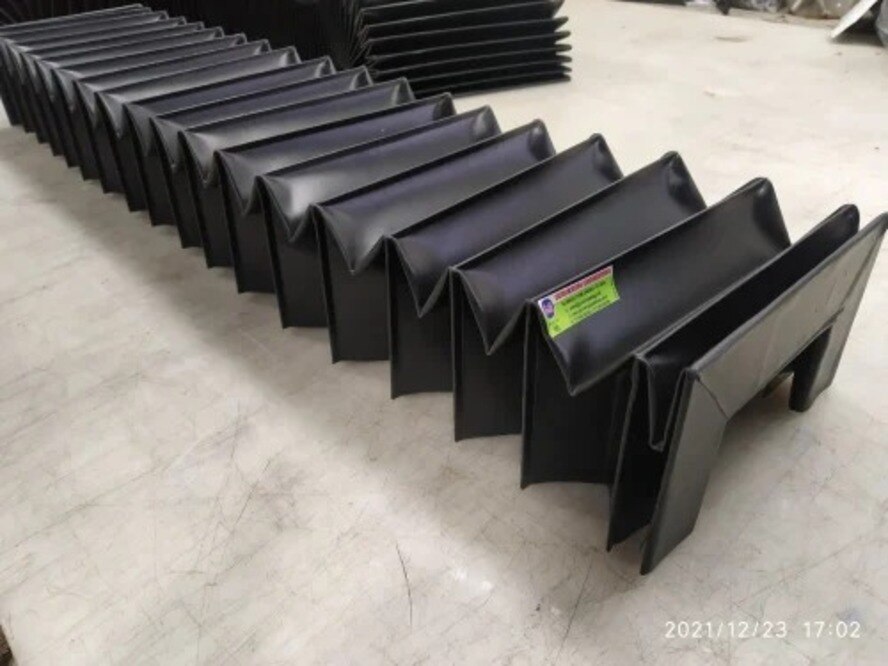
A humid monsoon room does not damage every laser machine bellow cover in the same way: condensation, rain, coolant splash, and standing water create different failure paths. By the end, you will know how to assess materials, folds, drainage, dimensions, supplier evidence, and maintenance controls before moisture reaches the machine’s moving parts.
Key takeaways
- Check dew point, not rain alone, when assessing condensation risk.
- Specify sealed fabric, corrosion-resistant hardware and drainage paths for monsoon service.
- Allow fold movement, compressed length and clearance before approving dimensions.
- Inspect damp bellows for trapped water, mould, corrosion and guideway contamination.
Why can humid air damage a bellows cover without direct rain?
Humid air can damage a bellows cover when its surface reaches the surrounding air’s dew-point temperature, even without rain. Relative humidity describes how much water vapour the air holds compared with its maximum at that temperature; dew point tells you when that vapour becomes liquid.
| Condition | What it means | Main risk |
|---|---|---|
| Relative humidity | Water vapour remains in the air | Moisture uptake during long exposure |
| Condensation | A guideway, bed, or bellows surface reaches or falls below dew point | Liquid water forms on or inside folds |
| Rain or coolant splash | Liquid strikes the cover directly | Local penetration through seams, joints, or gaps |
| Standing water | Water remains pooled on a fold or machine surface | Prolonged soaking, corrosion, and trapped contamination |
A room at 75% relative humidity can be harmless while surfaces stay warm, then become damaging after shutdown when a cold machine bed or guideway falls below dew point. Textile layers absorb moisture; swelling and softening follow, while mould grows in damp material and water collects in folded valleys.
Repeated humid-dry cycles stress fabric, coating, adhesive, stitching, end frames, and machine structure at different rates. That movement can open seams, loosen attachments, and distort the folding pattern.
Laser machine bellow covers for monsoon humidity in Chhatrapati Sambhajinagar need a moisture-control plan, not a generic waterproof claim. Laser bellow covers for humid conditions require:
- Drainage for a wet cover
- Sealing and washdown protection for a flooded or coolant-washed cover
- Drying before compressed storage
- Inspection beneath folds, at seams, fasteners, and mounting joints
A wet cover needs drying and inspection; a flooded cover also needs contamination removal and drainage verification.
Which material and construction details decide whether a cover suits monsoon service?
Choose the cover by its complete material system, not by the word “waterproof.” For laser bellow covers for humid conditions, request the base fabric, coating polymer, operating temperature range, flame behaviour, abrasion rating, mildew or fungal resistance, and compatibility with your coolant and cleaning chemicals.
| Option | What it means | Monsoon trade-off |
|---|---|---|
| PVC-coated polyester | Tough, economical coated fabric | Good abrasion resistance; check low-temperature flexibility, plasticiser loss, and chemical attack |
| Polyurethane-coated fabric | Flexible, light construction | Identify polyester- or polyether-based chemistry; demand hydrolysis data because heat and moisture can degrade polyester polyurethane |
| Silicone-coated fabric | Flexible, heat-resistant surface | Strong temperature performance; verify tear strength, seam bonding, and resistance to the actual coolant |
| Laminated technical textile | Multiple layers combined for a designed barrier | Performance depends on every layer and adhesive; require damp-heat adhesion and flexing evidence |
Use this buying checklist:
- Require hydrolysis-resistance data for the proposed polyurethane construction, including temperature, humidity, exposure duration, and post-test strength or adhesion. “Suitable for humid conditions” is not evidence.
- Specify sewn or bonded seams, compatible thread or adhesive, sealed stitch holes, coating adhesion after damp-heat exposure, and reinforcement at mounting points.
- Confirm resistance to coolant, detergent, degreaser, and disinfectant used on the machine; test the finished cover, not only a fabric sample.
- IEC 60068-2-30 cyclic damp-heat testing does not prove resistance to wind-driven rain, coolant spray, washdown, or pooled water.
- An IEC 60529 IP rating applies only to the tested complete enclosure and configuration, not automatically to replacement bellows fabric. This is essential humidity protection for laser machines.
How should you design the folds, drainage, and dimensions before ordering?
A reliable order starts with the axis closed and open, not with a fabric catalogue. Record these values on the machine drawing:
1. Measure compressed length, extended length, travel, and folded height. A cover that reaches full travel can still foul the laser head when compressed if its stack rises into the moving envelope.
2. Measure guideway width, mounting-face dimensions, side and top clearance, bend radius, and laser-head or nozzle clearance. Check rails, clamps, cable carriers, and nearby guards through the entire stroke; a nominal fit can rub a rail or demand excessive drive force at the tightest position.
3. Give the supplier stroke speed and acceleration, including rapid reversals. Wet contaminated folds become heavier and increase fold-to-fold friction, causing irregular stacking, vibration, abrasion, or excess axis force on a fast laser axis.
4. Design monsoon machine protection bellows with a deliberate slope, a defined drainage route, and open or serviceable low points. Horizontal folds and valleys retain water; closed pockets trap humid air and condensate. Keep the collapsed stack above standing water.
5. Detail wiper interfaces, end-frame joints, fastener holes, and moving gaps as entry paths. The main panel can shed water while these interfaces admit rain, coolant, or sludge.
6. Confirm the assembled cover in a full-motion mock-up, including compressed and extended positions. Inspect clearance, bend radius, drainage, and mounting strength before production; otherwise a dimensionally correct cover can bind, pond water, or damage the machine.
How does a damp bellows affect the machine beneath it, and what should you inspect?
A damp bellows can transfer moisture to guideways and linear rails, where corrosion often starts at exposed edges, damaged coating, or mounting points. Ball screws, racks, bearings, cable carriers, sensors, motors, and electrical connectors can then suffer from moisture, sludge, or rust.
Axis bellows support humidity protection for laser machines by blocking splash and debris; they do not control dew point inside the laser head, beam enclosure, chiller, or optics compartment.
1. Inspect during every monsoon service, looking beneath each fold and along the guideway, not only at the visible outer surface. A monsoon machine protection bellows can hide retained water against the rail and machine bed.
2. Record water or sludge, fungal growth, coating blistering, seam separation, damaged reinforcement, rust on fasteners, and any change in folding force or alignment. Compare the cover’s movement with its normal travel; added resistance signals wet contamination, swelling, or rubbing.
3. Check the protected mechanism after opening the cover. Look for corrosion on rail edges, ball-screw threads, rack teeth, bearing housings, cable-carrier links, sensor brackets, motor mounts, and electrical connector backshells.
4. Do not leave a wet bellows compressed around a cold axis when production allows drying first. Extend or position the cover so it drains, remove standing water, and dry the machine before a long idle period; trapped moisture otherwise remains against both textile and metal.
What evidence should a laser machine bellows supplier provide before you approve the cover?
Approve the cover only against a written acceptance specification. A catalogue label such as “waterproof,” “corrosion-resistant,” or “fire-proof” does not identify test conditions or performance of the assembled cover.
1. Record the proposed base fabric, coating polymer, hydrolysis and mildew data, operating temperature range, abrasion resistance, and flame-behaviour test method. Ask whether each claim means water resistance or waterproofing.
2. Identify the actual coolant and cleaner used on your laser machine. Require chemical-resistance results for those products, including exposure time and temperature, rather than a generic compatibility statement.
3. Specify sewn or bonded seams, seam-sealing method, adhesive chemistry, thread type, coating adhesion results after damp heat, reinforcement at mounting points, and fastener material or corrosion grade.
4. Require a completed-cover test, not only a fabric datasheet. After cyclic damp heat, flexing, coolant or cleaner exposure, and repeated extension cycles, inspect seam adhesion, coating cracks, water retention, fold alignment, and the force needed to move the cover.
5. Give every laser machine bellows supplier the same dimensional drawings, travel data, and acceptance questions. If comparing a laser machine bellows supplier in Chhatrapati Sambhajinagar, give GURUKRUPA BELLOWS PVT LTD the identical pack.
For laser machine bellow covers for monsoon humidity in Chhatrapati Sambhajinagar, the useful comparison is documented performance of the complete assembly, not a catalogue claim about fabric alone.
Related product
 | Laser Machine Bellows ₹1000 We are committed to manufacture, export, and supply a qualitative range of Laser Machine Bellows for our esteemed clients. View product → |
Frequently asked questions
Why can humid air damage a bellows cover without direct rain?
Condensation forms when the cover surface reaches the surrounding air’s dew-point temperature. Moisture can then remain trapped in folds, seams and low points.
Which material and construction details suit monsoon service?
Compare coated fabric, seam sealing, fold construction, fasteners and resistance to water, coolant, oil, heat and abrasion. The correct specification depends on the machine environment.
How should you design the folds, drainage and dimensions before ordering?
Measure the travel, extended and compressed lengths, folded height, mounting points and nearby clearances. Add drainage paths that prevent water from pooling in the folds.
How does a damp bellows affect the machine beneath it?
Trapped moisture can carry contamination to guideways, promote corrosion, degrade seams and interfere with smooth movement. Inspect the cover, guideways, wipers, fasteners and drainage points.
What evidence should a laser machine bellows supplier provide?
Request material specifications, operating temperature and chemical-resistance data, dimensional drawings, movement-cycle information, seam and mounting details, and inspection records for the supplied cover.