A cover that looks closed at rest can still leave a cylinder rod, hose fitting, pivot, or pinch point exposed when the lift moves. By the end, you will be able to define the protection boundary, identify excluded hazards, compare meaningful specifications, and request a cover that survives the complete motion cycle.
Key takeaways
- Identify whether the cover encloses the rod, barrel, assembly, or a defined section.
- Treat hoses, fittings and hydraulic connections as separate protection unless included in the drawing.
- State heat, contamination, travel, compression and mounting requirements in the specification.
- Disclose sparks, flames, chemicals and side loads before requesting custom bellow covers.
Which Scissor-Lift Parts the Cover Actually Encloses
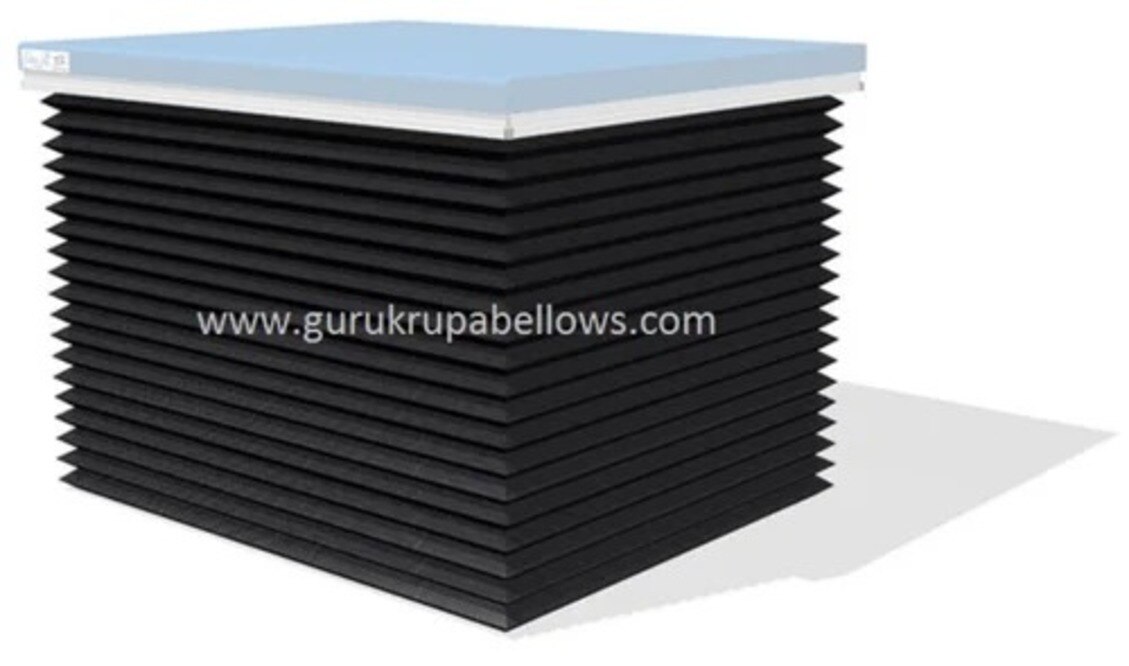
Do not assume a scissor-lift bellow covers the whole hydraulic cylinder. The drawing must identify whether it surrounds the exposed piston rod, the cylinder barrel, the rod-and-barrel assembly, or only a defined section; a hydraulic hose connection needs separate enclosure unless the design explicitly includes it.
| Component | Enclosed when | Outside the boundary unless specified |
|---|---|---|
| Exposed piston rod | End frames travel with the rod and maintain clearance through the stroke | Rod seal, barrel, or hose connection |
| Cylinder barrel | The bellow spans the barrel’s full protected length | Rod, fittings, and mounting clevis |
| Hose connection | A dedicated pocket or shield surrounds the connection without bending the hose | Hose length, fittings, and leak path |
| Complete cylinder assembly | The design encloses rod, barrel, ports, and attachment clearances | Nearby pivots, guides, and moving members |
Mark the fixed attachment plane on the frame and the moving attachment plane on the platform or cylinder. Draw the protected boundary with the platform fully raised, fully lowered, and stopped halfway; then check clearance during the entire motion, not just at those three positions.
A fabric bellow is flexible contamination protection, not a structural member or automatic personnel guard. The arms, platform, cylinder, pivots, and mechanical stops must carry operating loads. Unless the complete installation has been designed and validated as a guard, do not rely on it to block shear, pinch, crush, or entanglement access.
Leave hoses, fittings, pivots, guides, screw mechanisms, and adjacent moving parts outside unless the design encloses them. Provide removal or inspection openings for lubrication, cleaning, leaking fittings, loose fasteners, and damaged hydraulic components.
The Contamination and Heat Hazards a Bellow Can Resist—and Those It Cannot
A standard dust bellow is intended for ordinary shop contamination: metal chips, swarf, abrasive dust, paint overspray, oil mist, and limited welding spatter. It can reduce contamination-related wear on cylinders, guides, pivots, and lift arms, but it does not make cleaning, lubrication, or inspection unnecessary.
Check the cover against these hazards before specifying it:
- Hydraulic-oil spray, wash-down water, or cleaning chemicals require verified fluid compatibility and liquid-containment design.
- Continuous immersion and high-pressure water jets exceed ordinary dust-bellow protection.
- Sharp chips and external rubbing can puncture fabric, abrade coatings, or tear mounting edges.
- Unverified ultraviolet exposure can degrade the fabric or coating.
- Welding sparks, hot chips, and grinding debris can burn pinholes or damage seams.
- Direct flame and sustained radiant heat require a different protection strategy, such as a sacrificial shield, spark-resistant textile, metal cover, or combination system.
Heat-resistant or flame-retardant material reduces ignition and damage risk; it does not make the assembly fireproof. Stitched seams, pleat corners, mounting interfaces, and folded sections can admit fluid unless the bellow is designed, tested, and drained for containment.
A closed-looking shape does not create an IP54 or IP65 rating. Either rating belongs to a defined assembly tested by a specified method, not to fabric pleats alone. Provide inspection access, because the cover can hide cracks, leaking fittings, corrosion, loose fasteners, and damaged hydraulic components.
What Scissor Lift Bellow Cover Specifications Need to State
A useful set of scissor lift bellow cover specifications names more than “industrial fabric.” It identifies the fabric or coating, operating temperature range, contact temperature, oil and coolant resistance, UV resistance, flame and spark resistance, abrasion resistance, and chemical compatibility.
It also states whether the cover suits a hydraulic cylinder, electric actuator, pneumatic cylinder, or one specified cylinder type only.
Seam construction changes both durability and fluid resistance:
| Seam type | Main consideration |
|---|---|
| Sewn | Specify thread type, stitch protection, and leakage limits |
| Bonded | Check adhesive compatibility with oil, coolant, heat, and cleaning chemicals |
| Welded | Check weld strength, coating damage, and flexibility |
| Vulcanized | Check elastomer compatibility, repair method, and temperature limits |
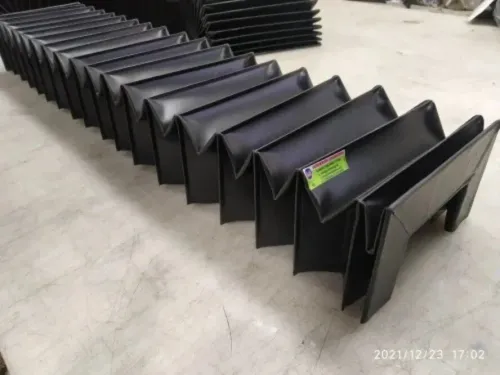
Also specify pleat reinforcement, end frames, flanges, and mounting-edge protection. The movement schedule must state lift orientation, extended and compressed or folded length, stroke, width and depth at both positions, lateral offset, bending radius, mounting clearance, maximum speed, acceleration, cycle rate, emergency-stop conditions, and allowable folded envelope.
Ask for these additional details:
- Cleaning method and permitted chemicals
- Expected service life and inspection access
- Failure limits for tearing, leakage, delamination, or loss of travel
- Compatibility with the named cylinder and its mounting arrangement
Flame-retardant material lowers ignition or damage risk; it does not support a fireproof claim without test evidence. A supplier that cannot state these limits has not provided complete scissor lift bellow cover specifications.
How Geometry and Pleat Design Prevent Binding and Early Failure
A cover can fit perfectly with the lift at rest and still bind during operation because the scissor mechanism changes angle, offset, and clearance throughout its stroke. Design the bellow around that moving geometry, not only its maximum and minimum height.
1. Provide a dimensioned drawing or three-dimensional motion envelope for custom scissor lift bellow covers. Show the fixed and moving attachment planes, arm angles, pivot locations, cylinders, hoses, mechanical stops, and clearance at every position.
2. Set pleat number and pitch against usable travel and folded height. Too little pleat capacity pulls the fabric taut before the lift reaches its end position; excess or unsupported material sags into the mechanism, traps chips, or rubs on an arm.
3. Run the lift at maximum speed and acceleration through unequal loading, side-to-side movement, and emergency stopping. Watch for twisted end frames, hose fouling, fabric trapped between members, and mounting loads transferred into the bellow instead of the arms, platform, cylinders, or stops.
Inspect the inner folds, not only the outer face. Check seams, coating delamination, punctures, and mounting interfaces; a hidden tear or loose edge can quickly become a binding fault. Make sure compressed material remains inside the allowable folded envelope throughout the cycle.
How to Request a Cover or Supply Quote Without Hiding the Risk
Start the request by naming the job type: replacement from an existing sample, drawing-based custom cover, or complete engineered installation. A sample alone can hide changed geometry; a complete installation requires review of attachment, clearance, inspection, and guarding needs.
1. Send a dimensioned drawing or three-dimensional motion-envelope file, not one photograph. Mark lift orientation, fixed and moving mounting points, extended and collapsed dimensions, stroke, width, depth, speed, acceleration, cycle frequency, allowable folded envelope, required inspection openings, and clearance from arms, pivots, hoses, cylinders, and stops.
2. Add the operating conditions: ambient and surface temperature, contaminants, cleaning method, expected service life, and mounting method. State whether the cover will face metal chips, abrasive dust, oil mist, hydraulic-oil spray, water, welding spatter, or cleaning chemicals.
3. Ask the supplier to identify the fabric, coating, temperature limits, fluid-compatibility evidence, seam and thread construction, pleat reinforcement, end-frame details, and fire-resistance documentation. Request a written statement of exclusions covering immersion, high-pressure washing, direct flame, sharp debris, rubbing, and unverified UV exposure.
4. For scissor lift bellow cover supply, require separate pricing for the fabric cover, metal shield, drainage arrangement, and safety guard. GURUKRUPA BELLOWS PVT LTD can support a local sourcing conversation for scissor lift bellow covers for details in chhatrapati sambhajinagar, but delivery location does not prove compatibility, guarding compliance, or service life.
Related products
 | Bellow Cover ₹5000 Product Details: Brand GURUKRUPA Color Black-Blue Size Customised With the support of our excellent team workers, we have been delivering the best... View product → |
 | Product Details: Brand GURUKRUPA Color Black-Blue Size Customised With support of our excellent team workers, we have been delivering the best... View product → |
Frequently asked questions
Which scissor-lift parts does a bellow cover enclose?
It can enclose the exposed piston rod, cylinder barrel, rod-and-barrel assembly, or a defined section. The drawing must identify the protected area.
Does a scissor lift bellow protect hydraulic hoses and connections?
Not automatically. Protect hoses, fittings and hydraulic connections separately unless the design explicitly includes them.
What hazards can a scissor lift bellow resist?
A suitable bellow can resist specified dust, debris, heat, corrosion and mechanical wear. Confirm the material and temperature limits for each hazard.
What should scissor lift bellow cover specifications state?
State coverage, extended and compressed lengths, diameter, travel, mounting method, material, temperature range, contamination exposure and required service life.
How does pleat geometry prevent binding and early failure?
Correct pleat depth, pitch, guiding and mounting clearance let the cover compress evenly without rubbing, buckling or trapping debris.