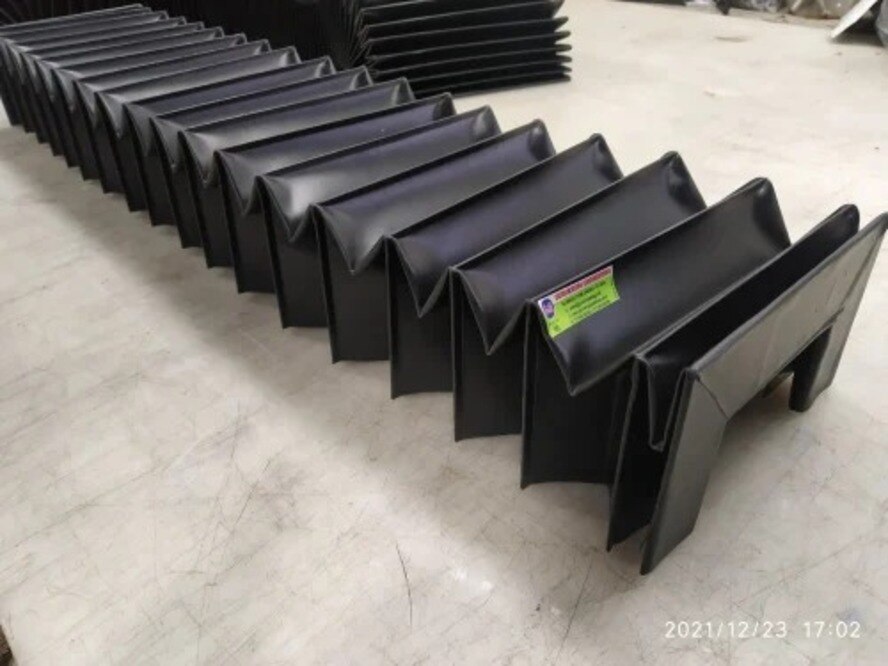
A laser bellow fits the protected travel envelope, not the machine’s advertised bed size or a label such as “all sizes.” By identifying the machine geometry, laser environment, travel dimensions, mounting details, and service clearances, you can compare standard, reinforced, and custom covers with a supplier’s drawing before ordering.
Key takeaways
- Match the cover to each axis, not only the machine model.
- Measure protected travel and parked length beyond the bed size.
- Specify heat, sparks, debris, and clearance limits before quoting.
- Send folded dimensions, mounting details, and operating conditions to suppliers.
Match the bellow to the laser machine and axis
Laser cutting machines usually need rectangular bellows over linear guideways, while tube lasers need a long-axis cover that clears the rotating chuck and support fixtures. Engraving and marking machines often use compact covers on X and Y axes; 3D laser systems require articulated, multi-axis protection with custom clearances.
| Machine type | Suitable bellow arrangement | Selection point |
|---|---|---|
| Laser cutting | Rectangular or reinforced linear bellows | Use heat- and spatter-resistant construction near the cutting head |
| Laser engraving | Compact X-Y bellows | Allow clearance for the moving head and cable chain |
| Laser marking | Short-travel, low-profile bellows | Check restricted mounting space and frequent head movement |
| Tube laser | Long travel-axis bellows, sometimes paired with chuck protection | Keep folds clear of the rotating tube, supports, and loading area |
| Fiber laser | Standard or reinforced bellows | State the 1.03–1.08 µm wavelength; mechanical protection is not automatically laser guarding |
| CO₂ laser | Heat-resistant or custom bellows | State the 10.6 µm wavelength and separate contamination protection from enclosure duties |
| 3D laser system | Fully custom multi-axis bellows | Specify inclined axes, changing angles, articulated joints, and collision clearance |
Use standard rectangular bellows only when travel, folded height, material resistance, and mounting interfaces match the machine drawing. High-spatter zones need reinforced construction; unusual travel or limited access needs a custom profile.
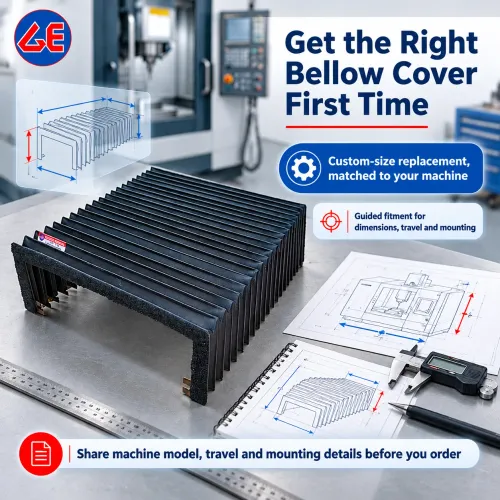
Send a dimensioned interface drawing or removed-cover sample. Include bolt spacing, flange or frame type, retaining strips, corner construction, replacement access, and whether the cover must come off without dismantling the guideway. These details matter when comparing laser cutting machine bellow cover options or laser machine bellow covers for different machines in Chhatrapati Sambhajinagar.
Choose by protected travel envelope, not bed size
A 1,500 mm bed does not define the bellow size. Two machines with that bed length can have different guideway spacing, carriage heights, travel directions, and mounting faces. Laser bellow covers by machine size must match the protected travel envelope: the space the cover occupies from fully compressed to fully extended.
Measure with the existing cover removed, then record:
- Minimum and maximum axis travel, including the full stroke in both directions.
- Guideway width and height, plus the protected opening or cross-section.
- Folded length, maximum extended length, folded height, and available installed height.
- Mounting-face width, flange or frame shape, bolt-hole spacing, and retaining-strip location.
- Clearance around the moving head, carriage, cable chain, hoses, brackets, and nearby hot or fixed parts.
- Access space for replacement, including whether the cover must come off without dismantling the guideway.
| Measurement | Record | Why it affects selection |
|---|---|---|
| Travel envelope | Compressed and extended lengths | Sets the bellows stroke and compression ratio |
| Protected cross-section | Width, height, and opening size | Prevents folds from rubbing guideways or the carriage |
| Interface geometry | Bolt pattern, flange shape, and mounting holes | Determines whether the cover can be fitted without adapters |
| Service clearance | Space above, below, and beside the cover | Allows movement, fold expansion, and removal |
Laser machine bellow covers selection should use these dimensional ranges, not labels such as small, medium, or large. Match the measurements against a dimensioned machine drawing or mounting profile; “size: ALL” is not a fit specification.
Compare shapes, folds, and construction methods
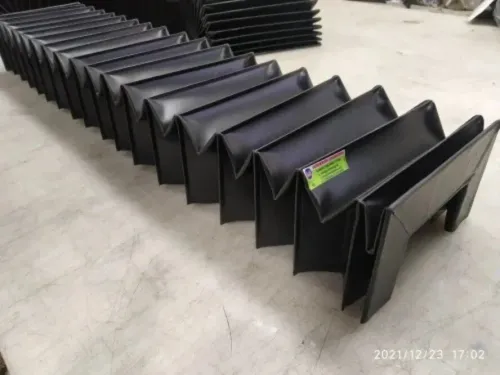
A rectangular bellows suits a straight guideway with predictable travel; an accordion profile suits an axis that must compress into a short space. Do not choose by appearance alone: folded height, extended length, fold pitch, and clearance at full travel determine whether the cover binds or collapses unevenly.
| Option | Construction and shape | Best fit and limitation |
|---|---|---|
| Standard rectangular | Repeated fabric-and-frame folds with flat mounting faces | Repeatable linear guideways and clean, enclosed axes; verify travel, folded height, and bolt pattern before ordering |
| Reinforced or heat-resistant | Protective outer layers, stronger corner construction, and heat-rated fabric | Cutting zones exposed to sparks, molten spatter, smoke, or abrasive dust; confirm temperature, flame, and spatter limits |
| Multi-axis or inclined | Segmented, guided, or angular folds built around changing movement | Inclined axes, unusual travel, and restricted mounting space; requires a dimensioned drawing |
| Fully custom | Sewn or welded bellows made to a sample profile or interface drawing | Irregular openings, tight carriage clearance, removable frames, and non-standard bolt patterns |
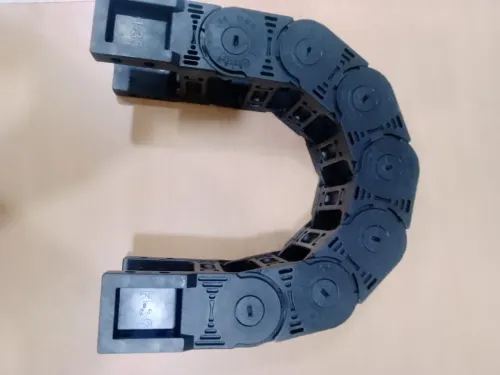
Laser cutting machine bellow cover options also depend on what moves beside the axis. Leave room for a separate cable carrier carrying fibre delivery, electrical cables, pneumatic lines, or assist-gas hoses; the bellows must not become their bend guide.
Specify custom laser machine bellow covers using the mounting-face geometry, retaining strips, corner details, replacement access, and whether removal requires guideway dismantling. Identify whether the cover provides contamination protection only; a fibre laser near 1.03–1.08 µm or a CO₂ laser near 10.6 µm requires a separately validated enclosure for laser safety.
Specify heat, sparks, contamination, and laser-safety limits
Effective laser machine bellow covers selection starts with the hazard at the cutting head, not the fabric name. Specify exposure to radiant heat, hot sparks, molten-metal spatter, smoke, abrasive dust, assist gas, and coolant.
A general-purpose PVC-coated fabric can fail under sustained heat or repeated hot-particle impact, so request stated temperature, flame, chemical, and spatter limits.
State these limits in the purchase specification:
- Maximum continuous and intermittent temperature at the cover surface
- Resistance to sparks, molten droplets, flame spread, smoke residue, and abrasive dust
- Compatibility with oxygen, nitrogen, compressed air, cutting oil, and coolant used by the machine
- Whether the cover protects guideways mechanically or forms part of a validated laser enclosure
- The laser wavelength: fibre systems commonly operate around 1.03–1.08 µm, while CO₂ systems commonly operate at 10.6 µm
“Laser-proof” does not by itself mean laser-safe. A safety enclosure requires evaluation of wavelength, optical density, exposure duration, beam geometry, seams, windows, and openings under IEC 60825-1. The complete guarding arrangement must also prevent accessible pinch, shear, entanglement, and hot-surface hazards; ISO 12100 supports the risk assessment and ISO 14120 covers guard requirements.
For unusual heat zones, inclined axes, or restricted mounting space, custom laser machine bellow covers let you define reinforced construction and safer interfaces. Ask the supplier to confirm the tested limits in writing, rather than accepting a material name as proof of protection.
Turn the measurements into a supplier-ready fit request
A quote request for laser machine bellow covers for different machines in Chhatrapati Sambhajinagar must describe the protected travel envelope, not just the laser brand or bed length.
State whether the cover serves a cutting, engraving, marking, tube, fibre, CO₂, or 3D laser axis, and identify the laser wavelength when the cover is near the beam path. Say whether it provides mechanical contamination protection only or forms part of a validated laser enclosure.
Send one dimensioned sketch, machine drawing, or clear photographs with these measurements:
- Guideway width and height, protected opening, and the carriage clearance on every side
- Minimum folded length, maximum extended length, required travel direction, and allowable installed height
- Mounting-face geometry, flange or frame type, bolt-hole spacing, retaining strips, and corner profile
- Clearance for cable chains, hoses, brackets, folds, and removal without dismantling the guideway
- Workshop temperature, humidity, dust, coolant, sparks or spatter, and the replacement-access requirement
- Existing cover photographs, material markings, and failure points if you are replacing one
Describe laser bellow covers by machine size as numerical ranges, including cross-section, travel, compression ratio, and mounting limits. “Size: all” is not a fit specification; two machines with the same bed length can need different covers. Use a standard rectangular option only after every interface matches.
Choose custom laser machine bellow covers for inclined axes, unusual travel, multi-axis movement, or restricted mounting space. GURUKRUPA BELLOWS PVT LTD can use the interface details to compare replacement access and service life, rather than quoting on initial price alone.
Related products
 | Laser Cutting Machine Bellows ₹1000 We offer Laser Cutting Machine Bellows made specifically for your laser machine. View product → |
 | Laser Machine Bellows Product Details: Minimum Order Quantity 1 Number Brand GURUKRUPA Color BLACK, SILVER Size ALL Specifications: Capabilities Applied/Processes: Thermal... View product → |
Frequently asked questions
How do I match a bellow cover to my laser machine and axis?
Use rectangular covers for many cutting-machine guideways, long-axis covers around tube-laser travel, compact covers for engraving and marking axes, and articulated designs for 3D laser systems.
Why should I measure the protected travel envelope instead of bed size?
The cover must span the guideway’s full working travel, plus folded length, mounting space, end clearances, and interference zones around fixtures.
Which bellow shape and construction should I compare?
Compare rectangular, flat-fold, apron, and articulated designs by fold height, compressed length, rigidity, access needs, and resistance to sparks or contamination.
What operating limits must I specify for a laser bellow cover?
State heat exposure, sparks, molten spatter, dust type, coolant or oil contact, cleaning method, moving speed, and any laser-safety clearance requirement.
What measurements should I include in a supplier-ready fit request?
Provide axis name, travel, guideway width and height, open and folded lengths, mounting-hole pattern, end clearances, fold direction, operating speed, and contamination conditions.
Related product
 | Trumpf Laser Bellows Product Details: Minimum Order Quantity 1 Number Brand GE Color Black Size any We offer bellows made specifically for your Trumpf® laser machine. View product → |